by Patrick Appel
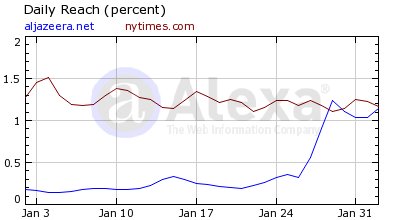
Brian Dana Akers compares traffic to the NYT and Al Jazeera:
by Conor Friedersdorf
Over at Commentary, I fear there has been a mistake. This essay on Rush Limbaugh purports to defend the man against wrongheaded critics. Try as I might, however, I can't find the paragraphs where the strongest arguments against the talk radio host are laid out. The refutations of those arguments seem to be missing too. It's awful when a site's content management system renders a piece so glaringly incomplete, especially when its author accusses others of existing in an information bubble.
Wilfred McClay does do a good job explaining El Rushbo's reach:
Like it or not, Rush Limbaugh is unarguably one of the most important figures in the political and cultural life of the United States in the past three decades. His national radio show has been on the air steadily for nearly 23 years and continues to command a huge following, upward of 20 million listeners a week on 600 stations. The only reason it is not even bigger is that his success has spawned so many imitators, a small army of talkers such as Sean Hannity, Mark Levin, Michael Savage, Laura Ingraham, and so on, who inevitably siphon off some of his market share.
That is a succinct explanation of why I spend so much time criticizing the man, despite the fact that if his words were judged on their intellectual merit, rather than their influence, he wouldn't be worth anyone's time. When pernicious content comes from his mouth, as it so often does, it actually matters.
We're also treated to a description of Limbaugh's talent as a broadcaster:
He is equipped with a resonant and instantly recognizable baritone voice and an unusually quick and creative mind, a keen and independent grasp of political issues and political personalities, and—what is perhaps his greatest talent—an astonishing ability to reformulate complex ideas in direct, vivid, and often eloquent ways, always delivering his thoughts live and unscripted, out there on the high wire.
There is just one factual inaccuracy here: the talk radio host does not have an "independent" grasp of political issues: as he has acknowledged, his habit is to carry water for the Republican Party even when he doesn't think they deserve it.
Here he is after President Obama's election:
I feel liberated, and I'm just going to tell you as plainly as I can why. I no longer am going to have to carry the water for people who I don't think deserve having their water carried. Now, you might say, "Well, why have you been doing it?" Because the stakes are high. Even though the Republican Party let us down, to me they represent a far better future for my beliefs and therefore the country's than the Democrat [sic] Party does and liberalism.
And I believe my side is worthy of victory, and I believe it's much easier to reform things that are going wrong on my side from a position of strength. Now, I'm liberated from having to constantly come in here every day and try to buck up a bunch of people who don't deserve it, to try to carry the water and make excuses for people who don't deserve it.
It's as clear an admission of partisan hackery as you'll ever see. Anyway, the piece gives us one more passage of insight:
He has a deep-in-the-bones feeling for what is magical about radio at its best—its immediacy, its simplicity, its ability to create the richness of imagined places and moments with just a few well-placed elements of sound, its incomparable advantages as a medium for storytelling with the pride of place that it gives to the spoken word and the individual human voice, abstracted from all other considerations. He probably also understands why he himself is not nearly so good on TV, faced as he is with the classic McLuhanesque problem of a hot personality in a cool medium.
But what can we make of this?
Without Limbaugh’s influence, talk radio might well have become a dreary medium of loud voices, relentless anger, and seething resentment, the sort of thing that the New York screamer Joe Pyne had pioneered in the 50s and 60s—“go gargle with razor blades,” he liked to tell his callers as he hung up on them—and that one can still see pop up in some of Limbaugh’s lesser epigones.
The "lesser epigones" are apparent references to Mark Levin – better to gargle with razor blades than put a gun to your temple! – but is the substance of Rush Limbaugh's admittedly less angry sounding rhetoric any less noxious? Usually I'd revel in explaining why, but for once I'm going to outsource this portion of the talk radio dissection to Jonathan Chait, who gets it exactly right in this post.
The Commentary article tells us, "he is aware that every word he utters on the air is being recorded and tracked by his political enemies in the hope that he will slip up and say something career-destroying. Limbaugh the judo master is delighted to make note of this surveillance, with the same delight he expresses when one of his “outrageous” sound bites makes the rounds of the mainstream media."
Chait responds:
"Surveillance" is funny word to use here — it is generally thought to apply to the unwanted monitoring of private conversation, not the practice of listening to political diatribes broadcast on national radio so as to rebut them.
And why do Limbaugh's enemies "surveill" his program in the belief that he will destroy his career? McClay won't come out and explain, so allow me: Limbaugh is a racial demagogue. He plays constantly upon the racial paranoia of his audience. If he were black, we would call him a "race man."
I illustrated that same point here, noting that he's frivolously accused so many people of racism in recent years he has likely surpassed Al Sharpton.
Chait continues:
Limbaugh is obsessed with race. In his telling, racism against whites does not just happen here or there, it has overwhelmed — indeed, completely replaced — traditional white-on-black racism. "Racism in this country is the exclusive province of the left," he says. In Limbaugh's world, minorities deploy racism endlessly and with impunity against whites, who are hamstrung by out-of-control political correctness. He presents Obama's agenda as the blacks' revenge against White America for slavery and Jim Crow. ("He's angry, he's gonna cut this country down to size, he's gonna make it pay for all the multicultural mistakes that it has made, its mistreatment of minorities.") Even such disparate events as a random school bus fight between a couple kids who happen to be black and a kid who happens to be white reveal, in Limbaugh's fevered mind, a widespread pattern of racial victimization against whites triggered by Obama:
You put your kids on a school bus, you expect safety but in Obama's America the white kids now get beat up with the black kids cheering, "Yay, right on, right on, right on, right on," and, of course, everybody says the white kid deserved it, he was born a racist, he's white.
This is another interesting quality of Limbaugh's. He stands in stark contrast to the general pattern of a Republican Party that has steadily distanced itself from racialized appeals to whites. McClay, obviously, can't acknowledge that, either. Instead he offers up descriptions of Limbaugh such as "he reminds one of the affirmative spirit of Ronald Reagan and, like Reagan, reminds his listeners of the better angels of their nature."
In partisan politics, the knee-jerk reaction is to defend whoever on your side is being attacked in the media, whether they're right or wrong. What's happened lately is that Rush Limbaugh makes a remark that is intentionally racially provocative, knowing he'll be attacked in the media for it – the offensive mockery of Chinese dialect is the latest example – and true to form, many on the right defend him, no matter how outrageous his remarks.
Apparently they're oblivious to the problem: the knee-jerk instinct to rally around your ieological ally is problematic in this case because it entails rallying around a racial provacateer who consistently exploits America's fraught relationship with race in order to play on the anxieties and prejudices of his audience.
For all Rush Limbaugh's supposed brilliance and quick-wittedness, he would be terrified to debate a critic in a neutral written form – he knows that stripped of his broadcasting mastery, call screeners, and a medium where flawed arguments drift into the ether without rebuttal, his ideas would be shown for the weak, contemptible, indefensible nonsense that they are. A bully in the recording studio, he is too cowardly to test himself in direct debate on the Web.
by Patrick Appel
Another must-read dispatch by Graeme Wood from the streets of Cairo:
The demonstrators have been calling today "the day of departure" for Hosni Mubarak and, with their mission complete, presumably for themselves, too. Many protesters have been in Tahrir Square for as long as a week — exhausted from stress, from having to sleep body-to-body on cold pavement and patchy grass, and from having to improvise (with miraculous effect) a static defense strategy against an enemy with virtually limitless supply lines.
And yet today it seemed as if many of the protesters want never to leave. The atmosphere a few days ago was doomed but resolute, like the last days of the Alamo. Now it was ecstatic, with an optimism that seemed wholly warranted. "We understand Mubarak's strategy, and we reject him," a young man who spent five days in the square told me. "This is a place of liberation [tahrir], not negotiation. Over our dead bodies." Two days ago those last words might have been sounded prophetic, but now they sounded merely figurative.
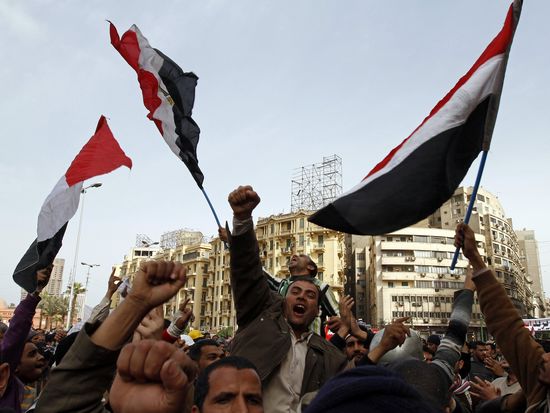
(Photo: Egyptian anti-government protesters shout slogans at Cairo's Tahrir Square on February 4, 2011 By Mohammed Abed/AFP/Getty Images)
by Chris Bodenner
That's what Goldblog calls a campaign by Washington Redskins owner Daniel Snyder to sue the Washington City Paper for publishing a comical image of him in a profile by sportswriter Dave McKenna:
The Wiesenthal Center, unbelievably, is now accusing the CIty Paper of trafficking in
Nazi imagery! Tablet's Marc Tracy reports that the Center [on behalf of Snyder] is demanding that the City Paper "apologize for the image, which, it accused, is 'associated with virulent anti-Semitism going back to the Middle Ages, deployed by the genocidal Nazi regime, by Soviet propagandists, and even in 2011 by those who still seek to demonize Jews.'"
Tracy goes on to write, "So, to be clear: WCP at most implicitly trafficked in anti-Semitic tropes–a breathtakingly dumb allegation, but that is the Center's allegation; the Center, by contrast, explicitly–not allegedly, but indisputably–associated a small alternative newspaper with 'the genocidal Nazi regime.' Nice."
by Patrick Appel
Fareed Zakaria goes into detail:
Why would economic progress spur protests? Growth stirs things up, upsets the settled, stagnant order and produces inequalities and uncertainties. It also creates new expectations and demands. Tunisia was not growing as vigorously as Egypt, but there too a corrupt old order had opened up, and the resulting ferment proved too much for the regime to handle. Alexis de Tocqueville once observed that "the most dangerous moment for a bad government is when it begins to reform itself."
It is a phenomenon that political scientists have dubbed "a revolution of rising expectations." Dictatorships find it difficult to handle change because the structure of power they have set up cannot respond to the new, dynamic demands coming from their people. So it was in Tunisia; so it was in Egypt. Youth unemployment and food prices might have been the immediate causes, but the underlying trend was a growing, restive population, stirred up by new economic winds, connected to a wider world. (Notice that more-stagnant countries like Syria and North Korea have remained more stable.)
Clive Crook looks at Egypt's economy from a different angle.
by Patrick Appel
Drew Linzer and Lisa Blaydes explain their research on "how well can we expect candidates associated with Egypt's religious 'right' to perform." Joshua Tucker adds:
I want to draw readers' attention to the authors' use of the idea of bounds. Their piece should not be read to say the Muslim Brotherhood will win 60% of the vote in a fair election, and therefore would automatically capture the presidency in a presidential election. Instead, their data suggests that we might want to think about the likely support for a Muslim Brotherhood type party as falling somewhere between 20% and 60%. This is obviously a wide range, but it does represent a first step towards bringing hard data to this question as opposed to speculation.
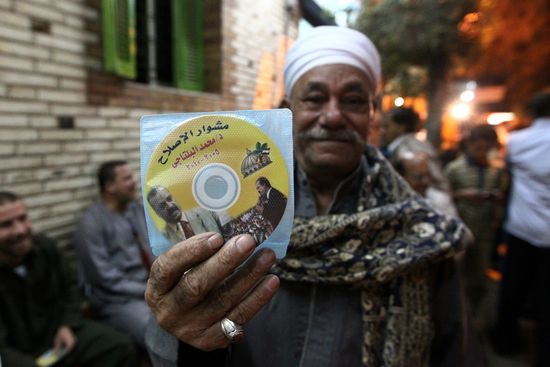
(Photo: An Egyptian man holds a CD with information about the Muslim Brotherhood's MP and parliamentary candidate. It was distributed during a campaign rally during the last Egyptian general election in the village of Mit Nama, 20 kms north of Cairo, late on November 21, 2010 . By Khaled Desouki/AFP/Getty Images)
by Conor Friedersdorf
Here's a mischevious take on constitutional jurisprudence:
Ours is a pluralistic society and value change is not one-way. Respect for the founders and an enthusiasm for the values and aims of the original constitution has surged both in legal academia and the broader culture. To interpret precedent in light of an originalist understanding of the meaning, purpose, and values of the imagined original constitution is simply one way to bring changing American values to bear on the text.
To paraphrase Mr Posner, sometimes "judges and elected officials interpret and reinterpret the constitution in light of their own changing originalist scholarship and values, and these interpretations pile up and form a body of political and judicial precedent that certainly bears some resemblance to non-originalist case law in the recent past, but diverges considerably from it." I submit that it's totally arbitrary to embrace the idea of an evolving constitution only so long as it evolves in a liberal or progressive direction. If a large number of ordinary Americans, legal academics, and judges have recently come to venerate the founders and the original meaning of the constitution, there's no reason a living constitution should not reflect that.
by Patrick Appel
One can take issue with Kristof's commentary, but this, from Tahrir yesterday, is an incredible piece of reporting :
I backed into Amr’s wheelchair. It turned out that Amr had lost his legs many years ago in a train accident, but he rolled his wheelchair into Tahrir Square to show support for democracy, hurling rocks back at the mobs that President Hosni Mubarak apparently sent to besiege the square.
Amr (I’m not using some last names to reduce the risks to people I quote) was being treated for a wound from a flying rock. I asked him as politely as I could what a double-amputee in a wheelchair was doing in a pitched battle involving Molotov cocktails, clubs, machetes, bricks and straight razors.
“I still have my hands,” he said firmly. “God willing, I will keep fighting.”
by Chris Bodenner
They didn't understand the perils of hotlinking.
by Chris Bodenner
When Cairo correspondents describe the street battles as "medieval", they aren't kidding.
 The Dish