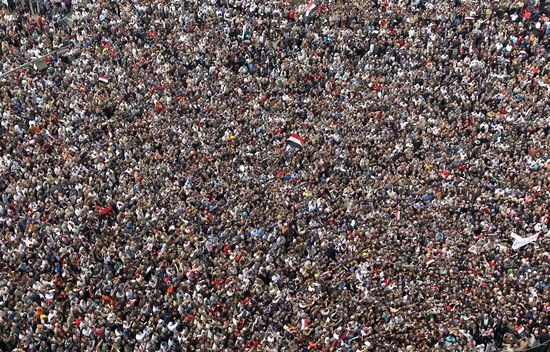
“The Day of Departure”

FridayTahrirNewer

by Patrick Appel

The Guardian:

The Muslim Brotherhood has said it would not field a presidential candidate or seek ministers in a new cabinet, ABC reports. Christine Amanpour, who interviewed Mubarak yesterday, is interpreting the move as calculated to soothe western fears of an Islamist government succeeding Mubarak.

BBC:

State TV has a split screen showing live shots of a pro-Mubarak rally on one side and the scene in Tahrir Square on the other. They describe the first as pro-stability and pro-dialogue and the latter as demanding political reforms. So, at the moment the two sides are busy with their separate rallies. The Tahrir Square crowd aren't going anywhere. Across town Mubarak's supporters are gathering.

The Lede:

In stark contrast to the scenes of chaotic street battles around the square over the previous two days, when opposition protesters successfully defended their encampment against attacks by regime supporters hurling rocks and Molotov cocktails at them, the square was peaceful on Friday because Egypt's military set up checkpoints around the entrances to the square, frisking anyone who wanted to enter. People who want to join the demonstration are then required to pass through security checkpoints set up by the protesters themselves, who want to root out agitators.

Al Jazeera:

Our correspondent in Cairo says pro-Mubarak gangs are not visible at all in the streets and that the army has taken extensive measures to secure the demonstration. She says imams, speaking in mosques today, have called for calm and praised the role of the army as it is working to prevent violence. 

EA:

Al Jazeera English reports stone-throwing battles in side streets off Tahrir Square, beyond the anti-regime barricades, involving about 300 pro-Mubarak men. …

The "scuffle" in Alexandria was some protesters telling others not to burn an effigy of President Mubarak. Al Jazeera's correspondent reports a "positive atmosphere" of people coming together. A wall of sound is heard as the chants continue after Friday Prayers. Meanwhile, even the regime-supporting Nile TV has shown aerial shots of the Tahrir Square gathering in Cairo.

National Journal:

The crisis is costing the country at least $310 million a day, the BBC reports. That’s according to an analysis from Credit Agricole bank, which revised its economic growth estimate for Egypt this year from 5.3 percent to 3.7 percent. There had already been an increase in food prices in the troubled country, considered a contributing factor in the demonstrations.

 (Photo: Anti-government demonstrators gather in Tahrir Square on February 4, 2011 in Cairo, Egypt. Anti-government protesters have called today 'The day of departure'. Thousands have again gathered in Tahrir Square calling for Egyptian President Hosni Mubarak to step down. By Peter Macdiarmid/Getty Images.)

In Defense Of Cities

by Conor Friedersdorf

The indispensable Ed Glaeser was interviewed on that subject, and both the left and the right ought to listen to his prescriptions. Here's one of his challenges for liberals:

My largest message to the environmental community is to fight development when it's harmful for the environment, but support development when it's helpful for the environment. Local activists can't stop development in the U.S. as a whole. There's just going to be too many areas where they're going to be happy to build. We're going to build, roughly, in the long term, 1.5 million, 1.4 million new housing units a year to accommodate the population growth and the depreciation of old housing. While local activists can't turn that off, they can determine where it happens, because they can, in their own communities, stop development. When you turn off the flow of new housing in your community, it turns on somewhere else…

The sad fact from an environmental point of view is that building in the San Francisco Bay is a great thing to do. There's an incredibly temperate climate, which means that the carbon emissions for households there are among the lowest in the country. It's got plenty of access to great public transportation. This is the area that should be building a great deal of housing. But when you make it difficult to build there, you make sure that there's housing being built instead in the suburbs of Houston, where you'd need a lot of energy to create a pleasant manmade environment, and there's a lot of driving.

And for the right:

Why have cities fared so poorly in the political discourse over the past 200 years? The truth of the matter is that I think that the Obama administration is simply trying to give us a level playing field. It needs to be presented as that. To those Republicans, to those Tea Party activists who believe in the home mortgage interest deduction: Shouldn't the U.S. government stop engaging in social engineering? Shouldn't the U.S. government stop engaging in those policies that artificially push people out of the homes that they would have? Haven't we had enough of activist government trying to shoehorn us into low-density living?

That's how I try to present it, and I actually believe that. I have some libertarian bent. I think that things are problematic in part because they impinge on basic human freedom, the ability to choose cities if you want to choose cities. Given how anti-urban the broad spectrum of public policy is, if anyone attempts to depict the tiny things that are slightly pro-urban as being an attempt to socially engineer Americans into cities, I find that quite odd.

The whole interview is worth a read.

“Politically Correct” On Egypt

by Patrick Appel

Massie asks "what's politically correct about opposing Hosni Mubarak?":

Disparaging those who disagree with you as "politically correct" isn't an argument, it's a way of avoiding argument. Look at me, it says, and see how brave I am to stand alone against the tide. Here I must stand for I can do no other. Unlike the soft-headed simpletons who prefersome sort of lemming-like approach that makes them feel warm and fuzzy. Alternatively, perhaps "politically correct" is just another word for fashionable these days.

Anyway. Granted, Con [Coughlin] worries about the impact on Israel of regime change in Cairo. But almost no-one encouraged by this week's events believes that all will be plain-sailing on that front. Of course there are many difficulties and even more imponderables ahead. The alternative, however, or one of the alternatives, is endorsing a status quo that has manifestly failed. That's not a workable option.

Pushing Without Plotting

TAHRIR OBAMA

by Chris Bodenner

Michael Scherer spells out the tough spot the Obama administration finds itself in:

Secretary of State Hillary Clinton announced [Thursday] afternoon, "The Egyptian government must demonstrate its willingness to ensure journalists' ability to report on these events to the people of Egypt and to the world." But she stopped short of explicitly condemning the official Egyptian role in the crackdown, and she went on to urge opposition groups to sit down with Vice President Suleiman, as Suleiman has demanded.

From the beginning of this crisis, the Obama Administration has tried to stay a half-step ahead of events in Egypt, not wanting to be seen as dictating any outcomes in the internal struggles of an ally. As a result, the Obama Administration has appeared, more often than not, to always be falling a little behind the curve, reacting to the last outrage even as a new one unfolds. If violence sparks again on Friday night, as many expect, and the government causes more bloodshed, we can expect more outrageous condemnations by the White House officials. But will those words will be enough to preserve for the president the role he seeks on the world stage, as a leader [and Nobel winner] promoting democracy and human rights?

(Photo via Enduring America)

“From ‘The Day of Rage’ To ‘The Day of Departure'”

108796128

by Chris Bodenner

Scott Lucas, a live-blogging force of nature during this revolution, catches you up to speed:

In the space of [the last] seven days, Egypt has entered unthinkable territory — the prospect of the downfall of President Hosni Mubarak, and those around him, after 30 years in power. But the twists and turns in those seven days, almost as stunning, have complicated even that dramatic storyline. Only 48 hours ago, I was assessing that Mubarak's power and authority was now reduced to the protection of the military.

That was very wrong.

The President and his machine displayed what could still be done through the pro-regime demonstrations and the unleashing of the violence on Tahrir Square on Wednesday. From the easy assessment of "Mubarak goes soon rather than later", the question became one of whether the protest would crack.

Crack, yes. Collapse, no. After the anti-regime demonstrators not only held Tahrir Square but fought back, edging back their foes, Mubarak and his Cabinet had to face again their tenuous political position. The Vice President and Prime Minister offered the superficial concession of an apology for Wednesday's bloodshed and the promise of an investigation. VP Omar Suleiman gave ground on the question of Mubarak's son Gamal standing for the Presidency in September and played up his offer of discussions with the opposition, including the Muslim Brotherhood.

However, on the central and immediate question of Mubarak's depature, they were defiant, even hostile. And then last night Mubarak put out his message through an unusual source: US-based journalist Christiane Amanpour. In a phone call, he wrote another chapter of his sacrifice for his country. He really wanted to leave office, he declared, but for the good of Egypt, he had to remain. Otherwise there would the Muslim Brotherhood brotherhood in power and a nation in chaos. (To which an observer cheekily noted, "Good. Because we haven't seen any chaos in the last two days.")

Why would Mubarak put out his message through a prominent American reporter, even when his followers were beating up and detaining dozens of foreign journalists as the enemy? Because he was not speaking primarily to his people but to an audience in Washington.

For all the significance of the Battle of Tahrir Square and the continuing protests across Egypt, the breaking story last night was this US proposal:

Officials from both governments are continuing talks about a plan in which Mr. Suleiman, backed by Lt. Gen. Sami Enan, chief of the Egyptian armed forces, and Field Marshal Mohamed Tantawi, the defense minister, would immediately begin a process of constitutional reform. …

This was the proposition put to Mubarak by President Obama's envoy Frank Wisner when he arrived in Cairo on Sunday. And it was the plan that Mubarak rudely kicked away with his speech on Tuesday night, symbolically torched when his supporters laid siege to the opposition on Wednesday, and ground into the dust with the pursuit of journalists on Thursday.

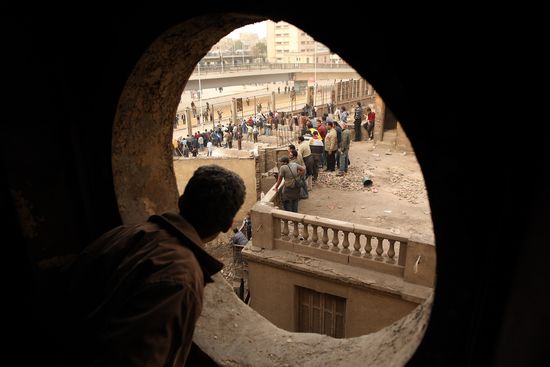
(Photo: A man looks down from the window of a derelict house as anti-government protestors man barricades in Tahrir Square on February 3, 2011 in Cairo, Egypt. By Peter Macdiarmid/Getty Images)

A Massive Hit-And-Run

by Chris Bodenner

Al Jazeera digs up a video supposedly shot last Friday:

Here's another video from Egypt's "Day of Rage" on January 28 shows a vehicle ploughing over protesters. The person who posted the clip claims it is a diplomatic vehicle that "ran over more than 20 people" but we can't verify these details at this time.

I realize that posting horrific clips like this runs the risk of indulging in disaster porn. But such rare glimpses of raw violence is the only way for many of us to appreciate the real costs of these protests and see through the statistics. Besides, the rage and desperation displayed by the crowd after the car attack feels more compelling than the blatant shock value of the beginning.

The Daily Wrap

Today on the Dish, we chronicled the chaos in Cairo as it unfolded, with more reports of bloodshed here, here, and here. The regime sent texts and thugs to target and harass, assaulted reporters. Graeme Wood praised the Mr. Cleavers of Cairo, and the army appeared to side with Mubarak. The regime accused protesters of being dangerous foreign elements and closed off any other political option, but secular solidarity prevailed. We sought to understand nations in transition, details on the dictator's son, and how the US measures up to Egypt's inequality. Yemen kept heating up, we kept tabs on the US response, and we considered Al Jazeera's coverage if protests spread throughout the Mid-East. Marc Lynch urged the US to send a loud and clear message to the army, and Scott Horton explained exile isn't what it used to be. Gladwell stuck to his guns, despite evidence to the contrary that Twitter did help. Michael Wahid Hanna feared for the Egypt after the cameras stop rolling, Thoreau had hope for democracy, and Gregory Djerejian pleaded for humility.

Conor expanded his attack on Andy McCarthy's sophistry, kept at the Fox's insinuation machine, and calculated traditional health care in a world where we could know when we'd die. One-armed citizens could carry switchblades, libertarians can't get by only on principles, and a high-functioning, meth-using Dish reader enlightened us.

Dissents of the day here and here, creepy ad watch here, chart of the day  here, cool ad watch here, the week in photos here, quote for the day here, FOTD here, VFYW here, and MHB here.

–Z.P.

Why Mubarak Won’t Leave

by Patrick Appel

Among other reasons:

If Mubarak stays on until September — even as a figurehead (and listening to Sulayman today it sounded as if that is what the Egyptian president has become) — the regime can carefully manage the process. If Mubarak leaves early — as the U.S. and the opposition demands –things become messier. 

According to the constitution, if the President steps down, he is not succeeded by the Vice President.  That's right — if Mubarak resigns and gets on an airplane tonight, Omar Sulayman, who seems to be in effect acting president at the moment, would not take his place.

Instead, the post would be filled by Fathi Surur, the speaker of the People's Assembly. Surur is a former law professor and a reliable regime stalwart. He is not from the military or the security apparatus and is widely regarded as a figure whose job has been to manage the parliament for the regime. And he has done so effectively. His presidency would delight nobody. (Some elements of the opposition have suggested that Surur should be pressed to turn down the post, in which case the job falls to the chief justice of the Constitutional Court. His profile is much lower than Surur but his career would inspire no more confidence.)