The Regime’s True Character

NightEgypt
by Patrick Appel

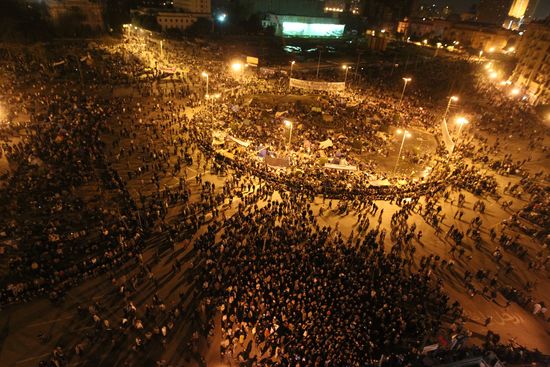
George Packer looks at Egypt from 10,000 feet:

When the people rise up, there’s no guarantee they’ll succeed. Just ask a Burmese or an Iranian. Egypt’s revolution has a number of counts against it, the main one being the hollow core where Egyptian civil society ought to be—the absence of institutions, groups, and leaders that could shape this massive expression of popular will into an organized counterforce to the regime’s violence, with the means to reach deep into the military hierarchy and a strategy for victory. Instead, Mubarak systematically closed off that space, so that he could say to the world: me or the Islamists, choose. In Burma in 2007, there was a similar void of opposition leadership, other than the moral power of the monks. Young Burmese later told me that they considered their headless revolution more flexible and durable than the older kind—one student called it “post-modern”—but the regime crushed it without much trouble, and hundreds of young Burmese are now rotting away in far-flung prisons.

(Photo: Egyptian anti-government demonstrators gather at Cairo's Tahrir square on February 3, 2011 By Khaled Desouki/AFP/Getty Images)

Take Pity On The Cold Sufferer, Ctd

by Conor Friedersdorf

A reader writes:

I've been a near-daily user of meth for roughly 14 of the past 15 years. That is, except for a few periods during which I *wasn't* using, totaling a little over a year, I've used meth 3 to 7 days of every week since May, 1996. (And I fear there have been far more 7-day than 3-day weeks; if I had to guess, I suspect I've averaged 4 to 5 days a week for most of those 15 years.)

I'm not particularly proud of this, frankly — and it's now reached a point where my use is interfering with the other, meaningful parts of my life. Otherwise, I'm either the exception that proves the rule, exceptionally lucky, or in abject denial. 

In the past 15 years, I've been a successful consultant and systems architect, served as CTO for a software company with $30 million in annual revenue, and owned and managed an old-school, brick-and-dead-trees firm in a decidedly non-technical area. In the past couple of years, alone, I've written grant proposals for a non-profit serving San Francisco's refugee population (immigrants, not Republicans), drafted business processes for a specialty defense contractor, designed a social networking site for people working in the financial services sector (bad timing, that), and engineered and installed a few medical marijuana grow rooms — up to code, but under the table. I still have all my own teeth (well, except for one crown), and the vast majority of my friends and business associates would be absolutely dumbfounded if they knew. But those are simply my bona fides; they have nothing to do with why I'm writing.

I'm writing to say this: In the past 15 years, I haven't seen *any* significant change in availability of meth. The quality *has* improved slightly, though — and, more importantly, the price in *absolute* dollars has declined. Bandwidth, pixels, and meth: Since '96, offering you significantly more bang for your buck.

Somehow, all this has come about *despite* my 87-year-old mother's being fingerprinted every time she buys Sudafed.

Oh, I'm sure the absurd barriers to decongestive relief accomplished more than simply shaving a couple points off CVS shares; for starters, it's probably now OK to use the Mr Coffee during your next stay at an Embassy Suites. But around here, at least, there's been a steady, consistent, dependable flow of industrial methamphetamine from South of the border. And that's not going to change, no matter how ridiculously painful or expensive it becomes to buy one of the few OTC remedies that actually works.

Dissent Of The Day II

by Patrick Appel

A reader writes:

I appreciate your dedication to the incredible developments in Egypt. It's truly a wonderful thing when people demand their own government and (hopefully) obtain it through the least violent means possible.

However, one of the main reasons I love your blog is for its variety in coverage; I can visit your blog once an hour and receive interesting tidbits on all sorts of topics, stimulate my mind, then get back to work. But ever since this revolution business started in Egypt (and prior to that, Tunisia), you're covering almost nothing else. I'm glad for some coverage, but really wish the minute-by-minute blow-by-blow would be stopped, so we can get some other interesting news and commentary in. I know you're doing some coverage of other items, but your Egypt coverage is very … intense.

Judging from the in-tray, this is a minority view. There have been countless e-mails thanking us for keeping the focus on Egypt. We are trying to strike the right balance – to not miss anything from Egypt while keeping an eye on other issues. But Egypt, like Iran before it, will continue to dominate for the immediate future.

The news media has a herd mentality. The MSM is often criticized for neglecting important stories until they break. But when a story makes it to the middle of the news hole, the media can dig up a huge amount of good information. And it's not just the MSM; most of the bloggers I track are writing about little besides Egypt. Even if we wanted to, it would be difficult to maintain our normal variety. 

These moments in the news cycle are fleeting opportunities not to be missed; events like this force most of us to pay heed to topics, ideas, and experts we'd likely otherwise overlook. Some subjects make it into the media spotlight repeatedly (see: Palin, Sarah), but Egypt hasn't been the center of attention for years. Obsessively tracking developments now not only provides current information on an event with potentially large effects on international peace, it lets us debate one of the most fundamental questions in politics – how and why a country transitions, or fails to transition, from one form of government to another and what that means.

A reader e-mail from over the weekend provides another perspective:

I recently found employment after a 6 month dry spell. While I'm happy to be working again, I find my reading time significantly reduced. The result is a Saturday reading binge where I catch up on the 1500+ posts I missed during the week. Using my RSS reader has given me the significant ability to read the posts sorted by oldest date first.

I have had the chance, through your blog, to follow the events in Egypt in real time but several days (hours now, I'm almost caught up) delayed. Rather than figure out the current situation and go backward, I can experience what you and others have experienced as the events unfolded. I think this kind of understanding is essential to having a detailed picture and avoiding the 20/20 vision hindsight often provides. 

I don't know how many of your readers use RSS in its many forms but I highly recommend it. It was originally a convenient way to put my reading in one place. Now I see another advantage: RSS can provide a short term historical narrative presented in the real-time thoughts and links of bloggers.

Reporters Under Attack, Ctd

Visit msnbc.com for breaking news, world news, and news about the economy

by Chris Bodenner

The assaults have escalated in number and intensity. The Lede:

ABC News has complied a very long list detailing about 40 incidents in which reporters have been "threatened, attacked or detained while reporting in Egypt" in the past few days. After Egypt's new vice president, the intelligence chief Omar Suleiman, blamed the unrest "foreign interference," Jon Williams, the BBC's foreign editor, wrote on Twitter: "Intimidation of journalists in Cairo on scale not seen anywhere for years – reporters attacked, equipment seized. VP blaming media unhelpful." … The Committee to Protect Journalists, listed more than a dozen journalists who had been harassed and placed the blame for the crackdown squarely on the shoulders of the Mubarak regime.

Of particular note:

A group of angry Egyptian men carjacked an ABC News crew and threatened to behead them today in the latest and most menacing attack on foreign reporters trying to cover the anti-government uprising.

More from the NYT:

The Washington Post said its Cairo bureau chief and a photographer who had been detained were released by Thursday evening. But two other employees – a translator and a driver – remained in custody. Two reporters working for The New York Times were released on Thursday after being detained overnight in Cairo.

AJE:

9:07pm Two Al Jazeera reporters have been attacked by a gang of thugs in Cairo

7:22pm Vice president Suleiman to Egyptian TV, (not naming Qatar or Al Jazeera): "I blame some sister countries that have unfriendly TV stations, which incite youth against us?."

5:56pm A Greek journalist was stabbed while covering the events in Tahrir Square.

EA:

1925 GMT: Al Jazeera reports that three of its journalists that had been detained earlier have been released. There is no word on a fourth journalist for the station who has been missing.

1923 GMT: Ayman Mohyeldin of Al Jazeera reports that two Brazilian journalists in Egypt for Radio Nacional and TV Brasil were forced out of the country. 

2030 GMT: "Swedish TV reporter Bert Sundström hospitalised in Cairo after beatings. Stable but serious condition."

2040 GMT: We are getting constant reports of journalists getting beaten, arrested, forced out of the country and their equipment being ceased. Many have been missing as well. There seems to be an all out attack against journalists by government and thugs.

Stupak On Steroids, Ctd

by Zoe Pollock

The GOP has ceded some ground on the language in the House's controversial abortion bill. But Evan McMorris-Santoro cautions:

The altered bill language will be undoubtedly be seen by some as a victory for pro-choice activists. But the bill still contains numerous provisions that appear to dramatically expand federal limits on abortion funding. The new version of the bill apparently retains the clause that limits the incest exemption to girls under the age of 18 and language that makes it tougher for women to obtain abortion coverage through their private insurers.

Steve Benen agrees:

I'm glad proponents have dropped the effort to redefine rape, a move so offensive it's still hard to believe Republicans considered it. But make no mistake — its removal does not make this a good bill.

Where Libertarians Go Wrong

by Conor Friedersdorf

Tim Lee has a theory:

One of the more pernicious influences of Rand and Rothbard on the libertarian movement was their tendency to treat every policy problem as almost reducible to a logical syllogism. Too many libertarians act as though they don’t need to know very much about the details of any given policy issue because they can deduce the right answer directly from libertarian principles. The practical result is often to shut down internal debate and discourage libertarians from thinking carefully about cases where libertarian principles may have more than one plausible application. Hayek seems to have written “‘Free’ Enterprise and Competitive Order” with the explicit purpose to combat that kind of dogmatism. He thought it “highly desirable that liberals shall strongly disagree on these topics, the more the better.”

And one way to do this is to be more ready to treat modern liberals with bottom-up instincts as potential allies rather than ideological opponents.

Falling Far From The Dictator

108797911

by Chris Bodenner

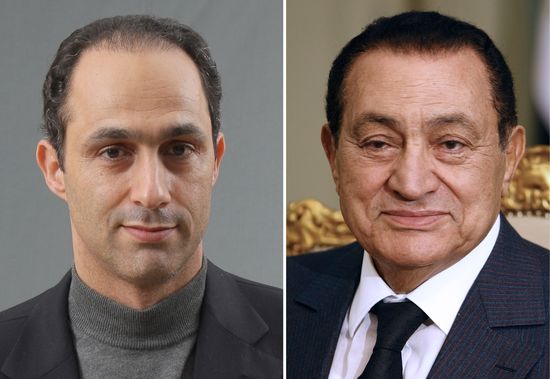
Suleiman, the Egyptian vice president, said today what everyone was suspecting – that Gamal, Mubarak's son, will not run for president in September. Samuel Tadros provides some background on the dubious dynasty:

In reality, the elder Mubarak was never fully behind that scenario. Whether it was a real assessment of his son’s capabilities or of the acceptance of the army to such a scenario, Mubarak was hesitant. It was his wife who was heavily pushing that scenario. … The army never liked Gamal or his friends. Gamal had never served in the military. To add insult to injury his friends were threatening the dominance of the army. The technocrat’s neo-liberal policies were threatening the army’s dominance of the closed economy and the party was becoming step by step an actual organization that competes with the army officers in filling administrative positions. Suddenly the doors to power in Egypt were not a military career but a party ID card. As long as the President was there however, the army was silent. The army is 100 percent loyal to the President. He is an October War hero and their Commander in Chief.

(Photos: Gamal Mubarak, son of Egyptian President Hosni Mubarak, posing at the AFP photo studio on January 26, 2008 during the World Economic Forum in Davos, and Egyptian President Hosni Mubarak pictured during a meeting with EU foreign policy chief Javier Solana in Cairo on September 2, 2009.  By Cris Bouroncle/AFP/Getty Images)