Fugitives No More

by Conor Friedersdorf

Bad joke, good legislation:

A Maine legislator has introduced a bill to make it legal for people with one arm to own and carry a switchblade (because you need two hands to operate a regular clasp knife). I actually quite like this idea, but think it's too narrow, I'd have worded it more like "lawful for people who, due to infirmity, disability or amputation find it difficult to operate a clasp-knife…" so people with arthritis, one-side paralysis, etc, could have and use that most useful of tools: a knife.

I agree with the author that the broader legal change would be even better.

The Regime Reconstitutes Itself? Ctd

by Patrick Appel

Larison agrees with Springborg:

The military has not directly participated in the crackdown, which preserves the appearance that the military was not involved in attacking the protesters and keeps the military from being split, but it has stood by while Mubarak’s goons target the protesters. As the new cabinet is filled with figures representing the interests of the military, this ought to have been clear to all a few days ago. If Mubarak is on the way out after the next election, Suleiman will be taking over for him.

In Tunisia the uprising prompted a “soft” coup against Ben Ali, and Ben Ali could not stay so long as the military was unwilling to use force to defend his hold on power. As quite a few people expected earlier this month, the alignment of interests between the military and Mubarak mattered more than the outrage and persistence of the protesters. Instead of a “soft” coup approved by the military, there won’t be any sort of coup, but an organized (though perhaps not all that “orderly”) transition from one military-backed strongman to another.

I’m not sure that this means that the “historic opportunity to have a democratic Egypt led by those with whom the U.S., Europe and even Israel could do business, will have been lost, maybe forever.” That assumes a great many things about what would have followed. It could also be that Egypt has avoided even more destructive political upheaval and massive suffering.

“The Battle For The Soul Of Egypt”

by Patrick Appel

Sand Monkey, an Egyptian blogger, had his website suspended. Totten, who knows the blogger, put up the activist's most recent post. The conclusion: 

The End is near. I have no illusions about this regime or its leader, and how he will pluck us and hunt us down one by one till we are over and done with and 8 months from now will pay people to stage fake protests urging him not to leave power, and he will stay “because he has to acquiesce to the voice of the people”. This is a losing battle and they have all the weapons, but we will continue fighting until we can’t. I am heading to Tahrir right now with supplies for the hundreds injured, knowing that today the attacks will intensify, because they can’t allow us to stay there come Friday, which is supposed to be the game changer. We are bringing everybody out, and we will refuse to be anything else than peaceful. If you are in Egypt, I am calling on all of you to head down to Tahrir today and Friday. It is imperative to show them that the battle for the soul of Egypt isn’t over and done with. I am calling you to bring your friends, to bring medical supplies, to go and see what Mubarak’s gurantees look like in real life. Egypt needs you. Be Heroes.

Sand Monkey reports over his twitter feed that he was apprehended while trying to deliver supplies:

I am ok. I got out. I was ambushed & beaten by the police, my phone confiscated , my car ripped apar& supplies taken.

The Echo Chamber

by Patrick Appel

A reader writes:

I don't get a lot of what's being said about Egypt. This isn't about the Dish's coverage, but about what people are saying in general. You just posted a quote from Marc Lynch:

"Egyptian military must receive the message loudly, directly and clearly that the price of a continuing relationship with America is Mubarak's departure and a meaningful transition to a more democratic and inclusive political system."

I admit I don't know very much about Egypt. But it really seems as if events there are fairly chaotic and have a momentum of their own. I'm not sure anyone could control them very easily now. And everyone is probably trying to hang on. The idea that such a statement from the US would have an effect seems pretty hard to swallow.

And such a threat – to withhold a relationship with Egypt after things settle down – seems totally hollow. Let's say there's a lot of violence, and six months later, a new regime is in power. Maybe they're democratic, maybe not. Are we really going to say, "Look, we told you during the revolution that you had to do this stuff, and you didn't, so we're not going to talk to you." Everyone knows that we'll do whatever is in our interests. That's what everyone always does.

Now that Mubarak hasn't accepted Obama's suggestion that he step down, everyone says, "Well, of course we knew he wouldn't do it, but it had to be said." But now people are insisting that we make demands on the Egyptian military – no one specific, just the military – and of course those demands will be taken seriously.

This isn't really the strangest stuff, though. We've backed Mubarak for more than three decades. We're the main reason he has been able to stay in power. We kept him there, and we've always looked the other way when confronted with his crimes against his own people. We've encouraged him to make decisions that are deeply unpopular among the Egyptian people on a whole variety of issues, including, most prominently, Egypt's relationship with Israel.

Pundits in this country always talk as if the Egyptian people will forget all of this if only Obama will say the right thing on day 6 of the revolution. People act as if our backing of Mubarak for more than 30 years won't really have any lasting consequences, but the things we say today, in the middle of the crisis, will.

Running through all of this is a fairly bizarre conception of the US's power, its ability to project that power, and its image in the world, combined with a staggering inability to consider, even superficially, how things must look to people in other countries . To people in Egypt, for example.

I think we sometimes loose track of how insulating our bubble really is, and how strange the echo chamber can become.

Dissent Of The Day

by Conor Friedersdorf

A reader writes:

I support developmentally disabled adults for a living, so I can put your post in more context (I live in Wisconsin). One of my guys has behavior that makes Pryor's guy sound like a saint.  He attacks us without warning.  He is well over 6 feet tall, and 250 pounds.  He is very scary.  Like Pryor's guy, this guy legally must be supervised 24/7.  Because of his size and aggression, it is unsafe for one person alone to care for him.  So, during hours when he is normally awake (8:30am to 10pm), there are two people with him, and when he is normally asleep (10pm to 8:30am) there is only one person supervising him.  But this person keeps him or herself in a locked room.  Nevertheless, there have been (very scary) times when our guy attacked someone in the middle of the night, without help, who happened to leave the safe room to use the restroom at the wrong time.

So, if you add this up, for every 24-hour day, there are 37.5 man hours of labor to support this one person.  And each person gets $11-$12 per hour–or about $20,000 per year if you work 40 hours/week.  So just for direct support staff's hourly wages, this costs $150,000 per year. 

When you factor in health insurance for the people who work there, rent for the guy's apartment, groceries, doctors appointments, prescription drugs, and salaries of our incredibly overworked supervisors who take care of the needs of everyone supported by the agency (like social security benefits, hiring [unsurprisingly, turnover is very rapid], mountains of paperwork, etc), $250,000 per year is about what it takes.  I was shocked when I first heard that as well, but it is very expensive to support someone like this.  Surprisingly, an institution (which would be less humane) is much, much more expensive than supporting a developmentally disabled adult in a home setting.  For a time, the gentleman I described was in an institution, but instead of 2 people with him at all times, it was five.  My guess is that he is happy living in his apartment and working at a job (yes, he has a job), and therefore less likely to attack.  But it's pretty tough to be happy at an institution, so he attacks more and more violently.  So the $250,000 for residential support is actually cost cutting compared to the only other alternative, an institution, which would probably be twice as expensive.  The only other cost-cutting would be a straight jacket or euthanasia.

Others who require 24/7 supervision can be supported for far less if they are not aggressive–they can have room mates so instead of paying for 2 staff for a single client it's 2-4 clients per one staff.  That's a huge cost saving.  But you can see that measuring cost per client is not a good assessment of effectiveness since cost varies so much based on the nature of a developmentally disabled adult's condition.

Our agency also has adults with less severe disabilities.  Typically, they get 2 hours of support per day; one is spent by the staff person helping with chores and cooking meals, and for the other, the staff person takes them out to the library or sandwich shop or something.  When politicians try to cut budgets for the developmentally disabled, they think that everyone will have to cut back a little bit.  In reality, it's closer to squeezing blood from a stone, since some people legally must be supervised 24/7 and there is no way to cut back on these individuals.  The only possible cutback is with the people without this legal requirement; in practice, this means that instead of 1 hour of support helping with chores and 1 hour of support out in the community, higher-functioning clients get just one hour of support helping with chores.  This means that these people do not get to leave their apartment, and that is pretty unfair–either that or our agency decides they cannot support people with 24/7 needs and they get thrown into an institution which is inhumane and far, far more expensive (and thus "cutting wasteful spending" actually backfires).

Gladwell Sticking To It

by Zoe Pollock

Ari Melber refutes Malcolm Gladwell's reiteration that how people choose to revolutionize "is less interesting, in the end, than why they were driven to do it in the first place":

For Egypt, Gladwell actually has it backwards. It is not a surprise that many Egyptians do not love their dictator—that is not what shocked Washington and the Arab world last week; it is that people managed to plan and execute such a massive public demonstration of that sentiment. So the "how" is more striking than the "why."

Suleiman Blames Outside Conspiracy

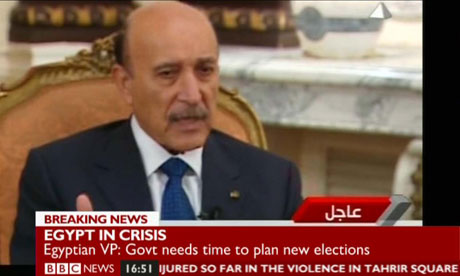
Egyptian-vice-president-O-009

by Chris Bodenner

Scott Lucas summarizes a 45-minute interview that just ended:

1636 GMT: The Vice President Omar Suleiman appeared on Al-Musriyya state TV and during an interview said that the demands of the youth of the January 25 movement were legitimate and acceptable and that they have been examined. However, he blamed foreign operatives with their own agendas whose objective was to create instability, intimidation and rift between Egyptians.

He claimed that these operatives wanted to carry out sabotage. He said that these operatives forced the government to deploy Army. He said that these operatives will be arrested and penalized. 

He said that constitutional amendments will be made to the constitution to allow more reform in the sections that determine qualification of candidates. He said that they had contacted all parties and two parties, including Wafd Party, had asked for  time while others had agreed to join reform talks. He said they had also contacted the Muslim Brotherhood and invited them to reform talks, but they were hesitant to join.

He adds that people who were responsible for the Tahrir Square killings last night will be held accountable for their actions. He claimed that they will find the people with horses and camels and tried to break up protests in Tahrir Square will be identified. He also claimed that pro-Mubarak protesters had been pushed towards Tahrir Square and that they will find out who pushed them there and find out who started the clashes. 

The Armed Forces were deployed to safeguard all people, he said, and that the Armed Forces are carrying out a new role which is to implement the curfew, protect civilians against the thugs and finally, burden the responsibility of the police. He claimed that what took place last night in Tahrir Square was because the Army was not instructed to stop protesters from peaceful protests and that there was no anticipation of violence, but they managed to separate the two sides. But he claimed that the pro-Mubarak supporters didn't go to Tahrir Square on their own, but were rather forced there by elements he did not identify. 

He asked the youth to stop demonstrating because it will simply continue the state of paralysis that government is in. He claimed that one million tourists had left the country in the past nine days. He said that continuing like this will only ruin the state and not bring reform.

An Al Jazeera analyst is currently saying how Suleiman's words were full of dog whistles encouraging violence against protesters. Watch live coverage here. Screenshot via The Guardian, which adds, "[Suleiman's] approach was predicted in this morning's Guardian by the novelist Ahdaf Soueif, who wrote:"

Their next trick will be to say that the young people in Tahrir are "foreign" elements, that they have connections to "terrorism", that they've visited Afghanistan, that they want to destabilise Egypt. But by now the whole world knows that this regime lies as naturally as it breathes.