Sophistry And Defining The Muslim Brotherhood, Ctd

by Conor Friedersdorf

Over at Ricochet, Claire Berlinski takes exception to a post I wrote yesterday about the Muslim Brotherhood. Put briefly, I discussed efforts to inform Americans about the organization, and criticized what I regard as flaws in Andy McCarthy's work on the subject. I took particular exception to his statement that "Hamas is not merely colluding with the Muslim Brotherhood. Hamas is the Muslim Brotherhood."

When Ms. Berlinski has issues with something I've written I take notice. Since discovering her work I've been impressed by it: she is constantly trying to persuade her readers that it is important to understand foreign affairs, and although I sometimes disagree with her conclusions, I always feel as if she's doing her best to inform. That isn't just gut instinct. What I mean is that when I come across a passage in her work, find my curiosity piqued, and go out seeking more information, I usually conclude after having educated myself that her characterization was at least fair. It's for this reason that I value her stuff. Especially on the subject of foreign affairs – her specialty is Turkey, where she resides – the lay reader is in the writer's hands. There isn't time to check every assertion or to second guess all analysis.

In recent weeks, she and I have disagreed repeatedly about the quality of Mr. McCarthy's foreign affairs analysis. At issue are his book, "The Grand Jihad: How Islam And The Left Sabotage America," his pamphlet, "How Obama Embraces Islam's Sharia Agenda," and the blog posts linked above. Says Ms. Berlinski in yesterday's post, "Conor Friedersdorf, I don't know what your problem is with Andy McCarthy. But you've got better things to do with your time on a day like this than to denounce his 'sophistry' about the Muslim Brotherhood." Truly, I haven't anything against the guy personally. But I find his work deeply flawed. That's my problem: I object to his arguments. Since he is one of the right's leading voices on these issues, a bestselling book author, and a frequent contributor at National Review, speaking up now seems timely. And it isn't as if Dish readers were lacking for breaking Egypt content. Later in this post, I'll return to this most recent disagreement about Hamas and The Muslim Brotherhood. Before I do so, I want to briefly sketch my general disagreements with Mr. McCarthy, because if Ms. Berlinski isn't clear on what my problem is I haven't been nearly as clear as I'd thought.

Issue one: Mr. McCarthy asserts that President Obama is leading a Grand Jihad against America wherein the hard left and radical Islamists form an alliance against this country. As he tells Kathryn Jean Lopez:

I mean the Islamist movement — which, though very mainstream among the world’s Muslims, is by no means representative of all Muslims. By “the Left,” I mean the modern hard Left led by President Obama — I do not mean all people who would identify themselves as progressives or liberals. And when I say Islamists and leftists work together, I mean they have an alliance, not that they’ve merged.

In contrast, I think that President Obama's foremost loyalty is to the United States, and that rather than allying himself with Islamists, he is prosecuting two declared wars and various undeclared drone wars and special operations against the Taliban, Al Qaeda, and affiliated Islamist terrorist groups.

Issue two: In the exerpt of his book that is printed in The Washington Examiner, Mr. McCarthy makes assertions about President Obama's rhetoric that proved, once I checked up on them, to be demonstrably false. See here.

Issue three: In his writing on the prison at Guantanamo Bay, Mr. McCarthy seldom if ever acknowledges that demonstrably innocent people were held there. Instead he argues as if all the detainees were guilty. This is not so.

Issue four: I believe justice demands that a defendant in a judicial proceeding receives legal representation as he or she navigates an unfamiliar system – and that attorneys who provide this service are showing loyalty to the justice system, not any group with whom their client happens to be affiliated. Andy McCarthy believes that "many" of the American lawyers who volunteered to represent Gitmo detainees (often at the request of the United States government!) were "pro-Qaeda or, at the very least, pro-Islamist." He also argues that "the issue isn’t so much whether, in a vacuum, Leftist lawyers are pro-al Qaeda or pro-Islamist. It is where their sympathies lie as between two opponents: the United States as it is and Islamism,” implying that these lawyers are on the side of Islamism. (Links here).

Issue five: In the pamphlet titled, "How Obama Embraces Islam's Sharia Agenda," there actually isn't an argument that comes close to demonstrating that President Obama embraces sharia! (Hmm. I wonder why.) What is offered in place of persuasive arguments is worth briefly exploring, because it exemplifies McCarthy rhetorical tricks that I find odious. For example, he writes, "Equally troubling is the administration's promotion of sharia in our financial system." Wow, I thought, I haven't heard about that! If you read on, however, you discover that insurance giant AIG at some point developed a sort of financial instrument for Muslim customers that didn't transgress against Islamic law. Then for entirely unrelated reasons – that is to say, because of the financial crisis – the federal government took over AIG (including that small part of the business involving a type of insurance that doesn't trangress against Islamic law). If you're Andy McCarthy, a fair way to describe this is that the Obama Administration is promoting sharia in our finance system. (See here for more holes in his argument.) Which is why I don't tend to trust his characterizations – there are the ones that are inaccurate, and the ones that are perhaps true in a Clintonian sense.

Having clarified my problem with Mr. McCarthy, let's return to the matter at hand: The Muslim Brotherhood. The organization is currently the subject of wide disagreement. For our purposes, it's enough to know that there are some people who think they're wildly dangerous, and should never be dealt with or trusted; other people who think they can definitely be engaged and influenced politically; and a mix of folks who aren't sure or take some middle ground. I don't have a dog in this fight – or if you prefer, I am in the group that is uncertain, and open to arguments from either extreme. Mr. McCarthy and Ms. Berlinski share a belief that the Muslim Brotherhood is tremendously dangerous.

Is it possible that Ms. Berlinski judges Mr. McCarthy's big picture judgments about the Muslim Brotherhood to be sound, and as a result is less inclined to hone in on the sort of rhetoric I've outlined above? I ask that she entertain the possibility – and that she ask herself how many of the complaints outlined above she is willing to defend. I submit that Mr. McCarthy is engaged in similarly flawed rhetoric when he writes that, "Hamas is not merely colluding with the Muslim Brotherhood. Hamas is the Muslim Brotherhood." Put another way, I think the average reader presented with that sentence comes away more misled than informed – that although I acknowledge that one organization formed decades ago as an offshoot of the other, it is misleading at best to argue today that they're synonomous.

Ms. Berlinski writes:

Conor, you've directed your readers to me. And I have consistently said just what Andy McCarthy says about the Muslim Brotherhood. (Here's my higher-quality argument, Dish readers: Andy's right.) You've also directed them to Eli Lake. At minute 4:53, Eli makes precisely, but precisely, the point you're denouncing as simplistic, namely, that Hamas is the Palestinian Muslim Brotherhood.

Strange as it is to say it, no, Claire, you haven't written the same thing – at least not in the passage I linked, or any other I've read by you. Pass along the relevant link that I missed if I'm wrong. As for Eli Lake, let's quote him from the conversation I linked:

I would point out, and it's something that I think is lost particularly in some of the commentary on the right – that there was a major split after 1966 when Nasser executed Sayyid Qutb who was a more radical Muslim Brotherhood leader. There were followers of Qutb who eventually formedEgyptian Islamic Jihad and murdered Anwar Sadat. And then there was a more moderate faction that Sadat allowed to organize the universities, and became a big part of regular Egyptian civil society. When I was living in Egypt I interviewed members of the Muslim Brotherhood who were the head or the equivalent of the American Medical Association for Egypt or the major newspaper editors.

But that said, the Muslim Brotherhood is not benign. They support Hamas. They support I think ultimately the decline or shrinking of any rights for women in Egypt… The really pregnant question is will they abide by the rules of competitive politics and civil society if they get power… It would be nice to lock in the Muslim Brotherhood in now for a deal where they agree to not do what Hezbollah does, which is to resort to militias and violence when they don't get what they want…

And here is 4:53, the passage where you claim he agrees with Andy McCarthy:

The Muslim Brotherhood chapter in Gaza is Hamas. And my view is that kind of maximalism isn't good for the Palestinians or the prospect of a two state solution. And if you have an Egyptian government that is openly supporting instead of having efforts underground to support Hamas that is going to be a major irritant. A likely scenario is that you would have open support for Hamas, that is officially at war with Israel, but not the abrogation of the Egypt-Israel peace treaty. And so the cold peace will become colder and less stable. And that would be a real problem.

Let's be clear here. When Andy McCarthy says that The Muslim Brotherhood is Hamas, the point he's making is that we can anticipate how the group will act if it comes to power in Egypt, because we know how Hamas acts in Gaza, and the two groups are the same. In contrast, Eli Lake doesn't believe we can know how the Muslim Brotherhood will act in Egypt if it comes to power, he describes a moderate faction of the Muslim Brotherhood in Egypt that is quite different from Hamas, and even in the clip you cite, he isn't arguing that The Muslim Brotherhood is Hamas – he is arguing that one of its chapters – the one in Gaza – is Hamas, and that an Egyptian government headed by the Muslim Brotherhood might strengthen the hand of Hamas in its ongoing conflict with Israel.

He goes on to speculate that if the Muslim Brotherhood ran Egypt, it would openly support Hamas, but maintain the Egypt-Israel peace treaty. If Hamas officials from the Gaza Strip were suddenly put in charge of Egypt, do you think they would maintain the peace treaty? If not, you apparently think there are distinctions worth making, and that the one's behavior isn't predictive of the other's behavior. Put yet another way, McCarthy writes, "Hamas is not merely colluding with the Muslim Brotherhood. Hamas is the Muslim Brotherhood." Lake says precisely that they'd collude with the Muslim Brotherhood, but that there would be a distinction between the stances taken by the two groups.

As I wrote yesterday, "Any analysis of the actual behavior of Hamas and The Muslim Brotherhood over the last couple decades shows that they're different organizations run by different personnel in different countries where they've made different things their main focus and evolved in unique ways, as is inevitable when taking an active role in the civic and political life of particular countries." Do they have a shared history and an overlapping ideology? Yes. Are they the same, so much so that one definitively predicts how the other will behave if it comes to power in a different country? Of course not.

So I reiterate my charge: Mr. McCarthy employs "a subtle, tricky, superficially plausible, but generally fallacious method of reasoning," also known as sophistry. Have I not made my case with the examples above? (Although to be fair, the notion that Obama is allied with our Islamist enemy isn't superficially plausible.)
Fox’s Rambling Man

by Conor Friedersdorf

Adam Serwer catches Glenn Beck darkly insinuating that leaders at ACORN and the Tides Foundation are playing a role in destabalizing Egypt. But it's just entertainment, right? What harm could possibly come from spinning these sorts of conspiracy theories?

Oh, wait. There was this August 1 story from The Washington Post:

When California Highway Patrol officers stopped him on an interstate in Oakland for driving erratically, Byron Williams, wearing body armor, fired at police with a 9mm handgun, a shotgun and a .308-caliber rifle with armor-piercing bullets, Oakland police say. Shot and captured after injuring two officers, Williams, on parole for bank robbery, told investigators that he wanted "to start a revolution" by "killing people of importance at the Tides Foundation and the ACLU," according to a police affidavit. His mother, Janice, told the San Francisco Chronicle that her son had been watching television news and was upset by "the way Congress was railroading through all these left-wing agenda items."

But what television news show could have directed the troubled man's ire toward the obscure Tides Foundation, which sounds as if it's dedicated to oceanography, or perhaps laundry detergent, but which is in fact a nonprofit that claims to support "sustainability, better education, solutions to the AIDS epidemic and human rights"?

Can you guess the answer?

Egypt, Day Ten: “Complete Anarchy”

by Patrick Appel

From AJE's live-blog, what they say is "a police vehicle running over a group of protesters":

From earlier in the live-blog:

Hundreds of thousands of pro-democracy protesters continue to defy the curfew in Alexandri and are calling for Mubarak to step down. People are chanting: "Erhal, Erha" ("Leave, Leave"). There are a mixture of people, men, woman old and young in the crowd.

The Guardian passes along the words of a "British man, Simon Hardy" who "called in to relay his experiences in Tahrir Square this afternoon":

In the last few minutes some snipers on top of the Hilton roof opened fire, maybe seven or eight gunshots. The protesters are saying two people have been killed, one shot in the head and one in the neck.

There are growing numbers of pro-government protesters on Ramses Street and behind the barricades on our side, still thousands of people in the square.

People are saying: "Is there going to be another attack tonight?" Anti-government protesters are saying that if they survive tonight, the demonstration tomorrow will be massive. They are calling it departure day, the day Mubarak will be kicked out of office. Everything hinges on the next 24 hours.

Atlantic:

Journalists in Egypt have come under increased attack in what appears to be a coordinated campaign by government security forces. At least ten have been detained, including three Al Jazeera journalists seized by secret police and two New York Times stringers arrested, and more attacked. "The crews have never been as scared as they are now," Al Arabiya news director tellsthe New York Times. Al Arabiya now reports that government forces are scouring hotels often used by the media for journalists.

BBC:

The BBC's Jim Muir in central Cairo says he's in middle of pitched battle on the northern side of Tahrir Square. He says the anti-government protesters are pushing forward – lobbing stones and rock. They've moved out well beyond the perimeter of the square. Says it's a scene of complete anarchy.

Lede:

In a video report filed late Wednesday, members of Egypt's security police were filmed taking a BBC correspondent, Rupert Wingfield-Hayes, and his crew into custody just minutes after they had left the home of a Mubarak adviser, Maged Botros. Mr. Wingfield-Hayes said that the BBC team was blindfolded and detained for several hours before being released. Adding to the impression that the crew's arrest was orchestrated by the government was the fact that, just before they were stopped by the police, as they left the Mubarak adviser's home, the had been surrounded by regime supporters decrying their coverage of the protests.

EA:

The government of Algeria has announced that the 19-year long state of emergency in the country will be lifted in the future. President Abdelaziz Bouteflika – who's ruled the country for almost two decades – announced that protests will be allowed, but not in the capital Algiers. Algerians have planned anti-government and pro-reform protests for the week after next and this move by the government are being hailed as a measure to try and stifle some of the support for those protests. 

HRW:

The events in Tahrir Square and elsewhere strongly suggest government involvement in violence against peaceful protesters.

The army, which had been controlling access to Tahrir Square very tightly, with tanks at all the main entrances to the square, checking identification cards and searching bags, allowed pro-Mubarak protesters into the square, including men riding horses and camels and brandishing whips. Soldiers mostly stood by and did not act to protect peaceful demonstrators or try to stop the attacks on them. The Egyptian Health Ministry said three people were killed in the violence and more than 600 injured.

It boggles the imagination that armed pro-Mubarak demonstrators on camels and horseback could have assembled themselves and passed through army checkpoints without government complicity and coordination.

A Marooned Mubarak?

53391882

by Chris Bodenner

Scott Horton explores why the Egyptian president could hold out longer than dictators of decades past:

[W]hy is Mubarak trying to squeeze a few more months out of his three-decade career in office and avowing his intentions to stay in Egypt rather than packing for the Riviera? It may be because exile isn't what it used to be; over the last 30 years, things have gotten increasingly difficult for dictators in flight. Successor regimes launch criminal probes; major efforts are mounted to identify assets that may have been stripped or looted by the autocrat, or more commonly, members of his immediate family. I witnessed this process myself, twice being asked by newly installed governments in Central Eurasia to advise them on asset recovery measures focusing on the deposed former leader and his family.

More menacingly, human rights lawyers and international prosecutors may take a close look at the tools the deposed dictator used to stay in power: Did he torture? Did he authorize the shooting of adversaries? Did he cause his enemies to "disappear"? Was there a mass crackdown that resulted in dozens or hundreds of deaths? A trip to The Hague or another tribunal might be in his future.

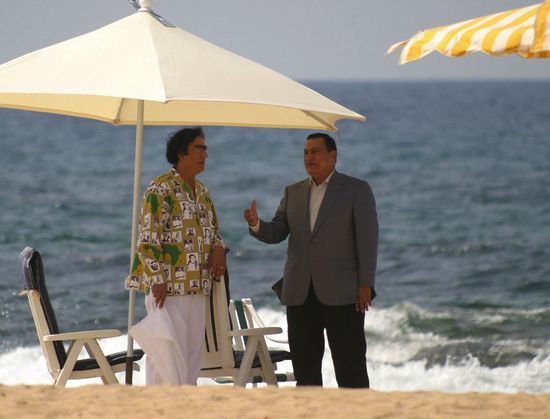
(Photo: Libyan leader Moamer Kadhafi listens to his Egypian counterpart Hosni Mubarak during their meeting 15 August 2005 in Sirte on the Mediterranean coast east of the Libyan capital Tripoli. By Osama Ibrahim/AFP/Getty Images)

What Can America Do? Ctd

by Patrick Appel

Yasser El-Shimy lists "five steps Washington should take to expedite the Mubarak regime's inevitable demise, and allow a transitional government to lead Cairo into democratic elections." His post assumes Mubarak steps down – which is an open question at this point:

Declare Washington's interest in forging a special friendship with the Egyptian people, offering to advise on (and potentially fund) education, infrastructure, technology, research and development, healthcare, etc. Egypt will be in a very grave economic condition, when Mubarak leaves, and will be grateful for all the help it can receive. The police force has reportedly orchestrated widespread acts of vandalism of public and private properties to spread panic among the population. The Egyptian stock market and many foreign investments are doomed for a few years to come. The government will be hard-pressed to meet the expectations of the population in light of the damage the Mubarak regime inflicted on the country prior to its departure and the flight of foreign capital.

Al-Jazeera’s Revolution? Ctd

108727470

by Chris Bodenner

Lawrence Pintak praises the network:

The media is by no means the only force at play in the continuing upheaval in Egypt, the Tunisian revolution, or the copy-cat demonstrations going on elsewhere in the Arab world. At root is a raw anger fed by decades of political, intellectual, and economic stagnation that has led to a powerful convergence of the region's three main political trends — pan-Arab nationalism, nation-state nationalism, and Islamism.

However, Arab media have been at the vanguard of articulating this new and explosive development. Arab satellite television, such as Al Jazeera — and the increasingly aggressive ethos of Arab print journalism exemplified by newspapers like Egypt's Al-Masry Al-Youm and Tunisia's crusading Kalima Tunisie — have fueled a sense of common cause among Arabs across the region every bit as real as the "imagined communities" that are at the core of the concept of nation.

Jeb Koogler, while also lauding Al Jazeera's role in Egypt, doubts it will have the same kind of impact elsewhere in the Arab world:

[S]ome Western commentators are taking their enthusiasm for Al Jazeera a bit far in assuming that the network will play a similarly positive role if protests in the region continue to spread. It's far from clear that Al Jazeera will be so gung-ho in its coverage of anti-government protests if the location were, say, Syria or Saudi Arabia. Or Qatar, for that matter, where the network is based. Al Jazeera blatantly refrains from criticism of a number of regimes and is quick to provide critical reporting of others. Egypt has long been the subject of some of the network's most critical coverage, so it's no surprise that Al Jazeera has embraced this story of anti-government ire. But Syria, on the other hand, were the protests to spread there, might find that Al Jazeera's coverage was much less sympathetic towards any type of protest movement.

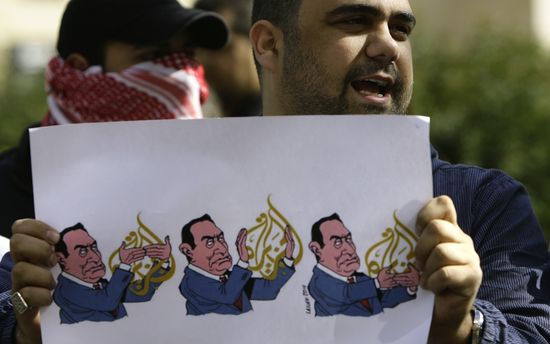
(Photo: A Lebanese activist a drawing of Egyptian President Hosni Mubarak blocking the logo of Qatari based Al-Jazeera satellite channel during a sit-inn to protest against the closure of its offices in Egypt, outside its offices in Beirut on February 2, 2011. By Joseph Eid/AFP/Getty Images)

The Pro-Regime Text Messages

by Patrick Appel

Ackerman:

One of the largest mobile providers operating in Egypt says the regime of Hosni Mubarak sent unattributed pro-regime text messages out over its network. And it’s not happy about the hack.

In a statement, Vodafone confirms that “since the start of the protests,” the regime has used emergency authorities to send “messages to the people of Egypt.” Rival providers Mobinil and Etisalat are subject to the same authority. None of the messages are “scripted by any of the mobile network operators and we do not have the ability to respond to the authorities on their content.”

Mackey has more:

The translations of the texts also appear to suggest that different messages were sent to different phones, perhaps indicating that the Egyptian government has specific information on each mobile owner. One message, apparently sent to suspected protesters, reads: "Youth of Egypt, beware rumors and listen to the sound of reason – Egypt is above all so preserve it."

Another message, seeking to rally regime supporters, read: "The Armed Forces asks Egypt's honest and loyal men to confront the traitors and criminals and protect our people and honor and our precious Egypt."

Gallery of text messages here

Obama’s Next Step

by Patrick Appel

Marc Lynch's latest is well worth a read. He believes that the "Egyptian military must receive the message loudly, directly and clearly that the price of a continuing relationship with America is Mubarak's departure and a meaningful transition to a more democratic and inclusive political system":

I would say that the time has come for the Obama administration to escalate to the next step of actively trying to push Mubarak out.  They were right to not do so earlier. No matter how frustrated activists have been by his perceived hedging, until yesterday it was not the time to move to the bottom line.   Mubarak is an American ally of 30 years and needed to be given the chance to respond appropriately.  And everyone seems to forget that magical democracy words (a phrase which as far as I know I coined) don't work.  Obama saying "Mubarak must go" would not have made Mubarak go, absent the careful preparation of the ground so that the potential power-brokers saw that they really had no choice.   Yesterday's orgy of state-sanctioned violence should be the moment to make clear that there is now no alternative. 

Egypt, Day Ten

CairoBattle

by Patrick Appel

A Flickr user has put up pictures from last night's fighting. The NYT has mapped the clashes. BBC:

An Egyptian army tank has moved against supporters of President Mubarak as they hurled rocks at anti-Muburak protesters in Tahrir Square, prompting cheers from anti-Mubarak demonstrators, reports Reuters.

The Guardian:

Hopes that the army would intervene on behalf of the anti-Mubarak protesters have been dashed, according to some people in and around Tahrir Square.

@estr4ng3d Military COMPLETELY siding with Mubarak now. Personnel at checkpoints search for foods, med supplies & arrest or send people back #jan25

AJE:

Group of 'thugs' just crashed through a phalanx of pro-democracy supporters shielding behind sheet metal on 6th of October bridge – soon after prime ministers promises that violence will not be repeated. No sign of army still.

EA:

Senior reporter Shahira Amin from State-run Nile TV has resigned and joined the anti-Mubarak protesters at Tahrir Square. Outlining threats and intimidations by the regime against Al Jazeera, she says she does not want to be part of the regime's propaganda.

Atlantic:

Besieged, under attack for hours, and increasingly desperate, protesters in Tahrir Square have set up a makeshift "prison" at the nearby Sadat metro station. Men fighting on behalf of Mubarak, and most likely at his behest, have been dragged, injured and sometimes unconscious, underground for "interrogation." Jarring photos of the station are an indication of just how far the once-peaceful protesters have been pushed and a reminder that war has no innocents. 

Lede:

[A]t least five people were killed and more than 800 wounded in the battle for the square, which continues to unfold in front of satellite news channels.

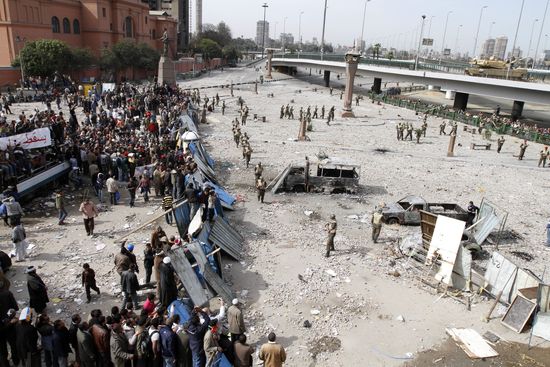
(Photo: Egyptian soldiers try to prevent anti-government demonstrators (L) from battling pro-government opponents (R) in Cairo's Tahrir square on February 03, 2011 on the 10th day of protests calling for the ouster of embattled President Hosni Mubarak. By Mohammed Abed/AFP/Getty Images)