The Mr. Cleavers Of Cairo

EgyptianCitizens 

by Patrick Appel

Graeme Wood has an excellent new dispatch from Egypt. He contemplates the future role of the citizens patrolling Egypt's streets:

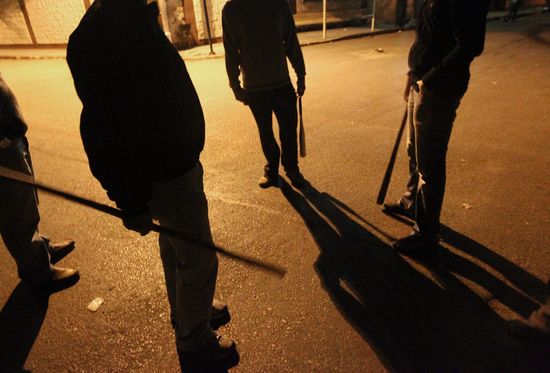
They talked to me, asked if I was Egyptian, and let me go without any difficulty at all. This scene repeated itself roughly three dozen more times between Heliopolis and downtown, and the traffic wardens apologized to me nearly every time for the inconvenience. Near Al Azhar University, a man with a huge gleaming meat cleaver — probably recently purchased from the kitchenware section of Khan al Khalili market — smiled and said, "Welcome to Egypt." 

I do not recall ever being so pleased to be surrounded by blade-wielding Arab vigilantes. The smile, I thought, was telling. Many people have told me that they are angry at having to stay up night with weapons, just to keep basic peace in their neighborhoods after the flight of the police Friday. But the smile of Mr. Cleaver told a different story. He seemed to enjoy being responsible for his area's safety, and pleased to be allowed to dispense justice there more responsibly than anyone in uniform had for quite some time. He was the place where the buck stopped and, if the buck wasn't careful, got ruthlessly chopped into many smaller bucks. His might not have been the role he wanted every day, but it evidently pleased him in the moment. 

These encounters happened mostly on Cairo's backstreets. If Tahrir Square is Cairo's heart, those backstreets are the capillaries snaking through Heliopolis, Nasr City, Islamic Cairo, and other areas where a huge portion of Cairo's middle class resides. I bring up Mr. Cleaver now because he could, if the clashes in Tahrir drag on, be decisive. Right now he is in his neighborhood, and the newfound mastery of his (hyperlocal) destiny is strangely refreshing. At some point, though, he and his ilk will start making a decision. Will they choose more order or more chaos? More order means more Mubarak, in a devil's bargain with the middle class whereby he restores order by arresting the protesters, putting cops back on the street, and, with the collusion of neighborhood vigilantes, turns Egypt into not just a police state but a pariah state as well. More chaos means more demonstrations and a scary, unpredictable future that could make his role as author of his own destiny permanent. Right now I can't tell whether the Mr. Cleavers of Cairo are rushing to help the pro- or anti-Mubarak side – or are content to sit back and wait. 

(Photo: Egyptian civilians carrying batons and sticks they stand guard in a Cairo street to protect their properties from looters in Cairo on January 29, 2011. By Khaled Desouki/AFP/Getty Images)
If Inequality Is A Factor For Egypt… Ctd

WorldIncome

by Patrick Appel

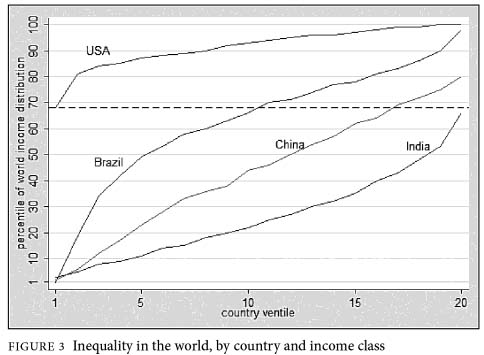
Alex Tarrabok posts the above graph:

Comparing between countries we see that the poorest 5% of Americans are among the richest people in the world (richer than nearly 70% of other people in the world). The poorest 5% of Americans, for example, are richer than the richest 5% of Indians.

A reader adds:

The main reason that the US has a higher Gini coefficient is that it is much larger than any of those other countries. The Gini tends to be higher for larger populations. So, for example, the Gini coefficient of income for the US will he higher than that of any individual US state. It's interesting that of this group, that Israel (population: 7 million) and Tunesia (10 million) have higher Ginis than Egypt (34 million) or Pakistan (170 million); nevertheless, comparing Ginis of different-sized groups is very much an apples-to-oranges comparison.

The Regime Backpedals?

by Chris Bodenner

The Guardian's Matthew Weaver notes the early morning news:

9.27am: The prime minister Ahmed Shafiq has apologised for the violence according and has promised an investigation.

9.34am: Rapid political manoeuvring: Egypt's Vice President Omar Suleiman has held a dialogue with the country's political parties and national forces in a bid to end the protests, according to Reuters. Opposition leader Mohamed ElBaradei is refusing to take part until Mubarak resigns.

AJE:

Egypt's cabinet denies that it had a role in mobilising Mubarak loyalists against pro-democracy protesters in Cairo's Tahrir Square and said it would investigate those behind violence. Cabinet spokesman Magdy Rady said: "To accuse the government of mobilising this is a real fiction. That would defeat our object of restoring the calm. We were surprised with all these actions."

Yemen Heats Up

by Chris Bodenner

Reuters reports:

More than 20,000 Yemenis filled the streets of Sanaa on Thursday for a "Day of Rage" rally, demanding a change in government and saying President Ali Abdullah Saleh's offer to step down in 2013 was not enough. … [B]y early morning, anti-government protesters had already gathered the largest crowd since a wave of protests hit the Arabian Peninsula state two weeks ago, inspired by protests that toppled Tunisia's ruler and threaten Egypt's president.

Brian Whitaker is tracking events:

Jane Novak, who blogs about Yemen, says the protest has been switched at the last minute from Tahrir Square (like Cairo, Sanaa has one too) to the new university roundabout due to "regime thugs camped out in Tahrir Square with car loads of guns".

The interior ministry announced yesterday that it has set up roadblocks around Sanaa and stepped up its security forces – supposedly to stop people smuggling weapons into the city. Meanwhile some (but not all) of the government websites have gone down, including the websites of the president and parliament. It is possible they have been attacked by the Anonymous hacking group.

Carnage Through The Night

108756040 

by Chris Bodenner

It's 9:20 am in Cairo. EA:

1749 GMT: Leading Islamic scholar Yusuf Al Qaradawi, who has called for the Egyptian President to step down, has just said, "My final words are to Mubarak: Haram (sinful) on you to kill your people. The shepherd has become a wolf."

0228 GMT: Eye-witness, Salma Al-Tarzi from, a woman in Tahrir Square, on Al Jazeera claims that there are still women, children and elderly alongside the men in Tahrir Square amidst the anti-Mubarak protesters. She claims it is the thugs, the militias and the intelligence agency that are opening fire on protesters amidst the pro-Mubarak protesters. 

She says some people are leaving, but a lot of people are not leaving because they cannot leave at this point. She says they are using stones and sticks while they are being shot at by the thugs. She says that people are too tired to be afraid of the gunfire.

0253 GMT: Anti-Mubarak protesters have finally managed to push pro-Mubarak protesters and thugs off the 6th October Bridge from which they were shooting from the square. This means they won't have the high vantage point from which to shoot on anti-Mubarak protesters anymore.

0310 GMT: Hillary Clinton in a call to Egyptian Vice President described the shooting on democracy protesters in Tahrir Square in Cairo as 'shocking'. Gunfire continues.

0335 GMT: Another eye-witness on Al Jazeera – @Monasosh – says that democracy protesters won't leave Tahrir Square, even though they are being shot at by thugs and pro-regime men. She said, "I don't understand what more the world needs to kick Mubarak out of Egypt?!" … She claims that they won't leave the square because they know if they leave, the regime will hunt them down one by one and kill them. She says the regime has done before and they will do it again.

Go here for footage of that interview. AJE:

8:42 am Egyptian state TV says five people were killed and more than 800 wounded overnight in Tahrir square.

8:08 am Anti-government protesters and supporters of president Mubarak continue to throw stones at each other as the sun rises above Cairo.

7:15 am The US calls on its nationals in Egypt to leave the country.

Go here for more information from the State Department. The latest from EA:

Reports that the Army is going to keep more protesters from entering Tahrir Square where democracy protesters have barricaded themselves and spend a brutal night when they were assaulted by thugs and pro-Mubarak protesters. Day light is creeping on Cairo and more democracy protesters are expected to turn up on the streets today.

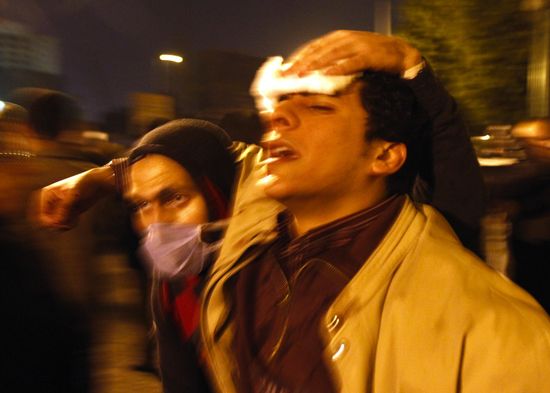
(Photo: A wounded Egyptian anti-government demonstrator (R) is helped by a paramedic at Cairo's Tahrir Square where crowds have gathered for a protest calling for the ouster of President Hosni Mubarak on February 2, 2011. By Mohammed Abed/AFP/Getty Images)

“Definitely The Mood Has Changed”

108736801

by Chris Bodenner

Speaking on the phone to FP's Joshua Keating, correspondent Maryam Ishani gave one of the more vivid accounts of Wednesday's bloodshed:

Now, I'm basically stuck between what they've established as two cordons around Tahrir. One is established by pro-Mubarak demonstrators, whose job it is to keep people out of the square. That includes ambulances and anyone who's not on their side. They ask you if you're pro- or against. They're looking for Americans and foreigners. They're saying things like, "You brought Baradei. This is your fault. You're trying to break Egypt." They're quite hostile. They physically hit me with sticks. I went in to film them throwing stones and they knocked me back pretty hard, which is not the mood of the demonstrators inside the square.

The second cordon is also pro-Mubarak demonstrators, who are just beating up the demonstrators inside Tahrir. They have swords — I'm not exaggerating — they have things that look like machetes with a 12-inch blade or longer, sticks, pipes, automatic weapons.

This is why people [are] saying they're actually police. They're in very large numbers, not just people who collected. They're generally all men between the ages of 20 or 30. Among them are some pretty thuggish types. I walked down a street into a crowd of about 10 of them and I was so uncomfortable with the look on their face that I just turned right around. It literally looks like their job is to just beat people up. They're working their way into Tahrir an inch at a time with the cordon behind them keeping everyone out, specifically the press. They're confiscating cameras. They'll take things away and break them. They're throwing stones. They mean business in a way that hasn't been the case so far.

Ishani adds:

[T]hose on the pro-Mubarak side are chanting Islamic slogans. Throughout the day, we've been hearing that Friday is supposed to be what everyone is calling a "day of jihad" that both sides are gearing up for. Both sides are gearing up for a street fight on Friday. Definitely the mood has changed.

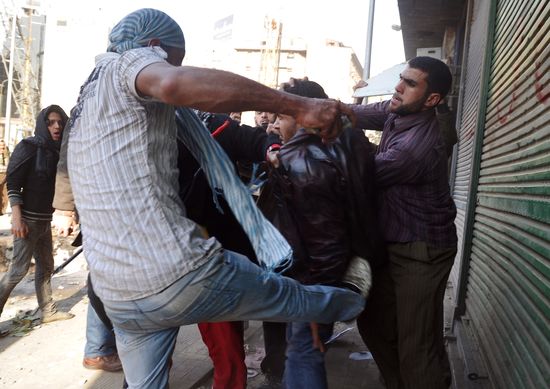
(Photo: Egyptian anti-government protestors (L and R) beat and lead away a supporter of embattled President Hosni Mubarak during clashes in Cairo's Tahrir square on February 02, 2011. By Miguel Medina/AFP/Getty Images)

The Regime Reconstitutes Itself?

ShieldsGetty

by Patrick Appel

A report from an Al Jazerra web producer:

I saw one wounded protester being treated by doctors and then taken away to the ambulances. The doctor who had been working on him told me that the man had been shot in the head but still had a pulse and might survive. There was a puddle of blood on the concrete beneath the man. The doctor said the gunfire came from pro-Mubarak protesters, not from army. I saw second wounded protester also being treated for a gunshot wound, he looked unresponsive. One protester told me six people had died today, however another doctor in the square told me four had died.

Michael Martinez reports on the military's idleness:

"The military's refusal to act is a highly political act which shows that it is allowing the Egyptian regime to reconstitute itself at the top and is highly, utterly against the protesters," said Joshua Stacher, assistant professor of political science at Kent State University and an expert on Egypt. 

Robert Springborg argues along similar lines:

The threat to the military's control of the Egyptian political system is passing. Millions of demonstrators in the street have not broken the chain of command over which President Mubarak presides. Paradoxically the popular uprising has even ensured that the presidential succession will not only be engineered by the military, but that an officer will succeed Mubarak. The only possible civilian candidate, Gamal Mubarak, has been chased into exile, thereby clearing the path for the new vice president, Gen. Omar Suleiman. The military high command, which under no circumstances would submit to rule by civilians rooted in a representative system, can now breathe much more easily than a few days ago. It can neutralize any further political pressure from below by organizing Hosni Mubarak's exile, but that may well be unnecessary. 

The president and the military, have, in sum, outsmarted the opposition and, for that matter, the Obama administration. They skillfully retained the acceptability and even popularity of the Army, while instilling widespread fear and anxiety in the population and an accompanying longing for a return to normalcy. 

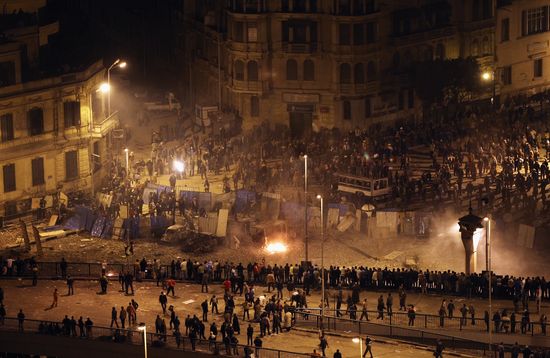
(Photo: Anti-government demonstrators hide behind makeshift shields as Molotof cocktails are lobbed by supporters of Egyptian President Honsi Mubarak early on February 3, 2011 in Cairo, Egypt. The two groups skirmished throughout the night. By John Moore/Getty Images)

Nations In Transition

Mansfieldsnydergraph

by Patrick Appel

A reader writes:

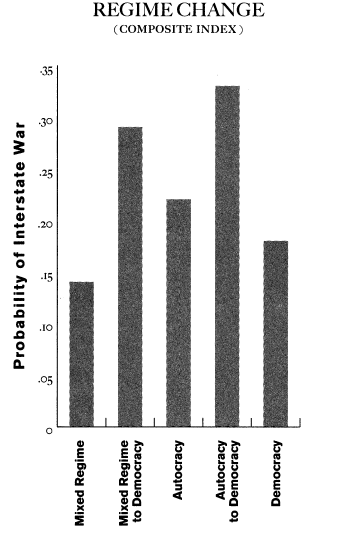
Your reader claims that "Recently transitioned democracies are ten times more likely to engage in war than are stable autocracies for the first ten years – Mansfield and Snyder, "Democratization and War."

That's not even close to what Mansfield and Snyder find. According to their study, the likelihood for recently transitioned democracies to engage in war is about 60% higher than for autocracies. Since all the articles are behind paywalls, I've attached the key graph from their 1995 Foreign Affairs article.

(Their findings and methodology are – still – hotly contested in political science and much weaker for larger interstate wars, but that's a different story). I'm sorry to be nit-picking, but since the reader wants to claim the authority of political scientists for her/his argument, I find it bothersome that s/he is off about what they're saying by several orders of magnitude.

“Tonight Was The Battle Of Tahrir, And The Protesters Won”

by Chris Bodenner

Al Jazeera correspondent Evan Hill had some of the most compelling coverage of the fighting on Wednesday. Here are a compilation of his latest tweets, in rough chronological order:

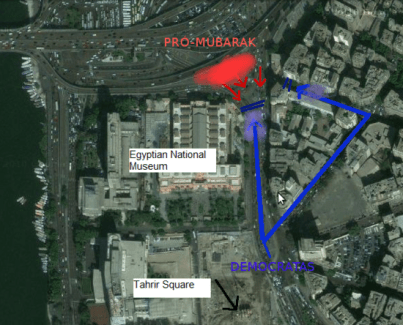
A crowd on top of the 6th of October overpass has stayed since the pro-Mubarak lines broke and is throwing molotovs at the Tahrir protesters

Every so often a car pulls up on top of the overpass and appears to deliver molotov cocktails to the pro-Mubarak supporters.

If protesters hold on, they've maintained the most important symbol of their movement. As long as they're in Tahrir you can't ignore them.

Inside kasr al nil [bridge]: a stockpile of rocks, seems like half of the ppl have bandages here

The whole road leading into tahrir from the bridge has been turned into a stockpile of rocks. Boss yells: come to the front!

I'm about 100 meters behind the front line and the sounds from ahead are like a premodern war, constant banging and shouting

The rain of rocks back and forth at the museum is constant, most coming from the protesters. The background drum beat on metal never stops 

Right at the barricade now, men in headwraps just sling rocks over the top without knowing what they'll hit Map of tahrir

Automatic heavy caliber gunfire 75 meters or so away, army likely keeping people at bay. So much gunfire

There's a line of skirmishers in front of me throwing rocks with little cover, but the pro mubarak crowd is really thin

Someone here just landed a molotov on the overpass and a big cheer went up

Anti govt supporters are advancing from here, they've taken the bridge

Just saw two protesters being taken away, one was shot in the head, doctor said by pro mubarak demonstaters

Victorious anti government protesters begin washing pro mubarak graffiti off the statues in the former no mans land

Anti govt protesters just dragged one or two guys inside the barricade, made me walk away when I started taking pictures

Made it back safe. Soldier tried to confiscate my camera. I convinced him to just take the battery, and the memory was hidden.

I am going to be busy filing and uploading, but suffice to say tonight was the Battle of Tahrir, and the protesters won. Cairo is changed.

(Video shot by Evan Hill. Map of the battleground via weddady)