The Daily Wrap

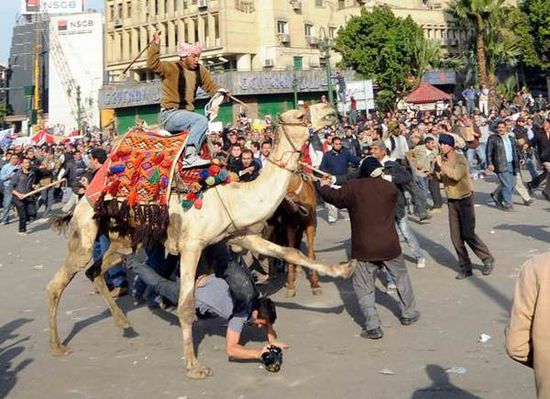
Today on the Dish, clashes broke out in Egypt, even reporters were attacked, and we followed the chaos here, here, here, here, here, and video here. Steve Negus feared a culture of criminality, Andrew McGregor ran through future scenarios, and Patrick pointed out the Glenn Beck divide. Conor called out Thomas Friedman's nonsense, and deflated the National Review's shoddy logic on the Muslim Brotherhood.

Ambinder picked apart what the US wants, Larison had doubts about Egyptian democracy, and we explored what it meant for oil. Scott Horton considered Mubarak's fear: hate ratio, Graeme Wood offered perspective on Tahrir square, and Shadi Hamid charted the two routes to Arab democracy. Exum explained why the US is so close with Egypt's army, Egypt was more equal than the US, even though wellbeing was declining as its GDP went up, and a blogger explained how not to say stupid stuff about Egypt. Yemen appeared shaky, but Joshua Foust argued it didn't have to do with Egypt.

Conor mourned the fact that controversial blogging and careers don't mix, and annihilated the broken logic of torture advocates. Conor doled out advice for gender conferences, Yglesias seconded Conor on Beck's craziness, and outlawing Sudafed wasn't going to stop meth users. AOL explained how to make money on the web, Conor weighed in on the new governor of the Golden State, Boehner tried to redefine rape, and this is how to look smart. Houses sat empty, cooking could be easy, and a young man stood up for his two mothers.

Interactive global map of unrest here, chart of the day here, MHB here, FOTD here, VFYW here, poignant VFYW observation here, Palin's phrenology here, and Milbank fail here.

–Z.P.
The Glenn Beck Divide?

by Patrick Appel

Michelle Goldberg watches as Egypt splits Republicans:

Now, as Egyptians pour into the streets and demand control of their political destiny, an interesting divide is opening up on the right. On one side are those who actually took all that democracy stuff seriously. On the other are those who see the Muslim world only as an enemy to be crushed and controlled. With a Republican primary approaching, it remains to be seen which view of Middle Eastern policy will triumph among conservatives.

As I wrote earlier, this is a somewhat simplistic understanding of the democracy debate as a whole. David Sessions doesn't like how Goldberg attributes Beck's position to the religious right:

Glenn Beck’s crazed notion that the Egyptian revolution is really a progressive plot to overthrow America is not “rampant on the religious right” just because John Hagee, a fringe pro-Israel preacher few Christians have heard of, is saying outrageous things again. When I have written presumptively about the religious right’s political views, they have been quick to assure me that they don’t necessarily watch or agree with Glenn Beck (though other anecdotal evidence suggests some of them do). But again, the only people referenced here are Hagee and Mike Huckabee, neither of whom really speak for the rank-and-file of the religious right in any way significant enough to label their opinions “rampant.”

Against Pragmatism

by Patrick Appel

Chait asks Obama to further distance himself from Mubarak:

The Egyptian populace seems almost totally united in opposition to Mubarak, with the only significant support coming from those in Mubarak's pay. The opposition has all the nationalist and religious legitimacy it needs. At this point Obama needs to forcefully cut Mubarak loose. The only delay, I would hope, is his slowness to respond to events, a trait he has consistently displayed since the campaign. Sometimes that caution has served him well, but here it hasn't. If Obama does not act soon it will be a black mark.

Any Excuse For Torture

by Conor Friedersdorf

There's a story making the rounds about Al Qaeda gathering radioactive material in order to make dirty bombs. A reader emailed the link to The Dish with this note:

"Freight trains were found to be carrying weapons-grade nuclear material across the Kazakhstan-Russia border…"

And you think Cheney was bonkers to use torture?

Get real.

So let me get this straight. Dick Cheney pushed the American government to torture people. It did nothing to stop the particular story that concerns you. And that's a justification in your mind for the torture?

This is the sick logic of torture supporters. If there are no terrorist attacks, it means torture worked. If there is the threat of a terrorist attack, it means we need more torture. If there's a successful terrorist attack, it means we didn't torture enough.

Torture advocates are unfortunately a part of our discourse – but the folks who made it happen belong in jail.

“How Not To Say Stupid Stuff About Egypt” Ctd

by Patrick Appel

There are intellectually honest writers – Larison chief among them – arguing that Egyptian democracy, or some imperfect version of it, is against US interests. There are also those who argue the next leader of Egypt will potentially be as bad or worse than Mubarak and that a transition in leadership is likely to cause great violence. But another clique – Glenn Beck is the most visible, but Pamela Geller is another good example – is using conspiracy theories and racist anti-Muslim rhetoric to argue in support of Mubarak and against democracy. The Sarthanapalos blogger was wrong to conflate the Larisons and Becks of the world. A reader writes:

"[T]he implication is that democracy is not to be trusted in the hands of certain nations, people and religions is offensive, racist and ignorant."

Bullshit.  A caricature of what most people are saying when they express skepticism about democracy in certain nations that have no experience with it, especially if those nations don't have a stable middle class.  Recently transitioned democracies are ten times more likely to engage in war than are stable autocracies for the first ten years – Mansfield and Snyder, "Democratization and War."  If the statistics offend Sarthanapolos's sensibilities, then s/he can get a straw and suck it up.

Implying that certain groups who happen to be brown are biting off more than they can chew is not automatically racist; the automatic reversion to racism as a defense against such arguments made about such groups often is (my argument isn't reliant on the fact that the revolutionaries are Brown/Egyptian/Arab/Muslim–that charge falls on Sarthanapolos).

Another reader writes:

In light of recent events in Egypt, I want to mention that, according to the CIA World Factbook, not even our own government officially considers us a "democracy." The money quote is under the heading government type.

"Constitution-based federal republic; strong democratic tradition".

I wonder if bloggers like Sarthanapalos (see your "How Not To Say Stupid Stuff About Egypt") and other media realize how stupid they themselves sound when they talk about "Democracy" as if it is was almost a holy word.

The Founding Fathers of this nation had good reason for not making ours a true democracy. Does tyranny of the majority ring any bells? Democratic tradition, to use the term the CIA uses, comes with responsibilities (lots of 'em) in order to be effective and efficient and just. Freedom is a good thing, but to invite people to live in a house of democracy without the proper foundation seems to be a like building a house of cards.

The democracy/republic distinction can be confusing. Bernstein explained it well awhile back. Another reader:

Sarthanapalos is a little quick to cry racism and ignorance when people don't want Egypt to open up its elections. The Muslim Brotherhood is the big populist bloc people are concerned about, mostly because their stated objectives are to institute Sharia law and to cancel the Egypt-Israel peace treaty. There is some debate whether Sharia is compatible with democracy and western notions of human rights. Also, canceling a peace treaty is one of those things that tends to cause war. So it's perfectly reasonable to have concerns about whether democracy and peace can be sustained when the democrats we're talking about want neither.

It's unclear what the Muslim Brotherhood's role would be in a democratic Egypt, but it is a genuine concern.

Where Could Egypt End Up?

by Chris Bodenner

Andrew McGregor runs through a wide-ranging series of scenarios, including "Islamists Take Control of Egypt through Elections":

While many reports suggest a Muslim Brotherhood takeover is imminent, results from the last relatively free elections in which they were able to contend indicate the MB has the support of roughly 20% of the electorate.  The Muslim Brothers’ armed wing was dissolved long ago and there are no indications of the movement turning to violence in the current turmoil. Having committed to a policy of building an Islamic state through grass-roots activism after top-down efforts to seize power in Egypt nearly resulted in the destruction of the movement in the 1960s, the Brothers are in the midst of an ideological dilemma – stay the course and possibly be left behind or ignore the movement’s principles to try and maneuver the movement into a leading position in the effort to overthrow the government.  The Brothers are as likely to split over this issue as they are to become a late player in the uprising. …

Though relatively unlikely, an Islamist victory at the polls would lead to three possibilities:

a) Countercoup – The Algerian Scenario: When the FIS appeared to be winning the Algerian general elections in 1991, the Algerian military moved quickly to seize the government with U.S. and French support. The United States may similarly decide Egypt, as the leading nation of the Arab world, is simply too important to leave to Islamists of any stripe.

b) A moderate Islamist government willing to work with the West as well as the East, on the pattern of Turkey’s ruling Justice and Development Party (increasingly the Islamist’s model of choice).

c) An Islamist government sacrifices much needed American subsidies to break with the West, renege on the treaties with Israel and provide a haven to extremists. This scenario remains the most unlikely at the moment. While the existing relationship with Israel will be re-examined by almost any new government, a break with the West would have little appeal to most Egyptians.

(Hat tip: Arabica)

Controversial Blogging And Careers Don’t Mix

by Conor Friedersdorf

James Joyner reports on the retirement of a pioneering blogger:

Power Line founder Paul Mirengoff has left the blog, after a controversial posting about the Tucson funeral service got him in hot water with his law firm. William Jacobson has the details but the short version is that Mirengoff took issue with a Yaqui Indian tribal prayer at the memorial service, contending that a Christian prayer would have been more appropriate given the victims and the audience.  This caused one of Mirengoff’s fellow partners at Akin Gump, who’s a member of the Yaqui tribe, to issue an outraged statement, which in turn caused the firm to demand Mirengoff take down the post and issue an apology.

Presumably, Mirengoff decided at this point that continuing to express controversial opinions on a personal blog wasn’t worth the risk to a highly successful and lucrative legal career.  (It should be noted that the Power Line gang posted under rather silly pseudonyms in the early years of the site, so one imagines they’d considered that previously.)

Although Power Line isn't my kind of blog, I think this is a shame, mostly because I want the blogosphere to remain a place that includes people whose primary career isn't journalism. Obviously I've got no objection to journalist bloggers. I am one. But we shouldn't have a monopoly on the public discourse.

And that is the likely result if controversial blogging, whether actually wrongheaded or not, causes people trouble at work. Personally, I disagree with Mirengoff's take on prayer at the memorial service, but the appropriate response to that is forcefully pointing out the error in his ways, not demanding that he remove the offending post. Hiding attitudes we dislike don't make them go away. In fact, only if people are willing to articulate offensive beliefs they actually hold can they be disabused of them. Admittedly, I have my own limits – that is to say, I can imagine extreme examples where I'd fire someone in an unrelated field for something the wrote on their blog. But I generally think it's best for us all if we can avoid that reaction, so I'm for erring on the side of maximal discourse. I'm not prepared to debate whether child rape is okay, or if Al Qaeda was justified in felling the Twin Towers. But the kind of prayer that should've been offered at a memorial service? That's the sort of thing Americans need to talk about if only because there's broad disagreement.

Richer And Worse Off?

Wellbeing

by Patrick Appel

Gallup provides the above graph, which shows wellbeing is declining despite increases in Egyptian and Tunisian GDP. Gallup concludes that "global wellbeing metrics make clear that leaders cannot assume that the lives of those in their countries would improve in tandem with rising GDP": 

In Egypt, all income groups have seen wellbeing decline significantly since 2005, with only the richest 20% of the population trending positively since 2009. In Tunisia, wellbeing for all groups has declined since 2008 at similar rates. As a result of these declines, wellbeing in these countries now ranks among the worst in the Middle East and North Africa region, on par with Libya, Palestinian Territories, Iraq, Yemen, and Morocco.

Peyton Craighill collects more data:

The most recent Egyptian data from March 2010 finds just 36 percent saying they are satisfied with the freedom available in their country and 61 percent are dissatisfied. That ranks Egypt fourth highest in dissatisfaction among the 151 countries polled by Gallup (only Bosnia-Herzegovina, Cuba and Madagascar showed higher dissatisfaction).

Yemen Politics, Breakfast Burrito Edition

by Patrick Appel

Joshua Foust contemplates Yemen's latest round of protests and Saleh's declaration that he won't run for relection. Foust asserts that while "some protesters in Sanaa have said they were inspired by the protests in Egypt and Tunisia, those two revolts did not inspire the protests anymore than my breakfast burrito did":

The latest round of protests probably had a number of causes behind them, one of which may have been the unrest in Tunisia and Egypt. At the same time, and quite unlike the protesters in Tunis and Cairo, Yemenis aren’t demanding revolution, but rather reform and peaceful transition of power. It is a totally different animal.

An  important point:

[I]n Yemen, there is a very regular pattern to protests, opposition and Saleh playing the crowds to stay in charge. In 2005, Saleh announced his intention not to seek reelection, only to stay on the ballot and win.