Take Pity On The Cold Sufferer

by Conor Friedersdorf

Megan McArdle has an excellent post up about efforts to fight meth production, and a proposal to make Sudafed a presciption only drug:

Let me start by saying two things:  first, that meth addiction is very bad, and the world would be a better place without it; and second, that home meth synthesis is obviously very dangerous. But it is not actually so bad that we shouldn't count the costs of suppression.  Which are considerable. After all, what we're effectively talking about is making it impossible for people to unplug a stuffy nose without going to a doctor.  

Which in turn means either that we're going to spend $50 to $100 per cold (obviously, much more expensive than even a bunch of really terrible meth lab fires) or that people are going to go without treatment.  I'm guessing that Keith Humphreys does not suffer from chronic ear or sinus infections, which are considerably worse than coughing up a little phlegm.

So there are the costs of making this category of cold medications prescription only. But look. Does anyone think meth or meth labs are going to disappear if we get rid of this ingredient? It's just implausible. A short term gambit that's only going to work until suppliers find a different method of manufacture, or else start smuggling it across the border.

There is no way to win the War on Drugs. There never has been. There never will be, short of becoming an authoritarian state. We can face up to that fact, or continue ceding liberties and conveniences one by one, for nothing.
Feared And Respected Or Hated?

by Conor Friedersdorf

Scott Horton offers questions to guide our thoughts about Egypt. Here's one I found particularly interesting:

How has Egypt’s brutal state security apparatus contributed to the current crisis? At the outset of the war on terror, Dick Cheney expressed admiration for the ruthless methods that Mubarak used to suppress the Muslim Brotherhood and shore up his own regime. Lawrence Wright described them penetratingly in The Looming Tower (generally, an excellent resource for those wanting a glimpse inside of Mubarak’s Egypt). These methods were widely seen as effective in insuring Mubarak a measure of stability. But the current developments show how deeply hated this internal security regime is and how ineffective it has been—so far—in quelling the uprising. The situation in Egypt seems to raise an old Machiavellian question: a leader may be enhanced by being feared, as long as those who fear him simultaneously recognize that he is guided by reason and at least a measure of justice. But once the fear-inspiring leader becomes an object of broad popular hatred, he is in a very difficult position.

Turnabout Is A Terrible Idea, Ctd

by Conor Friedersdorf

It seems as though one prominent progressive agrees with me:

The years 2009 and 2010 were a period of declining popularity for Barack Obama, for the Democratic Party, and for progressive politics in the United States of America. Under the circumstances, it’s tempting to examine any particular trend in American political life that operated in parallel to this and see it as advantageous to conservative politics. Hence the skyrocketing popularity of a deliberate kind of political entertainment in which folks like Glenn Beck lie to gullible conservatives about what’s happening in America appear to many as a form of successful political tactic. In reality, however, the declining popularity of Obama, Democrats, and progressives can be easily attributable to poor economic conditions. Now that trends have leveled off and Obama is back at 50 percent and we seem to be headed for a span of so-so growth I think we’re going to find that while Beck has certainly carved out a lucrative business niche for himself, that in political terms creating a paranoid and misinformed base is not helpful.

The Army’s Makeshift Jail

by Patrick Appel

Peter Bouckaert of HRW reports:

The situation at the Northern HQ of the army in Alexandria is very tense. The army has used the HQ as a detention center for all of the suspected looters and other troublemakers handed over to them by the neighborhood security committees since Friday. This is an unfamiliar role for the army, and they are clearly at a loss as to what to do. Many of the detainees are probably innocent, just caught in the wrong neighborhood without identification.

… The army is in a difficult position, as it has no evidence of wrongdoing by most of the detainees and no judicial system to process or release them. But they are the only functioning security institution. At the very least, the army should publish a complete list of the detainees and allow lawyers to visit them and ensure they are properly treated. And they should release the innocent as soon as possible.

What’s Egypt’s Economic Future?

by Patrick Appel

Larison remains wary of Egyptian democracy:

Everyone has understandably been speculating on the possible role of the Muslim Brotherhood in a democratic Egypt, but that is hardly the only political misfortune that could befall a democratic Egypt. While the protesters undoubtedly have real political grievances, it is economic woes that have triggered both the Tunisan and Egyptian uprisings, and it is not an accident that these are two regimes that have been doing many of the “right” things on policy in the eyes of economic neoliberals. In those countries with the weakest foundations as democratic states, the backlash against neoliberalism in Latin America empowered political movements in several countries that have produced economic mismanagement, political illiberalism, and the emergence of authoritarian populist rulers. It wouldn’t be all that surprising if the same thing happened in a democratic Egypt.

Violence In The Square, Ctd

108733049

by Chris Bodenner

Key updates from the best live-blogs. AJE:

Mohamed ElBaradei, an Egyptian opposition figure, calls on the the army to intervene as pro-Mubarak group continues attack on group that has been protesting in Tahrir Square.

An Al Jazeera correspondent is hearing scattered shots being fired on side streets near Tahrir Square and says "it's a very dangerous and difficult night here as people try to protect their neighborhoods and their families".

Al Jazeera reporting that the Egyptian museum was fire bombed and the army is now trying to put out the fire.

NYT:

CNN is broadcasting live video of the scene outside the Egyptian Museum as one Molotov cocktail after another is being thrown at the opposition protesters in Tahrir Square.

Atlantic:

The Egyptian military is taking its first proactive stance since violent clashes began in Cairo, acting to put out fires that have spread in Tahrir Square from molotov cocktails thrown by government forces from nearby rooftops, reports Al Jazeera Arabic.

Guardian:

US state department spokesman PJ Crowley has infuriated people with his appeal for "all sides in #Egypt to show restraint and avoid violence".

EA:

AFP claims from a witness that organisers paid people 100 Egyptian Pounds ($17) to take part in the pro-Mubarak rallies.

AFP is reporting, from a medic, at least 500 injuries in Tahrir Square today.

White House spokesman Robert Gibbs has told CNN, "We continue to watch the events very closely, and it underscores that the transition needs to begin now."

Watch a live-stream of the square here.

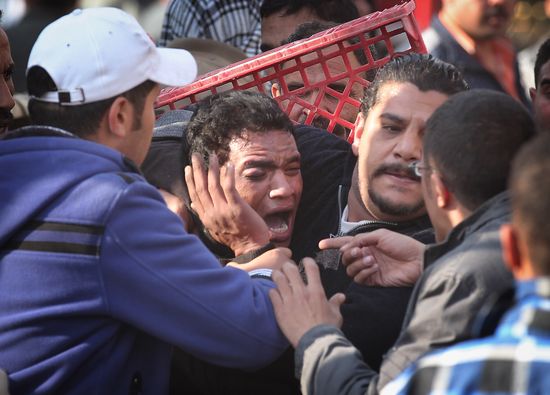
(Photo: Anti-government protestors surround a supporter of President Mubarak after he was beaten in Tahrir Square on February 2, 2011 in Cairo, Egypt. Yesterday President Hosni Mubarak announced that he would not run for another term in office, but would stay in power until elections later this year. Thousands of supporters of Egypt's longtime president and opponents of the regime clashed in Tahrir Square, throwing rocks and fighting with improvised weapons. By Peter Macdiarmid/Getty Images)

Egypt 2.0

by Patrick Appel

Ambinder chronicles the Obama administration's thought process and evolving position on Egypt:

What does the U.S. want?

Principally, an ally in the region that will not further destabilize the Arab-Israeli peace process, that will not complicate dealings with Iran, that will not (significantly) threaten Saudi Arabia's intra-Arab political aspirations while simultaneously containing them. The reality by late last week, as Obama and his advisers came to conclude, was that Egypt 2.0 would be a reforming Egypt as well. The sooner Mubarak understood this, the better. And of course, given that the protesters focused so cleanly on Mubarak as the source of their discontent, he would have to go. But Obama insisted that his team not call for regime change. For one thing, though protesters might suddenly experience a flood of positive feeling toward the United States, given the general level of anti-U.S. hostility inside the country, at least as assessed by intelligence reports, any government seen as being endorsed by the U.S. would risk legitimacy in the long-run.

"We recognize that the bar on the street is set at a place we could never possibly reach," the administration official said. "They want the U.S. to declare Mubarak needs to leave now. We're not in the business of regime change."

"As the president said in Cairo, Bush's freedom agenda has turned into a proxy for regime change, like getting rid of some leaders and replacing them with leaders more friendly to the U.S.," the official said. "The president believes that for these reforms to be real and lasting, these reforms need to be indigenous and lasting and pushed by the people."

The Beginnings Of A Crackdown?

by Patrick Appel

Kristof blogs his observations:

In my area of Tahrir, the thugs were armed with machetes, straight razors, clubs and stones. And they all had the same chants, the same slogans and the same hostility to journalists. They clearly had been organized and briefed. So the idea that this is some spontaneous outpouring of pro-Mubarak supporters, both in Cairo and in Alexandria, who happen to end up clashing with other side — that is preposterous. It’s difficult to know what is happening, and I’m only one observer, but to me these seem to be organized thugs sent in to crack heads, chase out journalists, intimidate the pro-democracy forces and perhaps create a pretext for an even harsher crackdown.

As does Wendell Steavenson:

"Of course they are all paid!” one anti-Mubarak protester told me, pointing at the pro-Mubarak cluster. “Crazy, crazy, crazy,” said one old man walking past, shaking his head at the clash of opinions and the rising noise level. “Mubarak is good!”

The pro-Mubarak supporters coalesced into a march of perhaps a hundred or so, and advanced toward the square. At the same time, a much larger pro-Mubarak march, several thousand strong, was coming from another direction, holding portraits of Mubarak, banners, and placards. Many of them wore small laminated Egyptian flags around their necks; when asked where the flags had come from, one said he had got it at the TV station where they had gathered for the march. One man held a banner which read “Baradei, You Are Not a Traitor, You Are a Spy!” But when I asked what it said, he hadn’t read it—it had just been given to him.

Scott Lucas:

A source in the ruling National Democratic Party said the party asked provincial offices to organise pro-Mubarak protests. Mohamed al-Helo, a member of Alexandria's local council, and Abdallah Osman, a high-ranking member of the NDP in Alexandria, were seen guiding the protesters.