by Chris Bodenner
Enduring America is rounding up footage from today. The Egypt section of Tumblr is another place to find good imagery. After the jump is dramatic footage of protesters on horseback:
by Chris Bodenner
Enduring America is rounding up footage from today. The Egypt section of Tumblr is another place to find good imagery. After the jump is dramatic footage of protesters on horseback:
by Conor Friedersdorf
In an interview yesterday, National Review's Andrew McCarthy displayed a bad habit that is characteristic of his commentary:
I’ve heard people, Hugh, over the weekend, talking about how Hamas seems to be now working with the Muslim Brotherhood. And I’ve had to remind them that no, Hamas is the Muslim Brotherhood. If you look at Hamas’ charter, it says that it is the Palestinian branch of the Muslim Brotherhood. So if you want to get a load of what Egypt will look like after a democracy ushers in the Muslim Brotherhood, have a look at Hamas. It’s not like we don’t have an example right in front of us.
See the trick? The Muslim Brotherhood in Egypt is itself an entity with moderate and radical factions. Here McCarthy treats it as an organization that can be spoken about coherently as a whole. Okay, fair enough. So there's The Muslim Brotherhood – and then there's this different entity, Hamas. There's a relationship between them. But delving into it would be to subtle for McCarthy. And he knows that Hamas carries strong negative associations among lots of people who've never heard of the Muslim Brotherhood. So he just conflates the two in a clever little talking point he's constructed:
"Hamas is the Muslim Brotherhood."
Well, no. They're actually different. Yes, Hamas was founded as an offshoot of The Muslim Brotherhood back in 1987. And Slate was founded as an offshoot of Microsoft in 1996. Now imagine someone coming along to tell, "Slate is Microsoft." You'd understand the flawed logic. A shared point in origin doesn't itself make entities identical. So what else has he got in making the case that "Hamas is the Muslim Brotherhood"?
Don’t take my word for it (although I covered the topic in some detail in The Grand Jihad). Don’t even take the word of the Justice Department, which amply demonstrated during the Holy Land Foundation terrorism financing prosecution that the Muslim Brotherhood’s top project in the U.S. has been to drum up support for Hamas. Look, instead, at some relevant sections of Hamas’s 1988 charter (“The Charter of Allah: The Platform of the Islamic Resistance Movement”), announcing the terrorist organization’s existence.
And he quotes a brief excerpt from the charter here.
Observe what's going on here. Any analysis of the actual behavior of Hamas and The Muslim Brotherhood over the last couple decades shows that they're different organizations run by different personnel in different countries where they've made different things their main focus and evolved in unique ways, as is inevitable when taking an active role in the civic and political life of particular countries.
Unfortunately, Mr. McCarthy is dealing with readers understandably ignorant of Middle Eastern history over the last two decades ago. And he has a talking point he wants to advance. So rather than grappling with a complicated reality in a way that makes him worthy of his readers' trust, he makes a ludicrously simplistic assertion, offers arguments for its truth that treat decades old rhetorical assertions as if they trump real world actions, and plows ahead like a zealous prosecutor – concerned only in proving his case, no matter if his shortcuts afford his audience a misleading picture of the world. The Daily Dish understands all too well that it's more complicated than McCarthy leads us to believe because we've been struggling through this stuff in an effort to inform as best we can. The only thing of which I'm certain is that I can direct you to people with higher quality arguments as you muddle through.
by Chris Bodenner
A reader writes:
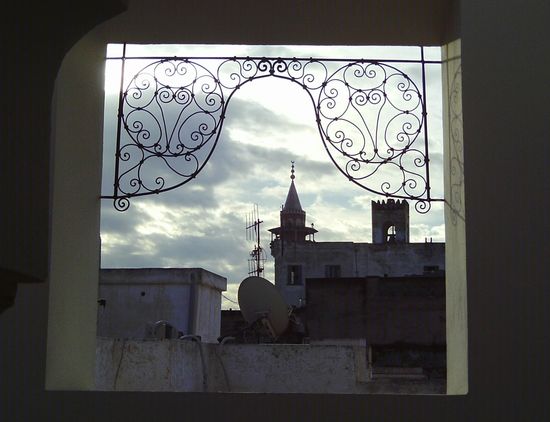
I just realized in viewing the latest VFYW of Tunisia that every photo I have ever seen taken from an Arab country has included satellite dishes and/or roof antennae. This didn't seem unusual until the context of Tunisia's and Egypt's and other Arab countries' recent protests was provided. The metaphor is one of striving to get information from the rest of the world, of trying to listen to voices outside their own country. It is suddenly poignant and moving and important.
by Patrick Appel
John Seabrook has a new article on crowd disasters. He applies his findings to current events:
Scientists who study crowd disasters often explain them as failures of collective intelligence. Unlike ants, for example, we are unable to communicate across the swarm: the people in the back, pushing forward, don’t realize they are crushing the people in the front. But if we lack a strictly biological capacity for collective behavior, perhaps we do possess a collective political intelligence that in certain situations, such as the demonstrations in Egypt, amounts to the same thing.
by Chris Bodenner
AJE's Dan Nolan:
So many bloodied faces pouring out of this battle. Just saw v young maybe 8yr? old boy unconscious being carried on man's back
Soldiers left 4 tanks outside museum. Now anti gov protestors sitting on top. Main battle bout 100m further toward gala st. UTTER CHAOS!
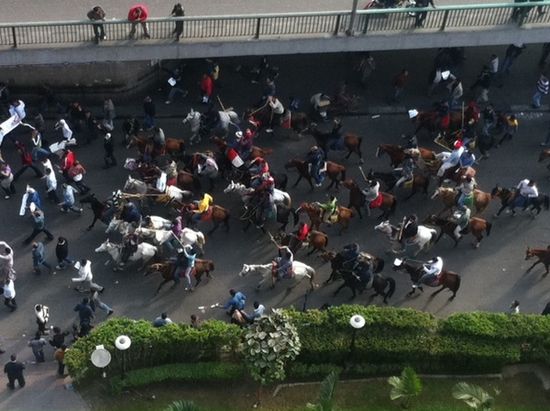
8 guys on horses + 1 on a camel just charged the wall of anti govt supporters. Insane scenes that i've not ever witnessed before!
NYT's Nick Kristof:
In my part of Tahrir, pro-Mubarak mobs arrived in buses, armed with machetes, straight-razors and clubs, very menacing.
Mubarak seems to be trying to stage a crackdown not with police or army, but with thugs. They are armed and brutal.
I saw some people who were motionless and seemed badly injured. Hard to know casualties, but they're adding up.
The army has unblocked one of the entrances to #tahrir and pro-regime protesters entered. Some with knives.
I have seen people die in front of me. I almost died myself. People here r becoming more defiant than ever. They won't leave.
Pro mubarak supporters jumping onto tanks. I am watching one have a very long talk with a soldier
:'( omg I have someones child, I have a child. 2 yrs max, green eyes, says his name mahmoud. Tweet it for me
May god take your souls if this childs parents are dead, may mubarak die. Mubaral your a murderer. Allah yel3ankoun, allah la ywafi2koun
I'm at the doctor point, way more injuries than I thought! Battery running out!
by Conor Friedersdorf
Earlier in the week I praised Ross Douthat's column on Egypt. Now Thomas Friedman, foreign affairs columnist for The New York Times, is opining on the crisis, and I'm puzzled by parts of the resulting analysis.
Here's how it begins:
I’m meeting a retired Israeli general at a Tel Aviv hotel. As I take my seat, he begins the conversation with: “Well, everything we thought for the last 30 years is no longer relevant.”
That pretty much sums up the disorienting sense of shock and awe that the popular uprising in Egypt has inflicted on the psyche of Israel’s establishment. The peace treaty with a stable Egypt was the unspoken foundation for every geopolitical and economic policy in Israel for the last 35 years, and now it’s gone. It’s as if Americans suddenly woke up and found both Mexico and Canada plunged into turmoil on the same day.
This is a comparison aimed to make the conflict understandable to the laymen. That's definitely me. And I'm left confused. Mexico is already in turmoil. If Canada followed suit tomorrow – say there were a ripped from the pages of David Foster Wallace novel scenario where the Quebec dispute escalated in the most unlikely way – the new USA geopolitical reality would still be totally different than what the Israeli people now face, right? And surely Canada's sudden failure as a state would come as a bigger surprise than the much more foreseeable and arguably inevitable developments we're seeing in Egypt?
Now another line from later on:
What the turmoil in Egypt also demonstrates is how much Israel is surrounded by a huge population of young Arabs and Muslims who have been living outside of history — insulated by oil and autocracy from the great global trends. But that’s over.
In what sense have these young Arabs and Muslims in Egypt been living outside history? Let's take a 31-year-old protestor born in 1980. On the Internet he reads Al Jazeera, he's part of the first generation using social media in Egypt, and prior to these rallies he wasn't exactly a political virgin. In 2009 alone, the president of the United States gave a major address in Cairo, tensions flared between Egyptian police and Coptic Christians, 26 alleged members of Hezbollah were tried in Cairo for plotting a terrorist attack there, a soccer game against Algeria turned into an international event, the Egyptian government was enmeshed in a controversy about whether or not it would allow a boat with relief supplies to Gaza, the Egyptian government says it prevented an Al Qaeda attack on the Suez Canal, and a bomb attack in Cairo killed one and injured 24.
In 2008 the Egyptian military tried and jailed 25 prominent members of The Muslim Brotherhood, and 800 more members of that lead opposition group were arrested, sparking a boycott of municipal elections. Numerous Egyptian journalists were tried and jailed by the government in 2007. The same year Amnesty International criticized the Egyptian government for torturing prisoners, dredging up earlier controversies about Egyptian cooperation with the American CIA in its War on Terror. In 2006 the International Atomic Energy Agency declared Egypt one of several countries developing a domestic nuclear program. A bomb attack at a Red Sea resort killed 20 people that year, and there were several rounds of Muslim Brotherhood arrests too. In 2005 20 Sudanese immigrants died at a protest in Cairo, scores were killed in a bomb attack on the Red Sea, and a parliamentary election ended with clashes between the police and the Muslim Brotherhood. In 2004, Yassir Arafat's funeral was held in Cairo.
If you were a 31-year-old protestor, would you feel as though you'd been living outside history, insulated from global trends?
by Patrick Appel
Sonia Verma of the Globe and Mail is tweeting from the scene. Her most recent tweets, blocked into paragraphs:
Pro mubarak supporters jumping onto tanks. I am watching one have a very long talk with a soldier. Standing at one of the exits to tahrir. pro mubarak supporters standing on army tanks.
Hundreds of pro dem protesters pouring out of tahrir as things heat up. Groups of men mobilizing, arming themselves with bricks and sticks. Crowds pushing to get out of tahrir square. People saying they will use bricks as weapons. People digging up bricks in tarhir square. Everyone on edge today. Very different vibe than yesterday.
The Guardian:
Very ominous information coming out of Cairo, with reports of gunfire. Al Jazeera suggests they might be warning shots to keep people away from the museum, which is being defended by a number of military vehicles.
Mackey flags the reaction of an Egyptian blogger:
In a biting, angry and harrowing commentary on the clashes unfolding in Cairo on Wednesday, the Egyptian blogger who writes as Sandmonkey has called the appearance of regime supporters on Cairo's streets, igniting violent clashes, a ploy by President Hosni Mubarak to create chaos and justify his continued rule.
The BBC:
People are using loudspeakers to appeal for calm in Tahrir Square. The army also appears to have parked several lorries across one road near the Egyptian Museum to separate the pro- and anti-government demonstrators. They are still, however, throwing stones at each other. Soldiers have their weapons drawn and one is reportedly firing into the air. The BBC's Ian Pannell says the situation is still very volatile and very dangerous.
by Chris Bodenner
EA:
1325 GMT: The Egyptian newspaper Al Masry Al Youm is evacuating its offices as its building in Shorouk is attacked by a pro-Mubarak group. A CNN crew has been roughed up, with reporter Anderson Cooper hit 10 times in the head. Press TV's Hassan Ghani has been hit in Tahrir Square.
AJE:
3:20pm Al Jazeera web producer in Tahrir Square says at least two camera crews (neither from Al Jazeera) being chased by mobs yelling "Al Jazeera, Al Jazeera!"
3:17pm Al Jazeera correspondents in Tahrir Square says that the pro-government mob is chanting slogans against Al Jazeera and apparently trying to find them. Reports of at least one Al-Arabiya correspondent being stabbed.
Graeme Wood, contributing editor to The Atlantic, reports on Twitter from Tahrir Square, "Beaten (lightly), had camera stolen by secret police at Egyptian Museum." He had posting photos from the clash; view them here.
Pro-#Mubarak thugs at #Tahrir v hostile to journalists. Several journalists attacked. I was threatened but am fine.
NYT:
Anderson Cooper, the CNN anchor, said that his crew was beaten by regime supporters who also tried to grab and destroy their television camera. He added that "the Egyptian military is just standing by" and allowing the violence to take place.
by Conor Friedersdorf
Over at Jezebel, there's an essay titled "In Defense Of The Gay White Male" that begins as follows:
I am a white, cisgender gay man. I'm Ronald Reagan at a bathhouse, the queer equivalent of "The Man." The oppressive, dingy pigeon in the flamingo pen. Parties become less diverse the second I walk in.
At the end of this summer, I had the fortune to attend a sexual freedom conference in D.C. A point made frequently there was that inequality is not equal. Race, gender, and gender expression conspire to strip a person of their freedom just as much as any outside prejudice or hateful legislation. I enjoyed this conference and what I learned there. At one point, however, an extremely (and admittedly) butch Latino lesbian took a genuinely moving speech about her resulting personal struggles to a crescendo. That crescendo was ending a sentence with something about "fighting against the oppressive tyrannies of white men." She paused then, as the entire room lit up with the kind of furious applause usually saved for a game-saving Steelers touchdown. I cheered too but didn't feel good when I was doing it.
Four years spent in queer media have taught me a fair amount about privilege, about the ways that my gay life is easier for reasons as basic as the color of my skin and the fact that my gender matches my biology. But the more I try to reconcile these privileges with my desire to create an equal queer world, the more I am left with one question: Can a nontrans, white gay man ever truly leave the comforts of his own identity without having to make frequent and loud apologies for the crimes of his ilk?
I sure hope that nontrans, white gay men can exist in this society without frequent and loud apologies, because I share Phoebe's reaction to this style of writing:
Stop! Apologizing! Stop apologizing for not apologizing while at the same time apologizing!
Seriously.
Is it a good thing to be cognizant of the advantages one has in life, and to appreciate as best one can that others experience the world differently? Yes! On matters of race and gender – and all sorts of other questions too.
But I dissent from the notion that worthy discussions are had only after everyone involved determines their place on the hierarchy of privelege, and explicitly addresses everyone "below them" with elaborate statements of apologetic non-apology. Or if you're among those for whom every matter must be reduced to privilege, consider what happens when your preferred mode of conversation is so complex in its jargon and etiquette that it disadvantages everyone who wasn't socialized into it at liberal arts school.
What do I suggest? Treat people as equals, respectfully, and with whatever empathy you can muster. And be nice. That almost always works, even for a "white cistern gay man" who somehow makes parties less diverse merely by attending. (See what I mean about the clubby nature of the diction? A Martian with a dictionary would be baffled by that use of diverse, but liberal arts college alum that I am, I get it.)
by Patrick Appel
A PhD student, in Cairo until a couple days ago, explains why he left despite not feeling like he was in any danger. I recognize this feeling:
I don't think I'm the only one, either in Cairo or at a keyboard back in America, who feels the urge to be a part of someone else's revolution because of that thrill. Even if I'm not participating, just being here is exciting. I won't lie and pretend there's no vicarious thrill to this. Bumming around Cairo, hunting for fresh vegetables, hanging out with neighborhood watch guys, speculating about when Mubarak will give up and go away, passing the time with other nervous expats while the streets take on a carnival atmosphere – ok, a carnival with tanks, but still, it's an adventure. I have front row seats for history.
But there are people back home who are worried about me, and the excitement isn't worth the possibility that the phones could go down again and they'd have no way to contact me. I'm a selfish only child, but not that selfish. So I'm going. I hope I can come back soon, under a new and better regime.
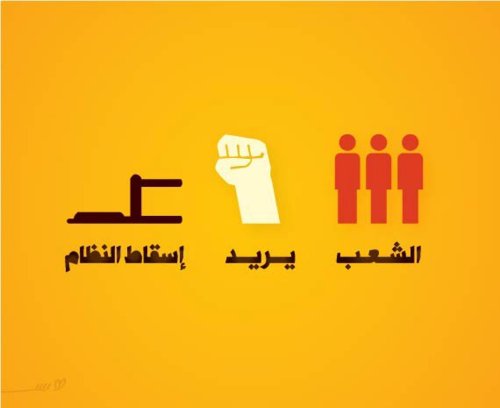
(Photo: "The people want to topple the regime" from twitter.)
 The Dish