Violence In The Square

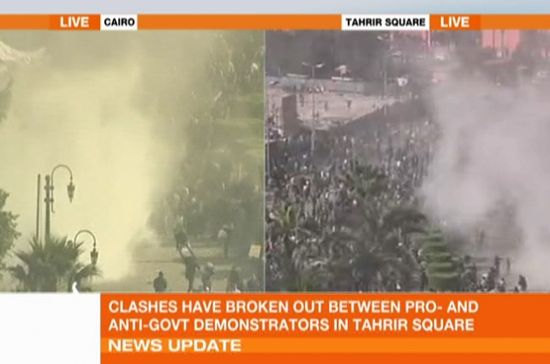
Screengrab

by Patrick Appel

Mackey passes along the news:

Al Jazeera reports from the middle of clashes between hundreds of rock-throwing regime supporters and opposition protesters near the Egyptian Museum close to Tahrir Square. The Arab broadcaster also reported that members of the Egyptian police on horseback were leading some of the regime supporters.

The Guardian has more. Here's Ahdaf Soueif:

In Tahrir Square, the army has pulled its positions well back into the square instead of at the peripheries and have stopped guarding the entrances to the square. The army s no longer checking the IDs of those who enter the square nor are they checking them for weapons.

A few minutes ago the Mubarak "supportrs" started attacking our press area in the square where activists have been collecting photo and video evidence of people who have been tortured under the Mubarak regime. As I write this the activists are being attacked with stones and sticks.

If Inequality Is A Factor For Egypt…

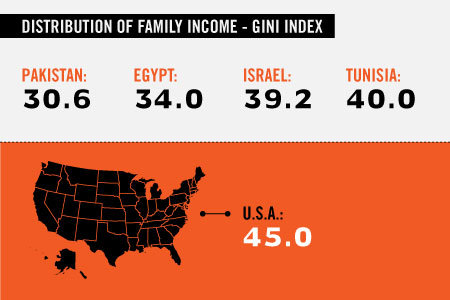
Gini
by Zoe Pollock

Cord Jefferson points out that Egypt is in many ways more equal than the US. The chart above is based on a measure of distribution inequality called the "Gini Coefficient"; "the lower the number, the more equal the data being measured":

Because despite our unprecedented prosperity, the inequality in the United States is not only drastically worse than Egypt's, it's also worse than Tunisia's and Yemen's as well. … It's important to keep in mind that, on a whole host of other metrics—average income, poverty rate, infant mortality rate, etc.—America is far better off than places like Egypt and Yemen. That's great, of course, but it ultimately does little to negate the fact that the rich are pulling away from the poor in our country at unprecedented rates.

What Does Egypt Mean For Oil?

by Patrick Appel

Frank Verrastro and Guy Caruso try to answer:

Egypt produces roughly 700 thousand barrels per day (mb/d) of oil, substantial volumes (2 tcf) of natural gas, and also is home to the largest refining sector in Africa and consequently exports refined product. Perhaps more significantly, however, is that its location and infrastructure facilities make it a key transit area for oil and gas movements both north and south. The fact that there is currently ample spare crude oil capacity in the world to offset any loss of Egyptian output is of little comfort due to the transit requirements of moving additional Middle East oil to European markets—hence the designation of the Suez Canal as a significant oil transit “choke point.” However, the presence of (global) spare production and refining capacity would, in time, allow for markets to adjust by altering supply routes and destinations to offset in-country supply losses.

The Daily Wrap

Today on the Dish, Chris blogged the path of the protests at dawn. Mubarak fans were laughed off, protesters ignored the Internet black out, and police cross-dressed in plainclothes. Many protesters congregated in Tahrir square, the march began, and deviated from the script. Peter Bouckaert covered the scene in Alexandria, protesters banded together, and we tried to keep track of the numbers. People wanted Mubarak to resign immediately, but he opted not to. Mubarak's speech didn't please the public or the US government, and we mulled his legacy as he followed Ben Ali's template, and apparently wasn't too big to fail. Conor read the right's spin on Obama's direction, Max Fisher relayed the latest on US opinions behind the scenes, and Islamists got shouted down. Hitchens advised despots on what not to do, Colum Lynch considered ElBaradei's role, and we tried to understand the Muslim Brotherhood.  We looked ahead to Friday, things almost turned violent, protests were wearing on the population, but there was a wisdom to the crowd.

Alan Jacobs refused to categorize the general effect of social media, Egypt's own media shifted, and Jeremy Scahill chronicled the Bush smear on Al-Jazeera. Alex Massie wondered if the world had peaked, and Larison remained pessimistic about the stability of change. The tsunamai reached Jordan, Israel feared for the future, and Evan Osnos fingered China as the next possible uprising. Dana Stuster weighed the options for Yemen, Ingrid Rowland searched Egypt's history, and Conor wondered if Roger Ailes and Glenn Beck ever had grandparents. Conor railed against a new bill that would give the President power over the Internet, and responded to readers complaints about the left's protest against the Koch brothers.

Egyptian protest signs here, army background here, tweets from the ground here, and a visual argument for democracy here. Quote for the day here, chart of the day here, FOTD here, VFYW here, VFYW contest winner #35 here.

–Z.P.
“Why It Is Wrong to Believe a Word Mubarak said”

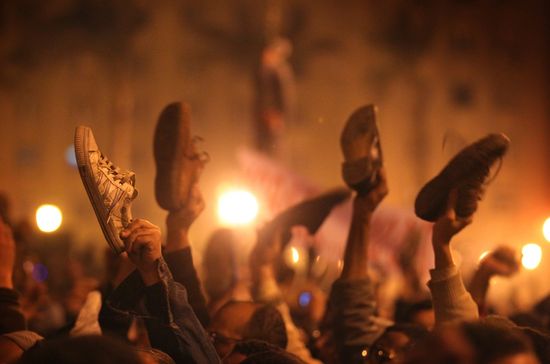
Shoesegypt
by Patrick Appel

An activist for Egyptian democracy uses Facebook to respond to Mubarak:

What has Mubarak left out in his speech:

1. Emergency law is still effective, which means oppression, brutality, arrests, and torture will continue. How can you have any hope for fair democratic elections under emergency law where the police have absolute power?

2. Internet is still not working, no talks of lifting censorship.

3. No talks of allowing freedom of speech, freedom to create political parties, freedom to participate in politics without the risk of getting arrested. FYI to start a political party you need the government's permission. How do you expect democracy to come out of this?

4. He said he will put anyone responsible for corruption to trial right? What about putting the police who killed 300+ to trial? What about members of NDP who are the most corrupt businessmen/politicians in the country. Do you think he'll put those to trial? Think again.

5. He didn't even take responsibility for anything that went wrong in the last 30 years. Not even his condolences to the martyrs who have fallen in this revolution.

(Photo: Anti-government protestors wave their shoes, in a gesture of anger, after President Hosni Mubarak announces that he will not seek re-election on February 1, 2011 in Cairo, Egypt. By Peter Macdiarmid/Getty Images. Hat tip: Mackey. )

Obamacare Concerns

by Zoe Pollock

Serwer sizes up Florida Judge Roger Vinson's ruling against healthcare reform:

Vinson's ruling reflects an explicit understanding among conservatives that legal fights are not so much won or lost on matters of legal precedent, but also on the field of public opinion, and that swaying the views of Justice Anthony Kennedy, whose opinion is ultimately the only one that matters, is most effectively done by portraying the mandate as a grave, un-American injustice — a yoke of oppression the American people are dying for the Supreme Court to lift.

Simply dismissing the "broccoli mandate" as silly or citing legal precedent won't be enough to win that argument — liberals need to find a concise way to articulate both why the individual mandate is constitutional and why it doesn't simply open the door to limitless government abuse, and thus far, they haven't found one.

His follow-up post on a zombie apocalypse wherein a broccoli mandate might be constitutional is also worth a read.

This Is Important Stuff, Ctd

by Conor Friedersdorf

A reader writes:

The only place you can see this kind of thing on TV is on the Trinity Broadcast Network, the crazy Pentecostal cable channel that will run programs in which "prophecy experts" will tell you why what's happening in the Middle East today was foretold in the Bible. If you've never been inside of that bubble, you can hardly appreciate how electrifying and compelling it is. I was caught up in it for a couple of years when I was a young teenager, and let me tell you, a lot of good people I knew took it completely seriously. The things Hal Lindsey ("Late, Great Planet Earth") said were shown by subsequent events to be nonsense, but nobody in those communities held him accountable. The narrative is too exciting to let go of.

Beck is doing the same thing, but on a secular venue, one with far more power than a Christian cable channel.

People listen to him and take him seriously in part because he is a compelling performer, but also because he finds a way to take frightening, confusing events, and fuse them together into a narrative that helps them make sense of things. And not only to make sense of them, but to anticipate what is coming next. Moreover, though Beck is not referencing Bible prophecy openly, having spent some serious time in those circles, what he's doing when he speaks of China and Russia taking advantage of chaos to invade the Mideast and Europe is straight out of Hal Lindsey and the Rapture crowd. He knows well what he's doing, and I don't think he's one bit cynical.

The real cynics are Ailes & Co. It makes me sick, because I know that my elderly parents have become big fans of Beck's, and take him very seriously. It is very difficult to have a rational discussion with them about politics or world events after they've watched an episode of Beck. It's all conspiracy and high emotion — and it's going to get worse. You watch: Beck is going to launch the meme that Barack Obama, a closet Muslim Marxist, was the Manchurian Candidate who collaborated in these events. And that idiotic idea is going to spread like wildfire among the Fox faithful.

Says another:

I don't watch Glenn Beck, but ever since my grandmother started she's been inconsolable with worry about the future. And not rational worries, like what if there's a nuclear war, or America goes broke. She's literally afraid that the president is secretly the tool of our enemies, that there are big society wide conspiracies that started back before World War I. Why she started trusting that man I'll never know, but she does, and she's spending her last years frightened as a result.

And a third:

I just got back from spending a week with my grandparents in Omaha… I'll just say that your post hit home.


What Federal Judges Must Do

by Conor Friedersdorf

Orin Kerr objects to Judge Vinson's recent opinion overturning Obamacare:

This might work as a Supreme Court opinion that can disagree with precedent. But Judge Vinson is just a District Court judge. And if you pair Justice Thomas’s dissent in Raich with Judge Vinson’s opinion today, you realize the problem: Judge Vinson is reasoning that existing law must be a particular way because he thinks it should be that way as a matter of first principles, not because the relevant Supreme Court doctrine actually points that way.


Remember that in Raich, the fact that the majority opinion gave the federal government the power to “regulate virtually anything” was a reason for Justice Thomas to dissent. In Judge Vinson’s opinion, however, the fact that the government’s theory gave the federal government the power to “regulate virtually anything” was a reason it had to be inconsistent with precedent.

Obviously, I’m not arguing that Judge Vinson was bound by Justice Thomas’s dissent. Rather, my point is that Judge Vinson should not have used a first principle to trump existing Supreme Court caselaw when that principle may not be consistent with existing caselaw. Either Justice Thomas is wrong or Judge Vinson is wrong, and Judge Vinson was not making a persuasive legal argument when he followed the first principle instead of the cases. Because Judge Vinson is bound by Supreme Court precedent, I would think he should have applied the cases.

Will Wilkinson sees things differently:

As Slate's David Weigel puts it, "the administration's lawyers are hoping that the next judges who take this case are more concerned with Supreme Court precedent than with, say, the Federalist Papers." But why say "the Federalist Papers"? Why not just say "the constitution"? The American public, and maybe a majority in Congress, naively believes that the constitution itself is the supreme law of the land. In fact, the Supreme Court's prior decisions, which may or may not be well-grounded in the text of the constitution, are the supreme law of the land.

This fact doesn't entail that Article III judges are bound to interpret the Commerce Clause in the same way the Supreme Court recently has done. It simply suggests that failing to go along with the Supreme Court's recently favoured interpretation will get your decision overturned by the Supreme Court… this perfectly reasonable line of argument [in the recent opinion] does not obviously defy the logic of prior relatively permissive commerce-clause decisions. The court has emphasised repeatedly that Congress' powers to regulate interstate commerce doesn't allow it to do anything; it's just so happens that Congress never steps out of bounds. Maybe it finally has. Forcing people to buy something on the grounds that they undermine the goals of some bit of legislation if they don't really is a new thing.

The Wear And Tear Of Protest

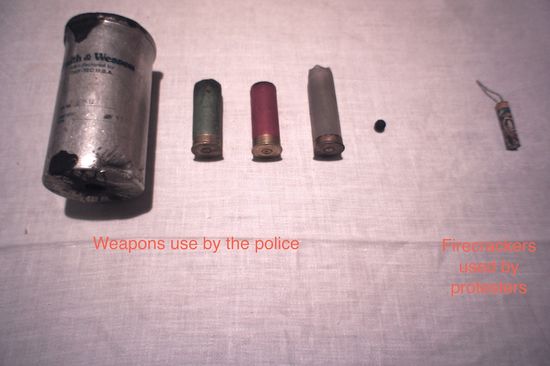
Useofweapons
by Patrick Appel

Wendell Steavenson reports on it:

There have been seven days of protests in Tahrir Square. Many people come for a few hours and go home and return; some stay, sleeping in flowerbeds and gutters. In the tiny mosque in the alleys behind the square, there was a line fifty people long to use the bathroom. The mosque has been operating as a makeshift field station, staffed by volunteer doctors, since last Tuesday. The doctors said they had had no shooting casualties since Saturday night, but there were plenty of people who were fainting, and suffering from high blood pressure or aching muscles from the cold nights. Soldiers, too, were coming in, with symptoms of exhaustion, tender muscles, and minor accidental injuries needing “a few sutures.” (The soldiers deployed next to tanks at the entrances to the Square are sleeping in situ, “in ten minute snatches,” one told me later.)

(Photo by Issandr El Amrani)

Excising The Judiciary

by Conor Friedersdorf

Senators Lieberman and Collins are teaming up on behalf of a disgraceful bill that would give the president unprecedented power over the Internet in a national emergency. Or if there wasn't an emergency, and the president just wanted to engage in wanton abuses of power, it would effectively enable that too, because it prohibits the court system from reviewing the decision to declare an emergency:

The revised version includes new language saying that the federal government's designation of vital Internet or other computer systems "shall not be subject to judicial review." Another addition expanded the definition of critical infrastructure to include "provider of information technology," and a third authorized the submission of "classified" reports on security vulnerabilities.

The idea of creating what some critics have called an Internet "kill switch" that the president could flip in an emergency is not exactly new. A draft Senate proposal that CNET obtained in August 2009 authorized the White House to "declare a cybersecurity emergency," and another from Sens. Jay Rockefeller (D-W.V.) and Olympia Snowe (R-Maine) would have explicitly given the government the power to "order the disconnection" of certain networks or Web sites. House Democrats have taken a similar approach in their own proposals.

Here's Doug Mataconis on the irony of this bill:

On Friday, the crisis in Egypt seemed to finally come to the attention of the West when the Egyptian government decided to completely cut off the nation’s connections to the internet… we need to step back and think about whether its really a good idea to be giving this kind of unchecked power to a President. Not just this President, or the last one, but any President. The most important thing to remember about grants of power like this is that they almost never get revoked, and the typically get expanded on over time.

Hosni Mubarak’s decision to cut off the Internet may have done us a huge favor in some respects by bringing this issue to the forefront. Do we really want our President to have the power to do something that dictators do when faced with citizen unrest? I don’t.

Me neither.

The Founders gave us a system of checks and balances. Pre-emptively dismantling it is idiocy. This is the sort of legislation that ought to be anathema to the subsets of the right and left that claim to care about liberty. Perhaps they can take time away from shouting at the Koch brothers and fretting about death panels to kill it?