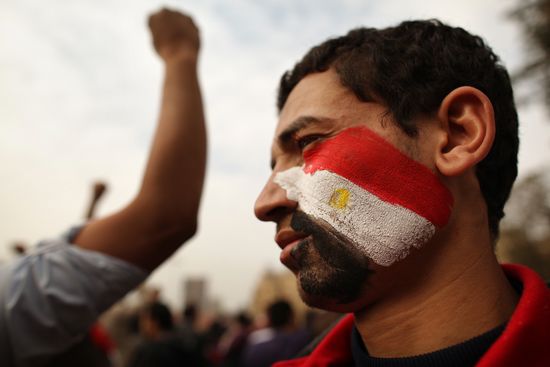
A youth with an Egyptian flag painted on his face stands in Tahrir Square on February 1, 2011 in Cairo, Egypt. By Peter Macdiarmid/Getty Images.
A youth with an Egyptian flag painted on his face stands in Tahrir Square on February 1, 2011 in Cairo, Egypt. By Peter Macdiarmid/Getty Images.
by Chris Bodenner
Robert Mackey relays the president's brief statement, just delivered:
[Obama] said that he told Egyptian President Hosni Mubarak in a telephone conversation after the Egyptian leader's speech on Tuesday night that "an orderly transition must be meaningful, it must be peaceful and it must begin now."
Mr. Obama said that Mr. Mubarak "recognizes that the status quo is not sustainable, that a change must take place." While saying that it was not the role of the United States to pick Egypt's leader, Mr. Obama said that he told Mr. Mubarak that the changes that need to begin immediately include engagement with opposition figures and preparations for free and fair elections.
by Zoe Pollock
Ingrid D. Rowland sees the youth protecting the Bibliotheca Alexandrina as "a matter of guarding an idea":
The Library of Alexandria has burned twice before, once, partially, when Julius Caesar made his landing in Egypt in 48 BCE, and again, with devastating effect, in late antiquity. The first burning was probably a mistake, the second the result of religious fanaticism, most probably the same fanaticism that killed the Alexandrian mathematician Hypatia in 415 CE for daring, as a woman, to profess philosophy.
… Blind rage cannot understand anything as complex or beautiful as Rome, or a library, or even a person, an animal, a book, a tree, a work of art—but blind rage can make these intricate systems stop, and the ability to make things stop has served many of our kind since time immemorial as a fine substitute for learning, experience, scientific method, artistic creation, philosophy. Destruction, too, can count as hard work. …
As these same young people now stand guard over their library in these difficult but hopeful days […], they are in fact standing guard for all of us.
by Conor Friedersdorf
A reader writes:
Look, my guess is that these people are not harassing the Kochs because of these guys' ideological interests. It's because they are super rich, and they use their money to get congress to pass laws which benefit the super rich. Why is this anger so difficult for you to comprehend? There are a lot of people hurting out there right now. Two years after the crash, Wall Street is humming along, bailed out, bonuses intact. None of the folks who nearly gambled away our economy have had to pay any kind of a price. And on Main Street, ten percent unemployment and millions of homes under water, regular citizens who played by the rules. This is not about ideology. It's about class. Have we all decided that class is just not something we're going to even talk about anymore? I honestly don't get that you don't get this.
I absolutely understand antagonism to Wall Street, resentment of companies who took advantage of the economic meltdown and their government connections to enrich themselves, and even opposition to the financial industry that predated the meltdown. There's a reason Elliot Spitzer's campaign commercials were effective.
If I heard that protestors were shouting to make themselves heard outside a Goldman Sachs shareholders meeting, I'd think to myself, "Okay, I get how that happened." Insofar as I can tell, however, the antagonism to the Kochs has a lot to do with the ideological causes they support, and very little to do with the shady behavior that characterized a lot of firms who raised populist hackles during the financial crisis.
Another reader writes:
While this is hardly the first event like this hosted by the Koch brothers, it's the first one that generated a dozen or more articles in my RSS feed the next day, including yours. That almost certainly wouldn't have happened except for the protesters, who, as you correctly noted, were a collection of miscellaneous leftist groups with different axes to grind. The only common thread was a desire to draw attention to the role big money players have in right-wing politics.
It's true that the protest generated media attention, though I don't see how that translates into policy changes in this case. (To be fair, I very rarely see a protest and think, "Ah, that makes sense." But occasionally!)
He continues:
As for "bullying," give me a break, Conor. Bullying implies a disparity in coercive power exactly the opposite of the two sides here. Do you really think the assorted billionaires and political pooh-bahs at the event felt the slightest bit threatened by the
protesters?
Honestly, I don't know.
In my time as a reporter, I was around my fair share of protests, sometimes interviewing rich people or college presidents or powerful politicians while people shouted or chanted outside. Every situation was different, and people in powerful positions reacted very differently to the presence of antagonistic activists, often in ways that didn't really correspond to the actual likelihood of physical confrontation. And I definitely know a lot of people who'd think twice before attending an event if they knew an angry crowd would be gathered outside. But perhaps no one in attendance at Rancho Mirage was bothered at all.
He concludes:
And please tell me you understand the difference between "folks donating to ideological causes with which they genuinely agree," and the distorting effect large concentrations of wealth can have on the political system. When private individuals can not only fund think tanks and media outlets to ceaselessly promote their agenda, but also summon senior government officials and legislative leaders to be lectured on policy by hand-picked speakers behind closed doors for an entire weekend, that goes well beyond "donating to ideological causes."
I understand the distinction, but this gets back to my point about protesting methods of political giving versus protesting a particular ideological donor's activities. It seems to me that the activist groups in question aren't opposed to rich people funding think tanks, media outlets, and conferences in principle – they reserve their objections for big spenders who disagree with their ideological agenda.
Isn't that the only conclusion one can raw in light of this reporting by Tim Carney:
The protest's organizer, the nonprofit Common Cause, is funded by billionaire George Soros. Common Cause has received $2 million from Soros's Open Society Institute in the past eight years, according to grant data provided by Capital Research Center. Two panelists at Common Cause's rival conference nearby — President Obama's former green jobs czar, Van Jones, and blogger Lee Fang — work at the Center for American Progress, which was started and funded by Soros but, as a 501(c)4 nonprofit "think tank," legally conceals the names of its donors. In other words, money from billionaire George Soros and anonymous, well-heeled liberals was funding a protest against rich people's influence on politics.
by Conor Friedersdorf
The Detroit Free Press confirms yesterday's suspicion:
High-end fireworks might have injured some people or damaged some property, but it's highly unlikely they could have destroyed an entire mosque. That's what firearms experts concluded Monday following the arrest of Roger Stockham, 63, who on Jan. 24 was picked up by police outside the Islamic Center of America in Dearborn and charged with plotting to blow up the building. Police said when they found him, he was wearing a black ski mask and had spray paint and more than two dozen high-end fireworks on him, including M-80s.
"I wouldn't expect that they'd be able to level a building," said Donald Dawkins, spokesman for the Detroit office of the U.S. Bureau of Alcohol, Tobacco, Firearms and Explosives. Fire experts noted, though, that M-80s are very dangerous."We've had people blow their fingers off," Detroit senior fire prevention inspector Capt. Steven Hurst said.
What boggles the mind is how the very disturbed suspect is possibly walking around as a free man to begin with:
According to the Reno Gazette Journal, in 1985, Stockham was arrested after he threw a pipebomb in a trash can at Reno's Cannon International Airport. During the federal court trial, Stockham said he regularly communicates with extraterrestrials, and psychiatrists testified that he believed he was Christ.
In 1981, he escaped from a mental hospital, and turned himself in four months later.
In 1983, he was released from a state mental hospital after a prosecutor said he hadn’t done anything “crazy” in awhile, the paper's archives show. A few years before that, he kidnapped his son from a foster home in Santa Barbara, flew a plane towards LAX with a gun and bombs and demanded he be supplied with a plane to fly to Iran.In 1977, he took his psychiatrist hostage in Century City, CA, again with bombs and guns, but surrendered after a standoff with police. Over the years, he also threatened to kill Presidents Jimmy Carter and George W. Bush.
As Bob Dylan might put it, how many terrorist acts must a man commit before they issue him a life sentence?
by Patrick Appel
Via Greg Scoblete:
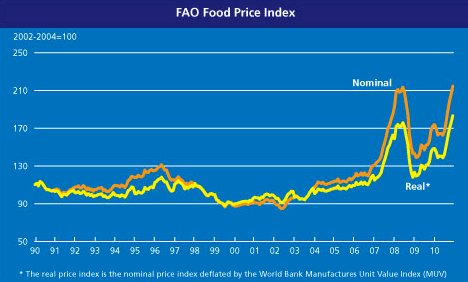
One trigger of the recent instability in the Middle East is the price of food, something the Food and Agriculture Organization said hit near record levels in January. Several months ago as part of our Gallup Global Top Fives, we identified the five most food insecure countries (Egypt and Tunisia did not make the list). If the trend line above continues upward, it's possible a few more regimes will come under intense pressure from their disgruntled citizenry.
by Patrick Appel
Nick Kristof expects Mubarak's speech "will not placate the public." And Kristof fears that "this choreography – sending former diplomat Frank Wisner …. to get Mubarak to say he won’t run for reelection — will further harm America’s image":
This will come across in Egypt as collusion between Obama and Mubarak to distract the public with a half step; it will be interpreted as dissing the democracy movement once again. This will feed the narrative that it’s the United States that calls the shots in the Mubarak regime, and that it’s the United States that is trying to outmaneuver the democracy movement. In effect, we have confirmed to a suspicious Egyptian public that we are in bed with Mubarak and trying to perpetuate his regime (even without him at the top) in defiance of a popular democratic movement.
But the US wasn't entirely happy with the speech:
U.S. officials, reacting to the speech, said Mubarak would have to go more swiftly than his remarks had indicated. "People are sending a clear message it is time for Mubarak to step aside," U.S. officials told CNN.
by Chris Bodenner
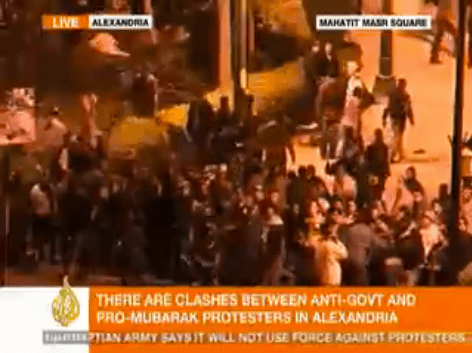
Says an Al Jazeera reporter. Gunshots being fired, people are throwing stones at each other. Clashes appear to between pro- and anti-Mubarak protesters. Watch live here.
Update: It appears that the Army is trying to keep the peace by shooting into the air.
by Chris Bodenner
Al Jazeera reports:
"Friday afternoon, we will be at the palace," protesters in Tahrir Square shout. Reports of a big march being planned after Friday prayers is being dubbed "The Friday of Departure" aimed at pushing Mubarak to quit office immediately.
But the current crowd isn't going anywhere:
2147 GMT: Twitter user @SandMonkey, who is in Tahrir Square in Cairo, tweets that more people are joining the protests there instead of going back.
 The Dish