Meanwhile, In Yemen

by Patrick Appel

Dana Stuster's reading of the situation:

There are no good options in Yemen.

As long as Salih retains his tenuous hold on power, the United States will be forced to deal with an autocrat, but then again, he always has been. Yemenis call their brand of politics “decorative democracy,” a façade which was only instated in an effort by Salih to regain American aid. Now, though, Yemen is an integral part of U.S. counterterrorism efforts and cannot be neglected as it has been in the past. Salih knows that his place is assured – it’s the confidence that allowed him to propose the abolition of term limits in the first place. The State Department will have another couple years of the same fair-weather ally they’ve come to know, but it will only postpone an inevitable transition. None of the candidates to succeed Salih seem conciliatory to U.S. interests, and it will not be enough to hope that Yemen’s coming resource crisis will force the prospective Islah Party government or al Ahmar military regime into a dialogue. The United States needs to start making friends now, especially outside of Sanaa, with local and tribal leaders. The tribes are a constant in Yemen; the government, after a 30-some year hiatus, is about to be a lot less so.
Shouting Down The Islamists

by Chris Bodenner

A compelling anecdote via Mackey:

Minutes after Mr. Mubarak announced that he would not seek another term in office, Sonia Verma, a reporter for Canada's Globe and Mail, witnessed an interesting clash between members of the Islamist Muslim Brotherhood and other protesters in Cairo's Tahrir Square. She reported via Twitter:

Brotherhood chanting "Allah Akbar." Others shout them down. This is still a secular protest.

US Ditches Mubarak, Ctd

by Chris Bodenner

A snap analysis from Scott Lucas:

2120 GMT: While the protesters' reaction to the Mubarak speech is the lead story tonight, the 2nd story may be the breakdown of talks between US officials and the Egyptian President.

It was notable tonight that there was a delay of more than an hour between the announcement that Mubarak was about to speak and his actual appearance. In that hour, Obama's people not only put out the news that the President — through the envoy Frank Wisner — had asked Mubarak to refrain from standing for re-election in September, they added to reporters that they had asked Mubarak to rule out any campaign by his son Gamal.

The White House delayed a press briefing, expecting to welcome a suitable Mubarak announcement, but time dragged on. The Egyptian President did not appear, and the White House press briefing was scrubbed.

Whether Mubarak rewrote his speech in that hour is not known, but his defiance and refusal to announce a transition was not a rejection of the millions of his people who turned out today. It was also a rebuff to the US Government.

Update via Max Fisher:

A U.S. official tells BBC's Kim Ghattas that Mubarak's pledge is "not enough," suggesting that the Obama administration's stance is further aligning with that of the Egyptian popular protest movement.

The Next Tahrir Square?

by Patrick Appel

Evan Osnos questions whether events in Egypt foreshadow an uprising in China:

[S]hould the Chinese regime rest easy as long as the economy improves? Not exactly. As Fareed Zakaria rightly points out, Egypt and Tunisia were vulnerable to unrest not because their economies were ailing, but precisely because their economies had improved in recent years, which only accentuated how far the economic gains were outpacing political liberalization. “It is this revolution of rising expectations that often undoes a dictatorship because it is usually unable to handle the growing demands of its citizens.” China has secured the loyalty of a critical mass of its people by improving their lives on some important measures. Before too long, I suspect, maintaining peace will depend on extending those improvements to other parts of Chinese life as well.

Breaking: Mubarak Not Running For Reelection

Screen shot 2011-02-01 at 3.58.40 PM

by Chris Bodenner

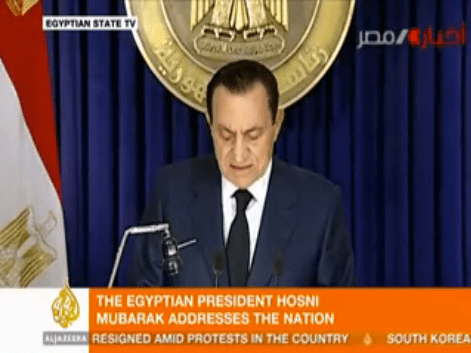
Just announced via Al Jazeera. Update: A few key quotes:

"I have exhausted my life serving Egypt but I am totally prepared to end my career"

"I pray to God to guide me to the successful right path to end my career in a way that is applicable to God and the people.

Update II: The massive crowd in Tahrir Square is not appeased, chanting "Leave! Leave!".  More:

2109 GMT: Al Jazeera correspondent reports protesters in Tahrir Square were heckling Mubarak speech as it was being given. Loud chanting now from the square.

2106 GMT: Mubarak reiterates he will serve out his term — "I pray to God" to help me ensure Egyptian stability and future. And he then returns to his pride in his years of service to his "motherland" Egypt, speaking of his defence of his country. "I will die on the soil of Egypt."

Update III: The Guardian summarizes:

That was a rambling speech in which Mubarak tried to show empathy with the protesters but at the same time suggested that they have been manipulated by political forces (perhaps trying to implicate the Muslim Brotherhood, whose role has been minimal). He also had strong words for those responsible for criminal acts.

Screen shot 2011-02-01 at 4.25.35 PM

(LEAVE LEAVE LEAVE)

Waiting On Mubarak

108697274

by Chris Bodenner

BBC's Kim Ghattas reports:

I just spoke to a senior U.S. official, who confirmed that Frank Wisner met President Mubarak and told him he should not seek re-election or put forward his son, Gamal, as his successor. The Americans are now waiting for an answer. However, the official also said that even if Mr Mubarak did not seek re-election, it was no longer enough. My understanding is that although they have not gone back to Mr Mubarak to say he must stand down immediately, they are hoping he has figured that out on his own.

The Guardian's Jack Shenker is in Tahrir Square:

[Shenker] asked people if Mubarak, who is expected to speak any minute, announcing his intention to step down at the next election, in September, would be enough. He said the "overwhelming consensus is that is absolutely not enough."

EA:

The chant from Tahrir Square in Cairo as the crowd await President Mubarak's speech on the large-screen TVs which have been set up: "Freedom! May God make it happen! May it be tonight!"

Mackey adds some perspective on the day:

To give American readers an idea of how long Hosni Mubarak has been Egypt's president, consider that he was elevated to that position in 1981, following the assassination of Anwar el-Sadat, which came just six months after President Ronald Reagan was shot by John Hinckley. If Mr. Reagan had been killed in 1981 and his vice president, George H.W. Bush, had taken over as president and remained in office until today, Americans would be in a similar position to Egyptians.

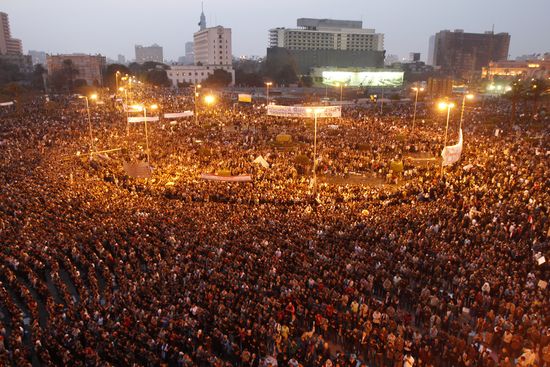
(Photo: Egyptian protestors take part in a demonstration on February 1, 2011 at Cairo's Tahrir Square as massive tides of protesters flooded Cairo for the biggest outpouring of anger yet in their relentless drive to oust President Hosni Mubarak's regime. By Mohammed Abed/AFP/Getty Images)

US Ditches Mubarak, Ctd

by Chris Bodenner

Max Fisher relays the latest:

U.S. special envoy to Egypt Frank Wisner reportedly told Mubarak that he should step aside and should not be a part of any transitional government, according the Los Angeles Times. President Obama appointed Wisner specifically to address the current political crisis in Egypt. If this report is true, it suggests that the U.S. position is for Mubarak to step down from office, perhaps immediately.

The Muslim Brotherhood, Ctd

by Patrick Appel

Daniel Levy gauges the Israeli reaction to Egypt. Levy's view of the Muslim Brotherhood:

Nathan Brown, an expert on Islamist parties, has warned against US policymakers being misled by a tendency towards "Ikwanophobia" (ikwan is Arabic for the Muslim Brothers' movement). One cannot support participatory democratic politics in the Arab world while being totally allergic to the role that democratic Islamists will play. These movements are part of the legitimate political mix. They are more often than not at loggerheads with Al Qaeda, and far from being Al Qaeda-lite, they are frequently the most effective bulwark against Al Qaeda-style extremism. 

Goldblog puts the Muslim Brotherhood in a less flattering light. Salon has an illuminating interview with Nathan Brown about the organization. It should be read in full, but here is one section on Israel and the United States:

They're clearly suspicious of the United States, and you'll hear some anti-American slogans from them — but no more so than from any other place in the Egyptian political spectrum. They don't stand out there, and there are probably more anti-American people in the committee of opposition leaders.

With regard to Israel it's a little bit different. Israel is unpopular in Egypt. And the Brotherhood since the 1930s has a very strong history of backing the Palestinian cause. They are critics of the Camp David accords and the Egyptian-Israeli peace treaty. Those are all popular stands. That said, no one in Egypt wants a war with Israel right now. So the Brotherhood tries to finesse this by saying, 'This treaty really needs to be put up for a referendum." If they were in the government, I think they would be in an embarrassing position. This is an international treaty that was ratified — are you willing to abide by the state of Egypt's international treaty obligations or not?

If it was a broad-based coalition government in which the majority clearly favored maintaining the current peace treaty, I think the Brotherhood would say: "We don't like this, we're not in favor it. But we're willing to accept the results of a legitimate political process." That's my guess.

Earlier commentary here.

Patronizing The People Into Revolt

108694111

by Chris Bodenner

Hitchens is heartened by the perpetual dimness of dictators:

None of them ever seems to master a few simple survival techniques: Don't let the supreme leader's extended family go on shopping sprees; don't publicly spoil some firstborn as if the people can't wait for him, too, to be proclaimed from the balcony; don't display your personal photograph all over the landscape; don't claim more than, say, 75 percent of the vote in any "election" you put on. And don't try to shut down social media: It will instantly alert even the most somnolent citizen to the fact that you are losing, or have lost, your grip. …

I remember thinking, of the Egyptian "elections" of last fall, that President Hosni Mubarak would have gotten more respect for simply canceling them than for pretending to hold them in the insulting way he did. Something similar applies to the "green" rebellion that followed Iranian President Mahmoud Ahmadinejad's most recent plebiscite: Everybody already knew that things were "fixed," but this time the mullahs didn't even trouble to pretend that they were not fixed. It's possible that people will overlook outright brutality sooner than they will forgive undisguised contempt.

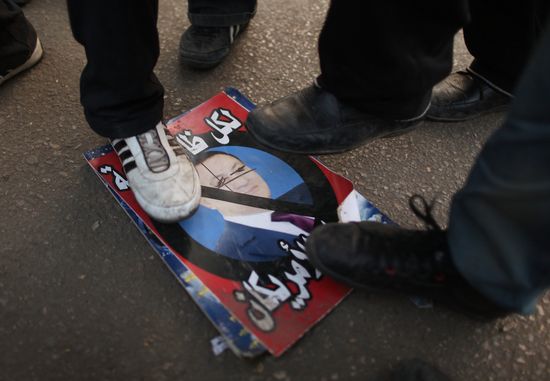
(Photo: People tread on a placard featuring President Hosni Mubarak in Tahrir Square on February 1, 2011 in Cairo, Egypt. By Peter Macdiarmid/Getty Images)