That's what protesters are calling tonight, in anticipation of Mubarak's address airing shortly. Watch Al Jazeera's live-stream here. HRW's Joe Stork is on the ground:
It's dark now and I'm in a room overlooking Tahrir Square. There's a huge crowd still, very vocal, lots of chanting – it took a long time to get here at noon because the streets around are sealed off by the army.
People don't have mass-produced posters, they're all home-made. The sense of people finally getting their voice is astounding, especially when you compare that with the near-total silence from the government – their response has been little or nothing to say, it's as if they don't know how to respond. I suspect it also reflects divisions within ruling circles about how to respond – how else can you explain that it took Mubarak six hours to speak after the announcement on Friday that he would address the nation? I think that also explains the confusion about the security services – they pulled police off the streets and although we heard that police were ordered back on the streets yesterday we don't see many in Cairo today. I didn't see any police around Tahrir Square or anywhere downtown.
1930 GMT: But the really important news this evening is that the protesters in Tahrir Square in Cairo have organised a football tournament with the Army.
Al Jazeera correspondent in Tahrir Square says that people are erecting tent, bringing in blankets, food is being distributed, either for free or at discounted prices, music is being played – so people are expecting to be here for as long as it takes.
President Obama has told the embattled president of Egypt, Hosni Mubarak, that he should not run for another term in elections in the fall, effectively withdrawing American support for its closest Arab ally, according to American diplomats in Cairo and Washington.
Reuters reports that Egyptian President Hosni Mubarak will make a televised address tonight. Citing a report from Al Arabiya, the Arab satellite channel, the news agency says that Mr. Mubarak plans to announce that he will not run in the presidential election scheduled for later this year. The Times has not yet been able to confirm this report but we will bring you more when we have it.
Mubarak said to address nation to say not seeking another term – the BenAli template and Tunisians still kicked him out.
(Photo: Egyptians gather to watch the Al-Jazeera satellite television station on a set placed on top of public telephone booths in Cairo's Tahrir Square. By Khaled Desouki/AFP/Getty Images)
Yoav Fromer runs through the reasons why Israelis have stayed glued to the TV this week. One startling statistic:
Based on a startling 2008 Gallup poll that found a whopping 64 percent of Egyptians in favor of making Sharia law into the exclusive source of their legal code, one can certainly understand concerns about the potential radicalization of the most populous Arab country.
But he ends on an optimistic note:
A truly democratic Egypt might offer Israelis the chance to achieve what the “cold peace” with Mubarak never did—by actually establishing real and warm relations with a real and stable democracy. … If Israelis can overcome their own myopic anxieties, they could yet come to realize that instead of facing a moment of grave peril, they might be looking at one of unprecedented opportunity.
Russia offers an experiment in a country giving itself over fully to the most heavy-handed of responses to terrorism. Putin was given the freedom to achieve security by any means–and Russians have ended up with a state that is less secure and less free. There are strategic reasons for adhering to the rule of law, beyond actually preserving the kind of society that terrorists seek to destroy. Even when liberals make that case though, as Obama did during the 2008 election, we've fallen short at actually following through on those ideals. The U.S. is not Russia, but in Russia's example we might learn a few things about the limits of unrestrained force alone in defeating terrorism.
While the last thirty years have seen remarkable advances in the spread of democratic government and liberal political culture, it cannot be stressed enough that many of these advances are still fragile and reversible in many places, and they are also very recent developments that everyone has to acknowledge to be historically atypical.
That doesn’t mean that we should ignore political change, or pretend that democratization always leads to a new form of despotism, but it does mean that we shouldn’t ignore the clear lessons of the dangers that come from democratization-as-shock-therapy when they are clearly relevant. If democratists would like a more up-to-date version of the warning about the potential dangers of rapid democratization and economic liberalization, they can consult World on Fire.
Jeremy Scahill chronicles the smear campaign against Al-Jazeera during the Bush years:
The Falluja offensive, one of the bloodiest assaults of the US occupation, was a turning point. … Some 600 Iraqis died, many of them women and children. Al Jazeera broadcast from inside the besieged city, beaming images to the world. On live TV the network gave graphic documentary evidence disproving US denials that it was killing civilians. It was a public relations disaster, and the United States responded by attacking the messenger.
7:40pm Reports that the tone of Egyptian TV is changing – said to sound more sympathetic to protests and has sent reporters to Tahrir Square. It is reporting "large peaceful protests, tidy protest and pro-Egypt protests".
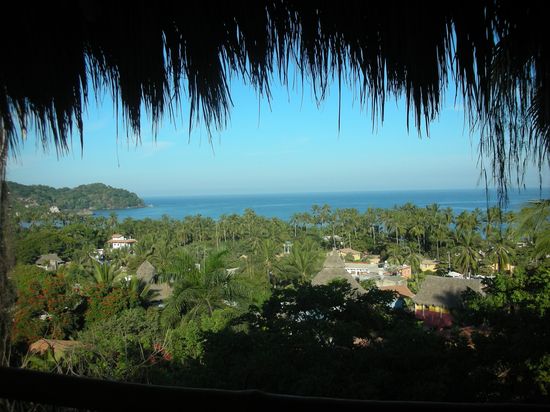
This week’s view was a cruel joke to us in the Northeast! I’m sitting home with my sick baby, while another two feet of snow dumps down, sifting through image after image of gorgeous beach bungalows. My guess is Kendwa, Tanzania, no real reason or story – just looked somewhat right so I thought I’d throw in a last second guess.
Another writes:
This looks very much like one of the small islands that make up the Ryukyu islands in southern Japan. I would hazard a guess of Ishigaki island, home of Ishigaki – the southernmost city in Japan.
Another:
Suva, Fiji? No good reason. Obviously tropical and with thached roofs. A high volcanic island with perhaps Pohutakawa trees flowering in the left foreground.
Another:
Koror, Palau? The tree in the foreground with the red dots on it I think is a “red bead tree,” which can be found in the South Pacific. Unfortunately, any other clues within the picture are lost on me.
Another:
The Flamboyant Trees, terra cotta-tiled roofs and tan stucco reminds me of the BVIs. I can’t be certain, of course, but this appears to be looking north from Diamond Cay toward Little Jost Van Dyke. Am I close? I always enjoy this contest – even if I’m on the wrong continent!
Right continent, but not close. Another:
I was there once, almost 30 years ago, but something reminds me of Puerto Limon, Costa Rica. But really, it could be any number of coastal towns around the world.
Another:
The architecture is African. It’s not a great fit for Anglophone Africa as the European influence seems more continental. It could be near the Dahomey Gap or around Angola, but I suspect it’s in West Africa. Freetown is still a bit wet relative to this vegetation, so it’s probably closer to the Sahel. Guinea is potentially a good match. A lot of the Guinea coast is mangrove, but there’s a region in and around Conakry with shallow seas and nice narrow beaches next to forest habitat.
This could be anywhere from the Kaloum Peninsula to the Loos Islands. I don’t think it’s Tombo Island itself, because that would be more built up, but the shallow sea and lack of mangroves is an otherwise good match. Kassa Island is a popular destination. I know the Air France crew will often boat there between flights to and from Paris. The crossing from Conakry means passing several wrecks of capsized old tankers. Half of these ships emerge from the water as they rest on their sides. From a distance it almost feels like you could touch the bottom if you jump out of your boat, but then you realize how huge these ships actually are. It’s shallow by shipping standards, but not by swimming standards. I’d love to know where these ships came from.
Ok, final guess: Conakry, Guinea, Kassa Island.
Another:
Close enough that I’ll bite. This looks a lot like a vista from above the highway (that’s a euphemism for a harrowing one-lane intermittently paved road) that hooks into town from the remote reaches of the northeast coast of Trinidad, in Grand Riviere.
We took our three children there three years ago to watch leatherback turtles (huge, dinosauric-looking deep-sea beasts that grow to well over a ton) heave themselves ashore on the beach after dark, right in front of the homes and hostels lining the coconut-tree-fringed shoreline, to dig sand pits and drop dozens of eggs into them. You can stand right next to them as they do so!
We also watched the baby turtle hatchlings, like tiny little windup toys scarcely larger than your average butterfly, come flapping out of the hot sand during daylight and dash to the surf as birds of prey wheel and dive on them. The absolute most extraordinary natural phenomenon I’ve ever witnessed.
It’s a fabulous, un-tourism-industry-tamed place, and therefore most affordable, too. The only catch is, you have to navigate hours and hours of horrendous winding road, dodging huge dumptrucks and full-throttle Asian compact sedans whipping around every blind turn to get there. Favorite vacation ever.
Another:
Looks like La Manzanilla, Mexico, a thriving little fishing village on the Bahia de Tenacatita between Puerto Vallarta and the port city of Manzanillo. One of those rare places where local Mexicans mix happily with gringo expats and travelers, it has quietly become a mini mecca for artists and chefs from all over Mexico, Canada and the U.S. My favorite town in the world and, with luck, my future home.
Getting close. Another:
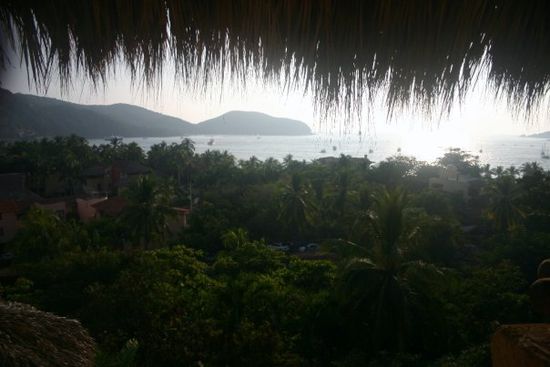
Long time watcher of these contests, first time submitter! I stayed in the Hotel La Quinta Troppo in Zihuatanejo, Mexico with a near identical view!
Quite close. Another:
I’ve been to the Pacific coast of Mexico several times and the thatched palapas looked familar. This picture reminded me of the rustic feel of Yelapa, Mexico. I spent time on the internet on this cold, rainy Saturday looking at warm, inviting pictures of seaside accomodations.
Another:
This is either exactly Las Brisas or near Las Brisas Hotel in Acapulco. If it is, the photographer shot this at a very clever angle. Wherever it is, I want to be there; more snow is coming to Connecticut. I’ve stopped bothering to dig out most paths, and the man who plows says he will have to come back with a bucket loader as there is no where left to push the snow with the plow. Between all the snow and the events in Egypt, this was a very calming photo to study.
And this week’s winner:
I knew this one right away. One of my favorite places on the planet: Sayulita, Nayarit, Mexico. Looks like the photo was taken towards the north end of town, just above the sports fields. Probably from one of these villas. Here’s a street view showing the pointy thatched roof house prominent in the photo:
About a half-dozen readers correctly guessed Sayulita, but the above reader was the first to do so and provided the only visuals. Congrats – we’ll get a window book out to you shortly. One final email for the super-fans:
After months of observing the methodologies employed by my fellow competitors, I am at long last throwing my hat into the View From Your Window Contest ring. Before I offer up my solution, I’d like to go meta for just a moment: I have noticed that there are 4 types of entrants to this contest:
1) The people who write, “I am absolutely, 100% sure of the location, because I was just there last year and will never forget it,” followed by a completely wrong answer. — I always feel a little sorry for these people. They were so certain! It must be a blow.
2) The people who write, “I am absolutely, 100% sure of the location because I happen to be: a) sitting there right now! b) looking at the exact same picture that I took last week when I was there! or c) *fill in the blank with another amazing coincidence!*” — These people make me jealous on some petty level that I’d rather not examine too closely
3) The people who write, “I am absolutely, 100% sure of the location because I recognized some infinitesimally arcane detail in the photo, and after spending several hours researching Dumpster Colors of the Southern Hemisphere, I was able to narrow it down to a city, whose streets I then spent several days examining, block by block for a LONG TIME on Google Earth, until I found the spot! Oh and, I got the last 3 contests correct!” — These people fill me with awe and admiration and maybe a just a little bit of fear.
4) The people who write, “I have no clue. I threw some search terms into Google and came up with this. Hope I’m right.” — These are my kind of people, and they have inspired me to join the VFYW Contest fray.
So, the red-flowered tree looks like a Flamboyant Tree and the overall feel of the photo says South Pacific to me. I put “Flamboyant Tree,” and “South Pacific” into Google, and came up with French Polynesia. I Google-mapped French Polynesia and found “Raiatea,” which appears to have grass huts, palm trees, Flamboyant Trees. That’s my story, and I’m sticking to it, in the true spirit of the Type 4 VFYW Contestant.
Matt Yglesias takes time out for some ideological point-scoring:
If you think back to 2003, 2004, and 2005 you very commonly heard (neo-?) conservatives arguing as if the main thing liberals found objectionable about George W Bush’s foreign policy was that liberals didn’t like the idea of Arab countries being democracies. Liberals tended to say “no, no” that what we didn’t like about Bush’s foreign policy was that his foreign policy was (a) terrible, and (b) getting huge numbers of people killed while (c) accomplishing nothing or (d) aiding the geopolitical aspirations of Iranian hardliners.
And whatever else happens, I think what we’re seeing in Egypt is a definitive refutation of that conservative argumentative frame. You don’t see American progressives out in the streets leading pro-Mubarak rallies, you don’t see Mohammed ElBarradei talking about how the Middle East is no place for freedom, and you don’t see any of the other things you would predict on the hypothesis that criticism of the invasion of Iraq was primarily motivated by a desire to shield Arab autocrats from criticism.
I honestly don't have a good enough recollection of 2003 to 2005 to gauge the accuracy of Matt's characterization. But it is interesting to me that President Obama is being attacked by some prominent conservatives for being too friendly to the protestors.
Hey, look, folks, if the industry of talk radio was responsible for Tucson, how about blaming Obama's Cairo speech for this? Yeah, have you seen, folks, the liberals, the Democrats, the media seem to be more embracing of the Muslim Brotherhood than the Tea Party movement. Have you noticed that? I have… "The Obama administration has aligned itself with Egypt for calls for orderly transition." Orderly transition? What if this bunch turns out to be led by Al-Qaeda, the Taliban, or what have you? It's the Muslim Brotherhood. For crying out loud, Obama "embraces," "aligns itself with protests in Egypt"? Uhhhh.
That really caught me, because we don't know who or what is behind this movement. We do know Obama has been focused on changing America. We do know that Obama has spent his time abroad apologizing for our past and he's been lauded for doing this by our media, the left, the likes of Colin Powell. If he were a traditional American president, Obama would have been using our authority — our moral authority — and experience to ensure our best interests remain intact.
As usual, this is riddled with nonsense. Since it's a given that Limbaugh will criticize Obama whatever he does, however, it's sometimes interesting to note the particular spin he employs – in this case because its evidence of a division on the right. See unofficial neoconservative spokesman Bill Kristol:
President Obama can overcome all the counsels of timidity and passivity. He can take charge of his administration. He can help usher Mubarak out—his presence is now a source of instability, and the longer the showdown continues, the greater the odds of a bad outcome.
The way it's shaking out is that Rush Limbaugh and the crowd at Andrew Breitbart's Big Peace are upset with Obama for being overly solicitous of Egyptian protestors – the dark insinuation is that he welcomes the rise of an Islamist government – while the neo-con critique is that George W. Bush's democracy agenda was correct after all, and Obama had better admit as much before he squanders this opportunity by backing a dictator. These conflicting talking points may give Sean Hannity a nervous breakdown, but master of cognitive dissonance that he's become, Limbaugh is able to fit all conservative taking points into the same monologue, even the ones he's just implicitly criticized:
Now, right now, folks, terrorists do not have a seat at the table of power, the table of government in Egypt. If Mubarak goes, the fact is that they're likely to have a seat. By the way, we're being told that in exchange for Mubarak we need Mohamed ElBaradei. Now, there's a good friend! Here's Mohamed ElBaradei who did his best to tell the world, "The Iranians aren't up to anything. There aren't any nukes being developed in Iran." He was a little more circumspect about it than that.
But, ladies and gentlemen, there are a number of things here to be somewhat concerned about. Egypt is an ally. They have been for a while. And if this goes the wrong way, you're gonna have, if Mubarak goes down, you're gonna have terrorists (Muslim Brotherhood) likely to have a seat at the Egyptian table of government, if not own the table. Now, if I'm wrong, then it's likely the military will essentially take over the country, but that's not democracy, either. Have you been struck by the fact that the Drive-Bys, the supporters the regime — even some commentators on our side — love to talk about this as a "democratic uprising." Muslim Brotherhood equals democratic uprising! Anybody see a conflict? But if it is a democrat uprising, then wasn't Iraq worth it?
Doesn't George W. Bush deserve some credit here? That was the essence of George W. Bush's foreign policy, particularly in his second term. He said, "The natural yearning of the human spirit is freedom. One of the things we're trying to do in Iraq is allow free elections, self-determination, self-rule, self-government — and once the Middle East sees that, it will start a chain reaction." Okay. Everybody pooh-poohed that. "Well, that's not what we're supposed to be about, building democratization. Freedom isn't for everybody. Who does Bush think he is? It's not worth the loss of American lives."
You remember the drill, Cindy Sheehan and all these people running around. Now all of these people trying to pooh-pooh what Bush is doing, "Oh, yeah, we got a democratic uprising! Muslim Brotherhood, democratic uprising! Mohamed ElBaradei, a Nobel Peace Prize Winner!"
For the record, I don't really know what Obama should do, it seems like he doesn't have any great options, and although I don't trust him on all sorts of matters relating to civil liberties, I have no reason to think he isn't doing his best here.


 The Dish