Mubarak’s Legacy

MubarakVoting

by Patrick Appel

Londanstani, who lived in Egypt for more than a decade, mulls it:

The system of government Mubarak inherited but then perpetuated contributed to his undoing. But the consequences of his method of rule and the acquiescence of his allies will be felt by Egyptians for some time to come. Mubarak often said he was working towards a gradual democratic transformation. But his actions did not bare out his words. Any credible secular party trying to establish itself was routinely denied permission. Parties that already existed were subverted from the inside. Secular political leaders like Ayman Nour were harassed and jailed on trumped up charges. Islamist politicians – even moderate centrists – were subjected to military courts and jailed by the thousands. Elections were regularly rigged quite blatantly, and often pretty badly (with journalists covering them often getting arrested). Secular middle class women who demonstrated in support of independent judges and secular democratic reform were sexually assaulted. All this generated little complaint from the United States. 

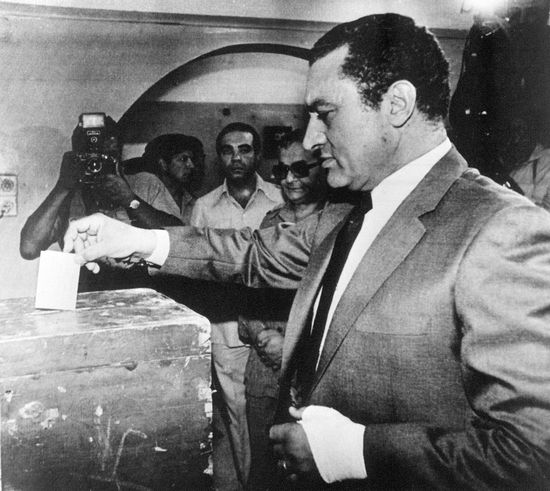
(Photo: Vice President Hosni Mubarak casts his vote on October 13th, 1981 in a national referendum on whether he will succeed the slain President Anwar Sadat as leader of Egypt. By Tom Hartwell/AFP/Getty Images)
Deviating From The Script

by Patrick Appel

An American PhD student who was in Cairo until yesterday writes "about the things that are not happening." Thoughts collected during his last night in Cairo:

When you hear about a revolution, in the Middle East or elsewhere, some assumptions and images pop automatically to mind. You probably imagine gangs roaming the streets, people using the anarchy to take personal grudges out on each other, or steal some stuff, or beat people up just because they're sixteen and drunk on power. You expect the movement factions to start maneuvering for to turn on each other as soon as the tyrant is gone. You expect scenes out of Hobbes. And around here, you expect people to start targeting Westerners. Introspect a little. Does this resemble the images that pop unbidden into your mind? It's okay. I'm not judging. They pop into my mind too – I grew up in the same media environment as other middle class Americans, after all.

The images fit so naturally together because they're from a script, one that's been developed and elaborated in reportage over decades, in several countries. It's an extremely polished, high-resolution image, backed by decades of examples, tastefully aggregated into a narrative so that details of actual countries and events fall away, and what's left is a sort of higher-amplitude Truth.

But so far it just isn't so. No “death to America”, no-one calling on anyone to hurt foreigners, and nobody actually doing it. There's looting – half of which I still think is being orchestrated by the government to scare people – but people organized neighborhood watches out of nowhere to prevent it. I admit I'm a little creeped out when teenagers with furniture fragments offer to walk me home, but I also have to admit that my neighborhood is quiet and safe.

The rest of his posts are also worth a look.

The March Begins?

TahrirDemo
by Patrick Appel

EA:

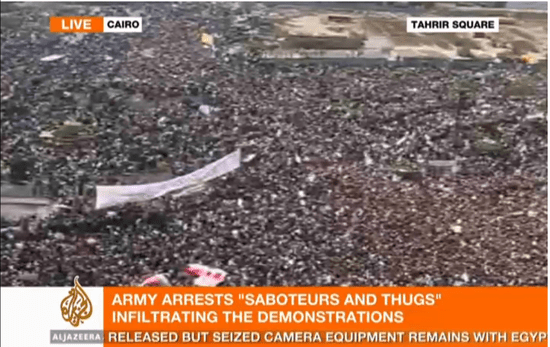
1320 GMT: Al Jazeera is now putting out estimates of more than 2 million in Tahrir Square in Cairo. The military is putting up barbed wire around the Presidential Palace in Heliopolis.

From The Guardian's live-blog:

1.08pm: Protesters are now starting to march in Alexandria, Human Rights Watch Reports. There is no clear route for the march, so a bit of confusion. 

The Harriet Sherwood, who's in Alexandria, adds:

No one is running this, apart from the people themselves

Update: Sonia Verma, who's tweeting at the scene, says Cairo is not following Alexandria's lead:

The square is packed but this march looks like it's not happening. Where are the leaders?

A Tunisian Tsunami? Ctd

by Patrick Appel

Now Jordan:

In Jordan, King Abdullah has dismissed the Government of Prime Minister Samir Rafai and asked a former Army general to form a Cabinet. Abdullah's move comes after a series of demonstrations by thousands of Jordanians called for Rifai's resignation amidst rises in fuel and food prices and a lack of political reform.

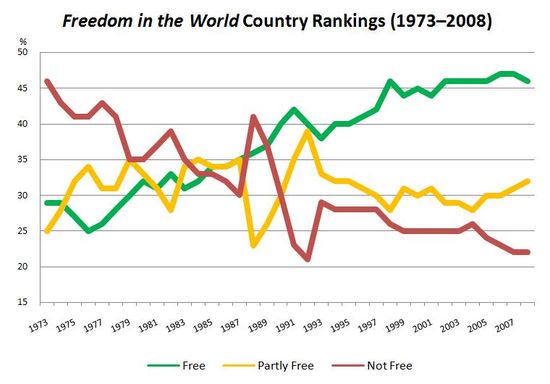
Has The World Peaked?

Freedom_In_World 

by Patrick Appel

Alex Massie allows himself to hope that it hasn't:

[I]n general or viewed from outer space this planet, despite its shortcomings and quotidian grumbling, is a better, safer, healthier, better-fed, more peaceful, freer, more liberal place than it has been at just about any point in recorded human history. For men and especially for women. Dr Pangloss would be proud.

Which is another way of saying that opinions on the present crisis in Egypt differ between those who fear catastrophe and those who see hope, note rage as the force driving the protests. Perhaps the optimists will be confounded and the world will take a sharp turn for the worse. If so then we may look back on these past 30 years as a Golden Age whose passing will be mourned as we wonder how and why and where we let it all slip away…

(Chart from Freedom House)

What’s The General Effect Of Social Media?

by Conor Friedersdorf

Alan Jacobs thinks that is an incoherent question:

As I mentioned the other day, the Shirky/Doctorow thesis is that the internet in general and social media in particular tend to generate political freedom; the Evgeny Morozov thesis is that those media tend to enable governmental surveillance and control of protestors and dissidents.

My question is: why are we so determined to speak in these essentialist terms? Maybe the most significant change in my thinking over the past twenty years is a deepening suspicion of generalizations. “To Generalize is to be an Idiot,” wrote William Blake; “To Particularize is the Alone Distinction of Merit.” The internet is new; social media are even newer; both are vastly dispersed throughout the global social order. Moreover, the internet is not just one thing, it’s ten million things; and different social media have different purposes, different architectures, different sets of users.

He argues that "the only way to make any progress in thinking about these matters is to 'Particularize' and to keep particularizing." That's pretty good advice for conversations about the news media too. We're all guilty of it sometimes, but any complain that starts, "The media is always doing x" should be suspect.

“Streaming Towards The Square”

108680039

by Chris Bodenner

The Guardian's live-blog is up and running with Matthew Weaver at the helm:

8.34am: "A lot of protesters are hoping and believing that this could be the final hours of the Mubarak regime," Jack Shenker reports from Cairo. The million-person march to the presidential palace will take the protests to a new level, it is hoped, he says. The regime's tactics to prevent people taking part, won't work, Jack predicts. "Tens of thousands of people have defied a strict night curfew after night," Jack says. "Right now in Tahrir, there is a huge presence, far bigger than it has been at this time. There are tens of thousands certainly. Thousands from different directions are streaming towards the square."

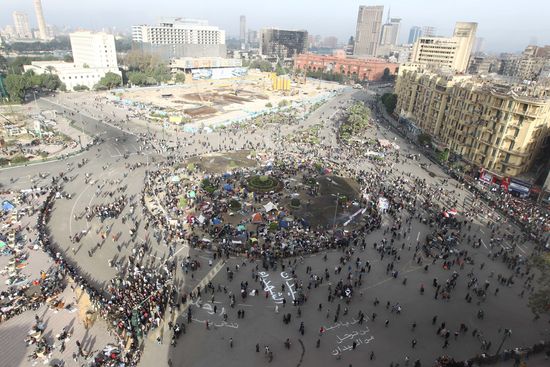
(Photo: Egyptians start to gather in Cairo's Tahrir Square heeding a call by the opposition for a 'march of a million' to mark a week of protests calling for the ouster of Hosni Mubarak's long term regime, on February 8, 2011. By Khaled Desouki/AFP/Getty Images)

Crossing Dress

by Chris Bodenner

ABC News' Lara Setrakian

There are rampant rumors/fears that plainclothes police will be in the crowds at Tahrir Square to crack down. We'll be looking out.

CNN's Ben Wedemen:

Many of men heading to Tahrir along Corniche look like baltagiya (plainclothed police heavies). Another Tienanmen Sq? … I've seen enough plainclothed #Egypt police in my face, and been roughed up by them, to know what they look like.

EA's Scott Lucas:

Egyptian state TV quotes army officials warning people to beware of 'thugs' who have stolen army uniforms by breaking into stores that sell them. They also warned people from illegally wearing them.

Total Internet Blackout: Who Cares?

108679424

by Chris Bodenner

Parvez Sharma spoke with a close friend and "the most articulate ordinary Egyptian I know":

M: Hey Omar…you know that there many tweets coming in saying he is going to shut down everything tonight…whatever little internet was left and mobiles and landlines even?

O: Fuck the internet! I have not seen it since Thursday and I am not missing it. I don’t need it. No one in Tahrir Square needs it. No one in Suez needs it or in Alex…Go tell Mubarak that the peoples revolution does not his damn internet! 

M: Ha ha! You just gave me a possible title for the piece my friend…

O: Tayyib good. But honestly I mean 40 % of this country is living below the poverty line and a large chunk above that is barely surviving and then you have middle class doctors and lawyers etc and then you have you know rich people like me yaani…I mean it is true that cell phone penetration has improved very much…you know they even say that maybe 60 million have cellphones…you know…but its like those basic yaani really basic mobiles…nothing fancy…no internet bullshit for example…I can tell you that the majority of Egyptians have no idea what Facebook is or what Twitter is! I mean you ask me this everyday—but its true yaani…and look at this… a very basic mobile is from 180 Egyptian pounds…a fancy internet capable phone like an Iphone and that Droid thing or the blackberry cost around 3000 pounds…and I will just talk about the so called middle class for a second…before revolution they said they would increase the minimum wage to 1200 pounds a month…right now it is about 800 pounds…800 pounds to feed a family of 4 maybe more? And then you go and buy an internet enabled phone which costs more than 3 months of your salary?.

Me: So how and why is this whole narrative evolving?

O: You mean all this internet stuff…well before he shut us out on Thursday…there was vibrant communication between a certain and very small class of society in terms of relative numbers…this is the class of people who have ALWAYS been absent and apathetic from the suffering of the Egyptian majority…the poor people…you know that was good…so maybe a little bit through twitter and all the apathetic students and professional class started communicating for the first time…

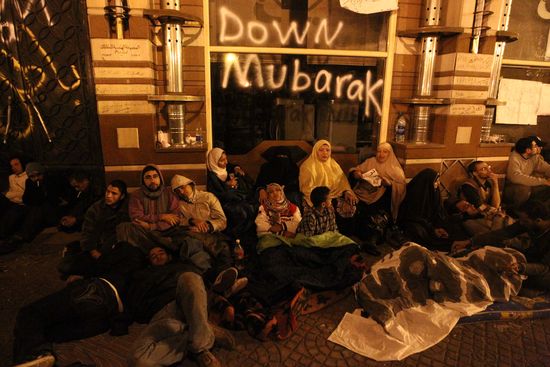
(Photo: Egyptians spend the night in Cairo's Tahrir Square, following a seventh day of protests calling for the removal of President Hosni Mubarak's regime on January 31, 2011. By Khaled Desouki/AFP/Getty Images)

The Counter-Protesters

by Chris Bodenner

Negligible:

0600 GMT: Frederik Pleitgen of CNN reports, "Just saw pro Mubarak demo for the first time at information ministry. About 50 guys chanting with signs."

0750 GMT: Ben Wedeman of CNN updates, "Small group of pro-Mubarak protesters chanting 'Yes to the Regime' below bureau window. Passers-by calling them 'For Rent'."