Peak Polarization

National Journal measures the record partisan gap – caused largely by the intensification of conservative ideology:

Because about twice as many voters consider themselves conservatives as liberals, Republicans are typically less dependent on support from moderates to win elections, which further amplifies the conservative influence over the party’s elected officials. “The Democrats are always going to be fractious and divided if they want to aspire to majority status,” says Jacobson, the political scientist. “That’s just the nature of their coalition. The Republicans don’t have to be that broad; they can be much more unified. Republicans are now a conservative and very conservative coalition, and their share of moderates is minuscule. The pressure right now is not coming from their centrists; it’s coming from their extremists.”

The difference is already apparent in the early months of 2011. After last November’s landslide, House Republicans hold 61 districts that Obama carried in 2008, but those GOP members are not straying from the party agenda nearly as much as McCain-district Democrats did from their party’s priorities over the previous two years.

Will Libya’s Rebels Be Any Less Brutal?

Larison argues against western intervention in Libya on the grounds that it might lead to more slaughter:

[O]utside support could easily pave the way for massacres of regime loyalists and those mistakenly believed to be regime loyalists by the rebels. Maybe no one is very concerned about this result, but it’s not something that can be entirely ignored when we’re talking about tying ourselves to the cause of the rebels.

It goes without saying that almost all Western analysts and pundits know very little about Libyan rebels or what it is, besides Gaddafi’s overthrow, that they will want when the war is over. It would be typical if anti-regime forces have a lot of old scores to settle, and tipping the balance in their favor (which is what interventionists are arguing that we do) will make it easier for them to do that. That outcome might happen anyway without outside intervention, but I don’t see why Western governments would want to take an active part in it. 

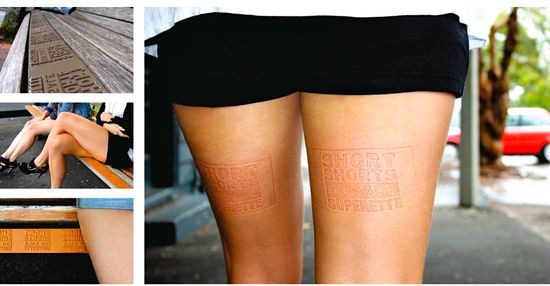
Creepy Ad Watch

Superette_Short_Shorts

Copyranter spots it:

How's this for invasive advertising? Superette, an Auckland boutique chain, wanted to promote a short shorts sale. From ad agency DDB Auckland's press note:

"We put indented plates on bus stop, mall, and park benches, so that when people sat down, the message was imprinted on their thighs. This meant that as well as having branded seats, a veritable army of free media was created, with thousands of imprints being created and lasting up to an hour."

Pretty clever though.

The Change In Egypt

A reader writes:

All the attention is focused on Libya, but the process going forward in Egypt is, so far, extremely impressive. The interim government constituted a technocratic Constitutional Committee with eight members, each of them a preeminent figure in Egyptian legal circles. The Committee's report is due to be floated today and a bit of it has just slipped out to the media in Egypt. It will

a. Abrogate Article 179 (Emergency powers of the President)–i.e., no more dictator as president

b. Amend Articles 76 (Conditions to elect the President), Article 77 (Presidential terms to be limited to two six-year terms), Article 88 (Judicial Supervision over the elections)–clearing obstacles to freely contest the presidency

c. Abrogate Article 93 (The Parliament’s power to decide upon the validity of its MPs’ memberships) and amend 189 (The Parliament and President’s power to amend the constitution)–clearing the way for free contest for parliament So far, this process is moving quickly and smoothly.

Over the weekend, Egyptian newspapers will publish the report. There will be a week for public commentary, and then the report, with possible amendments, will likely be implemented by the interim government. A lot of calls for the Armed Forces to bring in a civilian government led by technocrats without political aspirations. In a sense, that's what they're doing with this committee system. We have a long way to go, but so far I'd say Glenn Beck can choke on it. This is about as sober, serious, secular and focused on real democratic reform as we ever could have hoped for.

Encouraging, no?

The Slow Arc Of History

A Spanish court has just allowed a trial for a defendent claiming he was tortured in Gitmo:

A Spanish court Friday agreed to investigate a complaint by a Moroccan who said he was tortured while in the US detention camp in Guantanamo Bay, Cuba, judicial sources said. The National Court said it was competent to take the case as the complainant, Lahcen Ikassrien, has been living in Spain for 13 years.

More on the case here. Money quote on what is meant by torture in this case under Spanish and international law:

being held in cells made of chicken-wire in intense heat; being subjected to constant loud music, extreme temperatures and bright lights; constant interrogations without counsel; sexual assault; forced nakedness; threats of death; and severe beatings.

I have yet to see Rummy confronted with the question of torture in his television interviews for his book. But his future trips to Spain, one suspects, will be limited.

Psy-Ops Reax

The reaction online to Michael Hastings' new and disturbing expose of the use of "psychological operations" against US senators has been mixed. Ackerman and Shachtman ponder the difference between propaganda and spin. But Steve Clemons saw the proof first-hand:

In January 2010, I participated in a substantive and interesting conference call with Senator Levin when he was returning with Al Franken via Dubai from a CODEL trip visiting Afghanistan. I wrote about it then and was fairly surprised given the skepticism both had previously expressed for Afghanistan that they believed so readily what the military was telling them. It really seemed strange to me. … Caldwell should be fired. What he did, if Hastings has his details is right, is really outrageous and a further testament to the wobbliness of civilian control over the military in today's world.

James Joyner gets a whiff of Holmes' "axe to grind" and chalks the whole scheme up to generals trying to "put their best foot forward":

[Congressional delegations] are of course going to be presented with propaganda when they visit military headquarters at war. Hell, visitors from the next higher echelon headquarters are treated the same way — and always have been — even in peacetime garrison situations. It’s not much different from running around and picking up the house before guests arrive at your home.

John Cook isn't sure:

You can read that story as one in which a desperate general tries to use propaganda voodoo to influence American politicians, or you can read it as a story in which a general decides that some psy-ops troops under his command would be better utilized doing routine public relations duties. It's probably a little bit of both, and I suspect that whatever lies were being fed McCain et. al. would still have been lies if it were public affairs officers, rather than psy-ops troops, doing the feeding. 

DiA expresses pure disbelief:

It was crazy enough when, as Jane Mayer and others have documented, the CIA took the manuals developed by military trainers for hardening soldiers against the kinds of torture and psychological-manipulation techniques that had been used on Americans by North Korean and North Vietnamese interrogators, reverse-engineered those techniques, and started using them on captives at Bhagram, Abu Ghraib and Guantanamo. Then, when John McCain, who had himself been subjected to those torture and psychological-manipulation techniques in a Vietnamese prison camp, went ahead and endorsed their use by CIA interrogators, I thought the irony could go no deeper. Never underestimate the American military!

Daniel Foster looks back at the Bush administration:

Guidelines erecting a wall between foreign-targeted and domestic targeted “information” and “messaging” by the military have been established by a number of presidents and Pentagon officials, including George W. Bush in a 2002 National Security Presidential Directive that is still classified, and then-Defense Secretary Donald Rumsfeld in a 2003 “roadmap” that calls for “boundaries” between domestic and foreign information operations but doesn’t proscribe any activities that aren’t “targeted” at American citizens.

Adam Sorensen concentrates on the cover-up.