“Pickpockets Are A Dying Breed”

Joe Keohane wonders why:

Experts offer a few explanations for the gradual disappearance of pickpockets in the United States. Crime nationwide—from pickpocketing to homicide—has been dropping since the mid-1990s. People carry less cash today, and thanks to enhanced security features, it's harder for thieves to use stolen credit or debit cards than it was in the past. And perhaps most important, the centuries-old apprenticeship system underpinning organized pickpocketing has been disrupted.

Pickpocketing has always perpetuated itself by having older hooks—nicknamed "Fagins," after the crime boss in Oliver Twist—teach younger ones the art, and then absorbing them into canons. But due to ratcheted-up law enforcement measures, including heftier sentences (in some states, a pick, defined as theft from the body of another person and charged as a felony regardless of the amount taken) and better surveillance of hot spots and known pickpockets, that system has been dismantled.

Iraq Rages

AP110225122248

The fervor finally gets there:

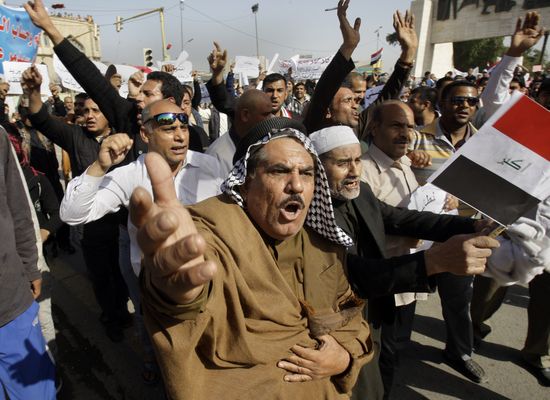
Inspired by protests in other countries such as Libya and Egypt, Iraqis are holding a "day of rage" against corruption and a lack of services. Clashes in Hawija left at least two people dead. There were unconfirmed reports of deaths in other cities. Large numbers have streamed into Baghdad's Liberation Square. Crowds of protesters carrying flags and banners chanted anti-government slogans as security forces were deployed in large numbers.

And Facebook is there yet again. But Joel Wing explains why the protests won't be nearly as big as they could be:

On the day that [Moqtada al-Sadr] came back to Iraq [Wednesday], his movement issued a statement saying that people should not join the planned “Day of Rage” protest on February 25. Instead, the Sadr Trend said that it would conduct a survey across the country on February 28 to see what services they wanted. If those were not met by the government it would hold its own protest in six months. That, along with a announcement by Grand Ayatollah Ali al-Sistani’s office that the demonstration could get out of hand and be exploited by others, will probably greatly reduce the Shiite participation in the march.

Another figure who won't be there: Muntazer al-Zaidi, the journalist who threw his shoe at Bush, was arrested ahead of the protests. Check for updates at Enduring America.

(Photo: Protesters chant anti-Iraqi government slogans during a protest at Tahrir Square in Baghdad on Friday, Feb. 25, 2011. Iraqi security forces trying to disperse crowds of demonstrators in northern Iraq killed a few people as thousands rallied in cities across the country. By Khalid Mohammed/AP)

“Why Are Casualty Figures In English So Low?”

A reader is wondering:

I've been looking at the Italian press because of the colonial connection and because they're just about the only country in Europe with actual relations with Ghadafi.  The US press seems to be mirroring Al Jazeera and reporting small groups of casualty numbers here and there.  The Italians are reporting much more alarming figures.  Maybe they're concerned about refugees, but there are probably more Italians on the ground in Libya than any other Europeans. Repubblica is saying at least 6,000 dead across Libya and RAI (Italian TV) is saying at least 10,000 dead across Libya.

This in a country with a population of about 6.5 million.  HUGE numbers.  Tiananmen Square type numbers in a country with maybe 5% of the population of China.  Utterly horrifying.  And with all our history of hating Ghadafi, why is our press being cautious now?

Those figures seem really high based on the other reports we've come across, but the discrepancy between Italian estimates and others is consistent. From the NYT:

Italy’s foreign minister, Franco Frattini, said Wednesday that estimates of more than 1,000 Libyan civilians killed in clashes with security forces and government supporters “appear to be true.” Figures for deaths in the Libyan unrest have been difficult to pin down. Human Rights Watch has confirmed roughly 300 deaths in the weeklong uprising, while noting that its estimate is conservative because of the difficulty in gathering information from morgues and hospitals when phone service is intermittent and the Internet is nearly blacked out.

Chart Of The Day

HealthcareSpending 

Aaron Carroll graphs our runaway healthcare spending:

It’s not that we shouldn’t spend more than other countries.  We should.  We are richer than almost anyone, and we should spend more on health care.  The problem is that we’re spending so much more than everyone else, even after taking into account our GDP.  We’re literally off the chart. And we’re not getting better outcomes for that money.

The Daily Wrap

Today on the Dish, Andrew picked apart Obama's marriage decision. Linda Hirshman saw a trap for Republicans, Jonathan Turley said it was still up to the Supreme Court, and Fox News reported blatant untruths about the decision's implications. Ilya Somi questioned what Obama has to defend, Jason Mazzone called it a gamble, and David Link narrowed it back to the question on Section 3. Civil unions arrived in Hawaii, and Timothy Kincaid envisioned what happens if Congress doesn't defend DOMA.

We took a step back to get perspective on the Arab 1848 and how long it's been brewing; day 11's full recap and analysis is here. Qaddafi went off the deep end (by phone), Drudge swallowed his poison, and some predicted the end is nigh. Beinart questioned the conservative's ability to accept democracy in the Middle East, Robert Fisk reported on the quiet in Tripoli, and Libya's effect rippled through the oil markets. The American public wanted the US to leave Arab countries alone, and we dug up the right's reactions to Bush's second inaugural speech and its call tyranny in the world. John Bohannon examined whether war is irrational, and Exum wondered who was really in charge. Americans lobbyists represented Qaddafi, EA caught up with Egypt, Santorum defended the Crusades, and Tom Friedman mixed his metaphors. 

We debated whether state workers are underpaid or overpaid, but closed the case on whether breaking teacher's unions aids education. Josh Sides compared unions and state debt, Rhodes Cook looked to Wisconsin's influence on 2012, and Weigel read the mood on the Kochs from Wisconsin. Reihan said Walker is just like any other politician fawning after celebrities and donors, Abe Lincoln once fled, and another insane attorney-general staffer bit the dust.  The US got served in the cannabis research race, North Korean kids didn't weigh up  to their South Korean counterparts, and robot journalists waved from the horizon.

Charts of the day here and here, experiment in beardage here, Palin crack here, Yglesias award here, VFYW here, MHB here, and FOTD here.

–Z.P.

Obama’s Risky Bet

Jason Mazzone believes that Holder's DOMA approach "represents a real gamble" because "the Administration is counting on the courts (and ultimately the Supreme Court) taking the unlikely step of deeming gays and lesbians a suspect class–and invalidating section 3 on that basis":

My students are often surprised that after we work our way through the equal protection cases, the Supreme Court's own list of suspect classes is very short. Students sometimes ask if we just didn't cover a whole set of cases. No, I tell them, this is all there is. Students also suggest the Court is simply slower in identifying all of the groups who merit special judicial protection and there are surely more cases to come. My response is that there is in fact very little likelihood that the Court will hold that a classification involving any additional group triggers a heightened form of scrutiny. …

In light of all of this, I am less moved than are other observers by Attorney General Holder's announcement yesterday concerning DOMA.

Libya, Day 11: “Gaddafi Will Burn Everything Left Behind Him”

The above Youtube shows "an 8-year-old girl named Fatima who says she was shot near her home – she's in a hospital in Misurata." Enduring America and Mackey collected other clips from today. A more graphic collection at SaveLibya. Scott Lucas took a knee this morning:

For the first day in weeks, there was an easing of immediate news on Wednesday,   allowing LiveBloggers to catch breath or — if they have become addicted to the rush of drama — to fret about what to write. 

That did not mean there was a lack of serious developments, merely that situations had Z9t7settled — perhaps only for a short while — into standoffs. Libyan leader Muammar Qaddafi, with the support of mercenaries and part of his military, had held onto Tripoli. For the first time, however, the opposition took cities in the west of the country, and last night a battle was shaping up for Tejoura, only 10 miles from the capital.
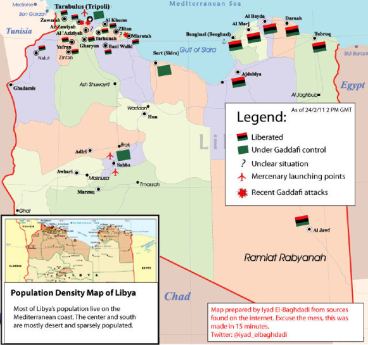
Meanwhile, the rebellion was trying to security its position in "free" Libya in the east of the country. Ben Wedeman of CNN reported last night, "Ad-hoc government in Benghazi in contact with Qaddafi's tribe, telling them they are opposed to his rule, not his tribe. Ad hoc government in Benghazi has set up committees to deal with security, public health, food supplies, evacuating foreigners."

Larger version of the above map here. A more explanatory map here. A dynamic map of the ongoing battles here. The Dish today already covered Qaddafi's latest rant, a look at his last stand in Tripoli, Robert Fisk's dispatch from that city, commentary on the oil question, and an optimistic take on Libya's future. Below are the most salient updates from the live-blogs. First from AJE (times local in Libya, +2 GMT):

1:03pm The president of Chad tried to send troops into Libya to support Gaddafi, says Al Arabiya.

4:00pm An eyewitness named Ali from Az Zawiyah tells Al Jazeera that soldiers fired at protesters with heavy fire arms for five hours this morning. Some of the protesters, he said were armed with hunting rifles, others were unarmed. "The shooting was direct to the people. They shot the people in the head or in the chest. They were trying to kill the people, not just terrify them," said Ali. He added that at least 100 people had been killed and that around 400 injured were taken to the hospital in Az Zawiyah.

8:32pm Patty Culhane, Al Jazeera's correspondent at the White House, says Obama's comments on Libya – that "this must stop" – are "striking". Yet the White House is not considering any action, she reported, and sanctions are the only likely action in the foreseeable future. "So far, however, the only action they're talking about is talking," Culhane said.

8:23pm The Swiss government has announced that it will freeze Gaddafi's assets.

11:10pm Ahmed Gadhaf al-Dam, one of Gaddafi's top security official and a cousin, defected on Wednesday evening, saying in a statement issued by his Cairo office that he left the country "in protest and to show disagreement" with "grave violations to human rights and human and international laws"

The Guardian highlights its main items:

• International response gathers pace after Gaddafi counterattacks
International efforts to respond to the Libyan crisis are gathering pace under US leadership after a still defiant Muammar Gaddafi launched counterattacks to defend Tripoli against the popular uprising now consolidating its hold on the liberated east of the country.

• Heavy fighting in former stronghold 
Screen shot 2011-02-24 at 6.41.29 PM

• British evacuees from Libya describe mass hysteria
British citizens fleeing the chaos engulfing Libya finally began arriving back in the UK reporting "mass hysteria" at Tripoli airport with as many as 10,000 people fighting to get out.

• David Cameron 'extremely sorry' as criticism of evacuation grows
David Cameron delivered an unequivocal apology for the failings that left British citizens stranded in Libya, as Douglas Alexander, the shadow foreign secretary, claimed a lack of basic ministerial experience led to the Foreign Office's failure to run an effective evacuation.

Etc:

6.23pm: The US is to join European nations in calling for Libya to be thrown out of the UN Human Rights Council, AP reports.

9.08pm: According to al-Jazeera, Gaddafi's supporters are trying to break into the Qatar embassy in Tripoli. Luckily the Qatari diplomats are long gone but this is presumably a revenge attack for Qatar's backing of al-Jazeera.

EA:

2155 GMT: The first edition of the newspaper in "free" Benghazi has been published

2145 GMT: Libya's Deputy Ambassador to the United Nations, who broke with the regime earlier this week, has appealed to key Brigadier Generals Mahdi Al Arabi and  Mohamed Al Esawi to turn against Muammar Qaddafi.

2045 GMT: Jason Pack of The Guardian profiles one of the key people remaining in Qaddafi's inner circle: Abdullah Senussi, "the leader's brother-in-law, his key enforcer, and former head of external security".

1015 GMT: Saif Al Islam Qaddafi, Screen shot 2011-02-24 at 6.39.37 PMthe son of the Libyan leader, has appeared on State TV to declare, "The world is conspiring against Libya….Why don't these TV channels show the pro-Gaddafi demonstrations?….Tripoli is very calm except for one incident….I challenge anyone to give me the number killed."
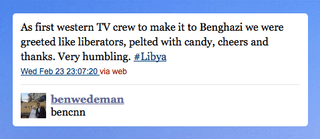
Some numbers:

The International Federation for Human Rights said the [130 troops executed in al Baida] were among at least 640 people who have been killed in Libya since protests started, AFP reported. The figure is more than double the official Libyan Government toll of 300 dead, and includes 275 dead in Tripoli and 230 dead in Benghazi.

And:

 France's top human rights official told Reuters that up to 2,000 people could have died by now in Libya.

Al Jazeera's lead story tonight:

Mustafa Abdel Galil, who resigned three days ago from his post as the country's justice minister, spoke to Al Jazeera at a meeting of tribal leaders and representatives of eastern Libya in the city of Al Baida. He warned that Gaddafi has biological and chemical weapons, and will not hesitate to use them.

'We call on the international community and the UN to prevent Gaddafi from going on with his plans in Tripoli,' he said. 'At the end when he’s really pressured, he can do anything. I think Gaddafi will burn everything left behind him.'

What Is Egypt’s High Council Thinking?

Exum asks:

I took two trips to Saudi Arabia last year, and one of the things that struck me about both trips was that no matter which "senior" figures and haut fonctionnaires I spoke with, it was clear that the real power was centralized to a high degree in just a few people. What those people — the king and his advisers — were thinking about Iran, Israel, and the future of the U.S. dollar? Anyone's guess. And I get the same feeling about Egypt. No one I speak with feels they have a firm handle on the thinking of the high council leading the military — and thus leading Egypt. When I left, in fact, journalists were still looking through pictures published in the Egyptian newspapers trying to find out who, exactly, was even on the council.