A video experiment in beardage.
Month: February 2011
Yglesias Award Nominee
"What ought to worry conservatives in particular is that Beck not only has the unusual capacity to discredit virtually every cause he takes up; he also confirms the worst caricatures of the right. What was true before is doubly true today. It looks to me like it’s only a matter of time — and I suspect not much time — until he blows apart professionally. If and when that happens, one can only hope that conservatism as a movement will have created enough distance from Beck to mitigate the damage," – Pete Wehner, Commentary.
The View From Your Window

Antigua, Guatemala, 10.13 am
What Does The DOMA Decision Mean? Ctd
Salon interviews Jonathan Turley, a law professor:
What's interesting is Holder's statement that the department will work closely with the courts to ensure that Congress has a fair and full opportunity to participate in pending litigation. That would seem to mean that the Justice Department will support a special counsel to defend these laws in support of Congress. That will create a situation where you have one lawyer representing the legislative branch and arguing in favor of constitutionality, and another lawyer representing the executive branch and arguing against constitutionality.
But he rightly doesn't expect this to make a huge difference, for all the hyper-ventilation on both sides:
I should note, though, that if this were to go to the Supreme Court, I do not expect that the position of the administration would necessarily sway any justices. The justices are likely to have very clear views on the constitutionality of this question. Justice Scalia recently talked publicly about the limits of the Equal Protection Clause. But it certainly adds more support to the challenges going forward. It never hurts to have the executive branch on your side.
The Quiet In Tripoli
A first-hand report from, yes, Robert Fisk, who has somehow gotten into the Libyan capital. Money quote:
There is little food in Tripoli, and over the city there fell a blanket of drab, sullen rain. It guttered onto an empty Green Square and down the Italianate streets of the old capital of Tripolitania. But there were no tanks, no armoured personnel carriers, no soldiers, not a fighter plane in the air; just a few police and elderly men and women walking the pavements – a numbed populace. Sadly for the West and for the people of the free city of Benghazi, Libya's capital appeared as quiet as any dictator would wish.
But this is an illusion.
Petrol and food prices have trebled; entire towns outside Tripoli have been torn apart by fighting between pro- and anti-Gaddafi forces. In the suburbs of the city, especially in the Noufreen district, militias fought for 24 hours on Sunday with machine guns and pistols, a battle the Gadaffi forces won. In the end, the exodus of expatriates will do far more than street warfare to bring down the regime.
I was told that at least 30,000 Turks, who make up the bulk of the Libyan construction and engineering industry, have now fled the capital, along with tens of thousands of other foreign workers. On my own aircraft out of Tripoli, an evacuation flight to Europe, there were Polish, German, Japanese and Italian businessmen, all of whom told me they had closed down major companies in the past week. Worse still for Gaddafi, the oil, chemical and uranium fields of Libya lie to the south of "liberated" Benghazi. Gaddafi's hungry capital controls only water resources, so a temporary division of Libya, which may have entered Gaddafi's mind, would not be sustainable.
The Arab 1848: A Long Time Coming
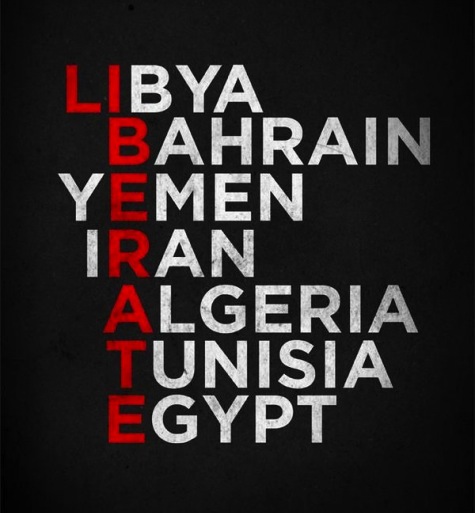
James Miller takes a moment to reflect on the past six weeks:
Before 14 January, most Americans didn't know Tunis from hummus. But suddenly the Tunisian regime fell, and President Zine Abedine Ben Ali quickly ended 27 years of rule by fleeing to Saudi Arabia. Two weeks later, US President Barack Obama gave his State of the Union address. He did not mention the word "Egypt". Three days later, every American was glued to a TV set to witness the final hours of President Hosni Mubarak's 30-year reign.
It happens that fast, and the whole world changes. Groups of dedicated and peaceful protesters join together, use technology to spread their voices, and bring down dictatorships. Well, Mubarak's demise is almost two weeks old. We are impatient for the next regime to fall. It could Libya, or Bahrain, or Iran, or maybe Yemen. It should happen any day now, right?
A step back. Many of the assertions above are completely, or partially, inaccurate.
The spark for what appeared to be an overnight revolution in Tunisia came almost a month earlier when Mohamed Bouazizi, a street vendor, lit himself on fire after having his merchandise confiscated by a municipal officer. But before this, there were years of economic and social oppression to drive Bouazizi to his self-immolation and to push others to the streets.
In Egypt, websites had been following the political degradation for at least a year. There were serious signs of trouble, long before the main stream media followed the story, with rigged elections, persecution of political dissent, beatings and killing by police, and bombings slowly eating away at Mubarak's credibility.
But the more critical misconception about these first two revolutions may be that the protesters in Tunisia and Egypt somehow toppled their dictators. While the protesters in both locations may have been the catalysts for change, they were not its agents. In both nations, members of the government and leaders of the military stepped in on behalf of the people on the ground. Dissent from within their establishments forced both Ben Ali and Mubarak into a corner. They would have to make a choice: face a bloody civil war and coups d'état, or step down.
Libya is not Egypt or Tunisia. Muammar Qaddafi has no centralized government, has no institutions, and has few rivals inside his own government or military. This is why were are seeing a very different pattern in Libya. The protesters are physically taking control of the country, not just a single square, and they are sometimes doing so by force. Each man employed by the Libyan state is being forced to pick sides. Many are joining the protests, but there is no other way for this to play out than violent revolution. There is no government, to speak of, to hold a gun to the back of the dictator's head.
Iran is also not Tunisia or Egypt, but for different reasons. The identity of the post-1979 pro-regime Iranian is closely tied to the idea that the current theocratic government is the culmination of the Islamic Revolution. Following orders, cracking down on dissenters, and maintaining loyalty to the Supreme Leader is almost an obligation. This is in sharp contrast to Egyptian and Tunisian societies, far more permissive despite their repression of political rivals or freedom of expression.
Cortni Kerr and Toby C. Jones take stock of the situation in Bahrain:
An uncertain calm has settled over the small island kingdom of Bahrain. The wave of peaceful pro-democracy protests from February 14-17 culminated in bloodshed, including the brutal murder of seven activists, some of whom were asleep in tents, by the armed forces. On orders from above, the army withdrew from the roundabout on the outskirts of the capital of Manama where the protests have been centered, and since shortly after the seven deaths it has observed calls for restraint. Thousands of jubilant protesters seized the moment to reoccupy the roundabout, the now infamous Pearl Circle. In commemoration of the dead, the demonstrators have renamed it Martyrs’ Circle.
The mood in the circle is buoyant, even carnivalesque. It is also dead serious, for the thousands of encamped demonstrators demand nothing short of fundamental change to the kingdom’s autocratic political order.
Jane Novak details Day 12 and Day 13 of the unrest in Yemen. The latest from Algeria:
A draft law approved by the cabinet would repeal the emergency law as soon as it is published in the government's official journal, the official Algerie Presse Service reported on Wednesday. Ending the emergency powers was one of the demands voiced by opposition groups which have been staging weekly protests in the Algerian capital that sought to emulate uprisings in Egypt and neighbouring Tunisia.
"The lifting of the state of emergency is still positive but it's not enough," Mustafa Bouchachi, chairman of the Algerian Human Rights League and one of the organisers of the protests, said on Tuesday. "We need a real opening up for political, media and social activities so that the people can experience democracy for themselves"
Anthony De Rosa provides a staggering list of sites with updates from 10 different countries.
(Image via Twitter user Rutevera)
Chait Bait
Tom Friedman gets a huge amount right here, as he often does. But the metaphors are pure Chait bait. Do not try to follow this at home:
A wake-up call’s mother is unfolding. At the other end is a bell, which is telling us we have built a house at the foot of a volcano. The volcano is spewing lava, which says move your house. The road will be long and rocky, but it will trigger a shift before it kicks. We can capture some of it. IF the Middle East was a collection of gas stations, Saudi Arabia would be a station. Iran, Kuwait , Bahrain, Egypt, Libya, Iraq, and the United Arab Emirates would all be stations. Guys, here’s the deal. Don’t hassle the Jews. You are insulated from history. History is back. Fasten your seat belts. Don’t expect a joy ride because the lid is blowing off. The west turned a blind eye, but the report was prophetic, with key evidence. Societies are frozen in time. No one should have any illusions. Root for the return to history, but not in the middle.
Hey, The Crusades Weren’t That Bad!
Santorum spreads the word. I must say it's refreshing for a pro-life fanatic to embrace a Christianity that endorsed mass murder. But, again, one wonders what world today's far right (which now runs the GOP) lives in. George W. Bush insisted that America was not engaged in a Christian war against Islam, but a democracy's war against terrorism and tyranny. And yet, even after the catastrophe in Iraq, the hard right has moved toward a war of civilizations rhetoric. Commentary's Jonathan S. Tobin is more than a little miffed:
Enflamed by hate-filled sermons, Crusaders massacred Jewish communities in Europe on their way to the Middle East and sacked and murdered some of the Christian communities they found in the Levant as well. The victory of the First Crusade culminated in the mass murder of all non-Christians in Jerusalem and brought to a temporary end the Jewish presence in the city. One can argue that their opponents were not exactly human-rights advocates either and that the crusading spirit can be traced in part to a drive to reclaim the Iberian Peninsula and other parts of Europe that had been overrun in the initial period of Muslim conquests in the first centuries after Islam’s birth. But the notion that the Crusaders were anything but an expression of violent religious extremism reflects an absurd lack of historical knowledge.
Santorum’s shaky grasp of history is bad enough, but by using the same speech in which he defended the Crusades to speak in praise of contemporary American military intervention in the Middle East, he has made a colossal blunder…. Unlike the Crusaders, who came to the region to slaughter Muslims and impose their religion on the survivors, Americans have come to fight the oppressors of Muslims and to facilitate their freedom, and so Santorum’s comments will be catnip to our enemies, who have wrongly tarred our soldiers with this label.
Qaddafi: Getting Even Weirder
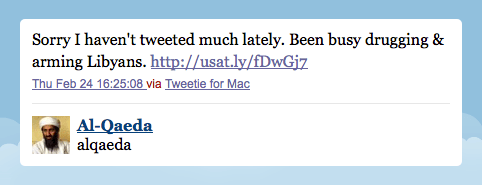
The latest rant is by phone, as if he cannot risk appearing in public. This time, al Qaeda is behind the uprising, everyone is on drugs and he is Queen Elizabeth II.
(Tweet via Mackey)
A DOMA Trap?
Linda Hirshman thinks Obama has set one for congressional Republicans:
If House Speaker John Boehner and his fellow Republicans elect to wage a fight for DOMA, they will undoubtedly phrase their announcement in the culture war language that plays so well with their party base.
But then, the Republicans and their lawyers will have to step into federal court and prove — subject to cross-examination — how the republic would be damaged if same sex spouses can get, say, federal railroad retirement benefits. As Boies said after dismantling that disqualified expert in the Proposition 8 trial, "the witness stand is a very lonely place."
 The Dish