The Pwning Of Scott Walker, Ctd

Here’s Ezra Klein’s reaction:

…if the transcript of the conversation is unexceptional, the fact of it is lethal. The state’s Democratic senators can’t get Walker on the phone, but someone can call the governor’s front desk, identify themselves as David Koch, and then speak with both the governor and his chief of staff? That’s where you see the access and power that major corporations and wealthy contributors will have in a Walker administration, and why so many in Wisconsin are reluctant to see the only major interest group representing workers taken out of the game.

Yglesias adds his two cents:

Imagine a world in which every single one of Scott Walker’s constituents had more access to Scott Walker than does a rich out of state donor. And imagine the richest man in Wisconsin had equal access to Walker as the poorest. Try to imagine it. I think that if we lived in that world, people would have a very different reaction to complaints about the disproportionate political influence of labor unions.

And Reihan chimes in with a somewhat different perspective:

I hate to tell you this, but I’m pretty sure that virtually all elected officials are willing to talk to campaign donors, rich people, and celebrities. Think about it. You’re basically the kind of person who ran for student body president, and suddenly really, really important people want to talk to you. Imagine how thrilling that must be! It should go without saying that this is completely pathetic. This is a big part of why we right-wingers think that politicians should have very narrow, circumscribed powers. They’re not an attractive bunch. Speaking only for myself, the politicians I come closest to admiring are the bona fide nerds who’d rather hang out at a diner in rural Indiana than talk to billionaires or celebrities.

What They Said Back Then: The Freedom Agenda

BushFlagGetty

Given the Arab 1848, and the quickening debate on the right about how to respond, check out the conservative response to George W. Bush's second inaugural address, and its call for an end to tyranny in the world. At National Review in that era, Larry Kudlow gave the speech a somewhat breathless preview:

On the day of his second inauguration can there be any doubt that George W. Bush is the most powerful and dominant politician on the face of the Earth? As his policies reshape the American economy and the world, he has far more clout and influence than his predecessors Bill Clinton or George H.W. Bush ever had. The younger Bush is more like Reagan. The Gipper revolutionized the economy with tax cuts and deregulation. He had far-reaching global influence with his vision of overturning the evil empire of Soviet communism. George W. Bush is equally visionary.

Now on to the reacts. Jonah Goldberg liked the freedom rhetoric:

I don't know that anyone thinks Bush is going to send tanks into Zimbabwe, Saudi Arabia and Pakistan tomorrow in order to be consistent with his speech. But, the more I think about it the more I believe that his speech was intended for a global and transgenerational audience. He was picking sides, throwing down the gauntlet, laying out first principles etc. I really would be surprised if that address isn't being cursed by mullahs and murderers around the world… Yes, he wrote a check yesterday we can never literally cash, but I like the dogma he laid out. And if we have to make practical concessions to reality every now and then — and be called hypocritical for it — that's fine by me.

Peter Robinson didn't:

Bush has just announced that we must remake the entire third world in order to feel safe in our own homes, and he has done so without sounding a single note of reluctance or hesitation. This overturns the nation’s fundamental stance toward foreign policy since its inception. Washington warned of "foreign entanglements." The second President Adams asserted that "we go not abroad in search of monsters to destroy." During the Cold War, even Republican presidents made it clear that we played our large role upon the world stage only to defend ourselves and our allies, seeking to changed the world by our example rather than by force. Maybe I'm misreading Bush — I'm writing this based on my notes, and without having had time to study the text — but sheesh.

Charles Krauthammer was optimistic:

The great project of the Bush administration — the strengthening and spread of democracy — is enjoying considerable success. Most recently we witnessed the triumph of the "orange revolution" in Ukraine, which followed the "rose revolution" in Georgia, bringing historic breaks from authoritarianism in two key former Soviet republics. Less publicized were elections in two critical Muslim states — Indonesia and Malaysia — in which Islamic parties were decisively defeated.

Elsewhere in the Islamic world, we saw (though many played down) the Afghan miracle: free and successful elections on perhaps the world's least hospitable soil for democracy. That was followed by Palestinian elections and the beginning of political reform. Even more encouraging was a public statement issued just weeks earlier by more than 500 Palestinian intellectuals demanding democracy, the rule of law, transparency and an end to Arafat-style dictatorial rule. And now, elections in Iraq, which are obviously problematic but also very promising.

Ed Morrisey gushed:

For too long, we have allowed those who trade stability for freedom in other nations to achieve the peace of the moment. On 9/11, we found out that this has its own price, and that we received no bargain for our efforts. Excusing dictators and kleptocrats in the long run creates fury, rage, and hopelessness that these same autocrats find useful in directing against us for their own purposes. That cycle has to end, for our own security.

In fact, in its own way, this might be one of the most radically classical-liberal American speeches in a generation.

Here's Victor Davis Hanson:

This is the first time that an American president has committed the United States to side with democratic reformers worldwide. The end of the cold war has allowed us such parameters, but the American people also should be aware of the hard and necessary decisions entailed in such idealism that go way beyond the easy rhetoric of calling for change in Cuba, Syria, or Iran – distancing ourselves from the Saudi Royal Family, pressuring the Mubarak dynasty to hold real elections, hoping that a Pakistan can liberalize without becoming a theocracy, and navigating with Putin in matters of the former Soviet republics, all the while pressuring nuclear China, swaggering with cash and confidence, to allow its citizens real liberty.

I wholeheartedly endorse the president's historic stance, but also accept that we live in an Orwellian world, where, for example, the liberal-talking Europeans are reactionary-doing realists who trade with anyone who pays and appease anyone who has arms-confident in their culture's ability always to package that abject realpolitik in the highest utopian rhetoric. But nonetheless the president has formally declared that we at least will be on the right side of history and thus we have to let his critics sort of their own moral calculus.

And finally, Peggy Noonan:

A short and self-conscious preamble led quickly to the meat of the speech: the president's evolving thoughts on freedom in the world. Those thoughts seemed marked by deep moral seriousness and no moral modesty. No one will remember what the president said about domestic policy, which was the subject of the last third of the text. This may prove to have been a miscalculation.

It was a foreign-policy speech. To the extent our foreign policy is marked by a division that has been (crudely but serviceably) defined as a division between moralists and realists–the moralists taken with a romantic longing to carry democracy and justice to foreign fields, the realists motivated by what might be called cynicism and an acknowledgment of the limits of governmental power–President Bush sided strongly with the moralists, which was not a surprise. But he did it in a way that left this Bush supporter yearning for something she does not normally yearn for, and that is: nuance. The administration's approach to history is at odds with what has been described by a communications adviser to the president as the "reality-based community."

(Photo: Paul J Richards/AFP/Getty)

“They Have Found The Enemy, And It Is Koch”

Weigel is on the ground in Wisconsin. He contrasts the anti-Koch mood of the protesters with the Kochs' political donations:

How can we judge how deep the Kochs' influence runs? That New York Times story points out that all Koch-affiliated companies and employees gave about $1.84 million to Republicans, nationwide, in the 2010 election cycle. Americans for Prosperity, the nonprofit Tea Party-organizing group co-founded by David Koch—he's still on the board—had a $40 million budget in 2010. (On Tuesday AFP announced a $342,000 ad buy supporting Walker.) Nationally, the labor movement spent far, far more than this. To take one example, AFSCME, whose green-shirted members have made their presence known in Madison, spent $87.5 million on the election.

 So why do they attract such animosity?

Partly because [the Kochs] do have some influence, and partly, as the Assembly Democrats kept goading Republicans, because they are shadowy "New York billionaires."

Obama’s Marriage Decision

Both sides on the marriage equality front are hyper-ventilating about the Obama administration's decision not to defend  in court the third section of DOMA as constitutional with respect to already married same-sex couples in various states and DC. Here are two representative emails. From the Christianist right, a fundraising email from NOM:

This is it. The whole ball game. If we back down here, it will be all over.

From gay blogger, Rex Wockner:

DOMA can't withstand heightened scrutiny, Prop 8 can't withstand heightened scrutiny, and pretty much any governmental anti-gay thing ever simply cannot withstand heightened scrutiny. Huge.

But there are some obvious points against this analysis, it seems to me. The first two sections of DOMA remain. So no state will be forced to recognize civil marriages from another (something that  was the case and would be the case without DOMA, given legal precedents). Indeed, DOMA will Weddingaisleremain in full and enforced by the DOJ until or unless the Supeme Court rules it as unconstitutional or the Congress repeals it in whole or in part.
What's left is the federal government's recognition of heterosexual civil marriages in one state but not of homosexual civil marriages in the same state – and it's here that attorney general Holder says that, given legal precedents already set, making such a distinction, as DOMA's Section 3 demands, violates equal protection rights under the Fifth Amendment. In the view of the Justice Department, laws discriminating in that way against gays as a class require "heightened scrutiny" in the Courts and when this is applied, it is clear that irrational discrimination is unconstitutional, and the Justice Department will no longer make that argument.

The reason Holder gives is that two new cases require the federal government to take "an affirmative position on the level of scrutiny that should be applied to DOMA Section 3 in a circuit without binding precedent on the issue." If forced to make such a judgment, which it hasn't had to make before, the Obama DOJ refuses. And so it withdraws from the defense of that provision of the law in the courts. Generally, the Obama administration has been punctilious in defending DOMA and even DADT in the courts, as well as other legislation on the books. But, Holder argues,

"this is the rare case where the proper course is to forgo the defense of this statute.   Moreover, the Department has declined to defend a statute 'in cases in which it is manifest that the President has concluded that the statute is unconstitutional,' as is the case here. Seth P. Waxman, Defending Congress, 79 N.C. L.Rev. 1073, 1083 (2001). "

Who can defend the statute? The Congress:

Our attorneys will also notify the courts of our interest in providing Congress a full and fair opportunity to participate in the litigation in those cases.

And so Obama has basically tossed the ball on this to the Speaker of the House, John Boehner. It's interesting that Boehner's immediate response is not to grandstand on the core issue but to change the subject to the timing:

"While Americans want Washington to focus on creating jobs and cutting spending, the President will have to explain why he thinks now is the appropriate time to stir up a controversial issue that sharply divides the nation."

But these cases are pending and the DOJ had to make a decision one way or the other. So will Boehner. This used to be a no-brainer. But as the polls show greater acceptance of gays and marriage equality, as the old arguments against it begin actually to repel previously anti-same-sex marriage legislators, as in Maryland, the Speaker is being offered to forge a defense of such discrimination in the courts. He seems queasy about that. And he should be.

Is War Irrational?

John Bohannon points to a study on the subject:

Models of rational behavior predict many of society's patterns, such as the prevalence of tax evasion and union strikes. But seemingly irrational behaviors like war—in which the measurable costs often far outweigh the measurable benefits—have stumped researchers going back to Charles Darwin. The prospect of crippling economic burdens and huge numbers of deaths doesn't necessarily sway people from their positions on whether going to war is the right or wrong choice. One possible explanation is that people are not weighing the pros and cons at all, but rather using a moral logic of "sacred values"—convictions that trump all other considerations—that cannot be quantified.

More concretely: 

[I]f people really were rational about their decision to support or oppose the Iraq War, then they should be weighing the death toll carefully. "If I think that deposing Saddam Hussein is worth 50,000 lives but no more," [Michael Spagat, an economist at Royal Holloway, University of London] says, "then I should flip when I discover that it has cost hundreds of thousands of lives. But my sense is that hardly anyone actually behaves this way." However, Spagat says that the study is limited by its reliance on hypothetical situations.

Chart Of The Day

Avent uses the recent oil price spike to make his pitch for higher gas taxes:

Petrol prices in America are substantially below levels elsewhere in the rich world, and this is almost entirely due to the rock bottom level of petrol tax rates. The low cost of petrol encourages greater dependence; the average American uses much more oil per day than other rich world citizens. This dependence also impacts infrastructure investment choices, leading to substantially more spending on highways than transit alternatives. And this, in turn, reduces the ability of American households to substitute away from driving when oil prices rise.

…[A] higher tax rate would also diminish the possibility that a sudden rise in oil prices would throw the economy into recession. That would be a nice risk to minimise! And yes, higher tax rates would hit consumers just like rising oil prices. But those prices are rising anyway; better to capture the revenue and use it, all while improving behaviour.

“How Does It Play In Oshkosh?”

Rhodes Cook thinks the Wisconsin union fight could influence the 2012 race:

Of Wisconsin’s 72 counties, both Obama and Walker swept 59 in their respective races – 46 of which were won by both candidates. Each carried most of rural Wisconsin as well as the bulk of longtime manufacturing centers, including the counties that include Green Bay, Racine, Kenosha, Manitowoc, and yes, Oshkosh. Which party wins these swing counties and constituency groups in 2012 – not only in Wisconsin, but also the whole swath of Rust Belt terrain “from Scranton to Oshkosh” – could be significantly affected by the outcome of the current Republican-labor showdown in Madison.

Libya’s Lobbyists

Suzy Khimm talks to Randa Fahmy Hudome, one of the first American lobbyists to represent Qaddafi:

She readily acknowledges the stigma associated with her lobbying past. "It's a legitimate question—being a highly paid lobbyist working for a terrorist government, isn't that icky, icky?" she says. But she stresses that she worked for Qaddafi "with the political and legal approval of the Bush administration…[which] encouraged me to help Libya transition from their position as a rogue nation to entering back into the international community."

… When Qaddafi agreed to give up Libya's weapons of mass destruction in 2003—so long as the US promised not to push for regime change—the Bush administration "was elated," Fahmy Hudome says. "Compare that to Iraq, where there were no WMDs. It was in the national security interest of the US to take WMDs out of the hands of a dictator."

After Libya gave up its WMDs, Washington lifted its political and economic sanctions on the country—and Fahmy Hudome successfully used the country's cooperation to convince American legislators to remove Libya from a federal list of countries sponsoring terrorism… "Libya had done everything that the US had wanted them to do," she says. "The US thinks about itself and its population and its people first. When we sometimes do that, other people are going to have to suffer."

Do Unions Increase State Debt?

Unionsdebt

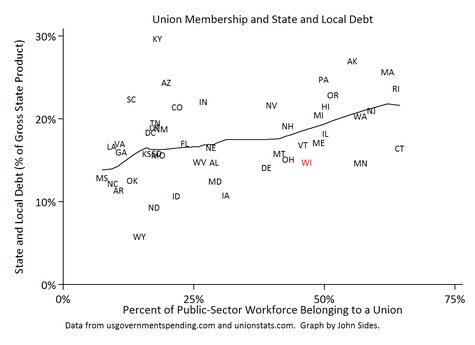
John Sides has posted dueling graphs on unions and state budgets. Reihan urges caution when interpreting such charts. Seth Masket finds the above graph the "most telling." Masket recognizes the limits of this correlation but asks us to suppose "for a moment that this relationship is causal, and that greater unionization leads to greater public debt load": 

The main benefits that union membership conveys are higher pay and improved working conditions, both of which cost the employer (in this case, the public) more. So if a greater percentage of your state's work force is unionized, you're probably going to be paying more for the labor. And since labor costs are usually contractual and not easily cut in the short run, states with greater labor costs will go into debt more quickly when revenues take a dive. This shouldn't be particularly controversial or surprising.

What the evidence above doesn't show is what citizens get by paying more for public labor.

With higher pay, you can usually attract better trained workers, turnover will be lower, services will be of higher quality, etc. (By the way, the two states with the lowest public sector unionization rates — Louisiana and Mississippi — have the highest corruption rates.)

Sometimes good things — even when they come from the government — cost more.

Mike Konczal yawns and instead focuses on the relationship between state budget shortfalls and state housing bubbles.

The Majority View

According to a Rasmussen poll, which should be taken with a grain of salt or two, "most Americans (67%) say the United States should leave the situation in the Arab countries alone." Larison contrasts this with the foreign policy debate among elites: 

[T]he public debate doesn’t include very many advocates for the majority view. This speaks volumes about the relationship between actual policy debates and public opinion. It seems unimaginable to most of the participants in foreign policy debate that a minimal or neutral role could be the appropriate and best answer to the question of how the U.S. should respond. However, if ever there were a occasion to exercise caution and restraint in using U.S. power and influence, responding to an internal conflict in a country where the U.S. has little influence and no reservoir of goodwill would seem to be it.