Why Public Sector Unions Are Different

Will Wilkinson explains:

The power to tax and spend is necessary for the performance of the democratic state's legitimate functions, but it is also a ready tool of exploitation and distributive injustice. An ideally legitimate state does nothing people can do better on voluntary terms, and it takes no more from people in taxes than is necessary to finance necessary public goods. But this is a moral target we never hit because the strategic logic of redistributive democracy reliably errs in the direction of expansion of services, deficit spending, and the abuse of taxpayers and other not-very-organised constituencies at the hands of highly-organised special interests. If we are concerned to minimise exploitation—if we care about the extent to which state violence is public-spirited and not merely criminal—we must go out of our way to acknowledge and guard against the abuses of fiscal democracy.

It is in the context of these concerns that we must consider the function of public-sector unions. If they do anything at all, it is to protect their members' claims on future government revenue from democratic discretion—to limit the power of the elected representatives of the democratic public to set the terms on which union-members will receive transfers from taxpayers. That these transfers come to workers in the form of compensation for services rendered the government seems to confuse a lot people. This is, I think, why people on both sides of the debate are distracted by the question of whether government workers are or are not "overpaid". To my mind, the real question is whether government workers should be granted special legal powers that (a) are unavailable to other groups whose welfare also turns on transfers from the treasury, or on the size of compulsory transfers from their bank accounts to the treasury, and (b) limit democratic sovereignty over the distribution of the burdens and benefits of the system of public finance.

He concludes that his "principled objection to public-sector unions is that their powers limit democratic sovereignty over taxation and public spending in a way that advantages some citizens at the expence of others—in a way that makes fiscal exploitation more, not less likely. Should they have grievances about their cut of the public budget, non-unionised government employees have recourse to the exact same democratic institutions as do other groups of citizens, which is as it should be."
George W. Bush, Iran, And Democracy

Interesting revelation in a recent Donald Rumsfeld interview when he discusses how George W. Bush handled the possibility of Iran getting nuclear weapons:

The pressure was to move diplomatically, not militarily, and the Bush administration during that period was, on some occasions, trying to generate support from other free nations in the world to put pressure on Iran and the Iranian government to behave in a manner, and discontinue their nuclear program. It was with minimal success. And the administration, you know, would blow hot and cold as to how they wanted to handle it. Sometimes, they would avoid negotiations. Other times, they would have Americans actually talking at various venues with the Iranians.

As you may recall, the right used Obama's willingness to negotiate with Iran as a cudgel during the 2008 election. This exchange about the rationale for going to war in Iraq is of interest too:

Hugh Hewitt: How much was this democracy movement on President Bush’s mind before the war began, Secretary Rumsfeld? And how much of that is a make good when the WMD weren’t found?

Donald Rumsfeld: That’s hard to answer. I don’t recall the idea of bringing democracy to Iraq as being part of the discussions in the National Security Council during the period with a build up towards the conflict with Iraq. It is, as you suggest, that, those words tended to become more prominent after the war had, major combat operations had been completed, and the subject of WMD had not been found in the kinds of supplies that had been anticipated, although there were certainly people capable of that. And the Duelfer report shows that Saddam Hussein indeed had maintained his capability to rapidly increase his weapons of mass destruction.

Hugh Hewitt: So you don’t recall deputy secretary Wolfowitz making that argument?

Donald Rumsfeld: I don’t, and I don’t recall the President doing it, or Secretary Powell.

Where Mahmoud Ahmadinejad And Glenn Beck Agree

A Tehrani explains how Iranian television is spinning the protests:

TV intermittently reminds its viewers that what is happening in Bahrain is an anti-monarchy protest by the Islamists. The footage from Egypt and elsewhere is narrated with commentary about how what is sweeping the region, from Tunis to Bahrain, Yemen, Libya, and possibly Saudi Arabia, is “political and revolutionary Islam.” At the same time, foreign journalists and anchors and stringers for foreign media based in Tehran are sternly warned not report as eyewitnesses on any opposition street protests here.

What About Education Reform?

Ozimek defends his stand against public sector unions:

In the debate over public sector unions a lot of liberals have been arguing that they are a positive political counterweight to corporate interests and a defender of the working man, and without them democracy will fail, the American Dream will die, and the earth will drift into the sun… or something like that. I recently provided an example via twitter that I thought demonstrated this isn’t always the case: teacher union opposition to charter school caps, which you’d hardly call good for working class people.

Kevin Drum responded that a single incidence of union political malfeasance doesn’t make them bad overall. Well that would indeed be a silly argument to make, and were this the only example of unions being on the wrong side of educational reform then that clearly would be the argument I was making. But do I really have to run down the litany of bad policies unions have fought to keep and good policies they’ve fought against in education reform? 

… [M]y opposition to unions can stand alone on economics alone: they’re an anti-competitive cartel, it’s as economically undesirable as any other cartel.  It’s union defenders who need to appeal to the political power of unions to explain their desirability.

What Do Americans Think Of Unions?

Nate Silver decodes Wisconsin polls:

The public might not be enamored of public sector unions, but by about a 2:1 margin, they think they have the right to exist.

I suspect, then, that the near-term political risks to Wisconsin Gov. Scott Walker are mostly to the downside. Part of it is that, as in debates over the budget at the federal level, there is an element of what chess players call zugzwang: since any specific solution over deficit reduction is likely to be fairly unpopular, the first mover or perceived aggressor is often at a disadvantage.

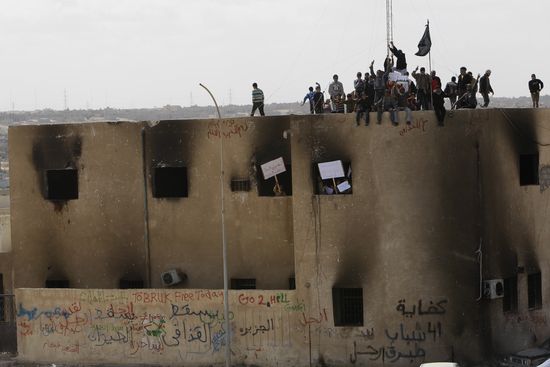
Libya Reax: “Don’t Just Sit There. Do Nothing”

LibyaPoliceStationAP

Kristol complains:

What exactly to do in each case is complicated; it depends on difficult judgments of facts on the ground. …

This is a time when one looks, necessarily, to the president. So far, one looks in vain. What has been strikingly lacking in the Obama administration's response is a sense of the possibility of the moment, a commitment to doing our best to bring that possibility to fruition, a realization that this may be an important inflection point in world history that should shake us out of business as usual.

 Greg Scoblete counters:

It seems to me that if you're going to demand action but casually glide over the specifics of what you want done – it's complicated, you see – then you don't have much grounds to criticize. That's not to say there aren't grounds to criticize the administration's handling of the situation, but vague calls to "do something" aren't very convincing.

Tom Malinowski:

There are numerous steps the United States and its allies can take today to affect the immediate calculations of the Qaddafi regime. Europe buys 85 percent of Libya's oil, after all. And the West largely controls the international financial system through which the Libyan leadership moves its money — and could block transactions with one word from the Treasury Department or other finance ministries. And there's more: Western governments could say today that they will seek international investigations and prosecutions of Libyan officials who murder their people. And they could offer to provide humanitarian assistance to parts of Libya that have fallen to the opposition. 

Mats Persson:

 The UK should throw its full weight behind German, French and Finnish calls for sanctions, including an EU-wide travel ban on Gaddafi and his family, as well as a freezing of their assets across the bloc. 

William Easterly:

Trade embargo [is] not a good idea — why punish the Libyan people? Libya’s opening to tourism and trade with the West in the last few years has arguably made this current revolt more possible, not less possible.

Andrew Carr:

The idea of [Responsibility to Protect (R2P)] was developed in response to the genocides and mass human rights abuses in the 1990s. But it may offer a way to respond to the uprisings in the Middle East. Where governments respect human rights while facing popular protests (as generally occurred in Egypt), then countries can be confident of the West's non-intervention and able to organise their own affairs. Where countries act contrary to international norms, then a response occurs on a sliding scale, from penalties (the EU is eyeing sanctions) and attempts to limit the violence, through to intervention in an extreme case.

Charli Carpenter:

What’s happening in Libya is extremely frightening. But it is a legal and political mistake to call it “genocide,” as a number of Libyan diplomats have done  … [T]here are international laws in place requiring governments not to stand by while another commits genocide. So accusations of genocide by one state are prone to trigger discussions about whether intervention is justified. This discussion, in cases where the word is used prematurely, often lead to a perception that what’s happening in Libya – or Sudan, or Burma – isn’t really “genocide” and therefore not so bad.

Well, crimes against humanity – mass murder, enslavements, rape, torture, imprisonment, apartheid – are plenty bad. 

Massimo Calabresi:

The greater danger may be of Gaddafi staying. “In the recent past [he] has been better behaved,” says a senior administration official, “But go back 20 years or so and he was a significant sponsor of terrorist acts who had a nuclear program. So a major concern is does the regime retrench in ways that affect our interests in the region? Even before this happened he was complaining that his gesture in giving up nukes had not been reciprocated with the kind of love he expected. If he somehow survives this he'll have no interest in improving relations with the west.”

(Photo: Libyan protesters stand on the rooftop of a burned police station, during a demonstration against their Libyan Leader Moammar Gadhafi, in Tobruk, Libya, Wednesday Feb. 23, 2011. Hussein Malla/AP)

Silence, With Purpose?

Larison thinks that the presence of American citizens in Libya explains the administration's muted response:

[I]t would be a remarkable display of arrogance and folly to start denouncing Gaddafi’s crimes when U.S. citizens could immediately be exposed to violent reprisals or arrest. It doesn’t seem to cross the minds of interventionists in this case that our government could imperil fellow Americans by following their advice. If official condemnations have to wait a few days or weeks until U.S. citizens in Libya are safely out of the country, that is what a responsible government should do.