Libya, Day 10: Overnight Updates

 Scott Lucas starts us off:

State media is reporting that the Minister of the Interior, Major General Abdul Fatah Younis, has been kidnapped hours after he dramatically broke ranks with Qaddafi — his friend and ally since the regime took power in 1969 — by resigning and calling on the armed forces to join the "February 17 Revolution".

This could be disinformation: in his speech yesterday, made just before Younis announced his departure, Qaddafi said the Minister of Interior had survived an assassination attempt. Or it could be a pre-emptive strike by the Libyan leader: Younis said late last night that the assassination attempt was by Qaddafi's own men, and today's rumour may be a signal that Younis has indeed been removed from the scene by abduction or worse.

More on Younis here. The latest from AJE:

12:51am: A pro-Gaddaffi Libyan police colonel says two "Islamic emirates" have been set up in the east of the country, and that drivers carrying food aid are too scared to drive to Benghazi, the site of the beginning of the uprising, because the people there are on hallucinogenic drugs. … Al Jazeera's Rawya Rageh says that all speakers in Libya's state TV press conference keep repeating that "assailants" and arrested men "are on hallucination pills".

4:51am The first major evacuation vessel sponsored by the US Government is set to evacuate American citizens from Libya.

5:54am Peru has become the first country to sever diplomatic ties with Libya in the wake of the Gaddafi regime's brutal suppression of the uprising there. Foreign minister Jose Antonio Garcia Belaunde said he would ask the United Nations to impose a no-fly zone over the country. Peru's action sets itself apart from at least one nearby country, Nicaragua, which has offered support to Gaddafi. …

Latin American leaders who have long been friendly with Gaddafi – such as Venezuela's Hugo Chavez and Cuba's Fidel Castro – are being noticeably silent on the revolt in Libya and its violent suppression, Al Jazeera's Lucia Newman notes.

6:00am More evidence that suggests foreign troops are being used in Libya – or at least that Libyans believe this to be the case. This video of a dead man shows someone holding what appear to be identification documents, possibly a passport, that looks like it bears the name "Republique du Niger" and the country's coat of arms. There is no way to verify whether the man bore arms.

1:46pm A British oil worker stranded with others in a camp in eastern Libya has called on his government to rescue them from a "nightmare" scenario. James Coyle told the BBC that he and around 300 other Britons, Germans, Pakistanis, Bangladeshis, Austrians and Romanians were stranded at the desert camp with only enough food and water to "maybe" last one day. Residents of nearby towns armed with AK-47s have come to the camp multiple times to take supplies, he said.

1:55pm The European reaction to Libya begins to get stronger: Following on the French president's call for EU sanctions, UK prime minister David Cameron has said he wants to see a full UN security council resolution regarding the bloody violence in Libya, the Reuters news agency reports.

2:23pm We're now broadcasting live from inside Libya; specifically, from the eastern city of Tobruk, which we hear is under protester control. Our footage shows an anti-Gaddafi rally, with people holding "Free Libya" signs.

A description of the above video:

From an intermediary, we've received mobile phone footage from a young Libyan in Tripoli that allegedly depicts gunfire in the Zawid Dahmani neighborhood of the capital last night, amid an ongoing and extremely violent security crackdown. You can hear a large explosion in the background – we're told it occurred at the "TV building" in the neighborhood. You can also hear a baby crying.

Below is another new clip, which shows "'mercenaries' attacking in Benghazi on Thursday. The screams of terrified onlookers are chilling":
Yesterday's round-ups are here and here.

Police Dogs Can’t Be Trusted?

73373583

Radley Balko's latest column has huge implications for the Fourth Amendment – and a nice anecdote about his dog:

For the first few years I had her, I was impressed by my late dog Harper's uncanny ability to assess people's character. She hated every crappy landlord and bad roommate. Barked at them. Snarled at them. Wouldn't go near them. But if I brought home a date I liked, Harper, a Shar Pei/Labrador mix, would curl up right next to the woman and turn on the charm. It took me several years to figure out that my dog wasn't a good judge of character; she was just good at reading me. She liked the people I liked and disliked the people who rubbed me the wrong way. For dogs descended from lines bred for protection and companionship, this talent makes sense. A dog adept at distinguishing friend from foe was likely to be kept around and bred, and one very good way to tell friend from foe is to read your master's body language.

My confusion about what was going on in Harper's head reflects a common misconception that is also apparent in the ways dogs are used in criminal investigations.

When we think dogs are using their well-honed noses to sniff out drugs or criminal suspects, they may actually be displaying a more recently evolved trait: an urgent desire to please their masters, coupled with the ability to read their cues. Several studies and tests have shown that drug-sniffing dogs, scent hounds, and even explosive-detecting dogs are not nearly as accurate as they have been portrayed in court.

So what's the problem?

As my colleague Jacob Sullum has explained, the U.S. Supreme Court says a dog sniff is not invasive enough to qualify as a "search" under the Fourth Amendment, so police do not need a warrant or probable cause to have a dog smell your luggage or your car. At the same time, however, the courts treat an alert by a drug-sniffing dog as probable cause for an actual, no-question-about-it search, the kind that involves going through your pockets, opening your luggage, looking in your trunk, and perusing your personal belongings. The problem is that a dog barking or sitting may be responding not to a smell but to his handler's hunch about a suspect's guilt.

(Photo: A British Transport Police drug dog watches a passenger walk down steps in the Elephant and Castle overground station on February 20, 2007 in London. By Bruno Vincent/Getty Images)

Freedom And Spending

After musing about how many people he could torture with a modest sum of money, Jason Kuznicki makes this point:

If you have a burning ambition to increase human liberty, the marginal returns to the enterprise are very unevenly distributed in terms of government finance. … [D]on’t imagine that lowering spending is always the best way to preserve or increase liberty. We could become a vastly freer country while paying only a little less in taxes, if the cuts came in the right places. And we could become a very, very unfree country with only a pittance in extra spending.

A Constitutional Monarchy? Ctd

A reader writes:

In this post (and some of the previous Bahrain coverage) one gets the sense that Bahrain is an absolute monarchy. This is not true. See Bahrain's constitution. Article I, Section B clearly states that Bahrain is a constitutional monarchy.

Further, section D states that "sovereignty being in the hands of the people, the source of all powers." What the protestors in Bahrain want is separation of powers and a weaker executive and stronger legislature. This constitution is why after three days of unrest Bahrain has gone back to normal and there is nothing at the Pearl Roundabout but some people smoking hooka and a popcorn machine.

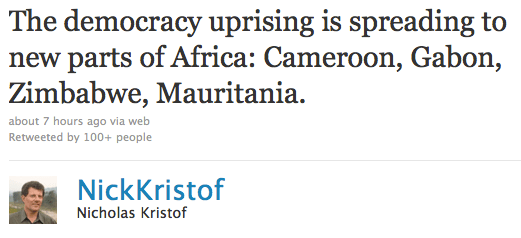
I realize that this does not fit with the "revolution" narrative promoted by Western journalists like Kristof – in which the people are facing off the Arab version of the sun-king – but reading silly things like constitutions is why thoughtful bloggers exist.

By the way, Bahrain's constitution is quite a piece of work. It might even serve as the model for other Muslim states because of how it deals with the question of Islam. It acknowledges that the Quran is not remiss in anything and that Islam is essential to salvation in the next life, while going on to say, "it is essential that we listen and look to the whole of the human heritage in both East and West, adopting that which we consider to be beneficial and suitable." That is a very progressive way of dealing with the thorny issue of Islamic constitutionalism.

The Daily Wrap

Today on the Dish, mercenaries attacked protesters and defected military, we gawked at cuckoo Qaddafi (the short version), and our jaws dropped as he rambled on. We weighed options for what the international community could do, Andrew balked at Wolfowitz's calls for a no-fly zone over Libya, and Larison argued against it. Andrew Solomon itemized Qaddafi's mistakes, and Evgeny Morozov fingered why social networks can be dangerous when governments don't fall. The first Western journalist entered Libya, John Barry enlightened us about "coup-proofing," and Andrew Barwig cautioned us to examine future electoral reform. The 1848 analogy gained steam, we previewed Iraq's day of rage, and full coverage from the long and violent weekend is here.

Andrew called Walker on his campaign promises to end collective bargaining for public sector unions, and found serious flaws in his budget. Ezra Klein asked if the GOP's hardball would pay off, Andrew called it over-reach, and Will Wilkinson questioned the left's back-up plan. The National Review offered a platform to the ever-incendiary Breitbart, and Rush Limbaugh went there. Maryland moved closer to marriage equality, Bruce Barlett examined tax trends, and Sanchez rebutted Andy McCarthy on Patriot Act wiretaps. Noah Millman chose foodie curiosity, and Felix Salmon raised renting over ownership as the next American Dream. Palin liked herself on Facebook, the Internet betrayed its partisanship, and Andrew unpacked her lies about reading all the newspapers.

Memo of the day here, quotes for the day here, here, and here, the future of eco-trash here, MHB here, FOTD here, VFYW here, and VFYW contest winner #38 here.

–Z.P.

Face Of The Day

Egho

Mackey finds it:

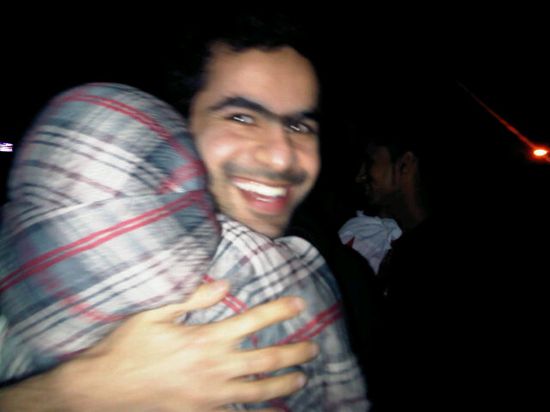
Ali Abdulemam, a prominent Bahraini blogger who was detained last year, was released on Tuesday night, according to Nasser Weddady, a Mauritanian activist and blogger. Maryam Alkhawaja of the Bahrain Center for Human Rights posted this image of Mr. Abdulemam in a set of photographs of political prisoners released in the past hour.

New Media Revolutions: High Risk, High Reward?

Evgeny Morozov remains pessimistic about the Internet's democratic potential. But even Morozov doesn't do the full-Gladwell:

The lesson here is that social media and technology can definitely make protests more effective. You look at what happened in Tunisia just a few weeks ago. Twitter and Facebook were used to get people into the streets. This is something that deserves recognition. The problem is that if the government doesn't end up falling in the end, the government also gets much more data and much better technology to engage in a crackdown.

What we saw happening in Iran two years ago was that the government simply went and collected all the tweets and Facebook messages and then went and arrested whoever it wanted because it had all the data. It's the same thing we saw in Belarus. Yes, it helped to bring people into the streets, but if the government doesn't fall in the end, it has a much better capacity, I would argue, than before technology, to actually go and track down anyone it doesn't like. So we have to be very careful.

Libya, Day 9: “My Heart Is Burning With Sorrow”

Al Jazeera says of the above video:

You must watch this. The family of Mohamed Bouazizi, the young Tunisian from Sidi Bouzid whose act of self-immolation triggered the Tunisian Uprising, has a message for the families in Libya who have lost their loved ones to the violent repression of the protests.

Below is the second half of today's news round-up. From the Guardian:

Gaddafi is not standing down or leaving the country. He said he would die in Libya "as a martyr". It was his first major speech since the beginning of the unrest that threatens to topple the regime. One of his sons, Saif, is expected to again address the country tonight. The Libyan leader has also telephoned Silvio Berlusconi, with whom he has forged a friendship, to tell him that "everything is fine" in Libya. But refugees streaming across Libya's eastern border into Egypt said Gaddafi was using tanks, warplanes and foreign mercenaries to fight the growing rebellion.

More on the Qaddafi/Berlusconi relationship here. The latest from AJE:

Libyan government spokesman gives press conference outlining the vision of Gaddafi's eldest son, Saif al-Islam. Plans for reform include boosting payments to the unemployed. Also announces the formation of a committee to investigate events over the past couple of weeks. He says people "will be shocked by the extent of the distortion committed by Arab and foreign press and media. The spokesman goes on to attack "the brothers in Qatar" [aka Al Jazeera]. …

The UN Security Council has agreed in the last hour [12:09 GMT] to condemn the violence used against protesters in Libya by the government there. …

Deputy Libyan ambassador emerges from UN discussions. This is significant, as the deputy has a radically different position to the pro-Gaddafi ambassador. … Libya's deputy UN ambassador says that Gaddafi's speech was code for his forces to start genocide against the Libyan people.

Nicaragua's president, Daniel Ortega, says he has telephoned Muammar Gaddafi to express his solidarity with the embattled leader.

Business leaders appear to be ready and waiting to move into a post-Gaddafi Libya. George Kanaan, CEO of the Arab Bankers Association in London, says reform will be "hugely positive" for the country – unlike Egypt, which already had a fairly open and "liberal" economy, change in Libya will encourage massive outside investment.

AP:

Sen. John Kerry, chairman of the Senate Foreign Relations Committee, said in a statement that the violent crackdown was "cowardly" and "beyond despicable." He urged U.S. and international oil companies to suspend their Libyan operations immediately until attacks on civilians stop. He also urged the Obama administration to consider re-imposing sanctions against Libya that were lifted by President George W. Bush after Gadhafi renounced terrorism and abandoned development of chemical, biological and nuclear weapons.

EA:

Here's a twist on this afternoon's Qaddafi speech…. The Libyan leader said, in his 90-minute ramble, that Minister of Interior Abdul Fattah Younis had survived an assassination attempt but was missing. Well, tonight Younis has said, "Qaddafi's men came to shoot me but the bullets missed me." … Speaking to Al Jazeera, Libyan Minster of Justice Mustapha AbdalJalil, who has also resigned, is praising protesting youth.

More fascinating details on the Younis defection here.