“Cash For High-Tech Trash”

Katie Fehrenbacher explains the concept behind ecoATMs:

Ecoatmimage4You drop off old electronics at one of these machines; it calculates their value, then pays you on the spot, in cash or coupons. The company says its secret sauce is the kiosks’ ability to automatically estimate — using electronic and visual techniques — a price of the unwanted items that will give consumers an immediate financial incentive to recycle 
at the station.

Quote For The Day

"The desire of Government employees for fair and adequate pay, reasonable hours of work, safe and suitable working conditions, development of opportunities for advancement, facilities for fair and impartial consideration and review of grievances, and other objectives of a proper employee relations policy, is basically no different from that of employees in private industry. Organization on their part to present their views on such matters is both natural and logical, but meticulous attention should be paid to the special relationships and obligations of public servants to the public itself and to the Government.

All Government employees should realize that the process of collective bargaining, as usually understood, cannot be transplanted into the public service.

It has its distinct and insurmountable limitations when applied to public personnel management. The very nature and purposes of Government make it impossible for administrative officials to represent fully or to bind the employer in mutual discussions with Government employee organizations. The employer is the whole people, who speak by means of laws enacted by their representatives in Congress. Accordingly, administrative officials and employees alike are governed and guided, and in many instances restricted, by laws which establish policies, procedures, or rules in personnel matters," – Franklin Delano Roosevelt.

“You Must Show The World What Has Happened Here!”

CNN's Ben Wedeman is the first Western journalist to enter Libya:

"Your passports please," said the young man in civilian clothing toting an AK-47 at the Libyan border. "For what?" responded our driver, Saleh, a burly, bearded man who had picked us up just moments before. "There is no government. What is the point?" He pulled away with a dismissive laugh.

On the Libyan side, there were no officials, no passport control, no customs. I've seen this before. In Afghanistan after the route of the Taliban, in Iraq after the fall of Saddam Hussein. Government authority suddenly evaporates. It's exhilarating on one level; its whiff of chaos disconcerting on another.

Follow Wedeman's tweets here.

Cuckoo Qaddafi

Scott Lucas awakes to find an early morning clip of the Libyan dictator on State TV, "which appeared to have no more purpose than to confirm that he was still in Libya":

It was an unusual setting, even for Qaddafi: he sat inside a "TokTok" vehicle, holding aloft a massive umbrella. The speech lasted all of 22 seconds with Qaddafi declaring, ""I am in Tripoli and not in Venezuela. Do not believe the channels belonging to stray dogs….I wanted to say something to the youths at the Green Square (in Tripoli) and stay up late with them but it started raining. Thank God, it's a good thing."

Max Read gawks at a 40-second version:

Qaddafi long ago mastered the '70s Dylan/"coked beyond belief in weird hats" look, but (besides the umbrellas) it's the shaky camerawork, authentically grainy film stock, and the long, meditative take of Qaddafi's palace that really makes this one special.

And yes, there's already a mashup.

The Weekend Wrap: Revolution In The Air

AP110220028721_

A lot happened over your holiday weekend. Bahrain, following a week of violence, took a big turn for the better on Saturday as security forces ceded Pearl Square to the protesters. Nick Kristof conveyed the joy of the crowd but cautioned against declaring victory just yet. Andrew hoped that calls for a constitutional monarchy come through and wondered about Obama's behind-the-scenes role. A young Bahraini girl smiled with guarded optimism, a Bahraini boy signaled victory, and a Muslim boy joined the cause against extremism.

Libyaflag

Meanwhile, the brutal violence in Libya continued to escalate. Massacres carried over into Sunday, spreading from Benghazi to the capital city of Tripoli. Qaddafi's son took to the airwaves that night to threaten an even bigger crackdown. The people reacted with rage while a group of prominent Muslim leaders implored the regime to refrain from violence. Those calls went unheeded as the bloodshed poured into Monday. Disturbing reports and graphic images here, here, here and here. As military commanders defected to the West and ambassadors abandoned their posts, Qaddafi appeared to be in his last throes.

50780409

A big reax of Libya analysis here. Marc Lynch pushed for US and UN intervention, Daniel Byman assessed American interests in Libya, and Ryan Avent fretted over the economic shocks. Andrew compared the Arab uprisings to the European revolutions of 1848 and pondered the impact that Bush and other neoconservatives may have had on the former. A glance at the far right's reaction here. Lucan Way described the vulnerability of regimes based on patronage while Graeme Robertson examined how protests topple regimes in general.

The Green Movement in Iran had another big day of protests on Sunday; read our news roundups here and here; watch footage from the streets here and here. Yet another Muslim nation, Morocco, joined in the democratic uprisings; read a roundup here and watch footage here and here. There were even some rumblings in China.
109330491

In Egypt coverage, the Dish took a long, comprehensive look at the country's future. We also kept an eye on Sheikh Qaradawi – a guru for the Muslim Brotherhood who just returned from exile – and dug up some disturbing data. Ian Johnson sharpened our view of the Brotherhood. Jeff Strabone addressed the post-Mubarak impact on Israel.

On the media front, Morgan Meis praised Al Jazeera's oil-financed integrity, Dan Drezner delved into the disastrous message control of Arab regimes, Andrew Exum emphasized the role of cell phones in the uprisings, Clay Shirky talked sense on the impact of Twitter and Facebook, and Malcolm Gladwell's thesis crumbled even more.

A reader commented on our coverage. Another provided a placid view of Isfahan, Iran.

— C.B.

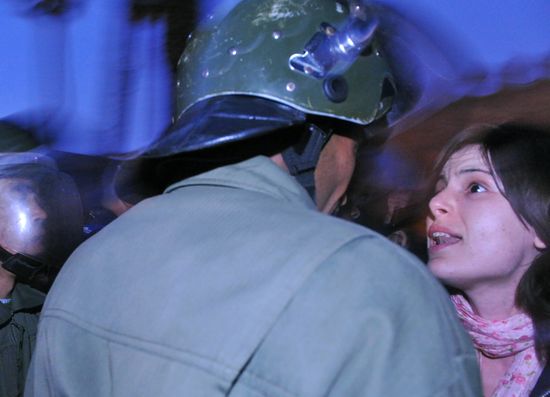
(Photo of celebrating Bahraini protesters by Hasan Jamali/AP; Libya's new flag by khalidalbaih, via BoingBoing; photo of Qaddafi by Mark Renders/Getty Images; video of Iranians chanting “Independence! Freedom! Iranian Republic!”; photo of a demonstrator arguing with a police officer in Rabat, Morocco by Abdelhak Senna/AFP/Getty Images)

Why Do Protests Bring Down Regimes?

LibyaEgyptAP

Joshua Tucker asked the question awhile back. Graeme Robertson's answer:

The key to answer this question, I think, is to understand the basic nature of authoritarian rule. While the news media focus on "the dictator", almost all authoritarian regimes are really coalitions involving a range of players with different resources, including incumbent politicians but also other elites like businessmen, bureaucrats, leaders of mass organizations like labor unions and political parties, and, of course, specialists in coercion like the military or the security forces. These elites are pivotal in deciding the fate of the regime and as long as they continue to ally themselves with the incumbent leadership, the regime is likely to remain stable. By contrast, when these elites split and some defect and decide to throw in their lot with the opposition, then the incumbents are in danger.

So where do protests come in? The problem is that in authoritarian regimes there are few sources of reliable information that can help these pivotal elites decide whom to back. Restrictions on media freedom and civil and political rights limit the amount and quality of information that is available on both the incumbents and the opposition. Moreover, the powerful incentives to pay lip service to incumbent rulers make it hard to know what to make of what information there is. Rumor and innuendo thus play a huge role in all authoritarian regimes.

In this context, protests are excellent opportunities for communication. 

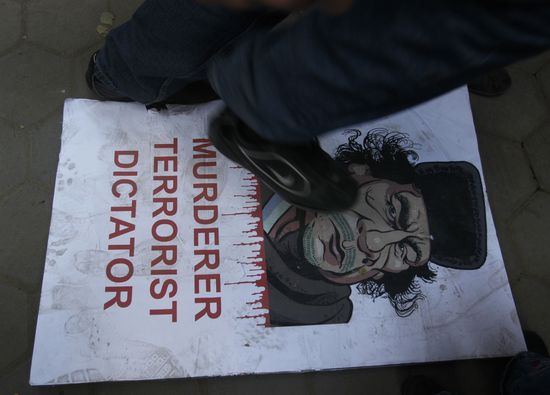
(Photo: A Libyan protester steps on a poster of Libyan Leader Moammar Gadhafi during a protest in front of the Libyan embassy in Cairo, Egypt, Monday Feb. 21, 2011. By Hussein Malla/AP)

After Qaddafi

Daniel Byman examines America's national interest:

Libya is not a close U.S. ally. While Libya is an important oil producer, and while it does assist U.S. counterterrorism efforts against al-Qaida and its allies, the decades of hostility and the bizarre nature of Qaddafi's rule have limited the rapprochement that has occurred in the last decade or so. So while policymakers worry that a post-Mubarak Egypt or a democratic Bahrain may be more hostile to the United States, in Libya there is a sense that a new regime can't be any worse.

That is always dangerous thinking in the Middle East, where bad regimes were often succeeded by worse ones. The chaos in Libya and the lack of unity among the opposition also raise the risk that strife could become a sustained civil war, with thousands more dying. For now, however, it seems right to hope that Libya will follow Egypt and Tunisia, even though there is little the United States can do to make this happen.

Email Of The Day

A reader writes:

For what it's worth, I'm not at all irate about your concentration of coverage on the uprisings in the Middle East. There are many venues for info on Wisconsin – TPM is a good representative example – and far too few doing the kind of broad synthesis you are on Iran/Libya/Bahrain/Yemen etc.

During the Egyptian revolution, while I kept my ear close to the live blogs of al-Jazeera English and the NYTimes, the Dish also was a superlative resource for the widest possible number of perspectives.

The Egyptian revolution exhilarated, then terrified, then exhilarated me again: I have many friends in the country whose safety I feared through in the days of retaliation, and whose exuberant joy in the wake of the Tahrir Triumph would, I would hope, move even the stoniest hard-right American heart. Watching the yearning for democracy, for self-actualization, for freedom, sweep through the region, not dependent on US interference but proving by its very spontaneity how intrinsic the desire for freedom is, has been something that has brought me to tears daily.

Wisconsin already has democracy. Many people are covering the situation there. (Also, I suspect, given what you've written so far, that I probably wouldn't agree with your take on it, anyway.) I say, feel free to indulge in as much coverage as you like of the truly historic protests in the Middle East. You are doing a mitzvah with your coverage!

Face Of The Day

BahrainChildGetty

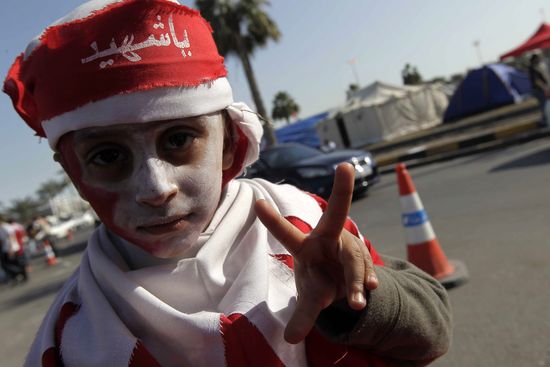
A young Bahraini anti-government protester wearing a headband reading 'Oh martyr' flashes the victory sign at Pearl Square in Manama on February 20, 2011. Bahrain's Sunni Muslim ruling family came under increased pressure to open in-depth negotiations with the Shiite-led opposition, as protesters stayed camped out in the capital's Pearl Square. By Joseph Eid/AFP/Getty Images.

There Is No Libyan Meet The Press

Drezner wonders why "leaders in Tunisia, Egypt, and Libya have been [utterly incompetent] at managing their media message":

[M]ethinks that one problem is that most of these leaders have simply fallen out of practice (if they were ever in practice) at personally using the media to assuage discontent.  I've been on enough shows on enough different media platforms to appreciate that there is an art, or at least a tradecraft, to presenting a convincing message in the mediasphere.  Authoritarian leaders in the Middle East are quite adept at playing internal factions off one another.  That's a different skill set than trying to craft a coherent and compelling media message to calm street protestors no longer intimidated by internal security forces. 

Indeed, as I argued in Theories of International Politics and Zombies, bureaucratic first responses to novel situations are almost uniformly bad.  Sayf pretty much admitted this last night, as he acknowledged that the Libyan armed forces were not trained to deal with street protestors.  I suspect the same is true with the state media outlets — they excel at producing tame, regime-friendly pablum during quiescent periods, but now they're operating in unknown territory.