Marriage Equality In Maryland

A heads up from a reader:

My state, Maryland, is poised to take a big step forward this week by legalizing same sex marriage. The State Senate appears to have the 24 votes to advance the bill and the House of Delegates is more than ready to pass it.  The Governor will sign the bill without pause. 

I am proud of my state.  Our General Assembly meets only 90 days a year and passes only 1/3 of the introduced bills (by law, the only bill that must pass is the state budget).

Often, the GA will kick the ball down the street rather than tackle a difficult piece of legislation (they have been doing so with the death penalty for over a decade).  Many state senators who oppose gay marriage have stated publicly that while they oppose the bill, they will vote for it so they are on the right side of history, which amazes me.  They cite co-workers and family friends who they feel deserve the dignity of full equality.

As a heterosexual male who has been married for over 10 years, I am excited.  I live on a street with one gay couple, who this summer can be legally married (they married in their church years ago).  Their employers and the church recognize their union and now the state is catching up. Next stop – the Federal government!

More details here. From the above Youtube:

The interfaith council lead by the "Standing on the Side of Love" campaign, gathered together religious leaders of many faiths and denominations; from episcopal, to Catholics, to Jewish, to Southern Baptist and many others.  All spoke from a perspective as to why they feel their faith should support marriage equality for same-sex couples. This is father Joe Palacios comments from the Catholic perspective.

Money quote from Palacios:

Here in Maryland – the cradle of Catholicism, of the American Catholic Church – we have a long history of Catholics forging a new path for justice and freedom for all.

“A Potent Mixture Of Fundamentalism And Modern Politics”

Ian Johnson recounts the Muslim Brotherhood's history:

Since the 1950s, the United States has secretly struck up alliances with the Brotherhood or its offshoots on issues as diverse as fighting communism and calming tensions among European Muslims. And if we look to history, we can see a familiar pattern: each time, US leaders have decided that the Brotherhood could be useful and tried to bend it to America’s goals, and each time, maybe not surprisingly, the only party that clearly has benefited has been the Brotherhood.

Johnson examines their platform:

In Egypt, the Brotherhood’s political platform officially says that women and Christians should not be allowed to become president. The platform also calls for religious oversight of secular courts and of all laws passed by civilian institutions. Whether this would be the thin edge of Islamic law, or sharia, is hard to know—even defining sharia is difficult because so many interpretations of the Koran are possible and have been championed by various schools of Islamic jurisprudence. But even if more moderate voices win out, it’s hard to see how the Brotherhood’s involvement in post-Mubarak Egypt will not increase pressures on ordinary people to conform to a more orthodox, or even fundamentalist, lifestyle that could be quite different from today.

The Economics Of Revolution: Oil Spikes

Avent grows worried:

In the long-run, a freer Middle East and North Africa would be an unqualified boon for the global economy, and for the citizens of those countries most of all. In the short-term, however, uncertainty is contributing to market volatility. Egypt is a far more populous country than Libya. But Libya has nearly ten times more oil than Egypt. And so unrest is contributing to a rising oil price. Brent crude jumped about 3% to nearly $106 per barrel today, and West Texas Intermediate is up just over 6%. Set against the world historical events taking place in Libyan streets, these seem like petty concerns, but for consumers around the world (and embattled central banks) rising oil prices could mean trouble.

What’s At Stake In Wisconsin: A Primer On The Debate

In an attempt to better understand what is happening in the state, we've collected commentary from across the political spectrum. Above is a Heritage video making the Republican case against public sector unions. On the other side of the aisle, here's Drum:

Of course unions have pathologies. Every big human institution does. And anyone who thinks they're on the wrong side of an issue should fight it out with them. But unions are also the only large-scale movement left in America that persistently acts as a countervailing power against corporate power. They're the only large-scale movement left that persistently acts in the economic interests of the middle class. 

Bainbridge:

A core problem with public sector unionism is that it creates a uniquely powerful interest group. In theory, bureaucrats are supposed to work for and be accountable to the elected representatives of the people. But suppose those bureaucrats organize into large, well-funded, powerful unions that can tip election results. With very few and very unique exceptions, no workplace in which the employees elect the supervisors functions well for long. … In effect, public sector unionism thus means that representatives of the union will often be on both sides of the collective bargaining table. On the one side, the de jure union leaders. On the other side, the bought and paid for politicians. No wonder public sector union wages and benefits are breaking the back of state budgets. They are bargaining with themselves rather than with an arms'-length opponent.

Sargent:

The flip side of this is that if labor loses after elevating the Wisconsin battle into a national battle, anti-labor activists will seize on it to embolden other governments to move forward. Indeed, I spoke to one anti-labor activist who said he's relishing a defeat for labor in Wisconsin, because it will stiffen the spines of other governments eyeing similar efforts. In other words, what happens in Wisconsin could have major ramifications for whether the phenonemon Krugman describes — the undermining of one of the last institutions representing the interests of middle-class and working-class Americans — will continue apace with the further erosion of public employee rights in other states.

Joe Klein:

As I said in my earlier post, a great many public employees are severely underpaid–this is especially true at the federal level, where the scientists testing drugs at the Food and Drug Administration or the bank regulators at the SEC could probably double their salaries by sliding into the private sector. But it's also true at the bottom of the wage scale, for the school bus drivers and home health care workers. The only rationale for public employees unions to exist is to create wage floors for such workers. But the public unions have set about, largely unimpeded, to build walls (work rules) that constrict government innovation and ceilings (opposition to merit pay) that make it less likely that the most talented professionals will remain in public service. That is the fundamental problem of governance we're facing as we attempt to compete in a global economy.

Politifact is policing the debate. Rachel Maddow claimed that "despite what you may have heard about Wisconsin’s finances, the state is on track to have a budget surplus this year." Politifact corrects the record:

There is fierce debate over the approach Walker took to address the short-term budget deficit. But there should be no debate on whether or not there is a shortfall. While not historically large, the shortfall in the current budget needed to be addressed in some fashion. Walker’s tax cuts will boost the size of the projected deficit in the next budget, but they’re not part of this problem and did not create it.

Ezra Klein:

State and local budgets are in bad shape. They'll need deep reforms across a variety of categories, from tax increases to service cuts to changes to employee compensation. But the focus on public employees — and the accompanying narrative that they're greedy and overcompensated — obscures a lot of that: It makes it seem as if the decisions that have to be made are easy and costless and can be shunted onto an interest group that some of us, at least, don't like. It's the Republican version of when liberals suggest we can balance the budget simply by increasing taxes on the rich. But it's not true.

Reihan:

[O]nce we’ve embraced best practices, increasing productivity is fundamentally a process of search and experimentation. Rigid work rules make search and experimentation really hard, which is why I’m skeptical about the virtues of organized labor in most domains, including the public sector. The issue of public sector reform and flexibility isn’t about who to blame. Rather, it is about trying to make government work better for everyone, including taxpayers.

Yglesias:

At the federal level, it’s now cliché to deplore talk of cutting spending by cutting “waste and abuse.” The recent focus on public sector pay largely strikes me as a revival of the same trope. In either case the name of the game is to persuade people that lower taxes are compatible with an identical level of government services. We’ll have all the same people do all the same stuff but just pay them less! I don’t buy it. Of course if you cut teacher salaries across the board they don’t just all quit and leave to be replaced by worse people. But what happens at the margin is that the best people leave, to be replaced by worse ones. There are (big) problems with teacher compensation schemes in the United States, but that doesn’t solve any of them.

Christian Schneider:

Clearly, the public has begun to recognize the largess of the Wisconsin pension system. According to a Wisconsin Policy Research Institute report in February of 2010, a private sector worker would have to earn $70,000 per year to earn the same pension as a public sector employee that makes $48,000. The average employer contribution for private sector plans is 5.3 percent of payroll, compared with the Wisconsin Retirement System, in which the employer contribution ranges between 10.55 percent and 13.3 percent of payroll. 

Cohn:

A new paper by the Economic Policy Institute breaks down the numbers and finds that Wisconsin’s public workers are, if anything, underpaid relative to their private sector counterparts. Of course, Walker and his allies insist that the real problem is not so much wages as health benefits and pensions. But the researcher who wrote the EPI paper, Jeffrey Keefe of Rutgers University, considers that possibility. Although public employees may pay less for some benefits–in particular, their health insurance typically comes with lower premiums and cost-sharing–he argues they still fare no better than their private sector counterparts when it comes to total compensation.

Adam Ozimek

Taking a crisis and using it to serve a “longtime ideological objective” is a pretty good description of a lot of what went into the ARRA, including a lot of the infrastructure investments and Race to the Top. You might argue that “well those are just good policy!” and with some of it I might agree, but they are long-term goals and not the best use of short-term stimulus, and they certainly had ideological detractors on both the left and the right. These parts of the ARRA strike me as fairly comparable to what Governor Walker is doing, so I’m not sure why anyone who didn’t complain about that aspect of the ARRA is complaining about this if they object to this type of policymaking per se. My guess is that most people are fine with this when the long-term ideological goals being met are their own.

Ezra Klein, again:

American labor — and all the good and the bad that it does — is one unit, combining the density and dues of both its public- and private-sector members. If public-sector unions had never been founded, labor would've been much weaker in the 20th century. If they're killed now, a resurgence of private-sector unions becomes even more unlikely going forward. The stakes here are for American labor — and the public — as a whole. They are not limited to a few public-sector unions.

Erica Grieder

[T]he impasse seems to have softened the Republicans a bit; Dale Schultz, a moderate Republican senator, has offered a compromise proposal. Will it work? Maybe, maybe not. But insofar as part of the reason we have legislatures is to give people a mediated space to air their grievances, the uproar in Wisconsin has had that benefit for the state.

Matt Steinglass:

In most lines of work, individuals' power to negotiate higher wages with large organisations is very limited. In government employment, individuals' power to negotiate higher wages is utterly non-existent. An individual teacher who bargains with a private school for a higher wage than her peers is going to have a tough negotiation on her hands; an individual teacher who tries to bargain with the City of Milwaukee for a higher wage than her peers is going to be laughed out of the superintendent's office. In his initial post on this subject, my colleague ventured that civil servants would constitute a powerful bloc able to protect their wages even without unions. I'm not really sure what this means. Through what mechanism are civil servants supposed to bargain for wage increases if they don't have unions? Who's supposed to do the bargaining?

Libya: What Can We Do?

Marc Lynch thinks it's "time for the United States, NATO, the United Nations and the Arab League to act forcefully to try to prevent the already bloody situation from degenerating into something much worse." He recommends the U.S. "call for an urgent, immediate Security Council meeting and push for a strong resolution condeming Libya's use of violence and authorizing targeted sanctions against the regime":

There is no avoiding what is happening in Libya. Al-Jazeera Arabic has been covering the Libyan situation heavily for the last couple of days and has powerfully conveyed the gravity of the situation, including broadcasting some truly disturbing images and video of protestors.  I've been stunned by what Libyans inside the country and outside have been willing to say on the air about the regime — prominent Libyan diplomats declaring Qaddafi to by a tyrant, major tribal leaders calling for his overthrow, Yusuf al-Qaradawi calling on the air for someone to shoot Qaddafi, and more. 

The Arab world's attention is focused on Libya now, after several days of a fragmented news agenda divided among Libya, Yemen, Bahrain, Egypt and more.  Voice after voice, Libyans and other Arabs alike, denounce the silence of the international community and call for action.  Qaddafi has few friends, and Qatar has called for an urgent Arab League meeting to deal with the crisis.  While history doesn't suggest we can expect all that much from that club, their public support for international action could go a long way towards overcoming any suggestion that this is an imperialist venture. 

Especially gruesome clips can be viewed here, here and here. Footage of a sniper shooting at a distant crowd here.

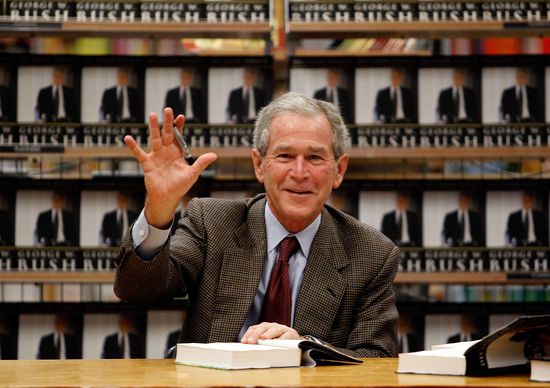
Bush’s Vindication?

BUSHTomPennington:Getty

Glenn Reynolds:

ANDREW SULLIVAN THINKS IT’S ODD that many on the right don’t share his enthusiasm for the revolutions in the mideast, but rather worry that they will turn out like Iran in 1979. Well, as I’ve said before, I think the United States squandered its momentum in 2005, and that now we look like the weak horse, and the Islamists look stronger. Of course, we can hope that the forces of bourgeois moderation win out, and I do, but is that how to bet?

Here's what he means by losing momentum in 2005:

Had we pushed the overthrow of tyrannical Arab regimes post-Iraq (as some unsuccessfully urged) there might have been a wave of truly democratic revolutions, with Iraq explicitly the model, leading to Egypt as the “prize.” We are now seeing, at least potentially, such a wave, but the U.S. has been propping up Mubarak — thanks, Joe! — the Saudis, and other despots since we lost our pro-democracy mojo in 2005 after the Cedar Revolution, for reasons that are still not entirely clear. That means the risk that power will coalesce around the only organized groups on the ground — the Islamists — is much greater now than it would have been then, and we are likely to be less favorably perceived. It’s possible, of course, that things will still go well — don’t write off people’s enthusiasm for freedom — but circumstances aren’t as congenial as they might have been.

It's hard to know what "for reasons that are still not entirely clear" and "pushed the overthrow of tyrannical Arab regimes" mean. Reynolds cites Saudi Arabia as a place where we could have pushed regime change in a way that would least likely create an Islamist "strong horse". Ooookaaay. And – call me crazy – but maybe the momentum for democracy was stalled by a total sectarian meltdown and civil war in Iraq, the model for democracy in Bush's dreams? Nonetheless, here's Condi Rice in Cairo calling for democracy in Egypt in 2005. Doing what Rice did in 2005 was pretty ballsy, especially given the cautionary tale of Iraq at the time. Maybe we should have cut off aid to Egypt long, long ago. On that, I agree with Reynolds. But that deal is inextricably wrapped with aid to Israel, since the 1979 peace agreement. And we know how untouchable that is. Complicated, isn't it?

But check out Bush's pivotal speech in Whitehall in November 2003 and think of the last few weeks Money quote:

The United States and Great Britain share a mission in the world beyond the balance of power or the simple pursuit of interest. We seek the advance of freedom and the peace that freedom brings…

By advancing freedom in the greater Middle East, we help end a cycle of dictatorship and radicalism that brings millions of people to misery and brings danger to our own people.

The stakes in that region could not be higher. If the Middle East remains a place where freedom does not flourish, it will remain a place of stagnation and anger and violence for export. And as we saw in the ruins of two towers, no distance on the map will protect our lives and way of life. If the greater Middle East joins the democratic revolution that has reached much of the world, the lives of millions in that region will be bettered, and a trend of conflict and fear will be ended at its source…

We must shake off decades of failed policy in the Middle East. Your nation and mine, in the past, have been willing to make a bargain, to tolerate oppression for the sake of stability. Longstanding ties often led us to overlook the faults of local elites. Yet this bargain did not bring stability or make us safe. It merely bought time, while problems festered and ideologies of violence took hold.

I still think that basic analysis is correct. Could it possibly be that it depends on which party holds the White House that determines Reynolds' position on any particular issue? Surely not.

But, look, I am not in any way sanguine about the future of Arab world in the wake of what appears to be its 1848. Anything can happen. But we know that the tyrannical stability we long pursued came back to haunt us. As I put it in my paywalled column this Sunday:

With the benefit of hindsight, the Bush administration's response [to 9/11] was 80 percent right and 100 percent wrong.

They were right when they immediately grasped that al Qaeda and its copycats were a product in part of repressive, secular Arab regimes who forbade legitimate outlets for dissent, and thereby made a huge young generation more susceptible to the extremes.

Democratization was the only ultimate answer – where politicians actually had an incentive to respond to real complaints (about public services, police, infrastructure, and the rest), rather than rant about Allah or the evil of the Jews and Americans. Give the Muslim world that air to breathe, Bush argued most famously in his London speech, and change would come. But tragically, he decided he couldn't wait and tried to impose democracy by force of American arms and with almost no planning in Iraq and Afghanistan. You know the rest of the story. Rousseau was wrong. You cannot force people to be free.

And so the last remarkable month has been, in some ways, a vindication of neoconservatism's core insight about the Arab world's yearning for democracy; and a refutation of neoconservatism's hubristic notion that another country, especially the US, could impose it.

Which is really a vindication for Obama, whose own speech in Cairo echoed many of Rice's themes. Iraq? Notice how the experience in Iraq was used by the Arab world's tyrants – by Seif Qaddafi as recently as last night – as an example of what happens when Western democracy is installed: chaos, mass murder, and civil war. Tunisia and Egypt managed to cancel out Iraq.

(Photo: Tim Pennington/Getty.)

The Origins Of Revolution

Lucan Way contemplates them:

Ties to revolutionary struggle give military and security officials a sense of mission required to engage in risky and violent behaviour necessary to put down large scale protest. In Iran in 2009, the legacy of 1979 ensured the loyalty of a powerful, and ideologically motivated coercive apparatus that was able to put down a serious opposition challenge.

By contrast, regimes rooted mostly in patronage – such as Egypt, Libya, and Tunisia – are much more vulnerable to crisis.

When-due to economic downturn, widespread protest, or a strong electoral challenge–the ruling coalition’s hold on power is threatened, regimes that are bound together primarily by patronage often suffer large-scale defection. Indeed, if a crisis convinces ruling elites that continued loyalty threatens their future access to patronage, it may trigger a bandwagoning effect in which politicians defect en masse to the opposition. As one defecting member of the ruling UNIP party in Zambia that collapsed in 1991 put it, “only a stupid fly … follows a dead body to the grave.”

China Too?

The unrest is real, but Jeremiah Jenne has some cold water for those hoping for more. Money quote:

The salient point is that many people in China do calculate the risk versus reward of taking on the government not only in terms of their own personal safety (because the Party still can be very brutal towards those it feels are a threat to its legitimacy) but also in terms of the larger cost of revolution and the possibility of undoing the very real gains many people in China have made over the past thirty years. While it can be easy to sell a message of "Stick with us or face the consequences" when you have near total control over the education, information, and media environments, it is still worth noting that an awful lot of people in China, especially in Beijing, buy into this.  So long as this is the case, and so long as there aren't any events or causes which mobilize popular discontent across class lines or geographic distance, the chances of a revolution — of any flavor — in China will remain quite remote.