The Cellular Revolution?

Internet

Exum makes two obvious points. That "the Internet, Facebook and Twitter played a terribly important role in mobilizing the Egyptians who filled the streets of Egypt to protest the regime" and that it "took ACTUAL BODIES out there in the streets and not 'Facebook Revolutionaries' just re-tweeting the struggle from the comfort of their homes." A more insightful observation: 

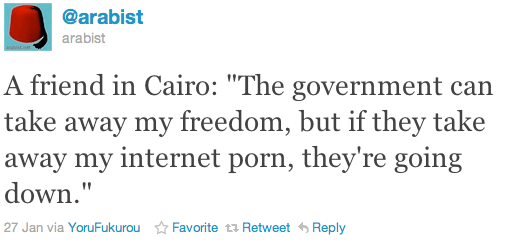
One interesting piece of analysis I have now heard from several smart observers is that by shutting down the Internet and the cellular phone networks, the Egyptian regime actually *increased* the number of Egyptians on the streets protesting. Not only did shutting down the Internet force people to leave the house and physically connect with their fellow protesters, but one friend noted that if you really want to piss off all of Egypt, a good way to do so is by shutting off cell phone service. More than Facebook or Twitter, cellular phone service unites Egyptians in a virtual community. And by shutting down cellular phone service, you're sure to anger Egyptians of all generations and classes — and not just the college kids with Facebook accounts. So score one for the enduring power of 20th Century technology, perhaps.

(Tweet from the Arabist)

Shot Dead In The Street

Graphic footage apparently captured in Libya today:

Another graphic scene after the jump:

These clips were taken directly off YouTube, so we can't verify their authenticity yet. The latest from EA:

Although it is impossible to confirm because of the communications blackout, there are mounting reports of a large number of casualties in the Fashloom and Tajoura suburbs of Tripoli. Residents of Tajura says the bodies of the dead are being left in the streets, because relatives cannot retrieve them amidst the shooting.

What Egypt Will Change For Israel

Jeff Strabone offers some thoughts:

The top two recipients of U.S. aid for the past thirty years have been have been Israel and Egypt. Israel's annual gift has ranged from $2.3 to $3.1 billion a year over the last decade, Egypt's from $1.5 to $2.0 billion. Without the many billions to Israel over the years, their republic might not have endured for the past 62 years. Without the many billions to Egypt, Israel would not have had a friend at its southwestern border. Looked at starkly, the U.S. has paid Mubarak to be Israel's friend at the cost of the livelihoods of the 80 million Egyptians whose hopes and aspirations he stifled for the past thirty years. This is a depressing calculus of human suffering, and that's without factoring in the suffering of the Palestinians.

It's safe to say that no democratically-elected successor in Egypt will be as Israel-friendly as Mubarak was. Why does this prospect alarm Israel? Israel has depended on Egypt for at least two things whose terms are likely to change: border security at Gaza and energy supply.

Israel had a chance to get ahead of events by making real concessions on the West Bank. Netanyahu doubled down on Greater Israel. I'm pretty sure the Arab 1848 will harden Israel's stance toward giving up its settlements. But one also wonders what the Palestinian position would be today if they had adopted non-violent resistance as a tactic instead of terrorism for so long. Both sides have missed an opportunity. But with the Obama administration caving to AIPAC on settlements at the UN, the US missed an opportunity as well.

Egypt’s Future, Ctd

CAMERONEGYPTKhaledDesouki:AFP:Getty

John Hinderaker gets a bad feeling about the return of Sheik Yusuf al-Qaradawi, who had been exiled by Mubarak, and his negative comments about Jews and American forces in Iraq from the last couple of years. On Friday, al-Qaradawi spoke to a crowd of, reportedly, more than a million Egyptians in Tahrir Square:

One of the western media's favorite Egyptian rebels is Google executive Wael Ghonim. No surprise there: if you had to choose among radical clerics like al-Qaradawi, hooligans like those who assaulted Lara Logan, and a suave, Westernized Google exec, whom would you want to interview? Ghonim was present on Friday and intended to address the crowd, but he was barred from the platform by al-Qaradawi's security. He left the stage in distress, "his face hidden by an Egyptian flag."

Juan Cole defends him:

Yusuf Qaradawi, the 84-year-old preacher whose roots are in the old Muslim Brotherhood before the latter turned to parliamentary politics, is nevertheless no Ayatollah Khomeini. Qaradawi addressed thousands in Tahrir Square in Cairo on Friday. Qaradawi called for Muslims to fight the Taliban and al-Qaeda alongside US troops in 2001. On Friday he praised the Coptic Christian role in the Egyptian revolution and said that the age of sectarianism is dead. Qaradawi is a reactionary on many issues, but he is not a radical and there is no reason to think that either the Youth or Workers’ Movements that chased Hosni Mubarak out of the country is interested in having Qaradawi tell them what to do.

Jake Caldwell assesses Egypt's food security:

As the world’s largest importer of wheat, Egypt is acutely vulnerable to any surge in food prices. Wheat prices have risen 47 percent over the last year and other staples are rapidly approaching dangerously high levels.

Rapid population growth, widespread poverty, massive unemployment among the two-thirds of Egyptians under 30 that form part of the youth bulge, and spiraling inflation all make it difficult for families to keep pace with rising food costs. Egypt has spent $4 billion a year, or 1.8 percent of GDP, on its bread-subsidization program in an attempt to insulate the 40 percent of Egyptians living on less than $2 a day from inflation. And yet prices continue to rise.

Aaron Goldstein raises concerns about Iran's plans to send two naval ships across Egypt's Suez Canal:

As disturbing as this development is what is equally troubling is the fact that Egypt's new military government has given Iran's intentions its blessing. It thus marks the first time an Iranian ship has crossed the Suez since 1979, the year of the Iranian Revolution. Israel understandably considers Iran's intentions to be highly provocative as they could conceivably attack the Jewish State from the Suez.

Pouya Alimagham gleans lessons for Iran from Egypt's revolution:

[T]he opposition’s strategy should not be limited to street activity, as it was in the past, but expanded into a more comprehensive approach including strikes, encampments in Iran’s own Liberation Square and, most importantly, garnering the support of Iran’s armed forces—all of which were tactics vital to success in Egypt. … The speed with which the dictatorships in Egypt and Tunisia fell stands in stark contrast to the Iranian government’s survival after the 2009 post-election turmoil – a critical point that needs to be considered when strategizing how to promote non-violent democratic change in Iran.

Exum worries about the police:

[W]e Americans paid — and are paying — a heavy price in Iraq and Afghanistan for the way in which the development of competent local police lags behind the development of the Army in both countries. In Cairo, at least, the police are rarely seen these days. The police officers you do see, usually directing traffic, never much respected anyway, have lost their ability to intimidate the people, who now periodically hurl abuse at them and who see themselves as having "defeated" the police during the demonstrations — and not just in Tahrir Square but all over the countryside, where police stations burned from Upper Egypt to the Delta. But the Army trying to serve the functions of the police in preserving law and order is as awkward here as it is anywhere else. You need local police to preserve order, and though things in Cairo at the moment reflect a kind of good-natured anarchy, things might not stay that way if demonstrations continue and expectations remain unmet. (That having been said, Cairo has always been a city of neighborhoods, and locals in these neighborhoods usually do a damn fine job of preserving order on their own, thank you very much.)

Juan Cole shifts the emphasis of the revolutions:

Despite the importance of Facebook and Twitter as communication and networking tools, Labor unions and factory workers have been more important in the Arab uprisings than social media.

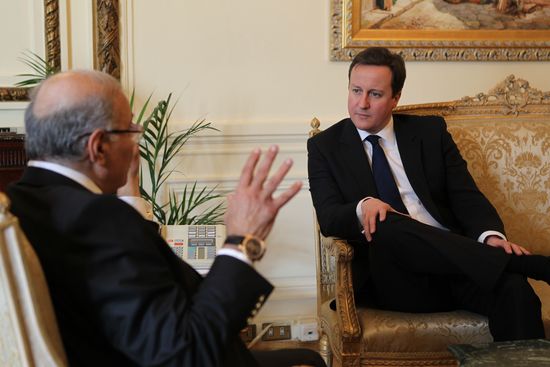
(Photo: Egyptian Prime Minister Ahmed Shafik meets with his British counterpart David Cameron  in Cairo on January 21, 2011, the first trip by a foreign leader to the Egyptian capital since the downfall of longtime president Hosni Mubarak. By Khaled Desouki/AFP/Getty Images.)
Yet More Perspective On Qaradawi

A reader adds to the record:

Here you can find his legal opinion from 2005 arguing in favor the death penalty for apostasy. Here he talks about female masturbation. And [above] you can find the Sheikh essentially arguing that God sent Hitler to punish the Jews.

If the recent proclamations from the Muslim Brotherhood about "freedom for all," "true democracy" and "human rights" aren't just the convenient talking points of the moment (for political expediency), but represent a genuine commitment to reform, then why would they invite Mr. Qaradawi to return from 30 years in exile and preside over that truly historic event on Friday? Are there no other more "moderate" preachers they could find in all of Egypt?

It seems much of the Western media and the so called "experts" take these proclamations at face value with no questions asked and no skepticism or common sense. It bears a kind of an eerie resemblance to the lead up to the Iraq War (the "Curveball" syndrome), which resulted in vast human suffering.

Point taken. And yet he has made real rhetorical overtures to the Coptic Christians in Egypt since his return. But his anti-Semitism? Really, appallingly awful. And, alas, not that exceptional everywhere in the region. My hope, of course, is that this sickness abates in more open societies where the rulers do not deploy anti-Semitism as a tool to keep themseves in power. My fear is that it has become so ingrained in Arab and Muslim culture that it endures; and that religiously influenced parties will deepen it.

Egypt’s Future

Adam Shatz examines it:

Mubarak is gone, but the streets have been mostly cleared of protesters and the army has filled the vacuum: chastened, yet still in power and with considerable resources at its disposal. Until elections are held in six months, the Supreme Council of the Armed Forces will be ruling by decree, without the façade of parliamentary government. The parliament, voted into office in rigged elections, has been dissolved, a move that won wide support, and a new constitution is being drafted, but it’s not clear how much of a hand the opposition will have in shaping it. More ominously, the Supreme Council has vowed to punish anyone it can accuse of spreading ‘chaos and disorder’.

The blunt rhetoric of its communiqués may be refreshing after the speeches of Mubarak, his son Gamal and the industrialists who dominated the ruling National Democratic Party, with their formulaic promises of reform and their talk of the nobility of the Egyptian people but ten days ago in Tahrir Square the protesters said – maybe even believed – that the army and the people stood together. Today the council’s communiqués are instructions, not proposals to be debated, and it has notably failed to answer the protesters’ two most urgent demands: the repeal of the Emergency Law and the release of thousands of political prisoners.

Even Morocco, Ctd

The Guardian reports on the latest Arab country to be swept up in the democratic fervor:

Sporadic outbursts of violence have continued in Morocco after Sunday's peaceful pro-democracy protests gave way to rioting, with five people killed in a fire at a bank in the northern port of Al Hoceima. Interior ministry figures showed that the protests were far more extensive than first thought, with nearly 40,000 people turning out in 57 towns and cities.

Protest organisers condemned the rioting and looting that followed the demonstrations, blaming it on thugs and football hooligans returning from matches. While the mostly middle-class pro-democracy protesters had pledged to remain peaceful, there were warnings before the marches that the real tinderbox in Morocco lay in the poverty-stricken outer suburbs of the cities, where many of Sunday's rioters are thought to live.

Jillian York has a good primer on the situation in Morocco. Follow Global Voices' updates here. Elsewhere in the Arab world today:

Bahrain: Hundreds of protesters remained camped at Pearl roundabout, the centre of a campaign for sweeping reforms in the tiny Gulf monarchy. Their numbers swelled into the thousands over the course of Monday. One grouping, calling itself "Youth of 14 February", issued a manifesto demanding the overthrow of the ruling royal family.

• Yemen: A crowd reportedly in the tens of thousands rallied in the city of Taiz to demand the removal of the country's long-serving president, Ali Abdullah Saleh, while several hundred protesters are camping on a square near the centre of the capital, Sana'a. The president has offered to talk with opponents, a move dismissed by the political opposition as a meaningless sop.

Sudan: Officials from Omar Hassan al-Bashir's ruling party said the president, who took power in a coup in 1989, would not stand at the next election, due four years from now. Opposition groups said the decision was an attempt to try to head off a popular uprising against his rule.

The Military Splits

LIBYAMALTABenBorgCardona:AFP?Getty

From AJE:

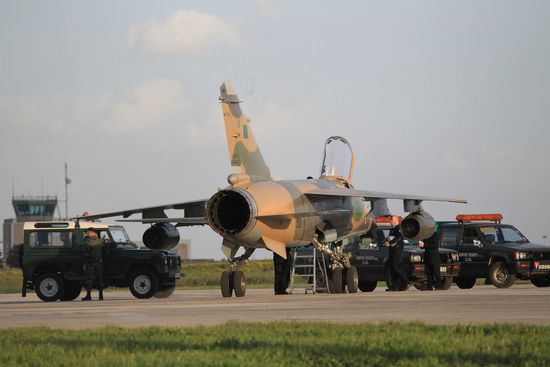
Karl Stagno-Novarra, Al Jazeera's correspondent in Malta, reports the pilots of the jet fighters that landed there are "senior colonels", who were ordered to bomb protesters. They refused and have defected to Malta, he said.

Then there are the videos (very graphic) of more soldiers slaughtered and then burned by their pro-Qaddafi military comrades.

(Photo: A F1 mirage of the Libyan airforce sits on the tarmac of Malta airport after landing on February 21, 2011. By Ben Borg Cardona/AFP/Getty.)

“Qaddafi is coming down, he is coming down, he is coming down.” Ctd

50780409

And coming down ugly:

Salem Gnan, a London-based spokesman for the National Front for the Salvation of Libya, says eyewitnesses in Tripoli have told him the navy has opened fire on parts of the capital.

We have just heard that the military ships are bombing an area in Tripoli and many people have been killed although we don’t know how many at the moment because people have just called to tell us it is happening.

Gnan said the navy appeared to be bombing a residential area outside the city centre as part of a desperate crackdown by Gaddafi’s troops.

He is even turning the ships on his people now. His plan is to use absolutely everything he can to stop what is happening.

Gnan said he had had also had reports of ongoing shooting around Gaddafi’s residence in Tripoli and said more people were taking to the capital’s streets as darkness fell.

“This is going on because if it stops that means it is finished. This will be the last act.”

Video from Misrata, not far from Tripoli, last night, via AJE:

The NYT reports that that ghastly rant by Saif Qaddafi might have been the last straw:

Witnesses in Tripoli interviewed by telephone on Monday said protesters had converged on the capital’s central Green Square and clashed with heavily armed riot police for several hours after Mr. Qaddafi’s speech, apparently enraged by it. Young men armed themselves with chains around their knuckles, steel pipes and machetes, as well as police batons, helmets and rifles commandeered from riot squads. Security forces moved in, shooting randomly.

It looks to me as if this is all but over. Ambassadors abroad are resigning right and left. There are no signs of the regime’s authority in the capital, except a few pockets of troops loyal to Qaddafi. Amazing. Look at the map. From Tunisia through Libya to Egypt and Bahrain, regime change has come from below in just a few weeks. Now wonder the King of Jordan is getting a little jumpy.

Can you imagine the mood among the Saudi dictators right now?

(Photo by Mark Renders/Getty Images)