Massacre From Above?

Screen shot 2011-02-21 at 12.09.35 PM

Al Jazeera is tracking the troubling reports:

5:50pm: Geneva-based Libyan News Network reports phones cut in Tripoli, amid "massacre" in Green Square. More details being sought.

6:26pm: Further reports of live ammunition being used on protesters in Tripoli, with lots of tweets saying security forces are again driving cars around the city, shooting at everyone and everything. Ahmed Elgazir, a human rights researcher, told Al Jazeera that Libya News Centre, an organisation based in Geneva, had received a call for help from a woman "witnessing the massacre" in progress, who called on a satellite phone after landlines were cut.

6:30pm: Planes of the Libyan Air Force reportedly opening fire on protesters in central Tripoli. No way to confirm this currently – but we are getting many reports of chaos on the streets of the capital.

Track the best tweets on Libya here. More here. From Iyad El-Baghdadi:

Video of Libyan soldiers shot & burned by Qaddafi forces for refusing to obey orders.

The ghastly, graphic video is after the jump:

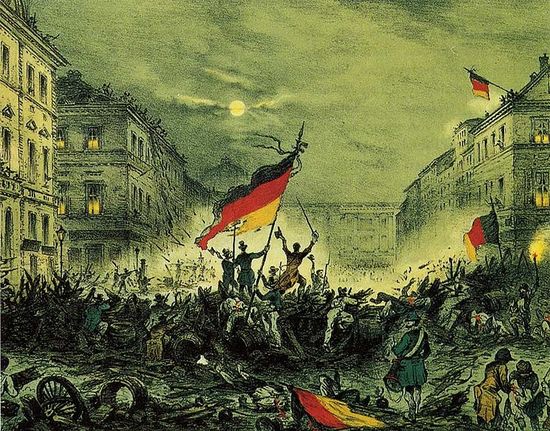
An Arab 1848?

765px-Maerz1848_berlin

For those not that versed in European history, Wiki has a useful summary of what occurred that year. Talleyrand, whose record in interpreting events so far has been not-so-great, nonetheless rightly notes that such change is never linear and certainly wasn't all sweetness and light:

Tunisia… Egypt… Bahrain… Iran… Libya… Yemen… Sudan… Jordan… and even Morocco… Who knows there the mania will go next? The street revolts in these places seemed initially to recall 1968. But they are now looking more like 1848. Yet today there is no Marx to make sense of them.

Those who prefer 1848 to 1968 should take heed of the past. The response to those revolutions was violent. They did not, amazingly, result in a major war among any of Europe's major powers unless we consider (as Marx might have done) 1914 to have been the logical outcome of the forces they unleashed. In their own time, however, none, with the partial exceptions of those in Denmark and Switzerland, resulted in the ideal, liberal democracy they urged so passionately.

That this happened in 1989, by contrast, had as much to do with the  magnetic existence of NATO and the European Union, and the bankruptcy of Soviet power as it did with the inherent, progressive convictions of the revolutionaries. None of these things, except perhaps the final one, is present in today's Maghreb and Mashrek and elsewhere nearby.

An 1848-scenario in a region as fractious as the Middle East is very worrisome. The best result, according to most informed observers, is a replacement of the region's detested despots with army juntas that will evolve gradually into civilian-led republics. But which group of revolutionaries will be satisfied with such an outcome? Probably none. Meanwhile juntas are not the most stable heads of government. A period of tremendous instability awaits.

The question he doesn't answer is: what happens when a backward region has an 1848 in 2011, an era where the rest of the world has already moved way past them – and the people, demographically skewed young, know it via the web and satellite TV? Does history move more quickly under those circumstances?

Here's what I assume: that we will see some good outcomes and some disastrous ones. But the idea that these tyrants could hang on for ever, given their records and within these global currents is a fantasy. My old friend Niall Ferguson urges a grand strategy for the US in this moment. I don't see that we have much control or input here except not to alienate the masses of the region, to help the more promising democrats, to protect our core interests, such as access to oil and free shipping, and to muddle through.

My sense is that this is a historical process that has been long delayed by tyranny in the Arab Muslim world. It will not mean a new 1989. But it is unstoppable – and a great power thousands of miles away cannot micro-manage or macro-manage it. And, for all one's worries, it is simply impossible (for me, at least) to hope that the tyrants win, in the interests of a stability that has been revealed to be so fragile anyway.
Libya Reax

Libyaflag

Juan Cole:

In a highly significant development, the leadership of the large and powerful Wafala tribe announced that it was now siding with the opposition against Qaddafi. About a million Libyans belong to this extended kinship group. Since cultivating tribal loyalties was one of the ways Qaddafi had remained in power, this major tribal defection underlines his loss of authority. It was further underlined when Arab Warfala leaders managed to convince their Berber counterparts in the southern Tuareg tribe, who are 500,000 strong, to join in opposing Qaddafi.

Blake Hounshell:

Seif's speech was certainly crazy, but he may be right about one thing: There is a nasty internecine conflict on the way in Libya. From all that we've seen, the regime will do anything to stay in power, including shooting people in cold blood with heavy-caliber weapons. It doesn't look like there will be a nice, friendly "let's all hold hands and clean up Tahrir Square" moment. After four decades of unspeakable tyranny, Libyans will be out for vengeance.

Issandr El Amrani believes that "the most important protests now taking place in North Africa are those in Libya":

[A] reason that Libya's regime appears in some respects more fragile (at least in parts of the country) is that it is the worst in the Middle East — basically the region's North Korea. Except that it's not protected by China, and is situated in a region of the world that is historically globalized. Libyans may have been cut off from the rest of the world by the sanctions, but they share an Arab and Mediterranean culture with over 300 million people and know that there is better than Qaddafi out there.

Fadel Lamen:

Qaddafi’s sons are said to be at odds, as was the case between Mubarak’s two sons during the last couple of days of his presidency. The struggle between the more mild-mannered Saif and his hardliner military brother Mu’tasim Billah, national security adviser to his father who enjoys the support of tribal traditionalists, illustrates the nature of the regime’s internal fissures. A castle coup by the nationalist moderate reformers within the regime may save the country many lives and more destruction.

Max Fisher:

There is no telling whether the ongoing fighting will be more or less likely to topple the regime than were the mass sit-ins of Egypt and Tunisia, or whether the protesters, as they become more isolated and violent, will coalesce into just another opposition militia in a part of the world that already has plenty. In a worst-case scenario, eastern Libya moves not toward peaceful regime change but low-level civil war.

James Ridgeway:

Complicating matters is Libya’s unusual position in world affairs. Not long ago it was a pariah nation. But since 9/11, it has wormed its way back into favor with the United States and Europe because Qaddafi joined the war on terror, cooperating in the Lockerbie bomb investigation, coming down hard on al Qaeda, and kicking out terrorists he had once sheltered. At the same time, he has steered Libya into an increasingly powerful position in world politics because of its vast oil reserves. Libya has an especially close relationship with its former colonial master, Italy. It now provides about 20 percent of all Italy’s oil imports and has invested in sizeable amounts in that country’s energy infrastructure including the transnational energy giant ENI.

As'ad AbuKhalil

The masses of Libya (the jamahir as that loony leader calls them) hate the leader, and the leader is hated in the region by fellow dictators.  So he has nowhere to go (possibly with the exception of Italy).  So he and his sons will have to fight to the end.  But the end is coming for them, no doubt.

(Libya's new flag by khalidalbaih, via BoingBoing)

More Scoop On Palin: Her Reliable Media Mouthpieces

Frank Bailey's co-authored manuscript, "Blind Allegiance To Sarah Palin," which leaked out via his agent's emails to potential publishers, is dynamite. Why? Because Bailey was as close to the Palins as anyone from Palin's first race for governor to the bitter end, is a rock-ribbed Fox News Republican, has vast amounts of firsthand data (the emails he has published alone reveal a lot), has contempt for Trig skeptics like yours truly, and comes to a simple conclusion in retrospect: Palin is a dangerous, vindictive, incompetent, congenital liar who has no business in any public office. Any publisher interested in the truth about Palin (Harper Collins therefore need not apply) should fight to publish it.

There's a useful summary of its contents at the Anchorage Daily News, and some notes from the paper's gossip column with this tart truth:

In the end, what makes Bailey's manuscript worth more than other Sarah books is his liberal use of contemporaneous records — long quotes from e-mails written at the time by the actual participants. If you want to understand who Sarah really is, you can't beat her own words.

There's also just, well, nutritious nuggets like the following. Bailey describes Palin's eventual media strategy: avoid any MSM interviews and get talking points out through surrogates. Who were they? Bailey names names: Bill Kristol, Mary Matalin, former Bush aides Jason Recher and Steve Biegun, GOP officials Nick Ayers and Michael Steele, Rush Limbaugh, Laura Ingraham, Glenn Beck, Greta Van Susteren, Sean Hannity, and Bill O‘Reilly. Then this sentence

We could normally expect them to repeat any coordinated message we sent.

My italics. First among equals as a propagandist posing as a journalist:

Of all the fawning—mostly middle-aged white men—nobody had infatuated eyes more than Bill Kristol…

He'd gone to Alaska on a cruise in June, 2007 and sat across the table from the sexy future of the Republican Party. Much as President Bush, when looking into Vlad Putin‘s eyes, saw his soul, Kristol understood that deliverance for his beloved GOP lived inside this stunning, five foot five inch Aphrodite from Wasilla. Due Diligence was conducted over moose stew, red wine, and winky charm. He did not need to ask about foreign policy or current event expertise. He saw a winner. Kristol began bongo-drumming her out-Mavericking John McCain virtues in every venue at his disposal… In public and to his contacts within the McCain camp, he made it known that she was not only legitimate, but the only intelligent choice if McCain hoped to have any chance in the upcoming election.

Burning Through The Night

The uprising in Libya intensifies:

Reports from news agencies, Twitter – and witnesses speaking directly to Al Jazeera – are painting a picture of semi-chaos overnight in Tripoli. It appears that some protesters from nearby towns converged on the city, and thousands from the capital itself turned out as well. They were allowed to march to the central Green or Martyrs' Square, which they occupied briefly before being confronted by security forces and pro-Gaddafi protesters, who came out in force after a late-night speech by Saif al-Gaddafi, the leader's son.   

During the night, protesters have broken into and burned a number of government buildings, reportedly including: State television; the main courthouse; a large, centrally located bank; an intelligence agency building; at least two police stations – one in Souq Jamaa and one in Zawadahmany.

Business Insider's Joe Weisenthal has more:

According to GulfNews editor Abdul Hamid Ahmad, Libyan protesters have now taken control of several Libyan cities, thanks to defections by by the military. Clearly, if you thought Mubarak had a loyalty problem, Gaddafi's is much worse. There are reports of defections not just at the military, but among various government workers, including diplomats at the embassy level. Meanwhile, international oil companies are jetting out of town. BP has stopped exploration and ENI has pulled family members of workers. Brent crude in London has hit $105.

The EU is preparing to evacuate all expats. Rolling updates from EA:

0835 GMT: Reports claim State TV headquarters in Tripoli was attacked by Libyan protesters overnight, and other public buildings were set on fire. Snipers reportedly fired on the demonstrators. There are calls across Libya for a march on Muammar Gaddafi's residence in Tripoli after 'Asr prayers, around 4:30 p.m. local time.

0948 GMT: Reports coming in that Libya's government headquarters in Tripoli is on fire. The building is near Martyrs' Square, where protesters are gathered. Eyewitnesses also say that demonstrators have burned all police bureaux in capital Tripoli.

1020 GMT: Asharq Al Awsatclaims Mustafa Abdul Jalil, the Libyan Minister of Justice, has resigned. According to Egypt's Youm7, this is because of the use of live bullets.

1030 GMT: Al Jazeera reports from medical sources that 61 people have been killed in Tripoli today.

1200 GMT: Al-Jazeera English's Gregg Carlstrom reports: "Police colonel in Benghazi tells Al Jazeera that the police 'are fully with the people,' receiving 'confused' orders."

1320 GMT: URGENT Anti-government protests break out in Libyan town of Ras Lanuf, site of oil refinery -Libya's Quryna newspaper (Reuters).

AJE is also live-blogging at a rapid pace. Jillian York is compiling missives from the ground. Mike Giglio relays one:

Ghazi Ramadan, 40, woke up in Tripoli Sunday morning feeling anxious and looking for news about the protests. The last few days had been frightening, he said in a phone interview, with bands of pro-government forces roaming the streets to preemptively disperse any demonstrations. Every time the Internet flashed back on, he rushed to Twitter for updates, but they were slow to come. So he took to keeping his ear glued to the front door, listening for gunshots and other sounds that might bring news of what was happening in the streets. It was after 8 p.m. when Ramadan began to hear anti-government chants. He walked outside to see people, mostly young men, rushing to a nearby square. He decided to join them. “I sensed the opportunity for change,” he said. “I don’t mind being dead. We’ve been dead for 42 years.”

More overnight footage here.

The New Economics Of Content

Jeff Jarvis argues that paid content isn't necessarily the future of Internet journalism:

Why do people write on Huffington Post? Because they can. Because they give a shit. Because they like the attention and conversation. Because they couldn’t before. Why do they sing their songs on YouTube? Same reasons.

Scott Esposito takes the opposite approach:

I don’t doubt that there are genuinely worthwhile content strainers out there (yours truly attempts to do his humble part, along with some worthwhile original content), but what The Huffington Post does is more akin to a fire hose than a strainer. As users and search engines get more savvy, I don’t see this kind of business model sticking around.

Nor do I see it being a source of great revenue. The Times could make a legitimate case to charge for what it does–you can’t get what the Times does anywhere else. That’s not true for HuffPo. And I think the audience that the Times has built can be monetized in ways that HuffPo’s never will. There’s a certain point when you go from taming the chaos to just being another part of the chaos, and HuffPo has passed that point.

Chart Of The Day II

Peter Smith explains:

A map of world's coffee-drinking habits locates the global epicenter far from tropical coffee plantations, in Scandinavia, where coffee consumption is well above the global average is 2.9 pounds (1.3 kilograms) per year.

While you might think of coffee as merely a good caffeinated drink, the seeds of the Coffea plant represent the second most important legally traded commodity, following oil, in terms of dollar value, writes Mark Pendergast in Uncommon Grounds.

(Map via chartsbin.com)

The Mysteries Of Mental Accounting

Jonah Lehrer curses expensive Internet charges at hotels and explains how our brains justify them:

In the end, expensive hotels are able to charge insane amounts of money for Cheerios and wifi because these exorbitant charges get posted to the mental account of the hotel bill, which will be hundreds of dollars anyways. As a result, the charges don’t seem quite so crazy. (This also helps explain why cheap hotels are so much more likely to offer free internet and breakfast buffets. Sometimes, we get more when we pay less.)

Female Reporting And Rape, Ctd

A Peace Corps volunteer writes:

I just wanted to bring up a connection you might have missed between Lara Logan's attack and the recent ABC story on rape in the Peace Corps.  Several commentators were saying largely the same thing about the Peace Corps that they are saying about foreign correspondents.  Politics Daily, for example, suggested the program should be shuttered.

Of course Peace Corps volunteers, like any journalist, deserve the very best protection and support from their organization.  But all risk cannot be eliminated. 

The female Peace Corps volunteers I know are quite aware that they are taking some risk of rape or assault by joining up (though that risk is not zero back home, a fact that is often lost). It's nothing like the kind of danger repeatedly stared down by Logan, whose courage I can't even begin to imagine, whose stone-cold determination leaves me frankly awestruck, but it is real.  They take these risks because they are doing something they consider worthwhile, and that is the right and privilege of every free American.

More on the topic here.

The End Game?

Massie's view of Libya:

[S]hooting people in the streets is also a sign of weakness, not strength. Increasingly it seems that the Qaddafis options amount to choosing the manner and moment of their defeat and eclipse. Eventually, failure carries a price. Even in authoritarian states.

I am praying hard for the people of Libya. The Qaddafis are merciless. They will not go easily.