The Bodies Pile Up In Libya

Enduring America:

A doctor in Benghazi says there have been 44 bodies at Al Jala Hospital. All are between 13 and 35 years. Most died from head, chest and/or abdomen wounds from high-velocity rounds. The doctor adds that protesters are in control of the building where the snipers are located and will track them down. Asked if the demonstrators will kill captured security forces, he replies, “Of course.”

The Guardian:

Local cleric Abellah al-Warfali told al-Jazeera that he had a list of 16 people being buried, most with bullet wounds to the head and chest.

I saw with my own eyes a tank crushing two people in a car. They hadn’t done any harm to anyone.

Mackey:

Though signs are hopeful for demonstrators in Bahrain, the scenes in Libya are bleaker. Human Rights Watch reports that 84 people have been killed there over the past three days, 35 of them last night.

AJE’s live-blog here. A report on the latest violence:

Libyan forces have reportedly opened fire at a funeral in the eastern city of Benghazi, killing at least 15 people and injuring scores more as protests against Muammar Gaddafi, the country’s long-time ruler, continued. The victims on Saturday were mourning the loss of protesters who had been killed during anti-government demonstrations in the city during the past week, witnesses told Al Jazeera.

Kristof

Reports from Libya are horrific. It shld be getting more attention, but we journalists can’t get visas. I’ll keep trying.
Obama’s Call To King Hamad Last Night

Was it the turning point? I guess we'll find out soon enough. If so, Obama's outreach to Shiite Muslim democrats could be transformative in the Middle East. Kristof:

There’s no hint of anti-Americanism out there, and people treated American journalists as heroes because we reflect values of a free press that they aspire to achieve for their country.

In fact, when was the last time you saw frenzied crowds in the streets in several Muslim Arab countries where the American flag wasn't being burned? We finally figured out how to help democracy in the Arab world: get out of the way and nudge quietly from a distance.

“It’s Unbelievable!”

PEARLSQUAREJohnMoore:Getty

Nick Kristof is on the scene:

I felt sick as I saw the first group cross into the circle.

But, perhaps on orders of the crown prince, the army troops had been withdrawn, and the police were more restrained today. Police fired many rounds of tear gas on the south side of the roundabout to keep protesters away, but that didn’t work and the police eventually fled. People began pouring into the roundabout from every direction, some even bringing their children and celebrating with an almost indescribable joy. It’s amazing to see a site of such tragedy a few days ago become a center of jubilation right now. It’s like a huge party. I asked one businessman, Yasser, how he was feeling, and he stretched out his arms and screamed: “GREAT!!!!”

But the future is unknowable:

Many here tell me that this is a turning point, and that democracy will now come to Bahrain – in the form of a constitutional monarchy in which the king reigns but does not rule – and eventually to the rest of the Gulf and Arab world as well. But some people are still very, very wary and fear that the government will again send in troops to reclaim the roundabout. I just don’t know what will happen, and it’s certainly not over yet. But it does feel as if this just might be a milestone on the road to Arab democracy.

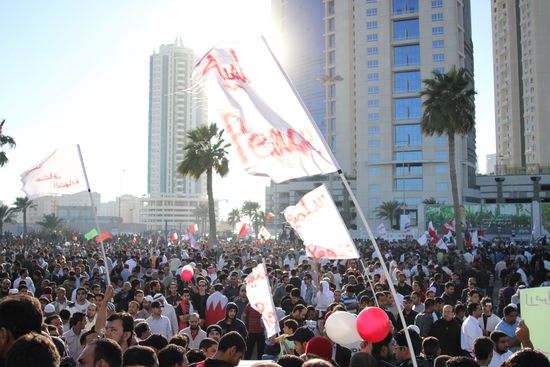
(Photo: Anti-government demonstrators rally as they re-occupy Pearl roundabout on February 19, 2011 in Manama, Bahrain. By John Moore/Getty.)

As Bahrain Turns?

FLOWERBAHRAINJohnMoore:Getty

Once again, Wikileaks sheds light on government failure. Just because these monarchs talk a modern game and are West-friendly (hello, King of Jordan), they actually rule in the end by the barrel of a gun and many by torture (hello, King of Jordan). Yes, Bahrain had elections. But look how they saw the possibility of real democracy. Apparently, the US has been trying to get the government to chill (but one senses that the real strings are being pulled in Saudi Arabia).

But, however it happened, in the last few hours, the tide seems to have turned:

Thousands of jubilant protesters surged back into the symbolic heart of Bahrain on Saturday after government security forces withdrew and the monarchy called for peace after two days of violent crackdowns…

The day started … with the police firing tear gas and rubber bullets at crowds of protesters. Young men collapsed in the road and others ran for cover. Then the government blinked, perhaps sensing that the only way to calm a spiral of violence that claimed more lives with each passing day was to cede the square to the protesters.

The police left, so suddenly and so completely that it took a minute for the protesters to realize they were gone and that they once again controlled Pearl Square.

By early evening, tens of thousands of people waving Bahrain flags, some dropping to the ground to pray, shouting congratulations to each other, had packed the square and the surrounding streets in bittersweet jubilation, savoring the moment with a degree of sadness for the loss of at least seven people killed during the week, disbelief that they had prevailed and absolute joy at their success.

(Photo: A person holds a flower in front of a barbed wire fence as anti-government demonstrators re-occupy Pearl roundabout on February 19, 2011 in Manama, Bahrain. Anti-government protesters were fired at with tear gas and rubber bullets as they marched to retake the roundabout, injuring several protestors at the site of two deadly previous confrontations between police and demonstrators. The Bahrain military has since backed off. By John Moore/Getty Images)

The View From Your Window Contest

Vfyw-contest_2-19

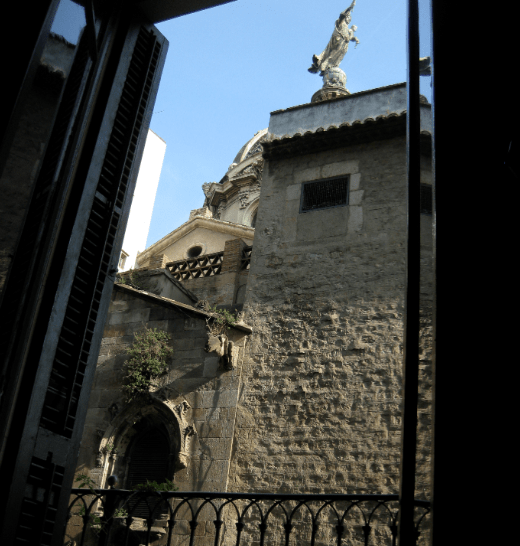
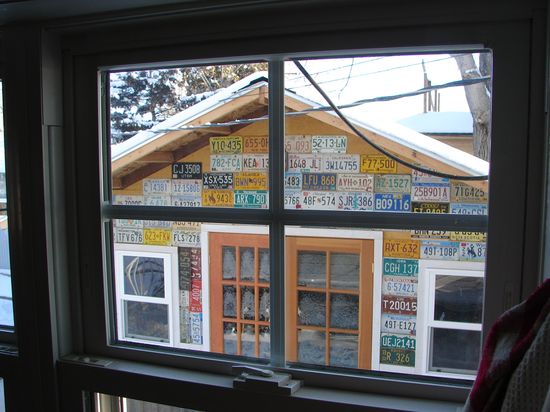
You have until noon on Tuesday to guess it. City and/or state first, then country. Please put the location in the subject heading, along with any description within the email. If no one guesses the exact location, proximity counts.  Be sure to email entries to VFYWcontest@theatlantic.com. Winner gets a free The View From Your Window book. Have at it.

An Unusual Case Of Reader’s Block

Geoff Dyer confesses:

Sometimes I’m too lazy to read, preferring to watch television; more often I am too conscientious to read. Reading has never felt like work in the way that writing has, and so, if I feel I should be working, I feel I should be writing. Theoretically, if I am not writing then I am free to read but, actually, I always feel vaguely guilty, and so, instead of writing (working) or reading (relaxing), I do neither: I potter around, rearranging my books, clearing up.

Humans Beat Watson… On Energy Use?

Jonah Lehrer marvels:

One of the most remarkable facts about the human brain is that it requires less energy (12 watts) than a light bulb. In other words, that loom of a trillion synapses, exchanging ions and neurotransmitter, costs less to run than a little incandescence. Or look at Deep Blue: when the machine was operating at full speed, it was a fire hazard, and required specialized heat-dissipating equipment to keep it cool. Meanwhile, Kasparov barely break a sweat.

The same lesson applies to Watson. I couldn’t find reliable information on its offsite energy consumption, but suffice to say it required many tens of thousands of times as much energy as all the human brains on stage combined. While this might not seem like a big deal, evolution long ago realized that we live in a world of scarce resources. Evolution was right. As computers became omnipresent in our lives – I’ve got one dissipating heat in my pocket right now – we’re going to need to figure out how to make them more efficient. Fortunately, we’ve got an ideal prototype locked inside our skull.

A reader made this point earlier in the week. Another reader's dissent:

If you are going to ask how much energy two Americans consume, you do not get a reasonable value by just asking how much food they eat. You will also consider how much electricity they require to light their rooms, how much oil was burned to transport the humans from hotel to studio, how much energy was expended growing, harvesting, transporting and preparing the food in the craft services area in the studio, etc.

Watson's energy expenditures are large but explicit, while the human energy consumption is hidden behind thousands of transactions and small components that each take their toll. Even if the cost side of the equation for the two classes of contestant favored the humans you must also remember that the benefit side is not equivalent between the two. A human can also only answer a handful of questions every minute while Watson could answer thousands per second; it would take an entire army of Kens and Burts to provide the same benefit that a single Watson cluster can provide.