Today on the Dish, Andrew differed with Larison on the future of protests in Iran, and protesters planned for a bloody Sunday. The Bahrain monarchy gunned down protesters by helicopter, Twitter tracked the voices on the ground, and doctors appealed for help. Jacqwi Campbell captured the protests and the police force, we analyzed the religious split, Mark LeVine assessed the US' interests, Ashley Bates provided a primer, and the crackdown continued. We tracked the aftermath of the rage still simmering in the Middle East, Libya sounded off, Nathan Brown glimpsed Egypt's future, and Najla Abdurrahman worried about Libya's invisibility. Gregg Easterbrook hoped for the end of family rule, Fareed Zakaria tracked the Mid East's youth bulge, and Western influence in the region crumbled.
Jacob Stokes lambasted defense budget hawks, we imagined taxes solving the deficit, and Ezra Klein asked progressives to compromise on it now rather than later (without Obama). GOP Senators caved, and partisanship prevailed. Andrew took Joe Klein's view on Wisconsin, and Adam Ozimek considered the drug war's casualties. Andrew admired the political spectrum reimagined, but didn't buy Palin's Birther dismissal. Jennifer Rubin dismissed Newt for 2012, and Palin crumbled under the media boycott. Nina Shen Rastogi exposed Bieber fandom's darkside, Evan Osnos perused Harvard lectures in Chinese, and hello used to imply surprise. The New Yorker fact-checks poems, and women earn more but don't spend it on dress socks.
Cool ad watch here, Moore award here, Yglesias award here, quote for the day here, FOTD here, MHB here, and VFYW here.
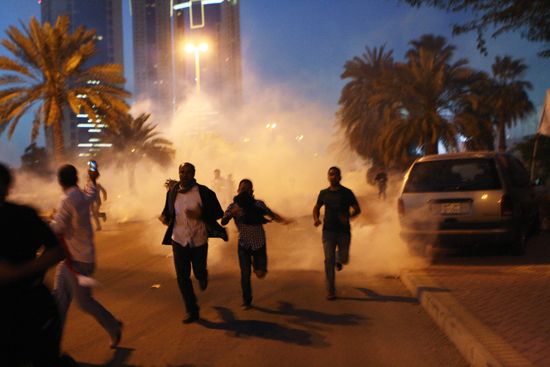
By John Moore/Getty Images
Thursday on the Dish, Andrew inquired as to just when the adult conversation on the budget might begin. He tackled Medicare cuts, and others even if they might hurt people now, because they'd hurt more later. Heather Mac Donald urged Obama to call the GOP's bluff, Andrew examined debt in the Golden state, and parsed Wikileaks on Uganda and the gays. We kept tabs on the protests across Bahrain, Yemen and Libya. Mousavi went missing, and Joshua Tucker tallied the lack of violence that usually characterize successful revolutions. Andrew downed Clive Crook's straw man attacks on Facebook, Amy Davidson marveled at the moving Twitter cloud of Mubarak's resignation, and Anand Gopal reported on strikes across Egypt. Ursula Lindsey catalogued sexual harassment in Egypt (readers wrote in about the US), John R. Guardiano reminded us that Muslims saved her, and Ann Friedman argued female journalists also get greater access to stories. Hamilton Nolan broadened the debate,
Frum outed Chris Christie as the RINO-proof nominee, we dug deeper into the Patriot Act reauthorization, and Birtherism is a shibboleth. The GOP's foreign policy muscles deteriorated, FBI may have fooled us twice, and Palin was still thinking about running. John Cassidy viewed the deficit through the bond market lens, and Bruce Bartlett urged Republicans to take a big bite out of the apple. Edward Glaeser pointed to urban schools as the great challenge of our era, Norm Geras weighed voting for convicts, and Mike Konczal exposed why the budget can't help reform prison policy. Reihan applauded the advantage of the English language, gay marriage isn't a slippery slope, and Seth Godin was curious about your overlooked gems. Readers nerded out on Watson, Ken Jennings relived his battle, Keisel sacrificed his beard for charity, and we checked out the Asscam.
Cool ad watch here, app of the day here, FOTD here, MHB here, VFYW here, and the real recipe for Coke here.
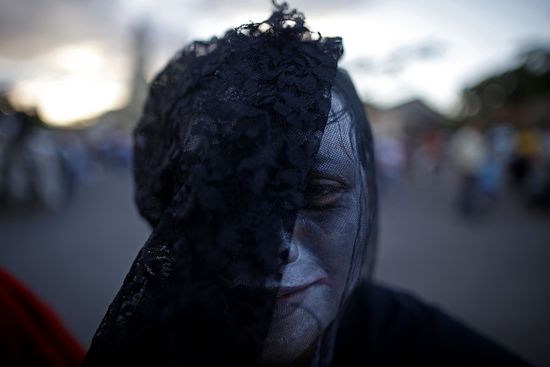
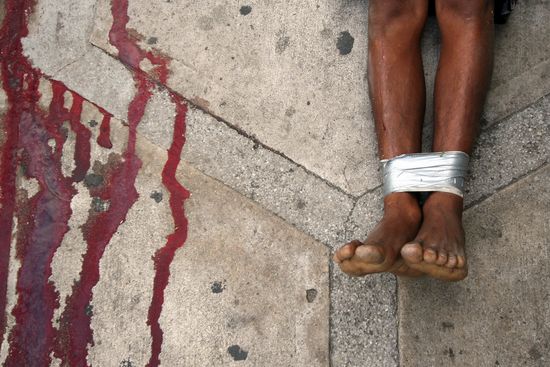
By Esteban Felix/AP.
Wednesday on the Dish, Andrew chided Obama for being more neocon than the GOP on the military budget, and wagged his fingers at Americans for being closet socialists. Andrew joined Frum in itemizing the right's budget delusions, and Ezra Klein clung to his optimism. We examined how Americans view defense spending, Kay McDonald blamed high food prices on corn ethanol, and Howard Gleckman continued to lay into Obama. Nyhan yawned at Silver's 2012 predictions, and Larison worried over Mitch Daniels' penchant for pandering. We photo-hunted the two-faces of National Review, and the right thought Islamists were infiltrating their ranks. Goldblog wasn't laughing at rape jokes, young conservatives shamed an old racist dude, and Dan Savage's Santorum prank lived on.
Libyans took to the streets, Tom Kutsch assessed regimes' stick and carrot methods to try to stop protests, and a reader gave us the insider baseball dish on Egypt. Andrew shed light on the disproportionate killings leaked in the Gaza memo, and Iraq's dysfunctions ran deep. Readers rebutted Gladwell, Brian Fishman contemplated al Qaeda's tone-deaf response to the revolutions, and not all Islamists are created equal. Andrew tested Beiber-Gaga magic, and previewed Matt and Trey's "The Book Of Mormon," Pinker didn't trust Watson to do more than play Jeopardy, and Jim Behrle prayed for a human win.
The best Mac apps here, ghost signs of Chicago here, content farm here, quote for the day here, dissent of the day here, Malkin award here, Moore award here, MHB here, FOTD here, VFYW here and unofficial contest here.
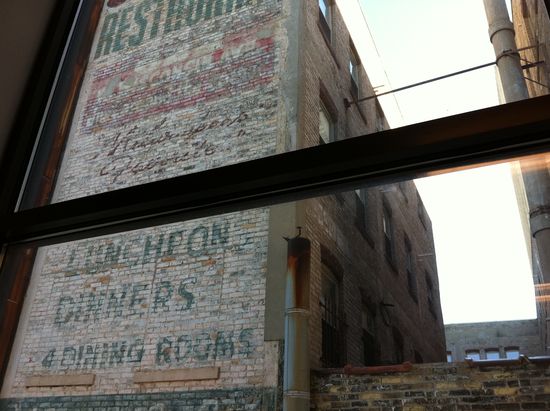
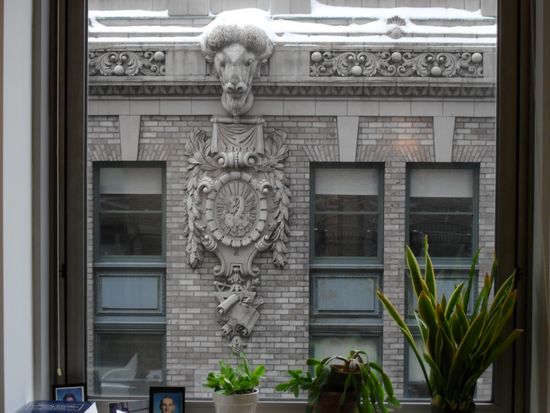
Milwaukee, Wisconsin, 3 pm
Tuesday on the Dish, Andrew bore down hard on Obama for wimping out on the budget. Howard Gleckman joined the pile-on, Ezra Klein called it a spork for its ineffectiveness, and Annie Lowrey put the budget in a manageable perspective. Andrew nudged Paul Ryan to step up to the plate, the right debated entitlements, and Yglesias and E.G. argued Social Security for different generations. Andrew's eyes widened at Obama's delusions, but he wasn't breaking up with him yet.
Andrew remained optimistic but not delusional on Egypt, the Internet graded Obama's performance, and Obama just couldn't win with the right. Mohammed Ayoob feared military regimes, Wendell Steavenson reported the tenet of the revolution was holding, and Erik Voeten charted today's coups that lead to competitive elections. We took stock of yesterday's protests in Iran, where the government isn't beholden to American aid, and Persiankiwi tweeted again. Thomas Ruttig reminded us of Afghanistan's mini-Mubaraks, Joel Wing kept an eye on Iraqi protests, and Robert Mackey compiled the footage and accounts of Bahrain's protests.
Andrew demolished Gladwell's thesis on the Civil Rights Movement and social ties, and Kevin Drum countered David Carr on why Twitter didn't kill online news. Nate Silver compared Sarah Palin to Al Sharpton, and she spurred the voting Birthers on. The CPAC war raged on, fueled by a diminishing Limbaugh, and Julian Sanchez eviscerated the Heritage folks on the Patriot Act. Families defended their gay relatives, the internet needed display ads, and Watson would never make for great TV.
Malkin award here, sane conservatism watch here, creepy ad watch here, FOTD here and reaction to yesterday's here, quotes for the day here, here, and here, dissents of the day here and here, MHB here, a heartbreaking VFYW here, and VFYW contest winner #37 here.
Monday on the Dish, Andrew defended Anderson Cooper for calling out Mubarak's lies and pushed back against those who insist on the irrelevance of social media. Jeff Jarvis likened Zuckerberg to Gutenberg, Andrew responded to renewed calls for neoconservatism, and Ellis Goldberg considered a slow-motion coup. Cairo quieted down, Algeria got active, Bahrain erupted, and Iran ignited. Graeme Wood updated us on post-Mubarak emotions in Egypt, Twitter funneled viewers to Al Jazeera, and Frum insisted too much is unknown. Egypt reminded a reader of the birth of a child, and the revolution could be connected to sex. Bruce Riedel highlighted al Qaeda's irrelevance in Egypt, Heather Mac Donald upended America's obsession with foreign terror, and Dexter Filkins compared Afghanistan to Egypt under Mubarak. Olivier Roy argued Iran isn't a model because jobs can't be found in the Koran, Larison distinguished Iran from Egypt, and we kept tabs on the country's dramatic protests into the night.
Andrew informed anyone under 30 that Obama just threw them under the bus with his budget. Andrew applauded Mitch Daniels for his CPAC dose of reality and praised Ron and Rand Paul for their candor and dissents. HuffPo profited off of vain writers willing to give it up for free, and Glenn Greenwald got targeted by a firm for supporting Wikileaks. Conspiracies don't die, stocks declined, and the Pigford case soaked up reactions from readers and in the blogosphere. Video games mirrored reality, Tyler Cowen shrugged over the new Ayn Rand trailer, O'Reilly got meme-ified, the Internet aged gracefully, and Andrew thanked everyone and Aaron.
Quotes for the day here and here, chart of the day here, MHB here, FOTD here, and VFYW here.
–Z.P.
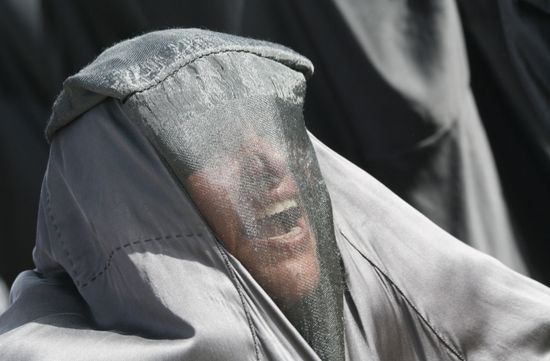
 The Dish