Struggling To Feed The World

Room For Debate examines rising food prices. Kay McDonald partially blames corn ethanol:

Right now, there is no shortage of rice. Rice is the most important food for nearly half of the world's population, and especially the poorer populations. Global ending rice stocks for 2009-10 were the highest in seven years. Wheat stocks are near their average level from this past decade and well above the low they reached in 2008. However, corn is in dangerously short supply — the lowest that it has been in 37 years.

The corn ethanol policy is a driver of high food prices worldwide. More than 15 percent of global corn production and a total of 35 million acres are devoted to U.S. ethanol. The U.S. is the largest exporter of corn, but we use twice as much corn to produce ethanol as we use it for food export.

Wheat and soy prices increase when corn prices are high, since their acreage allotment is replaced by corn. In addition, wheat and soy get substituted for corn as animal feed.

Dreaming Of A Grand Bargain

Ezra Klein clings to his optimism: 

I wouldn't be surprised if Obama has his name on a broader deficit-reduction bill at this time next year. If he takes the deficit away from Republicans before 2012, his reelection campaign becomes considerably easier. And on a less cynical level, his administration is stocked with deficit hawks — the same folks who actually balanced the budget under Bill Clinton. And similarly, Republicans want to deliver on the deficit-reduction promises they've made to their base. In theory, everyone's incentives and ideologies are pointing in the same direction. That's a good sign for progress.

“The Darwin’s Finches Of Religion”

Last night, I went to see part of a rehearsal for Matt and Trey's "The Book Of Mormon." Oh, man. I'm sworn to secrecy, but the set alone is worth it. In a "Spooky Mormon Hell Dream" number, the set looks like the Black Party, with Johnnie Cochrane singing below the Angel Moroni plonked on top of the proscenium. It may be the best thing they've ever done, and musically, there are some brilliant numbers, reminding me of Stephen Sondheim's accurate observation that "Bigger, Longer and Uncut" was the best musical of the last decade. Chris Beam previews it here:

What Parker and Stone do isn't religion-bashing. It's religion-teasing. And it's born more from fascination than disdain. "I'm an atheist that admires and likes religion," Stone told me in an interview. He describes the new musical as "an atheist's love letter to religion." If you had to classify Parker and Stone's world view, you might call it Hobbesian absurdism.

In the universe they've created, random, terrible things happen with no explanation. It's no coincidence that South Park's most famous line is "Oh my God, they killed Kenny!"/ "You bastards!"—in response to the frequent death of Kenny McCormick—with no explanation of who "they" are. Parker and Stone's Book of Mormon has a similarly bleak perspective. When the two missionaries arrive in Uganda, they find the natives singing what sounds like an uplifting "Hakuna Matata"-like spiritual. It turns out what they're chanting—assa dega ebo aye—actually means "Fuck you, God." The rest of the musical chronicles the missionaries' attempt to reconcile their faith with this place that God appears to have forgotten.

Religion is good dramatic fodder for a Broadway show. Young believers are strong-willed, forward-moving, confident of their place in the universe—just the kind of hubris that makes for a good slapped-in-the-face-by-reality story. Adding to Parker and Stone's fascination is the fact that Mormonism is itself a young religion. "It's like Darwin's finches of religion—we can watch it evolve," says Stone.

Well, more frogs than finches, but you need to buy a ticket to find out why. My view is that the duo's view of religion is that it's absurd and a good thing. Their view of atheism is best expressed by SP's depiction of Richard Dawkins and their episode featuring a universe war between different tribes of non-believers.

The Pitiful Republican Field, Ctd

Silver defends his evaluation of GOP presidential hopefuls against Nyhan's criticisms:

The way that I would recommend thinking about Mr. Obama’s re-election chances, at this early stage, is to start with the baseline re-election rate for incumbent presidents (which is about 70 percent), and then make a list of other factors that might lead one to believe that this figure overestimates or underestimates them. Under the list of favorable factors for Mr. Obama, I would include a bullet-point for “Public has tepid view of Republican candidates; Republican nominee might be weaker than average.”

Something for Republican strategists to worry about? Sure, if they enjoy worrying. But probably not something for them to lose any sleep over until and unless they are on the verge of nominating one of their more unpopular alternatives.

Nyhan goes another round. 

Faces Of The Day

20_fer-web

Argentinian photographer Irina Werning has an entrancing collection of photo reenactments from her subjects' childhood:

I love old photos. I admit being a nosey photographer. As soon as I step into someone else’s house, I start sniffing for them. Most of us are fascinated by their retro look but to me, it’s imagining how people would feel and look like if they were to reenact them today… A few months ago, I decided to actually do this. So, with my camera, I started inviting people to go back to their future.

A Really Expensive Way To Win A Game Show

John Seabrook wonders whether Watson, IBM's Jeopardy playing machine, will truly have commercial applications. Steven Pinker isn't sure:

I don’t rule out the possibility that some components of Watson could both provide insight into human cognition and lay the groundwork for more sophisticated artificial intelligence applications, such as natural language processing (the fancy term for understanding human languages like English, as opposed to computer languages). On the other hand, when a system is designed to meet a highly specific challenge like playing Jeopardy, and one where the reputations of the designers are on the line, there will be enormous pressure to tailor the system to succeeding at that challenge by any means whatsoever, including kludges that are specific to the rather peculiar requirements of the game of Jeopardy.

The Two Faces Of National Review

Once again, Adam Serwer is calling out Rich Lowry for criticizing Glenn Beck's loony ideas even as he publishes similar stuff:

Either these guys don't read their own magazines, or they're perfectly comfortable printing paranoid nonsense about American liberals and Islam if it fits with their political agenda. The only real difference between Beck, Kristol, and Lowry is that the latter two let the mask slip more often.

That goes a bit too far, but it's true that Lowry has published lots of indefensible work by Andy McCarthy. And every so often you'll see something at NRO that makes you wonder what exactly they're about:

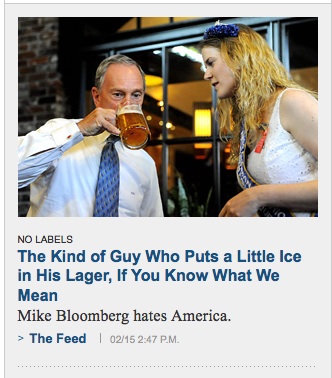
Bloomberg

That's telling, isn't it? An ideological adversary has a strange but substantively irrelevant habit – putting ice in beer – and the NRO reaction is an assertion that he hates the United States. In this iteration of conservatism, being a real American isn't about fealty to the Founding principles. It's all about cultural cues. Just like when the right trashed Barack Obama for putting mustard on his hamburger. (Yes, seriously.)

There's no excuse for a magazine with contributors as smart as Reihan, Ramesh, Jim Manzi, Kevin Williamson, Dan Foster, Yuval Levin, and others to engage in this sort of nonsense. It could be so much better.

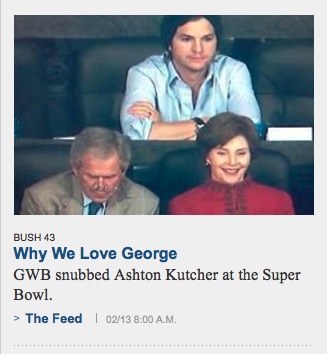
Another image from the home page:

Bush

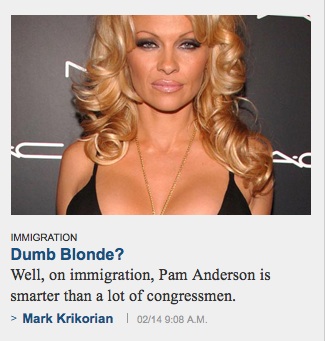
Never mind his disastrous policies – conservatives love it when someone snubs those coastal elite celebrities… except when celebrity might be coopted to serve ideologically friendly ends:

Pamella

This is what's become of The House That Buckley Built.