Inside Egypt

A reader writes:

In the “inside baseball” view of Egyptian politics, for the last month the game has been between VP Omar Suleiman and Defense Minister Mohamed Hussein Tantawi (sometimes also written Tantavi). The two have been very bitter rivals for most of the last decade, and it’s known, for instance, that Tantawi blocked Suleiman’s appointment as VP in earlier years. In the final hours of Mubarak, Suleiman stood decisively for Mubarak, urging that he stay on, while Tantawi led the joint chiefs of the military to accept Mubarak’s departure as inevitable and then to make the final push for it immediately after his Thursday speech. Tantawi is now clearly ascendant, and Suleiman, though not out of the picture entirely, has been marginalized. So far the military has taken a number of steps that nonexperts have characterized as anti-democratic–suspending the constitution and dissolving parliament.

If you understand something about Egypt, however, you know that these were actually the top two demands of the agitators for democracy, because they’re the two things that stand in the way. The reform faction now hopes that the “expert councils” will be formed with broad political participation and probably led by a handful of the nation’s best known judges. Their role will be to prepare the stage for new elections. If it’s done right, this process won’t be rushed because it will take some time and the elections will then follow in half a year. So far at least, the reform advocates have no real cause to be upset with the military council but history gives them every reason to be anxious about how things will develop further.

What we have seen so far is the adoption of nonviolent people power. What will be critical is the building of institutions and parties that can turn that slowly into a constitutional democratic republic. That’s the test. I’m hopeful, but it will be quite the miracle if they pull it off.

Here’s the full text of an expert analysis from which my reader draws of what’s been going on from professor Cherif Bassiouni of DePaul Law School, who’s as plugged in as anyone. Fascinating and hopeful stuff, especially about the military’s steady hand.
How Do Americans See Defense Spending?

  DefenseViews

Gallup:

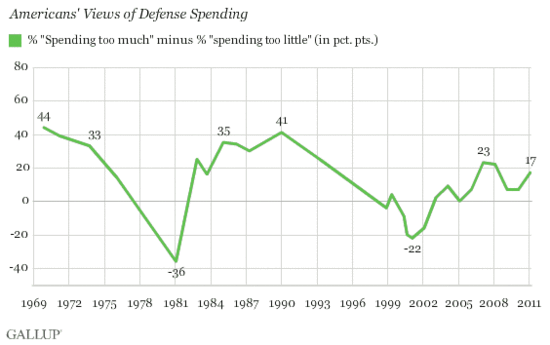
Americans do not provide government leaders with clear-cut direction on making defense cuts. They currently tilt toward the view that there is too much spending on defense, and that figure has increased slightly, from 31% to 39%, since 2009. However, almost as many Americans say current defense spending is about right, and combined with the 22% saying it is too little, the majority of Americans would theoretically oppose defense cuts.

Ezra Klein isn't so sure about that last sentence.

A Tunisian Tsunami? Ctd

Tom Kutsch takes stock of the stick and carrot measures implemented by Arab regimes fearful of uprisings like the ones in Tunisia and Egypt:

Syria and Libya acted preemptively, arresting activists likely to organize any street protests, saturating public places with security forces. In these countries, even a rally of a dozen people is treated like a threat to the status quo. President Mahmoud Ahmadinejad of Iran combined rank hypocrisy with his trademark brutality, congratulating "the justice-seeking movement in Egypt" while silencing Iranian protest leaders and dismissing their planned solidarity march as "divisive."

Whether shrewder or more fearful, other Arab leaders offered some wilted carrots. Jordan's King Abdullah dismissed his cabinet and appointed a new prime minister, pretending yet again that reform doesn't require constitutional limits on absolute monarchy but merely a shuffle of his minions. Bahrain's King Hamad, following the Kuwaiti example, took the hush money approach, offering more than $2,600 per Bahraini family (Kuwaitis got $3,580 each). The most serious gesture was the promise by the Algerian president, Abdelaziz Bouteflika to end decades of emergency rule which, as in Egypt and Syria, allows the government to ban public assemblies at will and detain people without charge indefinitely with virtually no judicial oversight.

None of these measures address the fundamental popular demands in these countries for the chance to live in freedom.

The Gaza Memo

800px-Israelis_killed_by_Palestinians_in_Israel_and_Palestinians_killed_by_Israelis_in_Gaza_-_2008_prior_to_Gaza_War

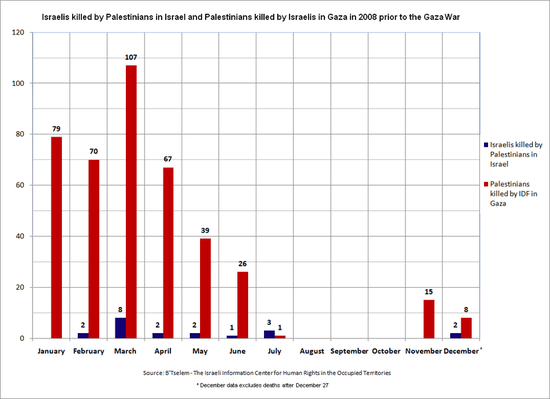
The core case of those of us who found the Israeli pulverization of Gaza so troubling was its vastly disproportionate toll on civilians, and what seemed like a policy of permanently and collectively punishing all Gazans for Hamas. The idea that it was vital self-defense – when the threat was so puny (see the graph above) and the response so massive (around 800 Palestinian civilians including 300 minors or children) – never rang true to me. While I was sick, a new Wikileaked memo was leaked from a few months before Cast Lead that casts some light on Israel's calculations:

Regarding the Tahdiya [the truce between Hamas and Israel], Hacham said Barak stressed that while it was not permanent, for the time being it was holding. There have been a number of violations of the ceasefire on the Gaza side, but Palestinian factions other than Hamas were responsible. Hacham said the Israelis assess that Hamas is making a serious effort to convince the other factions not to launch rockets or mortars. Israel remains concerned by Hamas’ ongoing efforts to use the Tahdiya to increase their strength, and at some point, military action will have to be put back on the table. The Israelis reluctantly admit that the Tahdiya has served to further consolidate Hamas’ grip on Gaza, but it has brought a large measure of peace and quiet to Israeli communities near Gaza.

Daniel Luban notes:

The memo does not say that the Israelis believe “military action will have to be put back on the table” because at some point Hamas will break the ceasefire, but rather because Hamas would like to maintain the ceasefire to strengthen its position. Thus if the memo accurately reflects the Israeli government’s thinking, it would appear that the Israelis were, from relatively early on, contemplating breaking the ceasefire in order to cut Hamas off at the knees.

Which they did. And then some. All timed perfectly between the US election day and Obama's inauguration. But all in self-defense, of course.

The Politics Of Lip Service

Larison worries that Mitch Daniels' distaste for pandering will doom his campaign:

One thing that makes it harder to estimate the strength of a candidate for the nomination is the ease with which a relative handful of activists can effectively tar a candidate as compromised or tainted very early on. As we are seeing with the treatment of Mitch Daniels, activists from one faction or another will savage a broadly acceptable candidate with no obvious, serious liabilities simply because he does not give their issues the priority that they think he should.

This isn’t a matter of single-issue activists objecting to a candidate because of real disagreements on policy. No one can actually point to anything Daniels has said on foreign policy or social issues that would put him substantively at odds with the broad majority of Republicans, but social conservatives and foreign policy hawks interpret a lack of statements on their issues as something close to betrayal. Arguably, Daniels’ main weakness, if we want to call it that, is his consistent refusal to pander to these activists by talking up their issues.

Not All Islamists Are Created Equal

DeathPenaltyIslam

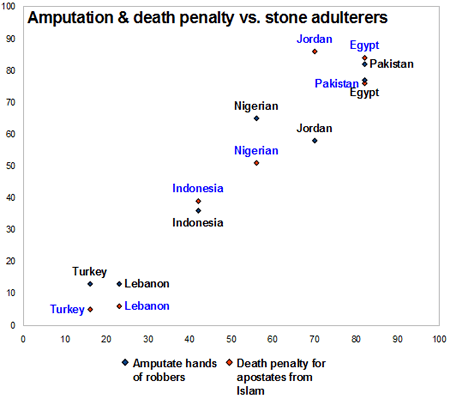
Razib Khan demonstrates "that it is very misleading for commentators to make an analogy between Turkish Islamists and the Muslim Brotherhood"

[P]eople regularly speak of “secular Egyptians,” “secular Turks,” “Turkish Islamists,” and “Egyptian Islamists,” as if there’s a common currency in the modifiers. That is, a secular Egyptian is equivalent to a secular Turk, and Islamists in Egypt are equivalent to Islamists in Turkey (who have been in power via democratic means for much of the past 10 years). Let’s look at the Pew Global Attitudes report, which I’ve referenced before. In particular, three questions which are clear and specific. Should adulterers be stoned? Should robbers be whipped, or their hands amputated? Should apostates from Islam be subject to the death penalty?

On the x-axis you see the proportion who accept that adulterers should be stoned. On the y-axis you see the responses to amputation and apostasy. The red points are the proportion who agree with the death penalty for apostates, and the navy points those who believe in whipping or amputation for robbers. … Compare Turkey to Egypt. They’re in totally different regions of the scatter plot. There is simply no comparison between these societies on these issues, despite both being Muslim and Middle Eastern.

I think the best riposte to this is the highly stimulating essay by Olivier Roy, cited on the Dish. Do yourself a favor. Read it. Islamism and modernity: a non-starter. Islam and modernity: not so much. And the next generation of Arabs and Muslims may know this better than any of us.

Rich And Gladwell, Wallflowers At History, Ctd

A reader writes:

I studied Journalism in the '90s. We were taught in the undergrad curriculum that the fax machine was crucial to the fall of the Soviet Union, specifically the '91 Coup attempt. We were told that the Soviet government controlled the newspapers and state TV but didn't predict the use of the fax machine to get the message out about the tanks rolling through Moscow.

Another writes:

Reading Rich and Gladwell reminded me of my experience reading Vaclav Havel.

Specifically, Havel's famous greengrocer. The greengrocer had a few signs in his window. Some were about his business, like the price of onions or tomatoes. But he also had a sign, provided by the regime, that said something like "workers of the world unite!" Even though he knew it was bullshit, the grocer posted the sign as a pledge of allegiance. The green grocer was engaged in revolution the day he tore down that sign and replaced it with a sign for beans because he was signaling to the world, "you and I both know this is bullshit."

I actually agree with Rich and Gladwell that Twitter and Facebook aren't strong connections. But discussing strong connections as a revolution's spark is a bit like discussing fish and bicycles. Revolutions are sparked by a call of bullshit gone out over a network. That network could be the sidewalks of Prague or the Facebook and Twitter accounts of Tunisians and Egyptians. A woman in Prague strolling down the sidewalk had no more connection to the greengrocer than the people plugged into a twitter feed in Cairo.

Another:

One of the primary things the Internet in general and social media in particular do is let you know that you are not alone – that throughout the world there are thousands, if not millions, of people who want the things you want. When people living in a repressive regime discover that there is a vast well of untapped resentment just waiting for a trigger, amazing things can happen.

The View From Your Window, Ctd

Ottawa-Ontario-357pm

Apparently three of our readers couldn't wait for the next contest on Saturday. One writes:

The shot is taken from along the river, obviously, and the horizon/time of day suggests we're looking west to one of the bridges across the river between Ottawa and Gatineau, Quebec, in the background. Based on the profile, it looks like the Prince of Wales Bridge, an old currently-not-in-use railway bridge named after our future king (sigh).

The key is the sort of semicircle formation off to the left, which looks to be a little area called the Chaudière Falls. To view the Falls and the Prince of Wales Bridge from that configuration, looking west, you'd have to be standing on the Gatineau side of the river, which is a problem up until we realize that the view from that window is, technically, Ottawa (very tricky).

So based on the implied elevation and the tiny bit of frame off to the right of the window, we're looking for a reasonably tall brick building in the Terasses area of Gatineau. I'll guess the Holiday Inn at the Plaza-La-Chaudiere.

Another:

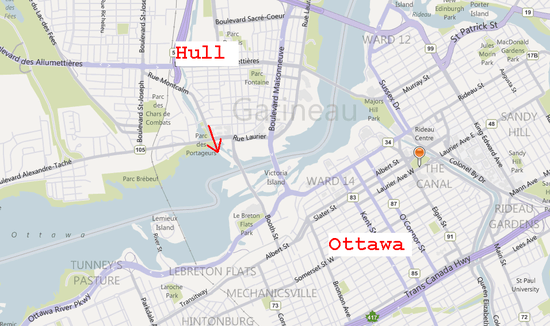
I had a little fun determining that your 2/15 VFYW "Ottawa" was actually taken from the Hull area of Gatineau, Quebec. The background, across the river, is Ottawa:

Hull_map

Another:

While the view is of Ottawa, the view is from Gatineau. Looks like it's from one of the massive Federal government offices with a great river view.  The Holiday Inn in the bottom left, together with the old stone building in the lower left give it away.  Here's a Google street view of approximately the same location.

Note that Ottawa and Gatineau together make up Canada's National Capital Region, but they are two distinct municipalities in different provinces, with different laws.  (Best known difference: Legal drinking age in Quebec is 18, in Ontario it's 19.)

We tried to get the exact location from the reader who submitted the photo, but no response. Update: a response:

Your reader is very close!  I work for the Government of Canada in a building that is attached to the Holiday Inn the reader mentions.  (Literally attached: we can take a corridor to the hotel without going outside.)  The photo is taken from a 16th floor office.

Tax Deform

Howard Gleckman continues to give the president no quarter:

In fairness to Obama, he’s hardly the first president to lard his budget with new tax preferences. … The difference now is that Obama keeps talking up tax reform even as he loads the code with more goodies. The more of this special pleading stuff he adds, the harder they will be to clean out if he really does try to lower rates someday. Worse, he’s increasing tax breaks at the same time he’s make painful cuts to a small slice of domestic spending. Is easing the commute from Westchester to Wall Street really a higher federal priority than helping low-income families pay their heating bill.

The Pitiful Republican Field, Ctd

Nyhan yawns at Silver's analysis:

Silver is right that the current GOP field lacks a widely praised figure who is held in esteem by both Democrats and Republicans, which may be a reflection of the candidates who have chosen to run or the increasingly polarized nature of our country's politics. It's not clear, however, that the absence of such a figure will matter.

The reality is that the economy plays a dominant role in presidential outcomes. To be sure, public reputations may matter in relatively extreme cases. In the past, for instance, I've argued that Hillary Clinton and Sarah Palin might underperform in the general election due to their polarizing public profiles (you could make the same argument for Newt Gingrich or other especially unpopular candidates). Other than Palin, however, it's not clear that the composition of the Republican field will matter much for the GOP's chances in 2012. The numbers that ultimately matter are economic growth, not early-stage polling.