Dissents Of The Day

A reader writes:

I assist our Community Reinvestment Director in preparing HuffPo blog posts. I also work with her and our other staff to write and place newspaper and magazine op-ed columns (in recent months we've been in the San Francisco Chronicle, Investor's Business Daily, American Banker and other publications). None of these outlets pays for guest opinion columns, so what precisely is the difference? Yes, HuffPo publishes bloggers because they attract readers. Presumably, newspapers publish op-ed columns for the same reason. Last time I looked, Hearst, Tribune Co., etc. are not running charities.

And what about expressing one's opinions in a widely-read forum (be it print or online) constitutes serfdom?  A bit of quick Googling produces this definition of "serf":

1.  a person in a condition of servitude, required to render services to a lord, commonly attached to the lord's land and transferred with it from one owner to another.
2.  a slave.

HuffPo blogging fits none of these criteria; we have no obligations whatsoever. When we think of something we want to say, we write it up and send it in. It's our subject, our timing, our choice on all counts. It's a fair exchange: HuffPo, the SF Chronicle or whatever publication gets some interesting content at virtually no cost (in both cases, of course, they are paying someone to review/edit and handle physical and electronic logistics of maintaining the platform); the writer/blogger gets her message to thousands of readers who wouldn't otherwise see it. The only difference is that at HuffPo we have much more control over scheduling. Calling this serfdom is just silly.

Another writes:

You asked, "If you can make a fortune off people's vanity and desire to express themselves, why not?"

It doesn't seem like you are taking into account the benefits "free" bloggers like myself accrue from sites like Huffington Post when we give them material that will result in pageviews. For example, I have a book based on my blog that will release on March 1 and I would love nothing more than to give them some free material that will raise the visibility of the book and get them some pageviews. It's not simply a narcissistic desire for self-expression.

I also think your comment shows a lack of awareness of how your blog generates pageviews that result in paychecks for those involved with the Dish. Most Dish posts direct people to other material that is free for you, and the dream of most bloggers is to get "Dished." Are you making a living off of people's vain desires for self-expression when you link to their Youtube video or blog post?

The CPAC War: Not Over Yet

Over at FoxNews.com, Kevin McCollough complains that CPAC is being ruined by people who like liberty too much:

It is the libertarian in attendance that produced the free pornographic calendar passed out to attendees in 2010. It is the libertarians in attendance who openly promote the inclusion of groups like GOProud, largely as an attempt to silence groups who would speak in strong support of traditional moral values. It is the libertarian in attendance who slandered President George Bush, by claiming his appreciation for the Constitution was best summed up as a “damn piece of paper.” It is the libertarian in attendance that proclaimed the war to prevent terrorists from regathering strength and coming after our homeland as “illegal.” And it is the libertarian in attendance that eschewed, booed, cajoled and screamed “war criminal” to Vice President Dick Cheney, a man who served his country with commitment and still attempts to help the world understand the threat of the radical Islamic element devising plans to eliminate us and our allies.

That about sums it up. The right can lean libertarian, putting up with the excess of free pornographic calendars, or it can lean “conservative,” and the excesses of torture, abridgment of civil liberties, and war crimes. Rush Limbaugh was unhappy with CPAC too:

So you had a weird list of priorities and focus.  I mean we had it all.  We had GOProud, the gay conservatives.  We had demands to legalize drugs, marijuana, at CPAC.  Most conservatives strongly oppose gay marriage and legalized pot.  We had would-be candidates promoted by the Washington ruling class. We had some candidates dumping on talk radio. We had Mitch Daniels saying, (paraphrasing) “We need to move beyond the audiences of Rush and Sean,” and so forth and the C-SPAN viewers, we need to move beyond that.

As the Dish pointed out yesterday, Mitch Daniels gave a stirring speech about the dire fiscal emergency that America faces. But Limbaugh pouts dismissively because as an aside, he pointed out the obvious truth that the right needs to win over a wider audience than talk radio blowhards can reach. It’s illuminating to see how threatened Limbaugh is by an unapologetic fiscal conservative who is capable of articulating the need for spending reforms without engaging in the culture war or character assasination. 

And perhaps he is right to be threatened. In a sense, the triumph of someone like Daniels would be the strongest repudiation of Limbaugh imaginable. It would clarify the ineffectiveness of his approach to politics.

Budget Numbers You Can Understand

Annie Lowrey has a clever piece up that puts the federal budget in perspective with a simple conceit:

For our purposes, let's use $60,000 as the government's income and $85,000 as its expenses.

Where does all of that spending go? Mostly, to mandatory programs, spending that does not change much year-to-year and is not easily reduced. But given that mandatory spending makes up about 60 percent of spending, if the debt is going to come down, these are the line items that need to change. Next year, Obama is requesting $17,400 for Social Security, $10,700 for Medicare, $6,100 for Medicaid, and $13,600 for other mandatory programs such as food stamps. There's no way around any of those expenditures, which total about $48,000—or more than three-quarters of the federal government's annual income. (Last year, mandatory spending alone actually exceeded income.)

Next she tackles the discretionary budget:

First and foremost is security spending. The country needs to fund the Afghanistan war and the Department of Defense. This is not cheap: In fiscal year 2012, Obama is asking for $20,000 for overall security costs.

So far, my friend, you're at $68,000. No cuts yet, and you've already blown your budget by about $8,000. But wait—there's more, as they say. You have to pay for all the debt you're ringing up. This year, you are on the hook for $5,500, and that is just for interest payments to creditors. So you see the problem here: Before you've even gotten to anything that anyone even talks about cutting, you're already about 25 percent over budget.

So what's left? "All of the money for bridges, schools, nuclear power plants, foreign aid, space flight, and everything else." And the numbers? "In the discretionary budget, the sums are astounding not because they're so huge, but because they're so puny: $400 on energy, $500 on agriculture, $1,000 on housing and urban development, and $1,800 on education, for example." What makes more sense? Eviscerating those budgets, or means testing social security, raising the retirement age, and cutting back on our military commitments?

We all know the answer. Except for Obama, the Democrats and the Republicans. Maybe it will take a national default to get our political leaders to lead.

The View From Your Window Contest: Winner #37

Vfyw-contest_2-11 This one turned out to be the most challenging view yet. A reader writes:

This is north enough that the grass appears to have some frost and the trees have lost their leaves, but south enough that there is no snow.  I’m thinking Virginia or North Carolina, both with a fair share of bases (particularly VA).  In honor of my Dad, who remains Semper Fi even as he has grown to detest our current wars, I’ll say Quantico. If you hadn’t provided the clue, I’d like to think I would have guessed this was a military installation on my own.  No more clues, please – have some faith that your more rabid guessers will come through.  Plus there are many of us who enjoy the wild misses with good reasoning nearly as much as the intimidating precision of the Master Googlers or “I’ve-got-all-weekend-to-look” Obsessive.

Only one reader correctly guessed this week, and only a few dozen even attempted, so a clue was pretty essential this time around. Another writes:

Been reading the blog for a couple of years, but this my first VFYW guess. As a student at the University of Louisville many years ago, a group of friends and I decided to take a road trip to check out the famous gold repository at Fort Knox. For some reason, this photo sparked that memory.

Another:

This picture reminds me a lot of Fort Knox, Kentucky, where I did basic training many years ago.

Another:

Given the ridiculously accurate answers this contest inspires, I’ve typically refrained from sending in my off-the-cuff guesses. But a slothy Saturday morning has gotten me over my fears of embarrassment.  So, here goes: the orderly, efficient scene, in a blatant example of stereotyping, suggests that this is Germany. I’m going with Ramstein AFB, near the city of Kaiserslautern.  Admittedly, the order and efficiency could be attributable to the whole military thing, but I’ve got my hook and I’m sticking with it.  In light of my lazy manner this morning, not to mention my fear of popping up on some NSA watch list, I’ve refrained from scouring Ramstein with Google Earth.  But I wonder if a bunch of other VFYW addicts spending hours scouring images of US military installations will set off alarm bells somewhere!

Another:

This looks like a view facing west from the hospital at Dyess AFB in Abilene, Texas. My father was stationed there for the last part of his career. It’s been a while since I’ve been out there, but it sure does remind me of home.

Correct on the hospital part. Another:

What appears to be southern pines are the only element that I recognize, and they make me think Georgia or the southeastern US.  Fort Benning, Georgia?

Correct state. Another:

The hospital at Fort Gordon, GA? I’m desperate to win this thing. I was tempted to make up a story, but my conscience got the better of me. So I’ll resort to begging. Please, please, please …

No begging necessary. From the reader who submitted the photo:

Dr. Matthew P. Burke, Major, US ArmyThis is the view from my brother’s window – the view from the hospital room of Major Matthew P. Burke on the 9th floor, west wing, at the Eisenhower Army Medical Center on Fort Gordon, near Augusta, Georgia, on January 29, 2011 at 8:03 AM.
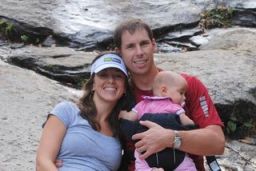
I gave Matt and his wife Bonnie a copy of the VFYW book for Christmas in 2009.  Matt asked me several times whether I had ever managed to get a window published.  Today might be my last chance during his lifetime. Here is why Major Burke is in the hospital; he was injured in the line of duty because he was engaged in physical training (cycling) when he was struck by an SUV.

Sadly, Matt succumbed to his injuries on February 6. His brother, Paul, followed up with the Dish:

I took the photo as I sat next to my brother’s bedside.  Bonnie, my parents, my brother Ted and I had been rotating shifts with Matt so that he was almost never alone during  Matt, Bonnie & Anna in Septemberhis final weeks (and, truly, he was never alone because of the remarkable care provided to him by his Army colleagues).  It had been a long night and I was tired.  When I turned from Matt and looked out the window behind me, I was struck by the shine on the Stars and Stripes as the morning sun dawned.

Since Matt passed away, Gen. Gamble has provided flags to Bonnie, my parents, and my siblings that were flown in Matt’s honor on the flagpole outside the hospital.  We were touched by this gesture, which now has even more meaning now that the Dish’s readership has shared with us my brother’s final view outside his window during this life.

(Photos by Paul Burke.)

A Budget With Few Friends

Ezra Klein puts on his "long game" goggles:

Thompson summed the reaction up well: "The same way a spork makes a incomplete fork and an ineffectual spoon, this compromise budget provides for both incomplete investment and ineffectual deficit reduction." And so it has found few friends.

But it's worth remembering that this is the White House's opening bid in a negotiation that's just getting started. They have made a decision — perhaps savvy, perhaps not — to leave it to the Republicans to take the first step on entitlements and tax reform.

The Republicans, due to their criticism of this budget, now have to offer something more far-reaching in their proposal. If they come up with a plan people like and some votes for it, the White House can join with them in negotiations and eventually sign onto a grand compromise. This budget will be largely forgotten. If they come up with a plan people hate that clearly can't get the votes, the White House can attempt a replay of the mid-1990s and hammer them with it.

This budget doesn't lead on long-term deficit reduction. But that's not necessarily because the White House is uninterested in that discussion. Note the section laying out the White House's interest and position on Social Security reform. Rather, they're keeping their options open until Congress makes the first move. This is a strategy that frustrates Washington — think back to the bipartisan criticism of the leeway the administration gave Congress during health-care reform and the stimulus — but it's tended to be how the White House approaches major reforms.

The Pitiful Republican Field

Nate Silver sizes it up. Money quote:

The Republicans have two candidates in Ms. Palin and Mr. Gingrich whose net favorability ratings are actually  in the double-digit negatives, something which since 2000 had only been true of Pat Buchanan and Al Sharpton.

Palin is the Sharpton of the far right in many ways. Buchanan is so much smarter and more honest than Gingrich.

A Fiscal Sideshow

Howard Gleckman slams Obama's budget:

In today’s budget proposal, Obama would increase taxes to 17.9 of GDP in 2013. This is just about what revenues averaged under Reagan. And it would be a step in the right direction. Except the chances of it happening hover around zero.

Obama would get there mostly with a collection of ideas that he failed to sell to even a Democrat Congress. They include: allowing the 2001 and 2003  tax cuts to expire at the end of 2012, capping the value of itemized deductions at 28 percent, taxing the compensation of hedge fund managers and other financiers at ordinary income instead of capital gains rates, and increasing  taxes on multinationals.

It is a deeply unserious proposal. It's like proposing a new paint for the living room, while the ceiling is slowly falling in, and the roof has a leak that won't quit.

Rich And Gladwell, Wallflowers At History, Ctd

Yesterday I discussed how new forms of media have helped foment revolutions:

Of course, strong connections like unions or political parties or churches or mosques and simply the courage of masses in the street are essential for revolutionary action. But this was true for decades – and yet the 1979 Revolution in Iran was indisputably galvanized by audio-tapes of Khomeini sermons smuggled in from abroad; and the 2009 Green Revolution was originally triggered by young people using Twitter and blogs and cellphone cameras to broadcast their numbers and outrage and courage.

Another example is the role that television played in catalyzing the Civil Rights Movement, particularly the Birmingham campaign of 1963:

[T]he campaign was a major factor in the national push towards the Civil Rights Act of 1964 … Television cameras broadcast to the nation the scenes of fire hoses knocking down schoolchildren and police dogs attacking unprotected demonstrators. Such coverage and photos were given credit for shifting international support to the protesters and making Bull Connor "the villain of the era". Kennedy called the scenes "shameful" and said that they were "so much more eloquently reported by the news camera than by any number of explanatory words."

In Malcolm Gladwell's 4400-word case against social media, "The Revolution Will Not Be Twittered," he relies on the Civil Rights Movement, namely the Greensboro sit-ins, to buttress his case for strong ties. "These events in the early sixties became a civil-rights war that engulfed the South for the rest of the decade—and it happened without e-mail, texting, Facebook, or Twitter." He continues:

The drawbacks of networks scarcely matter if the network isn’t interested in systemic change—if it just wants to frighten or humiliate or make a splash—or if it doesn’t need to think strategically. But if you’re taking on a powerful and organized establishment you have to be a hierarchy. The Montgomery bus boycott [that began in December 1955] required the participation of tens of thousands of people who depended on public transit to get to and from work each day. It lasted a year.

Gladwell's italics. Now consider the timeline for the '63 Birmingham campaign (April 3 to May 10 – five weeks):

On 3 April the desegregation campaign was launched with a series of mass meetings, direct actions, lunch counter sit-ins, marches on City Hall, and a boycott of downtown merchants. …

On 2 May more than 1,000 African American students attempted to march into downtown Birmingham, and hundreds were arrested. When hundreds more gathered the following day, Commissioner Connor directed local police and fire departments to use force to halt the demonstrations. During the next few days images of children being blasted by high-pressure fire hoses, clubbed by police officers, and attacked by police dogs appeared on television and in newspapers, triggering international outrage. … With national pressure on the White House also mounting, Attorney General Robert Kennedy sent Burke Marshall, his chief civil rights assistant, to facilitate negotiations between prominent black citizens and representatives of Birmingham’s Senior Citizens Council, the city’s business leadership. …

By 10 May negotiators had reached an agreement …

Gladwell discusses Birmingham in his essay but fails to mention any role that new media – i.e. television – played in accelerating the indispensable work of activists led by Martin Luther King:

Enthusiasts for social media would no doubt have us believe that King’s task in Birmingham would have been made infinitely easier had he been able to communicate with his followers through Facebook, and contented himself with tweets from a Birmingham jail. … [O]f what use would a digital communication tool be in a town where ninety-eight per cent of the black community could be reached every Sunday morning at church? The things that King needed in Birmingham—discipline and strategy—were things that online social media cannot provide.

But by the time King was put in jail, those strong-tie networks were already in full force. It took the horrific images of fire-hosed protesters being beamed into the TVs of Middle America to bring the crisis to a quick conclusion. Media matters. It cannot create change or the social forces behind it or the need for strong networks to carry it out. But it can be an accelerant in ways few activists have ever doubted. Necessary, if not sufficient.

Obama’s Fiscal Surrealism

This I didn't know:

Mr. Obama's budget also assumes annual economic growth of more than 4% from 2012-2014. That's far more robust than anything this recovery has produced so far, and it is at least a percentage point higher than most private economists or the Congressional Budget Office predict.

I'd love to see a reporter ask the president if he believes that 4 percent figure. The whole exercize in mendacity and delusion is so sad.