Nuns As Feminist Pioneers

Craig A. Monson, author of Nuns Behaving Badly: Tales of Music, Magic, Art, and Arson in the Convents of Italy, connects nunnery to women's suffrage:

American wives and mothers only got the vote in 1920, British women a year or two earlier, French women as late as 1944—by which time nuns in cloisters had “had the vote” for a millennium or more, choosing which women might join them and electing sisters to fill convent offices.

Which might begin to explain some of my convent misbehavior. If you take a number of well-bred, comparatively educated women, put them off by themselves, give them “the vote” and the opportunity to take on responsibilities that challenge their resourcefulness and creativity, it’s not surprising if they “get ideas” and develop a certain independent-mindedness.

Which is why this Vatican is so keen to go all Mubarak on them in the US. In Benedict's church, the only ideas allowed are his.

The By-Line Gender Gap

Venus

Elissa Strauss observes the lack of female by-lines in most major publications:

A perhaps deeper issue is that we still live in a world where news itself is gendered, where matters like making and raising human beings, gender identity, sexuality, and childhood and adolescence are considered something for the ladies, while subjects like war and politics, which are more likely to be covered by male writers and reporters, hold the monopoly on general interest stories. But I also think both editors and reporters often lack imagination when it comes to the ties between culture and gender and politics and the economy, and that perhaps we would all benefit from a more holistic view of how the world works.

Strauss includes responses she received from editors at The New Yorker (27% female bylines overall in 2010 according to the VIDA study), The New Republic (16%), The New York Review of Books (15%), and Harper's Magazine (21%). The Dish's staff is only 20 percent female. Does 20 percent gay help?

To help close the byline gap, Ann Friedman created a tumblr linking to the work of female journalists.

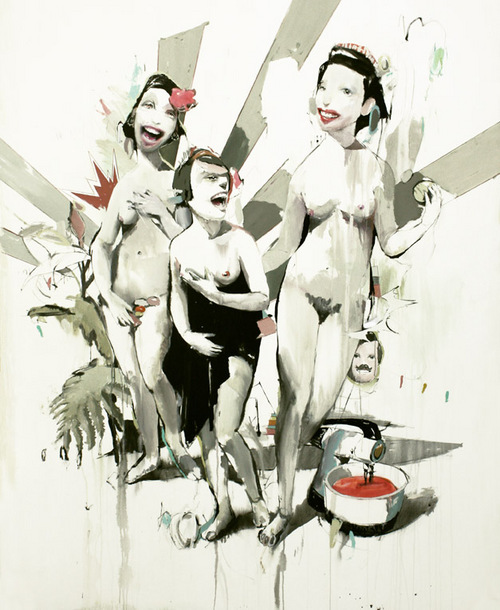
(Image: by Alexandros Vasmoulakis via Wooster Collective)

A Silver Lining To Sidewalk Rage

Maia Szalavitz sees one:

While it sounds like an oxymoron, altruistic punishment is basically how social norms get enforced. So when you expel a huffy "Excuse me!" to the rude sidewalk clogger in front of you who has stopped midstride to check his BlackBerry, you're trying to discourage behavior that endangers other members of the society. It's called "altruistic" punishment, because your efforts to protect civility come at personal cost with little chance of personal benefit: you are far more likely to get an obscene gesture or even a punch in the mouth than a thank you.

GPS Prevents Kids From Playing Hooky

Liz Dwyer summarizes:

[An Anaheim] city's school district has teamed up with local police for the ultimate Big-Brother-is-watching-you solution to truancy. They've embarked on a six-week pilot program where 75 students with four or more unexcused absences are carrying a handheld GPS tracking device.  Every morning the teens get a robocall reminding them to get to school on time. After that, they're required to pull out their GPS device five times a day and "enter a code that tracks their locations—as they leave for school, when they arrive at school, at lunchtime, when they leave school and at 8 p.m."

Home News

Ship

The Dish is moving! In April, we’ll be joining The Daily Beast.

For me, it’s a strange mixture of excitement and sadness. Sadness because the Atlantic has been a very special home for me and all the interns and staffers who have worked at the Dish. The more than four years that I’ve worked here have been the most rewarding, exhilarating and challenging of my career. I cherish my colleagues, their support and debate, and will miss them deeply. But be assured, I’ll continue to link, debate and argue with the team here, and remain immensely grateful to editor James Bennet and chairman David Bradley for their never-faltering faith in what we’ve tried to do. The Dish is almost unrecognizable from what it was four years ago – and that experimentation, growth and creativity were all made possible by the Atlantic. I also have a profound attachment to the magazine’s history and legacy and integrity, which makes leaving hard. But I am very proud to have played a part in the Atlantic’s self-reinvention in this period and its first profitable year in memory. To have played any part in perpetuating this legacy in an environment that has been as tough on magazines as any in memory is an honor I will cherish to the end of my days.

But there are some opportunities you just can’t let pass by. The chance to be part of a whole new experiment in online and print journalism, in the Daily Beast and Newsweek adventure, is just too fascinating and exciting a challenge to pass up. And to work with media legends, Barry Diller and Tina Brown, and with the extraordinary businessmen Sidney Harman and Stephen Colvin, is the opportunity of a lifetime. Barry was the person who first introduced me to the Internet in the early 1990s, and we have remained friends ever since. Tina Brown needs no introduction, but to see her in action as we have discussed this new adventure over the past few weeks has been quite a revelation. The Daily Beast, in a mere two years, has made its mark on the web, with 6 million unique visitors last month, and an eight-fold jump in ad revenue over the last year. It will give the Dish a whole new audience and potential for growth and innovation. I’ll also be contributing columns and essays to Newsweek.

We remain committed to the same principles from the very beginning: in no-one’s ideological grip, in search of the truth through data and open, honest debate, in love with the new media’s variety and immediacy, committed to accountability and empiricism and resistant to any single category of subject or form. I have no idea where we’ll end up or what the future will bring. But that’s been true for a decade. What I do know is that the Dish is immensely lucky to have this new home, a new challenge, and these new partners.

I also want to assure you that, as for the past ten years, through andrewsullivan.com, Time and the Atlantic, I will retain total editorial responsibility for what appears in this column. And though we will continue to evolve, there will be no substantive change in content as we move. You don’t even have to change your bookmark, since you’ll be automatically redirected, once April arrives. If you want to make sure you don’t lose track, bookmark us now and you will be automatically redirected when April 4 comes around.

I hope you’ll come with us, and join us, and be your usual informed, querulous, irreverent, ornery and intimate selves, correcting our errors, feeding us material, opening our eyes, chiding us and bucking us up every day at every hour on every continent. You have become the core of the Dish, and without you, we simply couldn’t do it.

Now we will ride a new Beast into a new decade. Here’s hoping it’s as exhilarating as the last one.
We Are In Many Moments

  57_vionnetbeijing

Jerry DeNuccio wonders if we can ever be "in the moment":

Not according to the Stoic, Marcus Aurelius, who says time is a “river of passing events,” and “no sooner is one thing brought to sight than it is swept away and another takes its place and this too will be swept away.” Not according to Job, who says time is “swifter than a weaver’s shuttle,” nor Andrew Marvel, who, at his back, hears “time’s winged chariot hurrying near,” nor William Butler Yeats, who says “The years like great black oxen tread the world/ And God, the herdsman, goads them on behind,” nor T. S. Eliot’s Prufrock, who says there is “Time yet for a hundred indecisions,/ And for a hundred visions and revisions,” nor Robert Frost, who says time “seriously, sadly, runs away.”

Certainly, being in the moment would seem impossible in our culture’s time-fissioning present, our iPhoned, Facebooked, Googled, Twittered restlessness, our desperate fear of missing the latest morsel of information, our attention never more than a nanosecond from seduction — our discontinuous, du jour present, a Smithsonian so densely packed with experiential exhibits that no lingering look, no settled examination, seems permitted. No sooner do we settle into a moment than another gallops by, all dust and flashing hooves.

This "in the moment" cliche, I think, can be misunderstood. The point is not to somehow stop time; the point is to transcend it. We are, as mortals, trapped in the "deadliness of doing," but if we can get above the practical mode of experience, we can experience moments in time that are also out of time, what Oakeshott meant when he spoke of salvation as having nothing whatsoever with the future. Or when he wrote of the gift of the religious and spiritual life in:

the poetic quality, humble or magnificent, of the images, the rites, the observances, and the offerings (the wisp of wheat on the wayside calvary) in which it recalls to us thet 'eternity is in love with the productions of time' and invites us to live 'so far as is possible' as an immortal.

The citations are from William Blake, who elsewhere, wrote of the real goal:

To see a world in a grain of sand
And a heaven in a wild flower,
Hold infinity in the palm of your hand
And eternity in an hour.

I think Eliot was onto the same thing when he wrote in his masterpiece that

to apprehend
The point of intersection of the timeless
With time, is an occupation for the saint

To reduce this ancient insight (also central in any ways to Buddhism) to somehow stopping time is to miss the point entirely. It is about being both mortal in time in a way that brings immortality to life 'so far as is possible' – in ritual, meditation, prayer and openness to what we see and engage each day through time, in time, and yet beyond it.

An idea that is actually a practice that escapes words.

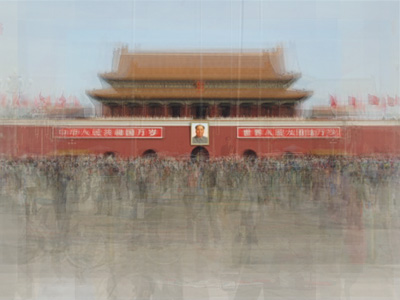
(Image: a view of Beijing by Corinne Vionnet from the series, "Photo Opportunities," made from hundreds of snapshots of tourist locations found on the Internet.)

Ajami vs Wieseltier

The professor’s grasp of the profundity of what has happened these past two months boils down to one core point, one that seems bizarrely beyond some of the more, shall we say, parochial responses:

There is no overstating the importance of the fact that these Arab revolutions are the works of the Arabs themselves. No foreign gunboats were coming to the rescue, the cause of their emancipation would stand or fall on its own. Intuitively, these protesters understood that the rulers had been sly, that they had convinced the Western democracies that it was either the tyrants’ writ or the prospect of mayhem and chaos.

So now, emancipated from the prison, they will make their own world and commit their own errors.

What will it take for Washington’s elite to understand that this is not about America? Mercifully, perhaps because of his unique background, Obama grasps this. Those trapped in old paradigms – like Wieseltier and Wolfowitz – are doubtless genuine and admirable in their concern about wanton killings by the Libyan dictator. But they do not seem yet to grasp – even after Iraq – that freedom is only freedom when you have won it on your own.

And a confession. For years, like many conservatives, I had become convinced that culture truly does matter and that culture would prevent the Arab world from ever developing the kind of democracy that exists in the West. The Persians and Jews and Turks and Kurds were different, I thought. The Arabs? Too tribal; too divided; too religious. Ajami reminds us that this narrative was favored by the Arab tyrants themselves and protected their interest. It was also favored by Israel, as a buttress to its case for open-ended colonialism in its own backyard.

What I failed to grasp is that culture changes, that the younger generation, as in Iran, were increasingly aware, thanks to the new media revolution, of how backward their own societies had become. Culture still matters, mind you; and I am not optimistic about what might end up in power in Libya, and remain wary of Egypt’s Muslim Brotherhood. But this is a process – and it may be happening faster now than before. We have surely learned to be humbler in our generalizations.

What took place, after all, in the cradle of democracy, Britain, before it became what it has become? (Sorry, America, but parliamentary democracy, and its core rationale, was born elsewhere). Huge religious conflict, a bloody civil war ending in the execution of the monarch, a fundamentalist dictatorship under Cromwell, another revolution in 1688, followed by three centuries of development and adjustment and war. And this was with the benefit of being on an island, with no standing domestic army and a weak royalty and strong aristocracy going back to the thirteenth century. I remain steeped in this history – and, while acknowledging its share of crimes and atrocities – proud of it. Because it was mine; because I fully identified with its national origins.

We in the West, in other words, are proud of and attached to our liberties because we and our forefathers grasped them for themselves. This mix of patriotism and liberty is vital and necessary. To have freedom imposed is to create chaos and resentment. To have the people grasp it for themselves is to expand the horizons of a stable democracy. There will be failures and successes. But Ajami is right. We should do all we can to assist if asked. But this is their moment, not ours, their countries, not ours, and it is time to let go of the neurotic need to control the entire world and to force it into our own ideological templates. It is time to watch and listen and engage and support. It is not time to intervene.

Waxing And Waning Of The Blogs

Scott Rosenberg corrects the New York Times:

Social networking is changing blogging. …More of us are using Facebook and Twitter for casual sharing and personal updates. That has helped clarify the place of blogging as the medium for personal writing of a more substantial nature. Keeping a blog is more work than posting to Facebook and Twitter. So I wouldn’t be surprised if, long-term, the percentage of the population blogging plateaus or even declines.

Maybe we’ll end up with roughly ten percent of the online population (Pew’s consistent finding) keeping a blog. As the online population becomes closer to universal, that is an extraordinary thing: One in ten people writing in public. Our civilization has never seen anything like it.

So you can keep your “waning” headlines, and I’ll keep my amazement and enthusiasm.

Scott Esposito piggybacks on his argument. I've stayed off Facebook for obvious reasons.

But whenever I've dipped into those waters, the more constantly updated chit-chat Facebook pages do remind me of mini-blogs. I often note to my hubby that he's a great blogger, and all he has is Facebook. And when I recall the early days of blogging, the audiences are of a similar size. But of course, Facebook is more restricted in audience and, in most cases, subject matter. But there are no rules here – just the liberation of self-expression. Democratized.

Naturalist Spies

Butterfly

Richard Conniff charts the intersection:

Spies have at times certainly pretended to be naturalists.  The most public of them was Sir Robert Baden Powell, better known as founder of the Boy Scouts.  As a British secret agent, he thought it clever to pose as “one of the exceedingly stupid Englishmen who wandered about foreign countries sketching cathedrals, or catching butterflies.”   His detailed maps of enemy fortifications were concealed within the natural patterns of butterfly wings and tree leaves, and he sometimes showed off these sketches to locals, secure in the sad knowledge that they “did not know one butterfly from another—any more than I do."

(Image: "A sketch of a butterfly contains the outline of a fortress, and marks both the position and power of the guns," from My Adventures As A Spy by Powell.)

Face Of The Day

Andrewmyers7

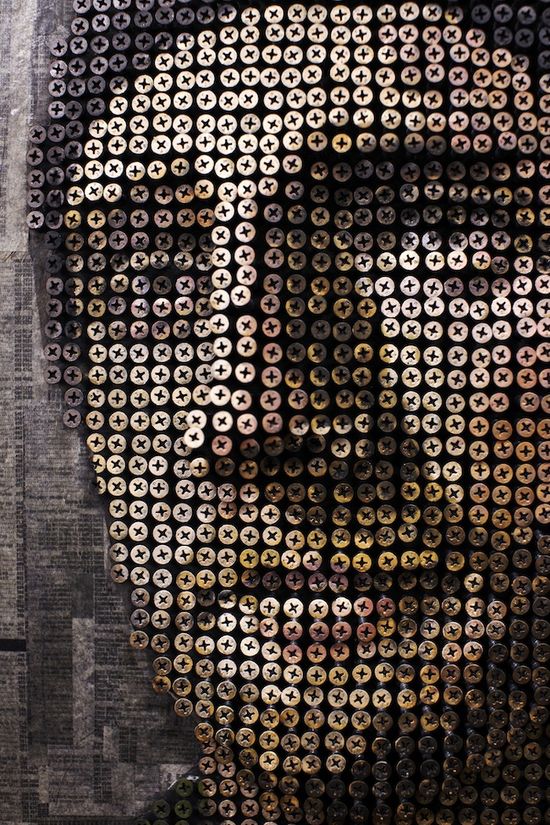
For more on Andrew Myers' amazing portraiture using screws, check this out – where you can also see how this portrait appears when viewed not at an angle. Money quote:

Meet Andrew Myers, one of the most patient modern-day sculptors around. This Laguna Beach, California-based artist goes through a multi-step process to create incredible works of art you almost have to see (or touch) to believe. He starts with a base, plywood panel, and then places pages of a phone book on top. (Cool fact: He'll use pages from his subjects' local area.) He then draws out a face and pre-drills 8,000 to 10,000 holes, by hand. As he drills in the screws, Myers doesn't rely on any computer software to guide him, he figures it out as he goes along. "For me, I consider this a traditional sculpture and all my screws are at different depths," he says.