
Ottawa, Ontario, 3.57 pm
Ottawa, Ontario, 3.57 pm
My vehement post yesterday about Obama's indifference to crippling long-term debt has been viewed in some corners as my breaking up with my latest political crush. I hate to disappoint my friends on the right and left, but strong criticism of a president does not mean abandonment. Obama remains, in my view, the best chance we've had in a long time to address our real problems in a civil and constructive way. That's why he mattered and still matters. My post reflects a crushing disappointment in his fiscal unseriousness, while acknowledging its short-term political canniness.
My belief in balanced budgets and living within one's means is deeply entrenched. I attacked my idol Reagan over it; I gushed over Perot on that count (about the only one); I backed Bill Clinton's first, Eisenhower-style budget; I praised the Gingrich-Clinton surplus. But, from the get-go, I went after George W. Bush on fiscal matters and his indifference to deficit spending (unlike most of the Tea Partiers). I went ballistic over Medicare D and unfunded wars. I have been relentless in skepticism toward the Tea Party's alleged fiscal credentials. So why would it in any way be surprising that I would treat Obama the same way? I gave him leeway in the first two years because cutting spending in such a recession would not have helped. In my post yesterday, I support his distinction between investment and mere spending.
But he was elected to provide change we can believe in. In the biggest domestic challenge – America's compounding bankruptcy – he has offered denial and politics.
And it is not as if I haven't challenged him elsewhere – on Afghanistan, on DADT repeal, on defending DOMA, and on Israel/Palestine, where he has gotten nowhere slowly and where Netanyahu has simply run rings around him. (The latest Obama capitulation to West Bank settlers is here.) There are, moreover, very few now on the right with any more fiscal cred, although it's encouraging to see Coburn and Daniels tell some hard truths. I remain skeptical of Paul Ryan, but if he comes through with a budget with serious longterm entitlement and defense cuts, I'll look again.
Maybe this is the first move in a very smart long game toward a Grand Bargain. If it is, I'll be as supportive of Obama as I was eventually on DADT repeal. But I have to judge what I see according to my principles. As a fiscal conservative, I think Obama is failing the test of history. But I sure haven't given up on him as a president yet.
Beinart outlines them:
When it came to Egypt … the relevant divide wasn’t between neoconservatives and liberals, both of whom generally supported the folks in Tahrir square. It was between neoconservatives and Islamophobes, the kind of folks who think the real problem with the Middle East is the Koran itself. The other divide was between the neoconservatives and Benjamin Netanyahu, whose government yearned for Mubarak to stay. The parting of ways between the American and Israeli right over the past few weeks should end once and for all the canard that neoconservatism is a creed hatched in the Knesset. For all its flaws, contemporary neoconservatism is a deeply American doctrine, very different from the more pessimistic worldview that dominates Likud.
But there is also a middle ground where many conservatives belong. It is one that celebrates, embraces, rejoices at liberation from tyranny, but worries about the possibility that such transitions may be coopted by opportunistic forces. History is full of this. I'm optimistic about Egypt, but not delusional. This will take time and, crucially, the kind of political statesmanship and prudence that makes all the difference in history and for which there is no substitute. So far, I must say, the most prudence I have seen has come from the Egyptian people themselves. But who knows who waits in the wings?
"She's very pregnant so she can't fly," – director Darren Aronofsky, explaining why Natalie Portman wasn't able to accept her BAFTA award in person.
Chait says there is no point in Obama proposing a real solution to the country's medium-term fiscal collapse … because of the nature of the current Republicans. That's Jon Cohn's and Josh Marshall's position too. I have not exactly been easy on the GOP either and their fiscal fraudulence when it comes to the long-term debt. And yet Tom Coburn boldly came out in favor of Bowles-Simpson, and Saxby Chambliss and Kent Conrad are on board for serious long-term entitlement and tax reform. It seems a little strange to believe that a GOP just elected on a platform of ending the debt would oppose Bowles-Simpson's outline for eventual fiscal sanity. And if they did, Obama could call them out for their fiscal recklessness.
Instead, Obama's transformation into a "what debt crisis?" liberal means that the GOP for the first time can legitimately call Obama out on his fiscal recklessness. Like Megan, I can see the point of spending in a recession. But when you have a new opportunity to set a new fiscal compass in a slowly recovering economy, outflank the GOP on the long-term debt, and help prevent a looming fiscal collapse, and you give the lame-ass SOTU Obama gave and unveil the risibly unserious budget we got yesterday, you reveal yourself as, well, not exactly change and certainly not hope.
I am not turning on the president given the alternatives, but I am not going to use the alternatives as excuses for the president to shirk his core responsibility to the next generation. I didn't send eight years excoriating George "Deficits Don't Matter" Bush to provide excuses for Barack "Default Doesn't Matter" Obama. Like other fiscal conservatives, I'm just deeply disappointed by Obama's reprise of politics as usual – even as the fiscal crisis has worsened beyond measure in the last three years. My point is that actually being honest about the budget and what it will take to resolve its long-term crisis is not political suicide, as Chait says. It's statesmanship. It's what a president is for.
One reason many of us supported this president was because he pledged not to return to the cynical politics of the Washington game in which partisan maneuvring always, always outweighs the national interest. But what he is telling us now is that he is indeed a classic pol, aiming for re-election, even if the US risks becoming a fiscal banana republic in the next decade.
And if you really wanted to help the economy, wouldn't reassuring domestic industry and international markets that the US is not on an auto-pilot for default be a lot more effective than planning more broadband access (however admirable that may be)? Does the president really believe that leaving Medicare and defense and Medicaid as they are is sustainable?
Leadership is not a bullshit SOTU that dredges up that ancient cliche about a "Sputnik moment" (really, Favreau? That's all you got?), as if Obama were Harold Wilson extolling the "white heat" of the technological revolution as some sort of cure-all. It is not new slogans like "cut and invest", which involve trivial amounts of money in the grand scheme of the things and may do actual harm to good government programs, instead of tackling where the real money is. It isn't trimming a pathetically small amount from defense, while still adhering to Cold War troop deployments across the entire globe.
It is preventing the US from moving inexorably to default as we go year after a year with a trillion dollar deficit even before the real turds start hitting the fiscal fan. Readers tell me Obama is once again playing the long game, tactically outsmarting Republicans, while freezing domestic discretionary spending, and waiting for his second term to deliver the real cuts and tax reform the US desperately needs. Usually, there is some evidence for this. But not now.
Politically, this may be a meep meep moment. But previous such moments have come in ways that helped the country, not hurt it.
Kevin Drum counters David Carr's social media scapegoating:
Journalism isn't shrinking because of social networking, it's shrinking because the internet has made every news outlet available to everyone.
American news operations don't have much in the way of foreign bureaus anymore, but that's because on a day-to-day basis they don't provide better content than we can already get from news media actually in foreign countries. Want to know what's happening in Britain? Surf over to the Guardian or the Telegraph. The Middle East? There's al-Jazeera. Ditto for just about every other place in the world, which has media of its own that can be mined for information a lot more cheaply than sending an American over to do it in person.
Joel Wing keeps an eye on Iraqi protests:
As the number of protestors have increased and spread from city to city, so have their demands. Originally, people were asking for better services such as electricity, jobs, and an end to corruption, but now the rule of law, an end to abuses in prisons, amnesty for prisoners who have been tortured, aid for farmers, and the resignation of local officials have all been added. Support for the marchers has also allegedly spread all the way to Grand Ayatollah Ali Sistani who refused to meet with speaker of parliament Osama Nujafi over the matter.
Prime Minister Nouri al-Maliki has tried some half-hearted attempts to quell the growing anger.
Thomas Ruttig says Afghanistan won't follow Egypt, despite similar levels of corruption in both countries:
There is simply no Mubarak or Ben Ali in Afghanistan but, as German journalist Marc Thörner writes, "any number of mini-Mubaraks or small Ben Alis." But when your own mini-Mubarak is armed and above the law (and even protects you from other mini-Mubaraks), false loyalties and fears are created. In a quasi-civil war – or whatever the exact definition of the current Afghan turmoil is – you really cannot expect people to turn to the streets because who exactly are they against and what exactly would they want and who exactly would they fear. Even if they often must feel like protesting publicly.
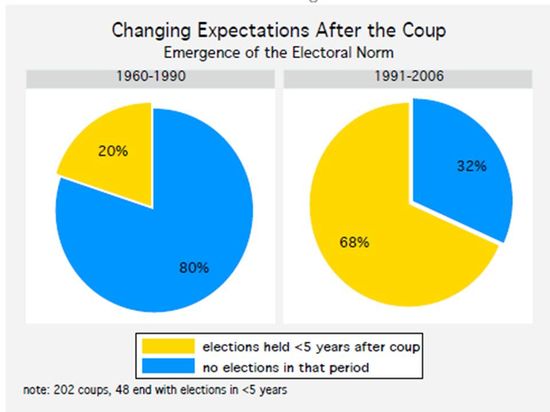
Erik Voeten posts the above graphic and summarizes some new research:
No-one can predict with certainty whether the military takeover in Egypt will lead to a functional democracy, a military junta, or some other form of dictatorship. Yet, this working paper by Hein Goemans and Nikolay Marinov provides some grounds for optimism. They show that while coups had traditionally led to durable dictatorships, this picture has changed since 1990. Now, the vast majority of coups result in competitive elections rather than durable dictatorships.
Yesterday, he was as livid as I remain about the rank recklessness of Obama's budget proposal:
“Americans expect their presidents to lead, they expect their presidents to take on the country’s biggest challenges, and arguably the biggest domestic challenge perhaps in the history of this country is this crushing burden of debt that is coming our way,” he said. “The president punted on the budget and he punted on the deficit. That’s not leadership … Anyone who knows anything about me knows we have to tackle entitlements or they’re going to tackle us.”
And yet no specifics on Medicare or defense yet. Hmmm. So let Ryan propose a budget that exposes Obama's irresponsibility and complacency. Let him be the leader Obama refuses to be. Let's see the real entitlement and defense cuts the US needs if it is to avoid default or a long slide into debt-ridden stagnation. Obama has doubled down on the unseriousness of the GOP on the debt, by revealing his own total lack of concern. He is calling their bluff at the country's and the next generation's expense.
The real question now is: will the GOP call Obama's bluff? Or do they have as little courage as he does? I'm pretty sure I know the answer, but I'd sure love to be proven wrong.
 The Dish