Faces Of The Day, Ctd

Several readers made this observation:

Are you telling me that girl independently invented metalworking advanced enough to create what looks like a stainless-steel machete, all by herself?  I don't think so. "Uncontacted tribe", my eye.

Another writes:

While that is a beautiful video and a concept I find fascinating, it involves the same “uncontacted” tribe that caused quite a stir a couple years ago.

For those of us living in the modern world, it’s romantic to think there might be some remote tribe of people untouched and untainted by civilization. There’s something very “Mosquito Coast” about it. But I suspect the truth is somewhat less interesting. From my limited research around the web, it appears that most of these tribes have in fact had contact but decided they didn’t like what they saw and moved farther away from civilization. In many cases their experience with outsiders is of violence and exploitation, so they simply want nothing to do with the rest of the world.

That doesn’t make them “uncontacted.” Just very isolated.

Update from a reader:

Take a look at this graphic explaining some of the details in a photo of the "uncontacted tribe". The  organization says inter-tribal trading neworks may have provided the machete.

Still Having The Power To Project

109095039

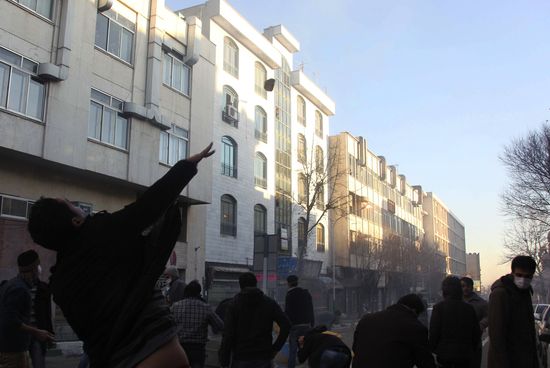
Scott Lucas takes stock of yesterday's protests in Iran and concludes:

So 25 Bahman was a victory, the biggest for the opposition since those December 2009 demonstrations on the religious day of Ashura. Still, it is only one day in the 20 months of post-election conflict. Today the regime will strike back with more declaration of foreign-supported sedition, more arrests, more references to the need to support the Supreme Leader. Opposition political parties, activists, students, and the person on the street will again be blanketed by warnings offset — despite the contradiction — by assurances that all is well.

Juan Cole reminds us how much more dire the situation is for Iranian protesters than it was for Egyptians:

Unlike in Egypt, where except for a day or two the Mubarak regime avoided direct physical confrontation of the demonstrators, in Iran the Basij, or volunteers for the Islamic Republic, attacked protesters on motorcycle and repressed them. Eyewitnesses said that dozens were jailed.

Meanwhile clerics in parliament called for the death penalty for demonstrators arrested at the scene.

(Photo: An Iranian protester throws a stone at riot police during an anti-government demonstration, under the pretext of rallies supporting Arab uprisings, in Tehran on February 14, 2011. By AFP/Getty Images. EDS NOTE: FOLLOWING AN OFFICIAL BAN ON FOREIGN MEDIA OUTLETS COVERING DEMONSTRATIONS IN IRAN, AFP IS USING PICTURES FROM ALTERNATIVE SOURCES)

The Staying Power Of The Military

Mohammed Ayoob fears the intentions of Egypt's military and other regional military regimes:

The military-dominated Egyptian power structure is replicated in many other countries in the region, with Syria and Algeria being the prime examples. One should not forget that the Syrian rulers killed 20,000 of their own citizens in Hama in 1982 to avert a challenge to the Assad regime. The Algerian military by aborting the 1992 elections let loose a reign of terror in that country from which it has not recovered until this day.

The Jordanian army ethnically cleansed Palestinian camps in 1970 to prevent the fall of the Hashemite monarchy. Arab armies are very efficient at ruthlessly suppressing the democratic aspirations of their peoples. So much of their energy is devoted to the task of regime preservation that it detracts gravely from their capacity as war-fighting machines as was clearly demonstrated by the defeats inflicted by Israel on the Egyptian, Syrian, and Jordanian armies in the 1967 war and on the Egyptian and Syrian armies in the 1973 war.

The Return Of Persiankiwi

Screen shot 2011-02-15 at 12.05.59 AM

A reader writes:

Just wanted to let you know that Persiankiwi, who was one of the most prominent sources of reliable tweets during the 2009 Iranian uprisings, and who went silent at the height of the repression, is back again. I held grave fears, so it's great to see her/him tweeting again.

Another reader points to prominent tweeter who hasn't reemerged:

I don't know if you remember Twitter user NextRevolution from that summer of 2009. He was a student at TUMS when it was stormed by the Basij. He went missing September of 2009. A friend from the States apparently took over his account and tried to give us updates. Just when it all looked hopeless, the friend tweeted "Everything is going to be ok" and then nothing ever since. I guess it wasn't.

George Papavgeris composed a beautiful song based on his original batch of tweets. At the time of the writing, NR was undergoing his first Twitter disappearance – the song ends with an imagined capture that NR in real life had just managed to escape.

The Daily Wrap

Today on the Dish, Andrew defended Anderson Cooper for calling out Mubarak's lies and pushed back against those who insist on the irrelevance of social media. Jeff Jarvis likened Zuckerberg to Gutenberg, Andrew responded to renewed calls for neoconservatism, and Ellis Goldberg considered a slow-motion coup. Cairo quieted down, Algeria got active, Bahrain erupted, and Iran ignited. Graeme Wood updated us on post-Mubarak emotions in Egypt, Twitter funneled viewers to Al Jazeera, and Frum insisted too much is unknown. Egypt reminded a reader of the birth of a child, and the revolution could be connected to sex. Bruce Riedel highlighted al Qaeda's irrelevance in Egypt, Heather Mac Donald upended America's obsession with foreign terror, and Dexter Filkins compared Afghanistan to Egypt under Mubarak. Olivier Roy argued Iran isn't a model because jobs can't be found in the Koran, Larison distinguished Iran from Egypt, and we kept tabs on the country's dramatic protests into the night.

Andrew informed anyone under 30 that Obama just threw them under the bus with his budget.  Andrew applauded Mitch Daniels for his CPAC dose of reality and praised Ron and Rand Paul for their candor and dissents. HuffPo profited off of vain writers willing to give it up for free, and Glenn Greenwald got targeted by a firm for supporting Wikileaks. Conspiracies don't die, stocks declined, and the Pigford case soaked up reactions from readers and in the blogosphere. Video games mirrored reality, Tyler Cowen shrugged over the new Ayn Rand trailer, O'Reilly got meme-ified, the Internet aged gracefully, and Andrew thanked everyone and Aaron

Quotes for the day here and here, chart of the day here, MHB here, FOTD here, and VFYW here.

–Z.P.

Valentine’s Day In Tahrir

TAHRIR SQUARE WEDDING

Jenna Krajeski connects the Egyptian uprising to love:

There is much talk about a “marriage crisis” in Egypt—low employment rates lead to low matrimonial rates—and the protesters in Tahrir Square were, indirectly at least, marching against it. Lack of jobs was high on their list of grievances. Many of those I interviewed said that getting married and having a family were things they dreamed of most in a post-Mubarak Egypt. One twenty-eight-year-old man I spoke to, on a relatively quiet day in Tahrir last week, illustrated his frustration by thrusting his hips back and forth, explaining, “No money, no sex.”

Al-Masr Al-Youm has a report on the recent spate of weddings in Tahrir.

The Pigford Case, And How To Talk About It, Ctd

A reader writes:

I haven't read the NR article, and I'm not inclined to subscribe, but Conor's summary cited "nearly 100,000 claimants in the Pigford case," contrasted with a census figure of 18,500 black farmers. I work at a legal administration company, and I can tell you that the number of "claimants" in a class action and the number of approved claims are usually very different numbers.  We could get a blank, unsigned form in the mail, with no accompanying documentation, and we'll make high-res scans of everything and (if the return address is legible) that person becomes a claimant in our database.  That doesn't mean they get a check. Again, I don't know if this is pertinent to the controversy, but if it does indeed hinge on the use of the word "claimants" then it's a red herring.

Says another:

It's wrong to use the number of claimants as an indication of fraud, and I saw that as a clerk to a federal judge who doesn't like seeing this kind of thing propagated.  Class actions do dragnets to gather up all potential claimants so they can be sifted through and processed in one go.  You don't want people weeding themselves out and then realizing later they actually were entitled to something once the settlement fund has already been distributed.  So, you cast a wide net and get everyone to submit up front everything that could possibly fit, and then you weed it out in the next steps of the process.  Consequently, first-step advertisements are typically worded very broadly and include a lot of "if you don't put in your claim now, you'll lose it" language.  You've likely seen some of them on TV advertising for drug class actions, telling anyone who took a common painkiller and had a common disease or heart attack to submit a claim.

That process leads to invalid claims being submitted, and that's by design, not necessarily because of fraud.  Folks often genuinely believe they may be entitled to compensation, and anyway it's better to be safe than sorry, so they're encouraged to submit their claim and then the work of the case is to sift through and see who belongs and who doesn't.  That's the way the process is supposed to work – it only yields fraud if there's fraud, i.e., lawyers coaching their clients to lie or the administrators ignoring their duty to weed out baseless claims.  There's no evidence of that here – especially given that past filing windows have weeded out so many claimants – and you certainly can't deduce it from the two numbers that you mentioned.

And a third:

The Congressional Research Service looked at just this issue and has a reasonable explanation (PDF) for the gap: at p. 8. The Census was enumerating "farms" in 1987, not "farm operators." This goes a long way toward closing the gap. Add to this the number of people who tried to enter farming but could not because the discrimination underlying the settlement prevented them from getting loans, and you've closed even more of it. Finally, the 100,000 number is the number of claimants, not the number of actual award to successful claimants. Only 69% of the original claimants under the original consent decree actually received payments.

Ta-Nehisi, Adam Serwer, and Cynic analyze the anti-Pigford campaign.