A “Slow-Motion Coup”?

Ellis Goldberg believes Egypt's military will impede democracy. He admits that it's possible that a "more open political system and a responsive government that ensures its own safety by trimming back the power and privileges of the military could still emerge." But he thinks the most likely outcome is "the return of the somewhat austere military authoritarianism of decades past":

Today, the army presents itself as a force of order and a neutral arbiter between contending opponents, but it has significant interests of its own to defend, and it is not, in fact, neutral. The basic structure of the Egyptian state as it now exists has benefited the military. The practical demands of the protesters seem fairly simple: end the state of emergency, hold new elections, and grant the freedom to form parties without state interference. But these demands would amount to opening up the political space to everyone across Egypt's social and political structure. That would involve constitutional and statutory changes, such as reforming Egypt as a parliamentary rather than a presidential system, in which a freely elected majority selects the prime minister (who is now appointed by the president). These changes would wipe away the power structure the army created in 1952 and has backed since.

Why Conspiracies Don’t Die

William Saletan critiques the latest in a string of interviews with leaders of the GOP who refuse to kill the birther conspiracies:

That's four straight interviews in which the country's three top Republicans—the speaker of the House and the GOP leaders in each chamber—have refused to condemn the spreading of lies about Obama's faith and citizenship.

These three men are confident enough in the personhood of fetuses to support banning abortion. They're confident enough in the efficacy and justice of the U.S. health care system to block funding of the Affordable Care Act. They're confident enough in Wall Street, despite the recklessness and bailouts of the last three years, to press for repeal of the Dodd-Frank financial regulation law. But ask them whether Obama is a Muslim or was born in the U.S., and suddenly they're too humble to impose their beliefs on others. They can only describe "the facts as I understand them." They can only speak "for me." They can only "listen to the American people," not "tell them what to think."

These men aren't leaders. They're followers. To lead a party, much less a country, you have to be able to say no. You have to stand up to liars, lunatics, and dupes on your party's fringe.

TPM: Just Follow The Polls

Josh Marshall pens the following sentence:

Let's not forget that all the available public opinion data suggests the public either opposes this or considers it a low priority relative to job creation and other priorities. There's really not more to say than that.

Really? The actual merits of a massive, out of control, entitlement-fueled debt are not worth even talking about?

Afghanistan’s Government: “A Vast Criminal Enterprise”

Dexter Filkins compares Afghanistan's notoriously corrupt government to Egypt under Mubarak:

On corruption [in Afghanistan], the American strategy isn’t clear. The American military appears to be succeeding in clearing the Taliban from large swaths of southern Afghanistan. But then what? At some point, the Afghans themselves have to take over—that is, the Afghan government. Without a government that is legitimate—that serves the people—it’s hard to imagine that the hard-won American gains can ever stick.

Which brings us back to Egypt. For thirty years, the United States supported a government that was predatory and corrupt. And so are we in Kabul. After Tahrir Square, do we really think the Afghans won’t notice?

Obama To The Next Generation: Screw You, Suckers

OBAMAKIDSTimSloan:Getty

The logic behind president Obama's budget has one extremely sensible feature: it distinguishes between spending that simply adds to consumption, and spending that really does mean investment. His analogy over the weekend – that a family cutting a budget would rather not cut money for the kids' education – is a sound one. We do need more infrastructure, roads and broadband, non-carbon energy and basic science research, and some of that is something only government can do. In that sense, discretionary spending could be among the most important things government could do to help Americans create wealth themselves. And yet this is the only spending Obama wants to cut.

But the core challenge of this time is not the cost of discretionary spending. Obama knows this; everyone knows this. The crisis is the cost of future entitlements and defense, about which Obama proposes nothing. Yes, there's some blather. But Obama will not risk in any way any vulnerability on taxes to his right or entitlement spending to his left. He convened a deficit commission in order to throw it in the trash. If I were Alan Simpson or Erskine Bowles, I'd feel duped. And they were duped. All of us who took Obama's pitch as fiscally responsible were duped.

The cynical political calculation is obvious and it is well put by Yglesias and Sprung. If Obama backs Bowles-Simpson, the GOP will savage him for the tax hikes, while also scaring the wits out of the elderly on Medicare. The Democratic left – just look at HuffPo today – will have a cow. Indeed, if Obama backs anything, the GOP will automatically oppose him. He has to wait for a bipartisan agreement which he can then gently push ahead. But that's exactly why we are in this situation today. Because no president has had the balls to deal with it, and George W. Bush made it all insanely worse. Sprung says the proposal on corporate taxes is a trial balloon. He argues that:

Corporate income taxes account for about 12% of the Federal government's revenue.  Obama's core premise for reforming them is structurally similar to the Bowles-Simpson commission's approach to personal tax reform: reduce targeted tax breaks while lowering the overall rate, currently at 35%.

And that's fine if you think we have plenty of time. But in a mere nine years, entitlements will account for 64 percent of all federal spending. And Obama just punted on his promise to cut Medicare payments to doctors, as pledged under Obamacare as a core part of the case that health insurance reform would cut the deficit. So congrats, Megan. We can chalk that up as a cynical diversion (even though Obama pledges to find savings elsewhere in the Medicare budget to make up for this lie – a promise we now have no reason to trust or believe).

There is some hope, as David Brooks has noted. Those who want to save the useful things that government alone can do, while pulling back from the fiscal brink, have to

get behind an effort now being hatched by a group of courageous senators: Saxby Chambliss, Mark Warner, Tom Coburn, Dick Durbin, Mike Crapo and Kent Conrad. These public heroes have been leading an effort to write up the Simpson-Bowles deficit commission report as legislation to serve as the beginning for a serious effort to get our house in order. They’ve been meeting with 20 to 40 of their colleagues to push this along.

They have to lead, because this president is too weak, too cautious, too beholden to politics over policy to lead. In this budget, in his refusal to do anything concrete to tackle the looming entitlement debt, in his failure to address the generational injustice, in his blithe indifference to the increasing danger of default, he has betrayed those of us who took him to be a serious president prepared to put the good of the country before his short term political interests. Like his State of the Union, this budget is good short term politics but such a massive pile of fiscal bullshit it makes it perfectly clear that Obama is kicking this vital issue down the road.

To all those under 30 who worked so hard to get this man elected, know this: he just screwed you over. He thinks you're fools. Either the US will go into default because of Obama's cowardice, or you will be paying far far more for far far less because this president has no courage when it counts. He let you down. On the critical issue of America's fiscal crisis, he represents no hope and no change. Just the same old Washington politics he once promised to end.

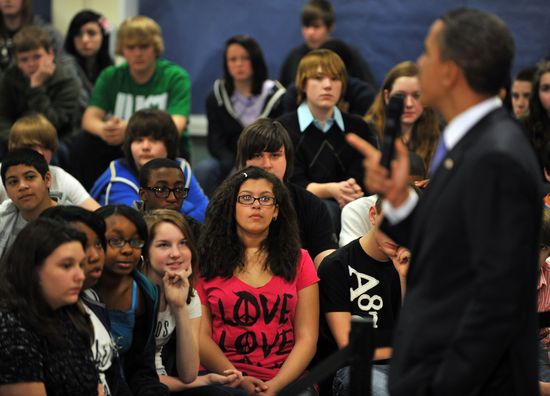
(Photo: US President Barack Obama talks to 8th grade students in the school cafateria after a tour of a science class during a visit to Parkville Middle School and Center of Technology on Feburary 14, 2011 in Baltimore, Maryland. By Tim Sloan/AFP/Getty.)
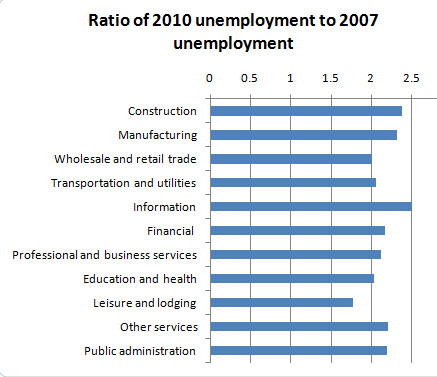
Chart Of The Day

Unemploymentsector

Krugman says unemployment has hit all sectors fairly evenly:

See the structural shift? Neither do I. As others have noted, basically unemployment doubled for every industry, every occupation, every state. Where are the sectors/occupations/regions gaining jobs? Nowhere to be found. There’s nothing structural about it.

Cowen counters.

Sim City Moms Stay Home, Ctd

A reader writes:

Will Wright is an avowed libertarian and has been since the very first version of Simcity, the algorithms in the game are designed towards that philosophical conception of the world. Game design allows people to create a world in which they control not only the user's perception of the world, but the public within it as well, and can enforce the rules which their philosophical beliefs dictate.  Computer programming, like every other maths or science major, attracts libertarians who are more comfortable with perceiving the world as a matter of hard and fast rules.

Another:

I've been playing Tropico 3 – or I was, until the Egypt uprising. It's not that Egypt cut into my game-playing time, it's that it was eerily like the game.

If you don't know it, T3 is a game where you are the dictator of a banana republic – on a tropical island, so as to invoke Cuba or Haiti – and like Sim City, you control everything, transportation systems, industry, etc. The difference is, you have a lot of game-play inspired by real dictators. You can have secret police, bribe or jail dissidents, have a secret Swiss bank account (with income that you graft off of industry), refuse to have elections, etc. The game typically ends with you getting run out of office, escaping by plane, with your Swiss bank account money.

As I watched the Egypt uprising, I was struck by all the things I recognized from the game (right up to when the Swiss said they were freezing his bank account– good thing THAT isn't in the game!). And now, I can't bring myself to play it. Even with a "benevolent dictator", it feels really creepy.

Lessons learned: if Ms. Potts found conservatism in SimCity, I learned you can't block out immigrants (or no one will take the bad jobs) and a little central planning goes a long way, if you want to make people stop building shacks by your tourist areas.

Anyway, I look forward to the day when the game seems quaint again and I can get back to playing without feeling echoes of the real people being oppressed by their dictators.