Iran Ignites

Enduring America is live-blogging:

1630 GMT: The BBC's account of events in Tehran reports use of tear gas by police against thousands of protesters. A BBC producer, affected by the gas, described central Tehran as "total chaos" with "severe clashes" and many arrests. …

1500 GMT: … Reports of violence are now widespread, with comparisons with the march of 15 June 2009 flowing in. BBC Persian is quoting a "secure and certain source" that tear and pepper gas deployed in Imam Hossein Square. Police deployed everywhere along Enghelab Avenue, blocking traffic. People are trying to get to Azadi Square on foot, with security forces getting more aggressive as marchers near the square. …

1343 GMT: According to CNN's Reza Sayah, there have been violent clashes in front of Tehran University, where some protesters have been taken away on motorcycle. There are also many protesters clashing with security forces at Iman Hossein Square, where people are chanting "Death to the Dictator, Death to Khamenei."

More footage after the jump:

An Iranian reader translates the chant:

Mubarak … Ben Ali … Now it’s your turn, Seid Ali (first name of the Supreme Leader)

Rich And Gladwell, Wallflowers At History: Egypt And Tunisia

Frank Rich eight days ago:

The talking-head invocations of Twitter and Facebook instead take the form of implicit, simplistic Western chauvinism. How fabulous that two great American digital innovations can rescue the downtrodden, unwashed masses.

His own paper today:

As protesters in Tahrir Square faced off against pro-government forces, they drew a lesson from their counterparts in Tunisia: “Advice to the youth of Egypt: Put vinegar or onion under your scarf for tear gas.” The exchange on Facebook was part of a remarkable two-year collaboration that has given birth to a new force in the Arab world — a pan-Arab youth movement dedicated to spreading democracy in a region without it. Young Egyptian and Tunisian activists brainstormed on the use of technology to evade surveillance, commiserated about torture and traded practical tips on how to stand up to rubber bullets and organize barricades.

They fused their secular expertise in social networks with a discipline culled from religious movements and combined the energy of soccer fans with the sophistication of surgeons. Breaking free from older veterans of the Arab political opposition, they relied on tactics of nonviolent resistance channeled from an American scholar through a Serbian youth brigade — but also on marketing tactics borrowed from Silicon Valley.

Gutenberg In The Middle East

6a00d83451c45669e20148c7f30e88970c-550wi

Jeff Jarvis broadens the debate on the revolution in social media:

After Mubarak left, [Google's Wael] Ghonim said on CNN that he wanted to meet Mark Zuckerberg to thank him for Facebook and the ability to make that page. After the Reformation in Europe, Martin Luther thanked Johannes Gutenberg. Printing, he said, was "God's highest and extremest act of grace." Good revolutionaries thank their tools and toolmakers. …

In the privileged West, we have been talking about net neutrality as a question of whether we can watch movies well. In the Middle East, net neutrality has a much more profund meaning: as a human right to connect. When Mubarak shut down the internet, when China shuts down Facebook, when Turkey shuts down YouTube, when America concocts its own kill switch, they violate the human rights of their citizens as much as if they burned the products of Gutenberg's press.

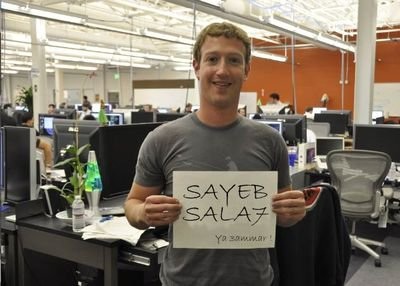
(Photo from July 2010, when "bloggers Photoshopped a picture of Mark Zuckerberg to show him holding up a sign that read, "Sayeb Sala7, ya 3ammar," the slogan for a freedom of expression campaign late in 2010.")

The Narrative, Ctd

A reader objected to the spin imposed on events in Egypt. Another reader differs:

As far as starting to write "the narrative:" I think the use of the words "rebirth" or "birth" are fairly apt in the case of the events unfolding in Egypt. When one gives birth to a child, one is consumed with THE event as it occurs (rather hard not to be), but deep down one knows that the real challenge lies in at least the next eighteen years (often more).

The raising of the child–the day to day "nuts and bolts" of the adventure is the real challenge. And how the child will turn out is partly a mystery, as the love and resources might not be enough to change a certain fate, or potential pitfalls the child's parents just can't help the child avoid. How Egypt will "turn out" is up to many forces and unseen events in the future–but we can certainly see evidence of the "people's" aspirations–they and only they can know for certain what it means to love this "child."

"We want a government of the people, by the people" – an Egyptian citizen heard on BBC radio. Surely, this is a "blessed event."

Agreed. This is the end of the beginning. That's all. The rest is up to Egyptians. But if their remarkable poise and nonviolence of the last three weeks are any indicator, the omens are good.

What Do We Really Know About Egypt?

Frum urges analytic humility:

When we talk about the reach of the Muslim Brotherhood in Egyptian society – or conversely the appeal of democracy – we are talking about things about which nobody knows very much and probably nobody can know very much. One out of seven Egyptians cannot read. Half of them live on less than $2 a day. What do they think? What do they want? And it may be an equally urgent question to know: who leads, guides and controls what they think and want?

Neoconservatism: Serious Again?

Over my sick break, Alex Massie pointed to my old disavowal of neoconservatism and argued that Egypt has made the philosophy newly relevant:

Neoconservatives are hardly the only people who believe in the long-term potential of democratic reform in the Middle East (plenty of liberals think so too) but they are much more likely to believe in it than other conservatives. It's an intra-mural skirmish more than anything else. … I know that many people on the British left refuse to believe that the neoconservatives are actually serious about liberalisation and democracy but that doesn't prevent them from actually being serious. Perhaps they are wrong, naive and utopian but they believe this stuff and it's silly to pretend they don't because doing so satisfies your own preconceptions.

I have indeed been impressed with Bill Kristol's and Bob Kagan's enthusiasm for the uprising in Egypt. I share it. You'd have to have a heart of stone not to. But the point of my post was that freedom and democracy cannot be imposed by force of arms and subsequently bloom overnight in a deeply divided and degraded place like Iraq. That was my error.

Egypt and Tunisia (and Iran in 2009) do not change my judgment on this. The revolutions erupted in part because the US had nothing to do with either, wisely kept its distance for a while, and the uprisings were indigenous and spontaneous.

I remain of the view that Jihadist government will discredit itself – as it has in Iran and Afghanistan and those parts of Iraq where it got a foothold. I also remain of the view that democracy is also the best answer to Jihadism in the medium and long run. But you cannot force people to be free; and the future of democracy in Egypt and Tunisia is still opaque and unknowable and risky. These are the heady days. More troubling ones may lie ahead.

What I will say is that, as I watched these miracles on television, I found my love of freedom and joy for the people of Egypt and Tunisia (as for the people of Iran) overwhelmed for a few days by my worries about such events spiraling out of control. But revolutions differ in their trajectories. Burke famously opposed the French one and backed the American one. What will make the difference is the character of the people, and the prudence of the statesmen and women who emerge in both countries. And others.

In the end, we live in an era where hope is battling fear. Suddenly, hope is winning again. Let us not lose our skepticism. But let us not be intimidated by it either.

Rich And Gladwell, Wallflowers At History: Egypt

Frank Rich, from his perch in Manhattan, may not know this but before the Egyptian Revolution,

according to data from security firm zScaler … fully 42% of the country's Web surfing on January 27 [was on Facebook], the day before Egypt's main ISPs abruptly severed ties to the Internet … Data from zScaler shows that traffic to social networking sites account for around 39% of all Web surfing on January 27th, while traffic to news sites accounted for another 27% of overall Web surfing activity…  Facebook.com out polled the Web sites of both Al Jazeera and Google by a factor of seven on January 27th.

Rich argues that because the authorities were able to shut down Facebook and Twitter thereafter, they were subsequently irrelevant. But if they were irrelevant, why did the authorities shut them down at all? Could it have something to do with this:

The Facebook appeal by Asmaa Mahfouz led to popular protests that saw tens of thousands congregating at Tahrir Square to demand an end to Mubarak's unbridled 30-year rule. … Asmaa Mahfouz told Al-Mihwar TV (Egypt) that the first activity was on Facebook. "Yes. I was angry that everybody was saying that we had to take action, but nobody was doing anything. So I wrote on Facebook: 'People, I am going to Tahrir Square today'. This was a week before January 25.

By then, anyway, Mahfouz was not the only one:

Facebook said that in the last two weeks alone, Egyptian users have created 32,000 groups and 14,000 pages on the service, which allow people to share and make plans together.

This early organization was crucial:

“On the 25th, the movements of the protesting groups were arranged in real time through Twitter," [computer security specialist Ahmad] Gharbeia says. "Everyone knew where everyone else was walking and we could advise on the locations of blockades and skirmishes with police. It was real-time navigation through the city, and that’s why it was shut down."

So Rich gets it exactly the wrong way round. It was precisely because Twitter and Facebook were so effective early on that the dictatorship shut them down completely. Moreover, we know that one early spark was Wael Gohnim's Facebook page. Money quote from a Newsweek piece, describing Gohnim's Facebook call for civil disobedience:

In the space of three days, more than 50,000 people answered “yes.” Posing as El Shaheed in a Gmail chat, Ghonim was optimistic but cautioned that online support might not translate into a revolt in the streets. “The bottom line is: I have no idea,” he said. While some commentators hyped “that the internet is making a revolution,” others proclaimed that the “revolution can’t be tweeted,” he said. “I don’t know, and I don’t give a s–t. I’m doing what it takes to make my country better.”

Ghonim implored his Facebook fans to spread word of the protest to people on the ground, and he and other activists constantly coordinated efforts, combining online savvy with the street activism long practiced by the country’s democracy movements. Ghonim seemed to view the page both as a kind of central command and a rallying point—getting people past “the psychological barrier.”

On Day 18, Ghonim tweeted

that he was not going to do any more television interviews and would communicate directly with his fellow Egyptians through Facebook. He then posted a long personal statement to his 700,000 followers on the social network, explaining, in Arabic, that he had not called for an end to protests, as Egyptian state television had falsely reported on Thursday night.

The real point here seems to me to be obvious, and certainly should be for writers as gifted a Rich and Gladwell. Words and images matter. And the sudden accumulation of words and images matter. They expose reality that is constantly veiled by tyrants. They inspire others to anger. They break through fear by revealing the courage of numbers.

Of course they are not enough. They are necessary but by no means sufficient. If a regime is as evil as Tehran's, nothing can stop the use of tanks and guns and thugs from murdering and torturing dissenters. But if social media can generate a collective spark that can then lead to street organizing, and then help spread that success via al-Jazeera, and the military and police split, then regimes once deemed unshakable can topple.

We just saw it happen three times in eighteen months in a region that has been stagnant with the same dictatorships for decades. One tragically failed to rid itself of its theocratic police state, but destroyed its legitimacy for good; two succeeded. But consciousness changed for ever. And social media empowered people, and helped give them the skills that democratic citizenship requires. No, it was not the whole explanation. But it was a critical, seminal, revolutionary spark.

(Photo: Peter MacDiarmid/Getty.)
Al-Jazeera’s Revolution? Ctd

Erick Schonfeld points to Chartbeat's realtime snapshot of what activity on al-Jazeera’s English website on Friday when Mubarak resigned:

Concurrent realtime visits spiked from about 50,000 right before noon ET to 135,371 when the snapshot above was taken. The number of people simultaneously on Al Jazeera’s website kept going as high as 200,000—that was at any given second, and translated into millions of people watching on the Web. (And this was on top of already higher traffic which had risen 2,500 percent earlier during the uprising).

Schonfeld emphasized Twitter's role in directing people to al-Jazeera:

If you drill down into the report for the article, “Hosni Mubarak resigns as president,” a full 71 percent of traffic at 11:40 AM ET came from social media. … And what was the biggest source of social media traffic? It wasn’t Facebook. It was Twitter (followed by Reddit). When it comes to spreading realtime news, the social revolution is very real and Twitter is in the vanguard.

Rich And Gladwell, Wallflowers At History: Tunisia

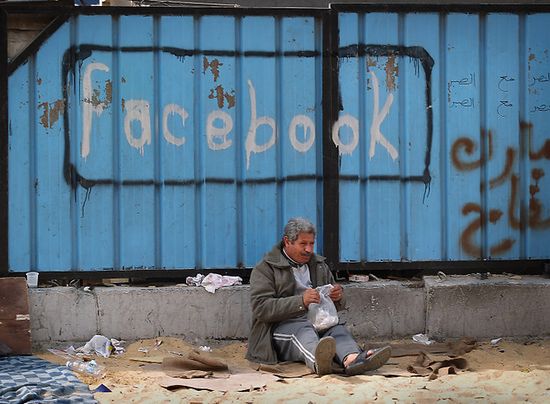
FACEBOOKGRAFFITIPeterMacDiarmid_Getty

It must have been a little galling for Malcolm Gladwell to observe the revolutions in Tunisia and Egypt. In an atypically mediocre piece, Gladwell not so long ago denied the fact that Twitter or social media or cell-phones or Facebook had anything much to do with the Iranian Green Revolution. His point, such as it was, was that such things were never sufficient in and of themselves to create a revolution. They were weak connections not strong ones, and a revolution needed strong ones to endure. Well, as almost everyone but his editors noted at the time: duh.

Of course, strong connections like unions or political parties or churches or mosques and simply the courage of masses in the street are essential for revolutionary action. But this was true for decades – and yet the 1979 Revolution in Iran was indisputably galvanized by audio-tapes of Khomeini sermons smuggled in from abroad; and the 2009 Green Revolution was originally triggered by young people using Twitter and blogs and cellphone cameras to broadcast their numbers and outrage and courage. Then followed revolutions in Tunisia and Egypt, where the same technologies were deployed as weapons against the authorities.

Perhaps sensing the lameness of his point, Gladwell went online again to reiterate his point with respect to Egypt last week. Perhaps the best rejoinder was the following January 29 Onion headline:

Panicked Malcolm Gladwell Realizes Latest Theory Foretells End Of His Popularity

Then came another old media dinosaur, Frank Rich. Here's what he wrote only a week ago:

The talking-head invocations of Twitter and Facebook instead take the form of implicit, simplistic Western chauvinism. How fabulous that two great American digital innovations can rescue the downtrodden, unwashed masses. That is indeed impressive if no one points out that, even in the case of the young and relatively wired populace of Egypt, only some 20 percent of those masses have Internet access.

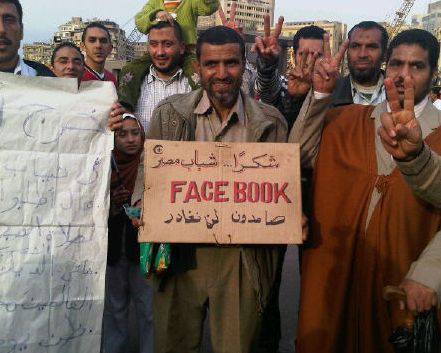
For Rich, reference to Facebook or Twitter and social media in the recent revolutions is a function of American parochialism, chauvinism or condescension! Hey, Mr Rich, check out the false consciousness among these US-brainwashed capitalist tools here:

Tumblr_lg3mzyOCZB1qz6z0no1_500

And let's look at the reality in Tunisia. Between one in ten and one in five Tunisians have a Facebook account – not that surprising when you consider that half the population is between 20 and 30, well educated, relatively secular and denied public forms of expression. In that revolution, the ability to upload videos of police brutality and post them on Facebook was central to why this time, the movement spread. In fact, it took off:

By January 8, Facebook says that it had several hundred thousand more users than it had ever had before in Tunisia, a country with a few more people than Michigan. Scaled up to the size to the U.S., the burst of activity was like adding 10 million users in a week. And the average time spent on the site more than doubled what it had been before.

Why on earth, according to Gladwell and Rich, would this happen if Facebook were irrelevant? The Facebook users kept one step ahead of the censors. Twitter helped keep dissidents in touch with the outside world when arrested:

Less than two weeks ago, Slim Amamou, a Tunisian blogger and activist, was using his @slim404 Twitter feed to let friends know that the police had been to his house. Later the same day, after he was arrested, the 33-year-old computer programmer managed to turn his phone on and log on to Google Latitude to broadcast his location: inside the country’s feared ministry of the interior.

Let's listen to a leader of the Tunisian revolution, Slim Amamou, now in the Tunisian government, explain how the Internet made a difference:

In 2008, there were uprisings in Redeyef, similar to what happened in Sidibouzid. But back then it seems that the internet community did not reach a critical mass. And then at that time, Facebook got censored for a week or two. I don't remember if it was related. But it was like a training for this revolution. People think that this revolution happened out of nowhere but we, on the Internet have been trying for years, together and all over the Arab world. The last campaign that mobilised people was for Khaled Said in Egypt, and we Tunisians participated. And you have to remember that Egyptians (and people all over the world) participated in the Tunisian revolution: they informed, they participated in Anonymous attacks and they even were the first to demonstrate for Sidibouzid in Cairo.

So, yes Internet was very important.

But what does he know from Tunisia, compared with Frank Rich on the Upper West Side?

(Photos: Peter MacDiarmid/Getty and Tumblr.)

The Passion To Be Reckoned On Is Fear

Heather Mac Donald rightly bemoans our preoccupation with foreign terror:

A Congressional hearing last week on terror threats facing the U.S. was covered by the New York Times and the Wall Street Journal, both of which told the identical story:  the U.S. is at serious danger from domestic, homegrown terrorists.  Left out of the coverage entirely was the more newsworthy statement during the hearing by the director of the National Counterterrorism Center that Al Qaeda is no longer capable of carrying out a 9/11-style attack on U.S. soil. …

Though thousands more Americans are killed and injured each year through garden-variety criminal violence than Islamic terrorism on American soil,  we now have an entire bloated federal agency dedicated to combating the alleged terrorist threat, pushing reams of paper by the hour in the effort to look crucial.  To date, no major federal agency has ever been dismantled, so there is no reason to think that the Department of Homeland Security will be, either.  But we still need to continue verbally justifying its existence.  Thus the whack-a-mole nature of the terror threat and the always scary rhetoric around it.