by Conor Friedersdorf
I don't even really understand this ad:
(Via Ricochet.)
by Chris Bodenner
Chris Orr writes a hathos-filled review of the new Adam Sandler/Jennifer Aniston vehicle, a remake of a 1969 film that won Goldie Hawn an Oscar:
Cactus Flower was not a "serious" movie, but it was a grown-up one. Just Go With It, by contrast, offers an interminable (and, for our purposes, necessarily incomplete) litany of jokes about breast implants, penile implants, butt implants, erectile dysfunction, irritable bowel syndrome, testicular injuries, erections, masturbation, overweight women, old women, women with big noses, men with big noses, gay men, lazy Hispanic nannies, lazy Hawaiian nannies, sex with sheep, mouth-to-mouth resuscitation of sheep, coconuts rubbed against breasts, coconuts rubbed against crotches, coconuts gripped between ass-cheeks, hands accidentally placed upon boobs, hands accidentally placed in toilets, hands accidentally shit upon, precocious children blackmailing adults, precocious children mimicking cockney accents, and precocious children dropped on their faces in the mud. There is even a scene, unconnected to any other moment in the film, in which an anonymous child hurls a soft drink on the belly of his very pregnant mother. Because, you know, it's funny.

Berwyn, Illinois, 4.08 pm
by Zoe Pollock
Steve Bogira explores the stark segregation in Chicago and asks why it isn't a more important issue for the mayor's race:
Citywide, Chicago's population of 2.8 million is tri-ethnic: 34 percent black, 33 percent white, and 27 percent Latino.But most African-Americans are clustered in two areas, as they were in the 1960s: a massive one on the south side, and a smaller one on the far west side. … This African-American subdivision of Chicago includes 18 contiguous community areas, each with black populations above 90 percent, most of them well above that. The west-side black section includes another three contiguous 90 percent-plus community areas. Fifty-five percent of Chicago's 964,000 African-Americans live in these 21 community areas, in which the aggregate population is 96 percent black. Two-thirds of the city's blacks live in community areas that are at least 80 percent black.
On the flip side are the 33 community areas, most of them on the north and southwest sides, with less than 10 percent African-Americans. In 26 of these community areas less than 5 percent of the residents are black.
by Conor Friedersdorf
Politics Daily has a piece up telling the story of a former FDA scientist who has his doubts.
by Chris Bodenner
Joshua E. Keating runs through the reasons:
What really sets the size of these islanders apart is the size of their islands: Tuvalu, Palau, Nauru, and the other countries on the obesity list are among the world's smallest countries in terms of land area and population. So a single tourist resort, fast-food chain, or trade deal has a much more profound effect on society than it would, say, in India or Nigeria.
Hawaii is a notable exception; it ranks near the very bottom of US states by obesity.
by Chris Bodenner
An Iranian reader reflects on his birthday:
I was born while shots were being fired outside of the hospital and my father was in his car across the street listening to BBC Radio. Hours later, on February 11, 1979, what was left of the Shah's military announced its neutrality and by that the Iranian revolution ended 2500 years of monarchy. The Islamic Republic was soon established and by the time I could pronounce the name of the leader of the revolution, the freedoms and democracy he had promised had been replaced with the iron fist of a small circle of his loyal revolutionaries.
At age 18, I was one of the millions of hopeful Iranians who stood in line to vote for the only presidential candidate who was no longer part of that circle. The nation stunned the regime's leadership on that spring day of 1997. The under dog became the President and the "reform" movement was born. The new supreme leader and his allies in the regime apparatus spent the next eight years blocking all his efforts of change, arresting many of his supporters and shutting down free press. I was one of the many victims of that crackdown. After spending 63 days in solitary confinement at age 20, I left Iran.
A few year later, when many had also lost hope and the reformist opposition was in political disarray, the supreme leader managed to manoeuvre Ahamdi Nejad into the President's chair. And four years of massive crackdown and scaling back of the limited freedoms began.
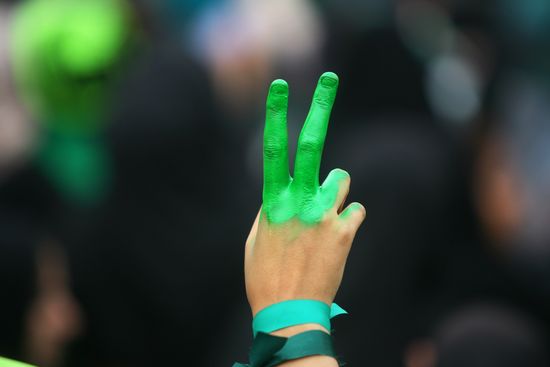
When people rose up again to put a stop to it in the election of June of 2009, Ahamdi Nejad and the supreme leader stood firm and went as far as announcing made up and pre determined results that had no correlation with the millions of votes cast. Such shocking and blunt cheating brought millions of angry young Iranians to the streets and the Green movement was born. The brutality of the regime put an end to the protest.
The story of that suppression was one that pictures exposed better than words could. At the time I was watching these events from Washington DC and as a child of the 1979 revolution, I felt the excitement, the pain and the suffering of the young women and men in the streets of Tehran with every fiber of my body.
Yesterday, on the 32nd anniversary of the 1979 revolution and my birthday, I watched the youth of Egypt in awe. They finished what the Green movement couldn't achieve two years ago. It was of course an ironic coincidence to watch Mubarak leave on the same day Shah's regime fell. But contrary to the comparison the supreme leader of Iran drew between the revolution of 1979 and the uprising of the Egyptian people, the two events have little in common beside the date of the of victory.
Every hour that has passed since the downfall of Mubarak, I see signs that the Iranian dictatorship is more nervous about the inspiration the people powered movement in Egypt will provide. The similarities of Egyptian uprising and the Green movement and emotional response of the Green activists to the scenes of cheer and jubilation in Cairo tells me that the desire of young Iranians for a day when they can dance in streets of Tehran is not only still alive but ready to erupt soon. Very soon.
(Photo: By Majid/Getty Images)
by Conor Friedersdorf
Recommended by Jonathan Last:
…a triptych of pieces in New York about internet porn. Start with “The Explosion of Free Online Porn” and move on to “How Porn Is Affecting the Libido” and “They Know What Boys Want.” It’s hard to properly state how great this cover package is.
 The Dish