History, Ctd

109007124

by Chris Bodenner

Robin Wright reflects:

First, the ultimate irony is that today is also the anniversary of the Iranian revolution. How different Egypt's transition is–and is likely to be. Whatever Iran claims, the theocrats have to be nervous about the strength of street power and the potential implications for their own opposition.

Second, in a region made famous for suicide bombings, the use of civil disobedience to peacefully force Hosni Mubarak from the presidency after three decades changes the political dynamics, not only in Egypt. The tools of opposition have changed profoundly too.

Finally, the Arab world's old authoritarian order is being shattered, whatever happens next. With Egypt accounting for roughly one-quarter of the Arab world's 300 million people, the transition of political power in Cairo will have widespread effect across the twenty-two nation bloc. From Casablanca to Kuwait, Tripoli to Damascus, Egypt's transition will affect every other Arab country in some way-small or large, direct or indirect.

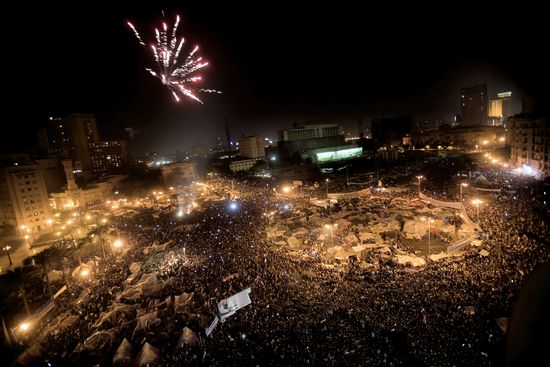
(Photo: Egyptian anti-government protesters celebrate under fireworks at Cairo's Tahrir Square after president Hosni Mubarak stepped down on February 11, 2011. Cairo's streets exploded in joy when Mubarak stepped down after three-decades of autocratic rule and handed power to a junta of senior military commanders. By Marco Longari/AFP/Getty Images)
Meet “Mubarak’s Poodle”

109009577

by Chris Bodenner

A reader writes:

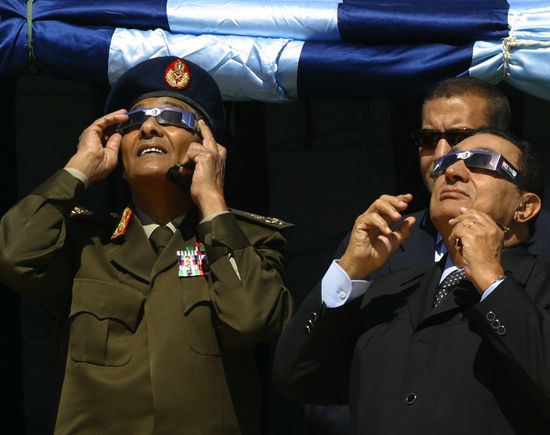
Please do a post about the new military leadership now in power, led by Mohammed Hussein Tantawi, head of the Higher Military Council. Tantawi's own underlings think he's "Mubarak's poodle" and think he's running the military into the ground. Tantawi is written about in a 2008 Wikileaks release. The U.S. cables describe him as resistant to political and economic reform.

(Photo: Egyptian President Hosni Mubarak (R) and Defense Minister Field Marshal Mohammed Hussein Tantawi (L), wearing special glasses to filter out the ultraviolet light, watch the solar eclipse in Sallum, on the border with Libya in northwestern Egypt, 29 March 2006. By Amro Maraghi/AFP/Getty Images)

Shelving The Freedom Agenda

by Patrick Appel

Heather Mac Donald takes a swing at conservative media:

I am by no means an unequivocal fan of revolutions; I do not believe that human rights are universal and timeless, rather than the product of evolving and contingent political beliefs.  But I could better stomach the right-wing media’s effort to discredit the Egyptian revolution and to portray it as a failure of Obama’s diplomacy if they had not given such unthinking jingoistic support to Bush’s Freedom Agenda, if Sean Hannity’s theme song was not “Let Freedom Ring,” if they didn’t claim a divine mandate to lead the world towards American-style democracy.

Face Of The Day III

AP110211014920

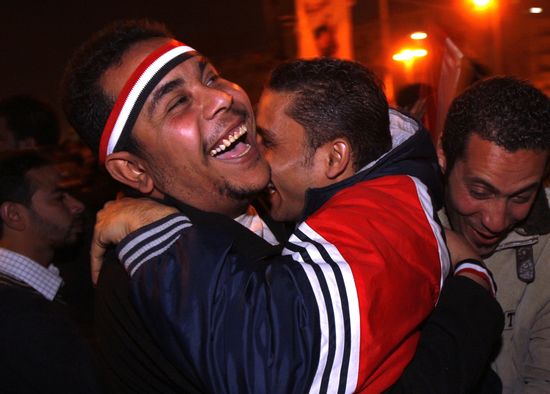
Egyptians hug each other as they celebrate after President Hosni Mubarak resigned and handed power to the military at Tahrir Square, in Cairo, Egypt, Friday, Feb. 11, 2011. Egypt exploded with joy, tears, and relief after pro-democracy protesters brought down President Hosni Mubarak with a momentous march on his palaces and state TV. Mubarak, who until the end seemed unable to grasp the depth of resentment over his three decades of authoritarian rule, finally resigned Friday and handed power to the military. By Khalil Hamra/AP.

Bush’s Role In The Revolution

by Chris Bodenner

He may have helped in a roundabout way:

Protesting against Bush's violent means of spreading democracy, a loosely formed group organized the largest demonstrations in Egypt's history around the March 20, 2003, invasion. They eventually became known as Kefaya, meaning "Enough." Adopting the mission to bring down Mubarak and restore power to the Egyptian people, Kefaya held regular protests that called for the end of the emergency law, more freedom for the Egyptian people, and better handling of the economy — essentially similar demands seen in Tahrir Square today. After heavy activity in 2004 and 2005, the movement fizzled due to apparent conflicts between the Islamic and liberal activists. Out of Kefaya grew the April 6 Youth Movement whose members and affiliates played an integral role in this year's #Jan25 demonstrations.

A Day For Joy

CelebrationGetty3

by Patrick Appel

Will Wilkinson confresses that it "is impossible, for me at least, to watch the crowds in Egypt, overjoyed at Hosni Mubarak's hotly-desired resignation, with dry eyes and an unclenched throat":

I admit that I am more than a little tempted to rain on the parade and note that Mr Mubarak's departure guarantees nothing and that it is not unreasonable to fear a turn for the worse. There's a tiny, stability-loving Burke on my shoulder, and I'm afraid he's no devil. All the same, for now I'm not listening. Well, I did listen a little, but I've heard enough. It is partly due to my Burkean worries that I feel the pessimist in me should just stuff it for now. Whether or not Egypt flowers into a model democracy, whether or not Egyptians tomorrow live more freely than Egyptians today, today they threw off a tyrant.

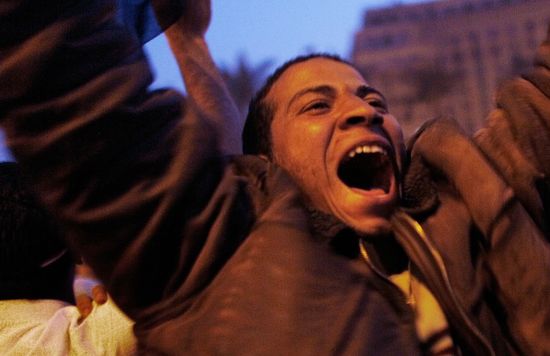
The surge of overwhelming bliss that has overtaken Egyptians is the rare beautitude of democratic will. The hot blush of liberation, a dazzled sense of infinite possibility swelling millions of happy breasts is a precious thing of terrible, unfathomable beauty, and it won't come to these people again. Whatever the future may hold, this is the happiest many people will ever feel. This is the best day of some peoples' lives. The tiny Dionysian anarchist on my other shoulder is no angel, but I cannot deny that there is something holy in this feeling, that it is one of few human experiences that justifies life—that satisfies, however briefly, our desperate craving for more intensity, for more meaning, for more life from life. Whatever the future holds, there will be disappointment, at best. But there is always disappointment. Today, there is joy. 

(Photo: A man in Tahrir Square celebrates as it is announced that Egyptian President Hosni Mubarak was giving up power February 11, 2011 in Cairo, Egypt. By Chris Hondros/Getty Images)

Von Hoffmann Award Nominee

"The toppling of the Tunisian regime led by Zine el-Abidine Ben Ali has led a lot of smart people  — including my FP colleague Marc Lynch – to suggest that this might be the catalyst for a wave of democratization throughout the Arab world. The basic idea is that events in Tunisia will have a powerful demonstration effect (magnified by various forms of new media), leading other unhappy masses to rise up and challenge the stultifying dictatorships in places like Egypt or Syria. The obvious analogy (though not everyone makes it) is to the velvet revolutions in Eastern Europe, or perhaps the various "color revolutions" that took place in places like Ukraine or Georgia.

Color me skeptical. In fact, the history of world revolution suggests that this sort of revolutionary cascade is quite rare, and even when some sort of revolutionary contagion does take place, it happens pretty slowly and is often accompanied by overt foreign invasion," – Stephen Walt, Foreign Policy, January 16th, 2011.

New York Daily News also deserves a whack. Awards glossary here.

A History Of Military Rule

by Patrick Appel

Larison fears for Egypt's future: 

There are times when the military’s intervention in politics can defuse a political crisis and provide a transitional phase to some sort of representative government. No doubt this is what many hope and expect will happen in Egypt. It is also true that these interventions typically work to the detriment of popular movements, and as long as the military retains the right to intervene to resolve political crises no government will be very safe from a future coup.

The “deep state” might be more or less heavy-handed in its involvement in politics, but it will remain as an ever-present reminder to any future government that it is not really in control of anything that matters. It might be worth considering that the overall effect of the protests so far has been the purge of the few civilians, technocrats and economic reformers that had been part of the political leadership. The current leadership is now drawn entirely from the military, which is the most powerful institution in the country and the one that has the most to lose from meaningful political change.

The Vindication Of Obama’s Egypt Strategy?

ObamaEgypt

by Patrick Appel

While Marc Lynch emphasizes that there "is no question that the first, second and third drivers of this Egyptian revolution were the Egyptian people," he still praises Obama's handling of the situation:

The Obama administration … deserves a great deal of credit, which it probably won't receive.  It understood immediately and intuitively that it should not attempt to lead a protest movement which had mobilized itself without American guidance, and consistently deferred to the Egyptian people.   Despite the avalanche of criticism from protestors and pundits, in fact Obama and his key aides — including Ben Rhodes and Samantha Power and many others — backed the Egyptian protest movement far more quickly than anyone should have expected.

Their steadily mounting pressure on the Mubarak regime took time to succeed, causing enormous heartburn along the way, but now can claim vindication.  By working carefully and closely with the Egyptian military, it helped restrain the worst violence and prevent Tiananmen on the Tahrir — which, it is easy to forget today, could very easily have happened.   No bombs, no shock and awe, no soaring declarations of American exceptionalism, and no taking credit for a tidal wave which was entirely of the making of the Egyptian people — just the steadily mounting public and private pressure on the top of the regime  which was necessary for the protestors to succeed. 

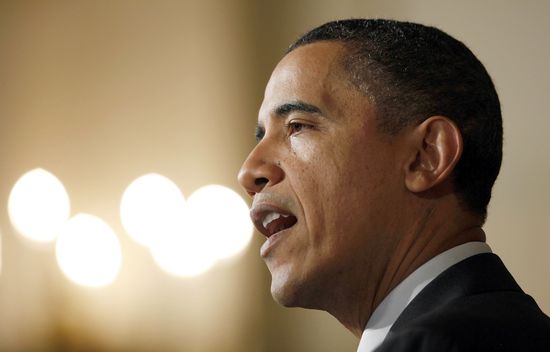
(Photo: President Barack Obama makes a statement on the resignation of Egypt's President Hosni Mubarak in the Grand Foyer at the White House in Washington, Friday, Feb. 11, 2011. Charles Dharapak/AP)