by Chris Bodenner
(Hat tip: Mackey)
by Chris Bodenner
A bit of intrigue:
Ahram Online, the English-language arm of the state newspaper Al Ahram, reported on Friday that a former senior Egyptian intelligence official told the newspaper that "both of last night's addresses by Mubarak and Suleiman were in defiance of the armed forces."
by Chris Bodenner
A reader writes:
Not sure Mubarak "chose" this day. I think his speech last night was a "Hail Mary," possibly with the intent of so enraging the protesters that they would get violent. Then the military could have felt justified in stepping in to suppress them. Thus, the pivotal moment was last night, when the protesters, despite their profound and understandable disappointment and anger, resisted the impulse to react with violence. At this point, most of the military leaders must have realized that, even if they themselves were willing to stand by Mubarak, the rank and file would not turn on the protesters if any attempt was made to disperse them or otherwise break up the demonstrations. Hence, a military coup ensued.
Days, months or even years from now, I would predict that the demonstrators' peaceful response to Mubarak's refusal to step down on the night of Feb. 10, 2011 will be viewed as the turning point in this revolution.
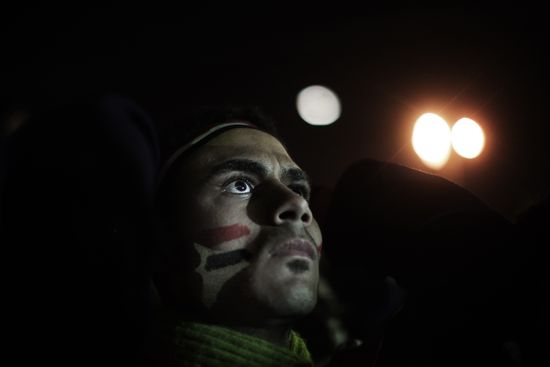
(Photo: An Egyptian anti-government demonstrator listens to a speech by Egyptian President Hosni Mubarak as tens of thousands gather in Cairo's Tahrir Square on February 10, 2011. Embattled Mubarak delegated power to his deputy and former intelligence chief Omar Suleiman and proposed constitutional reforms but said the transition to end his 30-year-reign would last until September. By Marco Longari/AFP/Getty Images)
by Patrick Appel
Channel 4 has video of the celebrations:
by Zoe Pollock
Max Boot advises terrorists to try protesting instead:
“People power” protests of the kind we have seen in recent weeks in Cairo and Alexandria have toppled far more rulers in recent decades than all the world’s terrorists and guerrillas combined. … In Egypt, Mubarak survived the massacres of tourists in the 1990s carried out by Islamist groups. He did not survive peaceful rallies in the heart of his own capital.
There is a lesson here for those not too fanatical or deluded to learn it. Put down the bomb, the sniper rifle, whatever weapon you have, and grab a placard, go on Twitter, organize a rally. True, many peaceful protests have been repressed too, as we have seen most recently in Iran; but they offer a much surer road to regime change than does blowing up innocent people.

by Chris Bodenner
by Patrick Appel
Goldblog looks at it with trepidation:
Now … comes a series of terrible challenges that could undo what the people have achieved. The Egyptian economy needs to grow at least seven percent a year to create the jobs necessary for the masses of underemployed, often-over-educated, young people who have been crowding the streets, and economic power is still in the hands of plutocrats and oligarchs, who are not terribly interested in reforming the system that has made them obscenely rich.
If economic power is in the hands of the oligarchs, political power now is in the hands of the military. In other situations, in other countries, what we've seen today is called a military coup. Egypt has no tradition of democracy, and a strong tradition of military leadership. The people, for the moment, seem to want the military. I don't think this will last. And because Hosni Mubarak spent 30 years marginalizing and banning secular parties and opposition movements, there is no obvious path toward representative democracy. I am not overly worried, for the moment, in the possibility of a Muslim Brotherhood takeover, but the fortunes of the Brothers could change quickly, and dangerously.
My apologies for being a downer, but Egypt's crisis has just begun.
By Patrick Appel
The removal of Mubarak alone (and getting the bulk of his $40bn loot back for the national treasury), without any other reforms, would itself be experienced in the region and in Egypt as a huge political triumph. It will set new forces into motion. A nation that has witnessed miracles of mass mobilisations and a huge rise in popular political consciousness will not be easy to crush, as Tunisia demonstrates.
I think that what you will see is military rule in the form of a junta overseen by the Supreme Military Council that leads to elections in September. It will take that long to organize UN oversight, constitutional change, etc. Whether Omar Suleiman will participate in that transitional arrangement will be revealed soon.
How has Barack Obama done during this major foreign policy challenge? I don't know, and you don't know, and the people talking about it on TV and in the blogs don't know; too much of what's happened (and what may have happened) is behind the scenes. Not just what Obama and the Americans are doing, but it's going to take some time for us to really know what many of the key Egyptians have been up to. If I had to guess, at this point, I'd say that at the very least he's avoided any significant egregious blunders, but even that is extremely provisional. We won't be able to really say much for a while.
What will the transition look like? Will the army truly allow the emergence of a pluralistic, representative model government? Will the interim government have the savvy to present such a road map early enough to placate activists? Will the process be transparent enough? Will international observers be invited to monitor elections? Will real democracy be supported by broader changes than just in election laws?
These and thousands of other questions swirl around like the flags and cheers in the square and across Cairo. But one thing is certain: A change of this magnitude in the most populous nation in the Arab World is a devastating blow to the status quo.
Tahrir has certainly erupted, in a mass celebration, waving of Egyptian flags, and singing that has spilled onto the surrounding streets and into the offices of Al Masry Al Youm, where my Egyptian colleague, a reporter who last night slept on a pile of old newspapers on the office floor after staying in the sorrowful Tahrir until 3 A.M., asked for a hug, and then ran to join the celebration.
The State Department is preparing an aid package for Egypt's opposition parties, fearing that a swift transition in the country could lead to a new authoritarian regime. The U.S. money would help opposition quickly get to work on constitutional reform, democratic development and election organizing in a country that has never known full democracy. Mubarak's resignation Friday will make the assistance more crucial. Administration officials would not say whether any of the aid would go directly or indirectly to the Muslim Brotherhood, Egypt's Islamic party. The U.S. has a long history of supplying financial aid to burgeoning democratic movements with mixed results: some Eastern European nations were able to throw off their dictators with training from the U.S., while others remain under authoritarian regimes.
Allahpundit has questions:
It’s unclear to me what Suleiman’s status is right now: If the military’s high council is formally in charge, is he the power behind the throne making executive decisions? Is he the de facto head of the council itself? Or is he out too along with Mubarak?
Despite the joyousness now, Egypt is now under military control. The fact that Suleiman announced the new political situation suggests — no one knows yet — that he believes he has its support to remain in power, something that the protesters absolutely refuse. The U.S. military believes that it can work with its longtime Egyptian military partner, but no one knows what will happen next.
by Chris Bodenner
"Tonight we party. Let's leave the analysis for tomorrow. Tahya Masr! [Long live Egypt!]" – Issandr El Amrani.
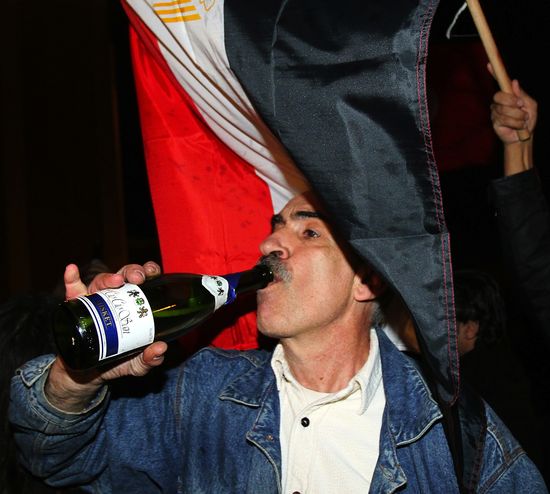
(Photo: A Lebanese man drinks from a wine bottle during celebrations outside the Egyptian embassy in Beirut on February 11, 2011 following news that Egypt's President Hosni Mubarak stepped down after three-decades of autocratic rule. By Anwar Amro/AFP/Getty Images)

 The Dish