The Figurehead Steps Down

by Patrick Appel

Amy Davidson reacts to the news:

[P]eople didn’t want Mubarak as a powerless figurehead; they didn’t want him at all. Why weren’t the protesters satisfied with that—with letting Mubarak be the pretend president, while someone else had the actual power?

Among her answers: 

If someone who isn’t president was acting as president, what would that say about the rule of law? How would they even know that Suleiman, rather than some generals, were the ones making the decisions? That would move them farther from the goal of accountability, not closer. Why turn the presidency into a sham institution at precisely the moment when they wanted democratic institutions to have meaning?

Breaking: Mubarak Resigns

Screen shot 2011-02-11 at 11.14.53 AM   

by Chris Bodenner

The Lede:

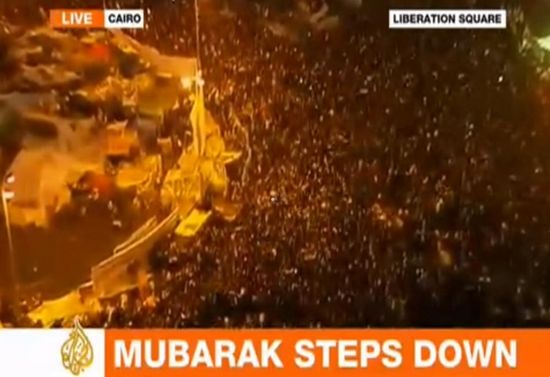
Egyptian President Hosni Mubarak has resigned, according to a statement moments ago on live television from Vice President Omar Suleiman.

Cheers immediately swept the crowds outside Egyptian state television headquarters.

Al Jazeera:

 Jubilation breaks out across Egypt. Flags waving. Joyous scenes in Tahrir Square, Alexandria, Suez.  Watch our live stream here: http://aje.me/jelive [go here if that link doesn't work]

No point any of our presenters trying to speak over the roar of Egyptians celebrating.

Mubarakresigns

Update from EA:

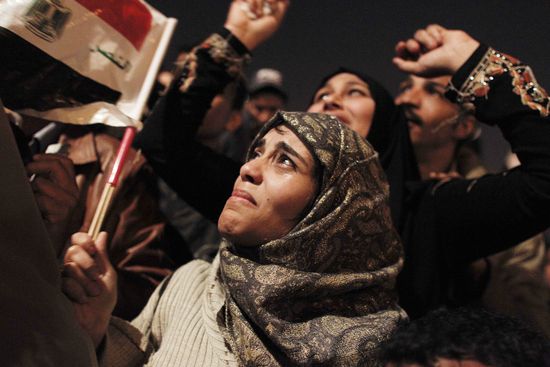
Rawya Regeh recalls the moment from outside the Presidential Palace, where an estimated 10,000 protesters had marched today, when the announcement of Hosni Mubarak's resignation was made: "People were crying, some people fell to their knees, praying immediately on the floor. The tears are everywhere, the smiles, the dances."

Regen continues, "I'm 30 years old….I was born the week President Mubarak assumed power. All my years of life I have known only one President, and I can tell you, I have never seen this sentiment in Egypt."

Update from AJE:

Missed the 30 seconds that ended the 30 years of Mubaraks rule? Watch it again here:

Leaving In Protest

by Chris Bodenner

More details on a key item mentioned in the morning roundup:

Lyse Doucet, a BBC correspondent in Cairo, reports on Twitter that Dr. Hossam Badrawy, the secretary-general of Egypt's ruling National Democratic Party told BBC Arabic that he is resigning because of his unhappiness with President Hosni Mubarak's speech on Thursday night.

Before Mr. Mubarak's speech on Thursday, Dr. Badrawy told several international broadcasters that he expected the president to announce that he was stepping down. Dr. Badrawy, considered a reformer inside the Mubarak regime who is close to the president's son Gamal, said on Thursday that he had been trying for days to convince Mr. Mubarak to step down.

State TV’s Mea Culpa

EGYPT STATE TV PALACE

by Chris Bodenner

Scott Lucas captions the above screenshot:

1530 GMT: Egypt State TV is speaking live with anti-Mubarak protesters surrounding the State TV building. A Nile TV anchor tells a protester on phone: "We fell into a trap" and were given misinformation in the first few days. Another anchor declares, "We want to reach a common ground for dialogue. We admit mistakes."

1530 GMT: Al Jazeera English says that only about 15 people are at State TV staffing the channel.

Signs of a shift by State TV started yesterday:

There has been a significant change in editorial tone of Egypt's state TV in the past few hours – no longer hiding protests, but showing the masses gathered in Tahrir Square. Presenter and guest openly criticising former ministers – by name – accusing them of corruption, greed and misuse of power

State TV cameras also began showing the same kind of footage of Tahrir Square as Al Jazeera.

A Prediction Predicament

by Chris Bodenner

David Rothkopf lays into the "serious" mistakes of the Obama administration yesterday:

The worst of them was CIA Director Leon Panetta's absolutely inexcusable and shockingly atypical decision to announce to the Congress that in his view Egyptian President Hosni Mubarak would likely be out of office by midnight. Obviously, the agency was feeling the heat because it had failed to call the uprisings in Tunisia, Egypt, and elsewhere in the one region of the world to which the most agency assets are (likely) directed. So it made the classic error of overcompensating for the past failure to predict event… by predicting one that didn't actually happen. 

This was a lose-lose idea.

Had Panetta been right, how would it have looked if the CIA had actually been the first entity to announce Mubarak's departure? Might it have fueled perceptions that the United States was pulling the strings behind the scenes in Cairo, that Suleiman was the CIA's guy? (Not exactly a big stretch to begin with.) Who thought it was appropriate that the U.S. ought to get in front of Egypt's story? 

The answer, one has to assume, is someone in the White House. It is hard to imagine that on this issue this administration would let its CIA Director make public remarks to the Congress without vetting them beforehand.

Rothkopf goes on to criticize Obama's two speeches of the day – one before Mubarak's speech and one after. Ackerman zooms out and explains why the CIA's Middle East forecasts "kinda suck".