Egypt: Day 18

Broken_Bones_Not_Spirit2

by Patrick Appel

AJE:

The Egyptian presidency is to make an "urgent and important" statement shortly, state television says.

BBC:

 AFP reports exchanges of gunfire between police and hundreds of protesters in the north Sinai town of El Arish. The report cites witnesses as saying several people were injured… Reuters are also now reporting violence in Sinai town of El Arish after about 1,000 protesters attacked a police station, burning vehicles and throwing petrol bombs.

Sultan Al Qassemi tweets:

Breaking BBC Arabic: Hossam Badrawi, Secretary General of the ruling NDP "I will be announcing my resignation from the NDP within hours"

Michael Hanna responds to the news:

With Badrawi's resignation, a key demand of the protestors is essentially met because the NDP will no longer exist as a serious entity.

The Guardian's morning round-up:

The Egyptian army has issued a statement backing away from ousting Hosni Mubarak and supporting a gradual transition to democracy (see 9.51am). "Communique No 2" said the hated emergency law would be lifted, but did not give a timeframe.

• There is speculation the army could now split into a pro- and anti-Mubarak factions (see this story). There are reports of Egyptian army officers joining the protesters (see 9.24am).

• Mass demonstrations are taking place in Cairo's Tahrir Square and elsewhere in the country, including Alexandria. Protesters have gathered around the presidential palace in the capital (see 12.34pm). Strikes are also continuing.

• Barack Obama has expressed dismay at the failure of Mubarak to stand down (see 9.04am).

Mackey has the text of the statement from Army:

 In view of the ongoing events that will determine the future of the country, and in line with the continuous monitoring of the internal and external developments and the president's decision to delegate his power to the vice president, the Supreme Council of the Armed Forces decides to guarantee the implementation of the following steps:

First:

• Ending the state of emergency once the present circumstances end.

• The outcome of the (court) appeals against the parliamentary election and the measures that will follow.

•Implementation of the constitutional amendments and holding a free and fair presidential election in line with the agreed constitutional amendments.

Second:

• The armed forces are committed to shepherding the legitimate demands of the people and strives with firmness and accuracy to ensure their implementation within a definitive timetable until the realization of a peaceful transition that produces the democratic society to which people aspire.

Third:

• The armed forces stress that there will be no detention of the honorable sons of the nation who rejected corruption and demanded reform.

• It [Egypt's military] stresses the importance of resuming work at government's services, the return of normal life in order to preserve the interests and the achievements of our great people.

(Photo via AJE's live-blog.)
Malkin Award Nominee

by Chris Bodenner

"Parents should be warned and frankly the authorities at CPAC should be told that there are minor age students who need to be looked after and protected. Have the Radical Homosexuals really infiltrated that deeply into what used to be a pro-family movement? Has the leadership of CPAC gone so far as to actually not read anything or think it’s just “political opinion” propagated by old fashioned and outdated leaders that adult homosexual predators exist? Well, they DO exist and they are taking advantage of the alcohol parties at CPAC to poison the minds and pollute the bodies of young conservatives who are still too naïve to know what is being done to them," – Eugene Delgaudio, President of the Public Advocate of the U.S., warning about GOProud in a fundraising email.

Why Keep Mubarak Around?

AlexandriaGetty
by Patrick Appel

Issandr El Amrani collects his thoughts. This is an important point:

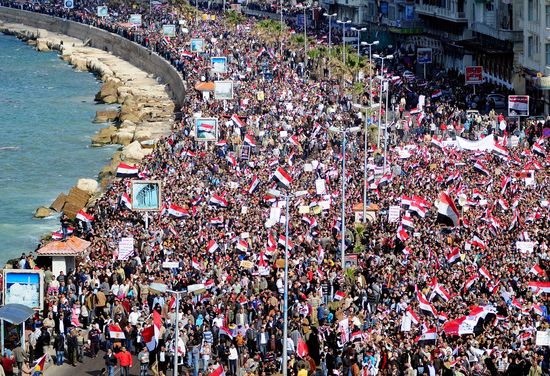
Who cares about the constitution? Perhaps not many protestors, but for the regime the constitution represents legitimacy. Mubarak needs to be in place, even if only symbolically, for amendments to the constitution to be made. If the constitution is suspended, then this forces the army to take charge itself (presumably through the Supreme Military Council), which opens the way to demands for civilian government and lifts the last layer of distance that the army has vis-a-vis the people.

(Photo: Egyptian anti-government protesters march in the coastal city of Alexandria on February 11, 2011. At least a million Egyptians took to the streets of cities around the country to demand the departure of President Hosni Mubarak, according to an AFP tally of official and witness accounts. By AFP/Getty Images) 

Jane Jacobs, Updated, Ctd

by Patrick Appel

Edward Glaeser's interview about his new article is worth a read:

One deterrent against middle-class high-rise living is that U.S. federal policy is strongly biased towards home-ownership. (I’m thinking here both of the home-ownership interest deduction and of the implicit subsidies through entities like Freddie Mac and Fannie Mae.) Given that more than 85% percent of detached houses are owner-occupied, and more than 85% of multi-family dwellings are rentals, the government is essentially bribing Americans to live in suburban, detached homes as opposed to multi-family dwellings or high-rise homes. That’s one reason why I think the United States should rethink its fascination with owner-occupied housing.

Another factor is that, despite heroic reform efforts, our urban schools continue to have significant problems. Until we figure out a way to handle urban schooling better—and there are lots of different ways to imagine doing that—it’s hard not to imagine that there will always be a push towards suburban living for families with kids. 

Things We Want To Believe

by Patrick Appel

Responding to my confusions, Larison clarifies his position on Egypt:

It’s true that I am very skeptical of mass democracy as a form of government, but that is because I worry about its potential for degenerating into an equally oppressive despotism, creating majoritarian tyranny, and smothering liberty. I have concerns about the prospects of Egyptian democracy, but what really moves me to keep making contrarian arguments is the need to counter the enthusiasm and wishful thinking that characterize most of the Western responses to these events. What I am most interested in here is that everyone paying attention to these events give some serious thought to how representative of the Egyptian people the protesters are, how Egyptians perceive these protests, and the possible consequences of rapid political change.

If the protesters are actually unrepresentative, that makes a significant difference not only for how we understand what to expect in a democratic Egypt, but it also tells us how successful democratic reformers are liable to be. Austrian liberals made great strides in forcing their government to become a constitutional monarchy with a representative parliamentary system, but they represented a small minority of the population and their politics and their agenda were profoundly unpopular in rural areas and among the working class. As the franchise expanded, they were swamped by mass movements that were more representative of the population and were also strongly illiberal and anti-liberal. Should democracy ever come to Egypt, that process will happen all at once. The Ghad and Wafd parties will be buried under tidal waves of populist, Islamist, nationalist, and socialist sentiment. Perhaps Egypt will still be better off in the end as a result, but it does no one any good to overlook the potential pitfalls. 

Glamour And Politics

by Conor Friedersdorf

Virginia Postrel reflects on their intersection:

Political glamour is most seductive when it’s selling systems that promise an escape from complexity and compromise. Whether expressed in full-blown communism, Western European socialism, or American technocracy, the glamour of top-down planning shaped 20th-century politics. F.A. Hayek lamented classical liberalism’s lack of similar Utopian inspiration but, in fact, Ayn Rand was masterful in her use of glamour. She knew not only how to tell a romantic story of struggle and triumph but how to create glamorous snapshots that focused her audience’s yearning for freedom and fellowship. Hence the persistent, if illusory, appeal of recreating Galt’s Gulch in the real world.

Why Can’t Americans Save?

by Patrick Appel

Tyler Cowen's answer:

First, and most important, median household income has been stagnant for the last 10 years. Yet there are many new attractive goods and services, including iPads, fun vacations and high-speed Internet access. There are also costly emergencies and commitments when it comes to health care and education, two areas which have seen high rates of inflation over the last decade. It’s hard to save money under those circumstances.

Al-Jazeera’s Revolution? Ctd

by Chris Bodenner

Hugh Miles casts doubt on the network's ability to undermine the regime in Saudi Arabia:

For years, the Saudis dominated the Arabian Peninsula and often meddled in Qatari politics. On several occasions in the 1990s, the Saudis simply invaded Qatar [Al Jazeera's  Screen shot 2011-02-09 at 9.45.53 PMhome] to remind it who was boss and, following Sheikh Khalifa's deposal, Riyadh tried to manipulate his return by organizing a countercoup.

But despite all the problems the Qataris have had with the Saudis, they are fully aware that if they upset the kingdom it is at their peril. As a result, coverage of Saudi affairs on Al Jazeera has not been as bold as coverage of Egypt and Tunisia. Issues of extreme sensitivity to the Saudi regime, such as royal family corruption and the succession question, are passed over lightly.

The Daily Wrap

Today on the Dish, we tracked the rumors of Mubarak stepping down and of a military coup, and wrangled the liveblogs when he announced he wasn't. His constitutional reforms meant nothing, and he essentially threw gas on the fire. Graeme Wood put the onus on the protesters to move the uprising past the carnival stage, and protesters played the numbers game, and promised to do it all again if Suleiman took over. HRW revealed truths about the military's relationship to the protesters, Egyptians reiterated this isn't an Islamic uprising, and Eric Trager examined the Muslim Brotherhood's long game. Andrew Mack expressed cautious optimism about the slow march to global peace, Andrew Masloski re-prioritized aid to Egypt, and faces of the fallen circled the Internet. Alan Abramowitz revisited past presidential turnovers, and CIA promotions for torturers could affect more than Panetta's reputation. Protests spread to Iraq, Islamist terrorism fell to .34% of all attacks, and we explored Afghanistan's attitudes toward democracy.

Conor pummeled David Horowitz, sympathized with Rich Lowry's tough predicament, and explored what a normal conservative would learn from NRO on Limbaugh. Chinese gays attended fake marriage markets, US math scores are actually improving, sex in movies went for lust over love, and some divorce for the tax break. Conor nominated one news organization for achieving ideological innovation in online journalism, and Republicans still had it out for Planned Parenthood. Foul grossout material died on the Internet, but inaccuracy and untruths were still very much alive, and Andrew couldn't believe he missed a revolution.

VFYW here, Sully bait here, FOTD here, Yglesias award here, dissents of the day here, and protest sign of the day here.

–Z.P.