Protesters On The Move

by Chris Bodenner

Scott Lucas paints a stark picture:

0155 GMT: Protesters have divided themselves into four groups almost now. The core of the protesters are occupying Tahrir Square like every night. The second and third group – made up of thousands more – are camped outside the parliament and the state TV building and will spend the night there. The fourth group is marching towards the Presidential Palace right now.

2330 GMT: Many sources, including CNN, are speculating that Mubarak did not step down because he may want to lure the protesters into committing acts of violence so he can then crackdown upon them.

“Sorry Is In Actions, Not Words.”

by Patrick Appel

Graeme Wood reports on the mood in Cairo after Mubarak's speech:

I filed out of Tahrir with a crowd that kicked up dust as it went, like a cattle stampede. By now it was nearly midnight, and many who had come to watch history being made went home filled with rage. Others, in a group of a few hundred, marched to the state TV station — a heavily guarded building about a kilometer away — and were, as of a few minutes ago, chanting "Irhal" so furiously that one could hear them across the Nile and up and down the corniche.

If Mubarak hadn't delayed so long, perhaps the protesters would still have had the energy to take the TV building outright. I have not seen the faces in the Square seem so bitter or fuming before; they looked like they wanted to overturn cars.

Wendell Steavenson was also at the scene:

I have never been in a crowd wracked with such intense emotion. After he finished, men wept openly while their friends consoled them. There was rage and screaming and shock. People could hardly find the words to voice their frustration. “It is promises in the air!” “He wants to keep his military honor!” “He cannot imagine that his people are telling him to go.” People shook their heads and looked up to the sky as if for some answer. One woman told me with a cracked, inchoate voice: “I’m angry … we’ve been waiting for years … wait until September? And he’s sorry!” she spat with sarcasm. “It’s too much! Sorry is in actions, not words. It’s the same old story. It’s no change. We’re just running in circles.”

Mubarak Throws Gasoline On The Fire

EgyptSpeechGetty2 

by Patrick Appel

Anthony Bubalo believes that Mubarak's speech was "a major miscalculation, not just by Mubarak but by the regime":

[The regime] had a chance to dispense with Mubarak but save (much of) itself. For a solid week and-a-half we were in post-Mubarak Egypt. Whether Mubarak was going to go now, or in September as he promised, was simply a matter of detail — albeit a very important detail. In effect, what we were witnessing was a negotiation between the rest of the regime and the protesters about how different post-Mubarak Egypt would be from Mubarak's Egypt. The regime hoped to make the minimum concessions to get the protesters off the streets. 

But now, by allowing Mubarak to hang around, by so spectacularly under-bidding in this negotiation, the regime has ensured that even when Mubarak is eventually forced to go — as I still expect he will be — the wrath of the protesters will remain focused on the system as a whole.

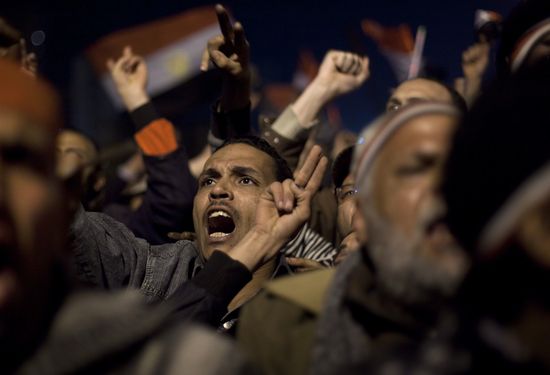
(Photo: Anti-government protesters react as Egyptian President Hosni Mubarak makes a televised statement to his nation in Tahrir Square in downtown Cairo, Egypt Thursday, Feb. 10, 2011. By Emilio Morenatti/AP. 

Torturers: Failing Upwards, Ctd

by Zoe Pollock

Scott Horton responds to the AP's story on torturers often promoted within the CIA:

Such a culture has certain legal consequences. Under the doctrine of command responsibility, when an organization involved in warfare fails to punish or discipline those who engage in criminal conduct, criminal liability passes to the senior officers of that organization. That’s a point for Leon Panetta and his senior deputies to ponder carefully. It is not just their reputations that are in jeopardy.

Deaf Dictator Syndrome

Snooz

by Patrick Appel

David Remnick diagnoses Mubarak:

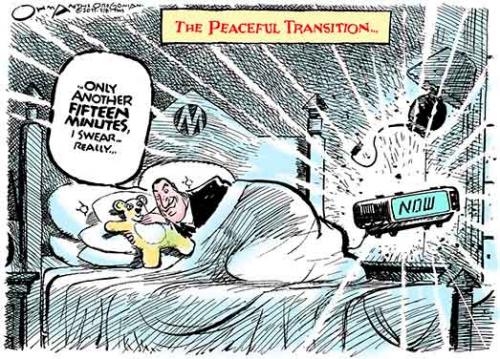
The delusions of dictators are never more poignant—or more dangerous—than when they are in their death throes. To watch Hosni Mubarak today in his late-night speech in Cairo, as he used every means of rhetorical deflection to delay his inevitable end, was to watch a man so deluded, so deaf to the demands of history, that he was incapable of hearing an entire people screaming in his ear. And it is almost always that way: the dictator, coddled in his isolation, surrounded by satraps and servants, immersed in his own sense of essential-ness, is the last to know.

Silawa likewise tries to get inside Mubarak's head.

(Cartoon via AJE)

Yglesias Award Nominee

by Patrick Appel

"Although the 'prop-up-Mubarak' position has recently solidified on talk radio and Fox News, during the early days of the Egyptian crisis, the only clear principle that emerged from the right was that Obama was wrong.  The terrible complexity of the situation, the conundrums and impossible trade-offs, were never acknowledged.  Has the Obama Administration been totally consistent from day to day?  No.  Is it driven more by developing facts on the ground than driving those facts?  Yes.  And good luck to anyone who thinks that he can do better in this diplomatic and moral morass," – Heather Mac Donald, Secular Right.

What Happens Next?

by Patrick Appel

Joel Rubin lists his questions:

1. What is the Army doing?  Will they follow Mubarak? There were rumors earlier in the day that the military would push out Mubarak, call for martial law and make steps to democracy. That scenario appears dashed.  The Administration needs to press all its contacts for real answers.

2. What will the protestors do?  Will more come out tomorrow? The protestors were planning on one million marchers for tomorrow.  Now how many? If they needed anything else to fuel their rage, Mubarak just gave it to them.

3. Is an “orderly transition” to democracy really possible with Suleiman or any other remnant of the Mubarak regime in charge?Mubarak said that he will transfer power to his vice president, Omar Suleiman, and will support changes to the Constitutional amendments, as well as move to end the Emergency Law — but that has been said before, and Mubarak insisted changes would be made only after stability has been restored, which, after watching the chants from Tahrir, doesn’t seem likely. There’s a credibility problem here.

 Rozen does some reporting:

“I have a feeling that we’re at the endgame now," said Stephen P. Cohen, president of the Institute for Middle East Peace and Development, and a former consultant to the National Intelligence Council who speaks frequently with Cairo military officials. "Mubarak has acted in such a way as to make Suleiman impotent. …We’re in a dangerous moment." 

Wired For War, Ctd

by Zoe Pollock

A reader writes:

I think one could argue that murder is less common among chimpanzes only because the risks to the attacker are significantly higher: without weapons, murder has to be executed (please forgive the pun) by hand which is ugly, painful and dangerous.

Another:

I read Horgan's article and the Dan Bailey article that he cites.  Junger's use of the neuroscientific word "hardwired" is low-hanging fruit as refutations go, but I don't see that Horgan made a strong argument against Junger's general implication that war comes from somewhere deep down in our humanity.

Horgan comes close to relying on the myth of the peaceful savage when he says that, "tribal societies in regions such as the U.S. Southwest did not fight continuously; they lived peacefully for centuries before erupting into violence."  In "War Before Civilization," Keeley points out that anthropologists attempting to argue for war as an invention of (to paraphrase) the white man have often done so by defining war in terms logistically impossible for primitive societies to meet.

While it is difficult for primitive societies to muster the supplies and manpower for even short-term group violence, some of them have homicide rates dozens of times higher than that of modern industrial nations (p. 29).

The Bailey article that Horgan cites is based on a 2007 book by Jonathan Haas.  Hass also edited a 1990 volume entitled, "The Anthropology of War" in which Clark McCauley notes that, of the three societies discussed that had the ultra-rare distinction of having never been known to engage in war, violent conflict was avoided largely through extreme ethnocentrism.  Basically, these societies shunned war as the purview of dirty foreigners, defined as everyone outside the tribe, whose influence was invoked at the slightest hint of intratribal tension.  In McCauley's words, "the fact appears to be that hating violence requires violent people to hate" (p. 14).

And if I might draw on my experience as a former Marine infantryman who served three tours in Iraq (which I normally hate doing as I've seen too many peers use the fact that they've "been there" to argue an otherwise groundless claim for the wonderfulness of the war), I have to question whether Horgan's point that young men don't CAUSE wars is all that important.  There's an endless list of causes one would need to draw up to explain every war that's ever been fought, but once they are in it, young men certainly contribute to an inertia that makes it difficult and sometimes suicidal to stop war.  Many that didn't necessarily want to kill from the outset become desensitized to the idea, or worse, are motivated by revenge as friendly casualties mount.
Doing His Own Dirty Work

by Chris Bodenner

Lisa Hajjar highlights a vivid detail from Suleiman's fascist resume:

In Egypt [in 2001], as [Egyptian-born Australian citizen Mamdouh] Habib recounts in his memoir, My Story: The Tale of a Terrorist Who Wasn’t, he was repeatedly subjected to electric shocks, immersed in water up to his nostrils and beaten. His fingers were broken and he was hung from metal hooks. At one point, his interrogator slapped him so hard that his blindfold was dislodged, revealing the identity of his tormentor: Suleiman.

Protest Sign Of The Day

108963333

by Chris Bodenner

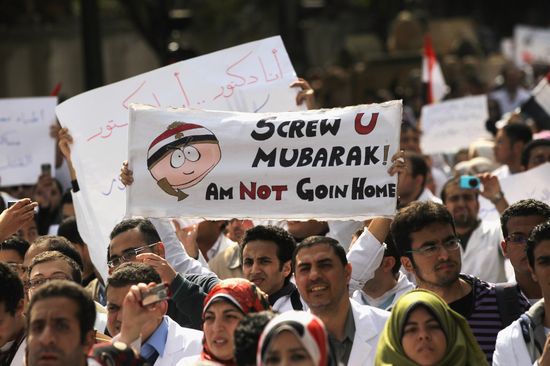
(Photo: Doctors, medical workers and students march through Cairo to join anti-government protests in Tahrir Square on February 10, 2011 in Cairo, Egypt. Thousands of workers from various unions across Egypt, including many medical workers, have gone on strike today with protestors calling for a nationwide general strike. The wave of strikes is increasing pressure on the government following more than two weeks of protests calling for the resignation of President Hosni Mubarak. By John Moore/Getty Images.)