Malcolm Gladwell, Call Your Office, Ctd

This YouTube has gone viral in the Arab world – close to half a million views so far. The times they are a'changing:

Money comment:

Libyan youth will be no different from European, American, Brazilian or Russian. They don't want to worry about politics, they want to dance! Welcome to the future!

Islamists shudder. But hey, even the Qaddafi son wanted Usher and Beyonce.

Quote For The Day

"Tripoli is a civil city no weapons here; we just fight with stones, even the ambulances are full of mercenaries … you have to sign a document that you agree that your son/daughter was killed by protesters or they won't release the body … lot of people have gone missing … kidnapped from outside their houses, people paid 7000 dinars to kidnap … my friends were shot by snipers on Friday … they died, and an old man died in front of him as well …around 40,000 people were protesting … there many snipers around -i have videos, but they are after me – they will catch me," – an al Jazeera source, descibing the purest kind of tyranny now fighting for its life in Tripoli.

“I’m The Scariest Thing Here”

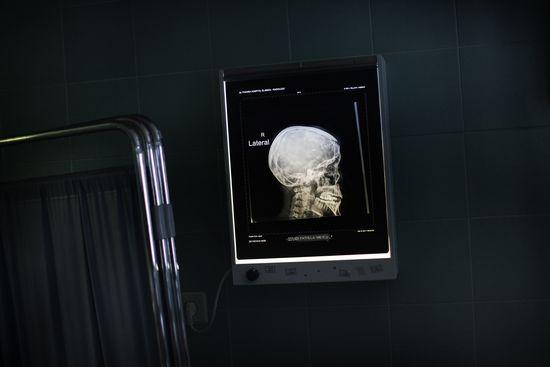
LibyaXrayGetty

Elissa Lerner reviews David Axe’s new graphic novel “War is Boring: Bored Stiff, Scared to Death in the World’s Worst War Zones,” with art by Matt Bors:

The tragedy of Axe’s book is not the actual tragedy of war, nor his boredom with it. It’s his boredom with himself and the rest of humanity, and for this reason his account should be read by budding war reporters, so that they might safeguard themselves against developing his outlook. Axe does offer a bit of wisdom at the end, but it is cold comfort. “The more of the world I see, the less sense it makes,” he writes:

The more different people I meet, the less I believe in their humanity. The older I get, the less comfortable I am in my own skin….the things we can believe in shrink into a space smaller than our own bodies. To preserve them, for as long as you might, arm yourself, and be afraid.

(Photo: The X-ray scan of a wounded anti-regime demonstrator shows a bullet lodged in his brain while he is nursed at the intensive care unit at a hospital in the eastern city of Tobruk on February 25, 2011. By Marco Longari/AFP/Getty Images)

The Tameness Gene

Evan Ratliff explores research on domesticated foxes:

Led by a biologist named Dmitry Belyaev, researchers at the nearby Institute of Cytology and Genetics gathered up 130 foxes from fur farms. They then began breeding them with the goal of re-creating the evolution of wolves into dogs, a transformation that began more than 15,000 years ago. With each generation of fox kits, Belyaev and his colleagues tested their reactions to human contact, selecting those most approachable to breed for the next generation. By the mid-1960s the experiment was working beyond what he could’ve imagined. They were producing foxes like Mavrik, not just unafraid of humans but actively seeking to bond with them. …

Miraculously, Belyaev had compressed thousands of years of domestication into a few years.

Walker’s Over-Reach, Ctd

Dick Morris's latest poll shows Wisonsin voters where the Dish is – in favor of Walker's specific requests of public sector unions, but unwilling to remove most collective bargaining rights. By slipping this collective bargaining provision into the bill – something he did not campaign on – Walker has blundered. Moreover, this measure would presumably be the most fatal to his opponents anyway:

By 54-34, Wisconsin voters support ending the automatic deduction of union dues from state paychecks and support making unions collect dues from each member.

In a poll reliant on Rasmussen's pro-GOP skewed sample, we get the following result:

More than half (56%) of respondents said Wisconsin state workers should have collective bargaining power. Just 32% sided with Walker and said state workers should not be allowed to collectively negotiate benefits and other compensation.

Almost identical. Why doesn't Walker concede on collective bargaining, declare victory and move on?

“Nobody Gives A Fuck About Us”

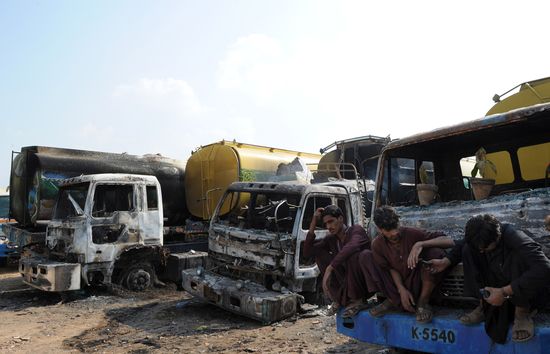
PakistaniDriversGetty

Sarah A. Topol reports on Pakistani drivers who ferry supplies and fuel to troops in Afghanistan:

Men who risk their lives on the perilous roads from Karachi to Kabul or Kandahar are caught in a tangle of poverty, rhetoric, and the imminent threat of death. … Each year has become more terrifying than the last, Dilshad tells me. Last month, a friend of his was killed when the Taliban set his truck ablaze on the Pakistani side of the route. On Feb. 7, gunmen torched five trucks. On Jan. 30, three trucks were attacked. On Jan. 21, three separate attacks in Pakistan left three trucks torched and one driver shot. On Jan. 19, Pakistan's local press reported the bodies of three kidnapped drivers were found peppered with bullets. Everyone gathered here has at least one tale of surviving a brush with death.

(Photo: Pakistani drivers sit on a burnt out NATO supply oil tanker the morning after an attack on the outskirts of Islamabad on October 4, 2010. By Aamir Qureshi/AFP/Getty Images)

A Poem For Sunday

109436402

“A Free Man” by Rosalie Hickler appeared in The Atlantic in 1928:

Pressed sorely on all sides, but loath to yield,
Sometimes when it has seemed that I must die
I see your banner, sharp against the sky,
And catch the glitter of your battered shield.
Then, spite of weariness, my arm is steeled
To lift my own discouraged banner high
And gather laughter for a battle cry
To fling against the fiercely crowding field.

I know what friendless struggles you incur,
Faring so carelessly in ways apart,
Still smiling to yourself, unconquered still,
Wielding the lightning blade Excalibur,
Your fair white plume unstained, O Gallant Heart,
Armored in triple mail from every ill.

(Photo: Libyans chant slogans against the regime of Col. Moamer Kadhafi after the pre-Kadhafi flag was raised at the ambassador's residence in Washington on February 25, 2011. Ambassador Ali Aujali resigned his post February 22. By Nicholas KAMM/AFP/Getty Images)
The Fallibility Of Rulebooks

Richard Dawkins recounts seeing a mother barred from bringing excema cream for her daughter onto a plane, and glimpses the larger picture:

Rulebooks are themselves put together by human judgments. Often bad human judgments, but in any case judgments by humans who were probably no wiser or better qualified to make them than the individuals who subsequently have to put them into practice out in the real world. … Discretion can be abused, and rulebooks are important safeguards against that. But the balance has shifted too far in the direction of obsessive reverence for rules. There must be ways to re-introduce intelligent discretion and overthrow the unbending tyranny of going-by-the-book, without opening the door to abuse. We should make it our business to find them.

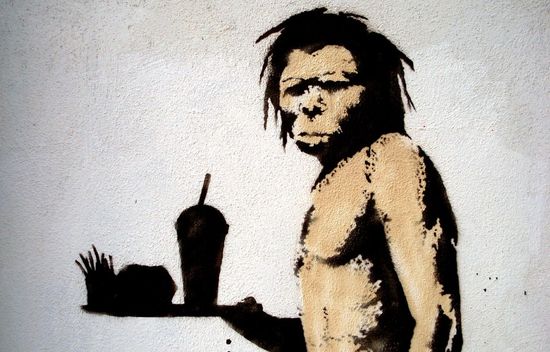
Are Cavemen A Myth?

BanksyCavemanLord

John J. Shea assembles the evidence:

Premodern humans—often described as “archaic Homo sapiens”—were thought to have lived in small, vulnerable groups of closely related individuals. They were believed to have been equipped only with simple tools and were likely heavily dependent on hunting large game. Individuals in such groups would have been much less insulated from environmental stresses than are modern humans. In Thomas Hobbes’s words, their lives were “solitary, nasty, brutish and short.” If you need a mental image here, close your eyes and conjure a picture of a stereotypical caveman.

But archaeological evidence now shows that some of the behaviors associated with modern humans, most importantly our capacity for wide behavioral variability, actually did occur among people who lived very long ago, particularly in Africa. And a conviction is growing among some archaeologists that there was no sweeping transformation to “behavioral modernity” in our species’ recent past.

(Banksy's Caveman photographed by Flickr user Jim Lord)

Oscar Betting

Nate Silver lists tips for winning your Oscar pool. Among them:

The Academy — which can take itself very seriously — is relatively unfriendly toward comedies. If two candidates otherwise seem tied, lean toward the more dramatic film. The exception is in the supporting actor and actress categories, where the Academy likes to have a bit more fun and playing comedic or otherwise quirky and offbeat roles may actually be an advantage.