“This Is Not An Islamic Uprising”

EgyptIsrael

by Patrick Appel

Greg Scoblete flags a new poll by The Washington Institute:

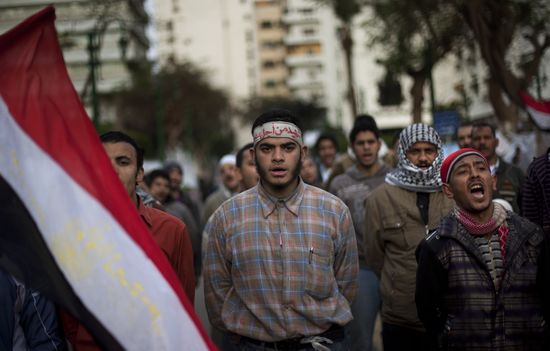
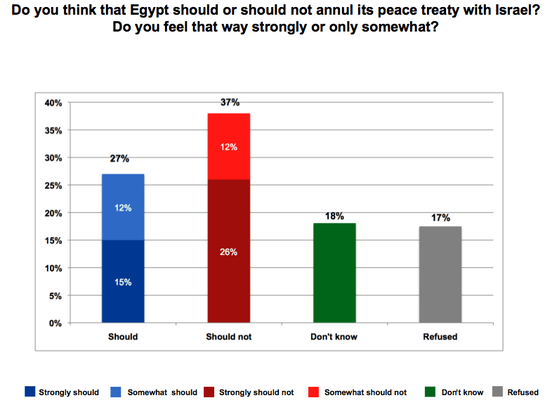
The Muslim Brotherhood is approved by just 15 percent of Egyptians — and its leaders get barely 1 percent of the vote in a presidential straw poll. Asked to pick national priorities, only 12 percent of Egyptians choose sharia (Islamic law) over Egypt's regional leadership, democracy, or economic development. And, when asked to explain the uprising, the issues of economic conditions, corruption, and unemployment (around 30 percent each) far outpace the concern that "the regime is not Islamic enough" (only 7 percent).

Ideological Innovation Is Possible!

by Conor Friedersdorf

Jay Rosen offers a characteristically smart interrogation of the AOL / Huffington Post merger:

Is ideological innovation possible in online journalism, and will we see it from this merger?

Well, is it?

No one ever thinks to ask that. Without understanding why, we just assume the answer is no. So the ideological possibilities for the new AOL narrow down to three: lean left… don't lean left or right… lean left but say you're not because it sounds better for a big company. Thus: Will AOL now lean left? (The Wrap, Feb. 7.) Arianna Huffington Will Not Make AOL a Leftie Blog (The Wrap, Feb 8.)

Jeffrey Brown of the Newshour on PBS put it this way when he interviewed Huffington and Tim Armstrong, CEO of AOL: "Does AOL risk something to its brand by partnering with Huffington Post, given its  reputation as a liberal, left commentary site?" Armstrong said the Huffington Post is a lot more than that; it's a general news, information and entertainment site.  But Huffington said she wanted to transcend the assumptions in Brown's question.

Here's Ms. Huffington's quote:

It's time for all of us in journalism to move beyond left and right. Truly, it is an obsolete way of looking at the problems America is facing.

What's happening to the middle class, what's happening in our foreign policy in Afghanistan are not easily divided into left-right positions. People have different positions across the political spectrum. All voices have been welcome at The Huffington Post. People ranging from Newt Gingrich to David Frum and Joe Scarborough and Tony Blankley have been blogging on The Huffington Post.

That lineup includes some people whose work I respect a great deal, but it seems a weird bunch of names to rattle off if we're talking about transcending how journalism usually covers politics. Newt Gingrich, David Frum, Joe Scarborough and Tony Blankley have very different ideas about what the future of the Republican Party should be… but I don't know if I'd say they've moved beyond left and right. All would like to be loyal Republican voters.

Okay, back to Jay Rosen, who has some interesting ideas about what actually transcending the status quo might look like:

The new AOL should announce that its dropping the View From Nowhere. When Arianna is asked the "lean left" question she should say that we're not going to impose an artificial neutrality on our editors and their sites, and viewlessness won't be mandatory for writers and contributors because it's not the best way to generate trust. But there won't be a party line or a single dominant perpsective, either. That wouldn't work for AOL or the expanded Huffington Post Media Group. What will work is pluralism, transparency and the View from Somewhere. And there are certain things that are non-negotiable.

His list of non-negotiables: "Accuracy in reporting. Fairness in portraying public controversy. Up-to-date information. No undue influence by advertisers or sponsors. Mutltiple portals for users to interact with and influence our coverage. And a fact-checking form on every piece of content." 

I'd read a site like that. And if I might plug my current employer, I'd note that The Atlantic has already adopted this model in many ways. Ta-Nehisi Coates, James Fallows, Megan McArdle, Andrew Sullivan, Jeffrey Goldberg, Clive Crook, Alexis Madrigal, Josh Green: there's no dominant perspective, artificial neutrality isn't imposed, everyone is implicitly or explicitly transparent about their View From Somewhere, and the non-negotiables (aside from the new fangled fact-checking form) are all in place.

It seems to be working out.
A Numbers Game

APEgyptParliament

by Patrick Appel

Thanassis Cambanis reports on the protesters camped out in front of Egypt's parliament:

Organizers of Tahrir Square are playing a numbers game. If more people show up each time they call for a big crowd – as happened on Tuesday, which drew perhaps the greatest amount of people since it all began on January 25 – then the revolution advances. That's their gamble. Several of them said they believe that success required steady escalation. Tuesday, the parliament. Friday, perhaps the state television headquarters or a ministry. Sunday, the police headquarters. And so on. They are hoping to organize major days of action three times a week, a plan that hinges on drawing more and more people each time. So far, popular response has exceeded their expectations at each turn. That's no guarantee that the pattern will continue, or that the regime won't use incalculable brute force or brilliant political maneuvering to shift the power balance.

(Photo: Anti-government protesters shout slogans as they line up after spending the night in front of the Egyptian Parliament in Cairo, Egypt, Thursday, Feb. 10, 2011. Around 2,000 protesters waved huge flags outside the parliament, several blocks from Tahrir Square, where they moved two days earlier in the movement's first expansion out of the square. Emilio Morenatti/AP)

A Fake Marriage Market

by Patrick Appel

Nicola Davison visits one. It's a vivid reminder how uneven tolerance remains:

I'm at a fake-marriage market, where Chinese lesbians and gay men meet to find a potential husband or wife. In China, the pressure to form a heterosexual marriage is so acute that 80 percent of China's gay population marries straight people, according to sexologist Li Yinhe, a professor at the Chinese Academy of Social Sciences. To avoid such unions, six months ago, Shanghai's biggest gay Web site, inlemon.cn, started to hold marriage markets once a month.

Balancing The Guns And Butter

by Chris Bodenner

Andrew Masloski recommends a way to re-prioritize aid to Egypt:

While Congress has entertained the notion of cutting some portion of US funding to Egypt in order to send a message to President Mubarak, the Egyptian people need to hear the message that the U.S. supports their struggle for a free and democratic Egypt.  By shifting the relative amounts of current U.S. funding so that development aid and military financing enjoy the same level of support, the U.S. has the opportunity to make good on its commitment to democracy and human rights without alienating the Egyptian military and still sending a strong message to Mubarak.

The Power Of Pure Stupidity

by Patrick Appel

Gopnik fears it:

In a practical, immediate way, one sees the limits of the so-called “extended mind” clearly in the mob-made Wikipedia, the perfect product of that new vast, supersized cognition: when there’s easy agreement, it’s fine, and when there’s widespread disagreement on values or facts, as with, say, the origins of capitalism, it’s fine, too; you get both sides. The trouble comes when one side is right and the other side is wrong and doesn’t know it.

The Shakespeare authorship page and the Shroud of Turin page are scenes of constant conflict and are packed with unreliable information. Creationists crowd cyberspace every bit as effectively as evolutionists, and extend their minds just as fully. Our trouble is not the over-all absence of smartness but the intractable power of pure stupidity, and no machine, or mind, seems extended enough to cure that.

Joyner nods:

It’s probably the single most frustrating thing about blogging: Even long-settled facts are still subject to “debate,” and it’s now easier than ever to link to “authoritative” accounts “proving” things that are wildly wrong.

A Slow March Towards Global Peace?

Battledeaths

by Patrick Appel

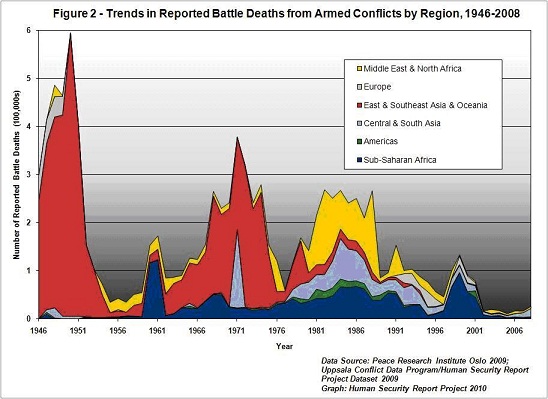
Andrew Mack lists "reasons for cautious optimism":

First, absent a global economic crisis that is far greater than the current one, economic interdependence will continue to grow. This will likely further increase the costs and decrease the benefits of interstate war—and hence the risk of it occurring.

Second, incomes will almost certainly continue to grow in the developing world. This will continue to enhance state capacity, which almost all the statistical studies agree reduces the risks of armed conflict.

Third, there are no signs that the international community’s commitment to peacemaking and peacebuilding is waning—indeed the contrary is true.

Fourth, in seeking to bring down repressive and authoritarian regimes, there are viable alternatives to violent insurrection—as the mass uprisings in Tunisia and Egypt remind us. Since the mid-1980s the number of autocracies in the world has declined by some 70 percent.[6] Yet strikingly few of these transitions were the result of violent insurgencies; still fewer resulted from foreign military intervention. A substantial number, however, were brought about by unarmed “people power” movements—and without any help from external powers.[7] Such movements offer a promising alternative to violent insurgencies whose success rates have been declining. 

Go Forth And Travel

by Conor Friedersdorf

One of the most thoughtful right-leaning talk radio hosts is Dennis Prager, and his latest at National Review is worth a read. It marks a trip to the 100th country he has visited, and offers some excellent advice:

For many years, I have urged young people to take a year off after high school to work and to take time off while in college to travel abroad, ideally alone for at least some of the time. Nearly everyone grows up insular. The problem is that vast numbers of people never leave the cloistered world of their childhood. This is as true for those who grow up in Manhattan as it is for those who grow up in Fargo. And as for college, there are few places as insular and cloistered as the university.

Insularity is bad because at the very least it prevents questioning oneself and thinking through important ideas and convictions. And at worst, it facilitates the groupthink that enables most great evils. Although one can hold onto insular and bad ideas even after interacting with others, it is much harder to do so, especially when one interacts on the others’ terms, as must be done when traveling to other cultures (and especially when traveling alone).

It is therefore one of the most maturing things a person can do.

He offers this assertion too:

The moment you meet people of other faiths whom you consider to be at least as decent, at least as religious, and at least as intelligent as you think you are, you will never be the same.

It's nice to be reminded that I shouldn't fall into the bad habit of disparaging the whole "talk radio right." There are a few thoughtful voices in that grouping.

Soldiers In The Shadows

108971007

by Chris Bodenner

In a report on the xenophobic tactics of the Mubarak regime, Peter Bouckaert of Human Rights Watch further debunks the myth that the military has been neutral towards protesters:

One activist who was brutally beaten while being detained by the military from Friday until Sunday last week told me how an Army interrogator, who tortured him with electric shocks, was absolutely obsessed with saving the country from the foreign spies trying to ruin it.

(Photo: An Egyptian soldier stands guard on the roof of the parliament in Cairo on February 10, 2011 amid rumors that embattled President Hosni Mubarak appears to be on the brink of stepping down. By Marco Longari/AFP/Getty Images)