Who Weds For The Tax Break? Ctd

by Chris Bodenner

A reader writes:

My boyfriend and I did exactly that last year. We've been together for 10 years, cohabitating for 6 and just bought a house. We ran the numbers and found that it would benefit us financially to get married. The tax break was the sole reason we did it. We will continue to run the numbers each year and if it becomes financially beneficial for us to get a divorce we will do so.

I assume the family values folks would view our marriage as valid even though it meant no more to us than any other financial decision. It had all the solemnity and emotion of opening a savings account. Still, we're straight and I guess that's all that matters.

A female reader writes:

It's callous, but that's exactly what my (male) partner and I did – we went to City Hall and signed a piece of paper so that I could be covered by his health insurance and we could enjoy a nice tax break. And I did it because, frankly, the shine was already off of the institution for marriage for me. Before my current partner, I had only dated women.

I had never imagined that I would fall in love with a man, but there I was. Although I'm glad that the people in my life are happy for me, I was appalled that some family and friends were taking this new relationship far more seriously than they had the several-year relationship with my previous partner, a woman. The beginnings of hetero-normative privilege were strange and painful.

When I started my new job last year and realized how expensive and crappy my new health insurance was, we tried to explore the domestic partner benefit with his employer. Happily, they do support same-sex domestic partners, but straight folks like us had to be married to qualify.

So why not? We're not married in the eyes of our parents, or my religious community, or anyone who matters to us. But we do get to enjoy privileges of protection that everyone should be enjoying. I'm happy to exploit it while I can and work for the situation to be better for everyone.

Another writes:

While the tax ramifications didn't determine if I got married, they definitely determined when I got married.

My wife and I decided to get married in late 1995.  A quick run through the estimated tax ramifications showed that getting married in 1995 would have cost us $4,000-$5,000 in additional taxes as we are both full time professional employees with above average wages.

We were married on January 1, 1996.
The Dust Spoke Of Survival

by Zoe Pollock

Derek Vertongen recalls an older Egypt:

When I first went to Cairo, Anwar Sadat had been dead for six years, but many of his official portraits still hung in shops and back rooms and petrol stations. Sadat looked friendly in the faded black-and-white pictures. His successor—the man sitting next to Sadat when he was gunned down in 1981—never did. The new rais, Hosni Mubarak, didn’t even smile. But slowly, his bovine gaze, his don’t-mess-with-me expression, was taking over. I remember seeing an art film in which, subtly, Mubarak’s portrait was in the background of every frame.

Cairo didn’t look promising on that first visit in August of 1987. I had landed in the middle of the night and decided to wait until dawn. The bus from the airport was brutal. At 6 a.m. the air was bad and I was shocked by the state that Egypt’s capital was in: covered in thick grime, it looked tired and squalid, as if something terrible had happened. When the sun rose and burned off some of the haze, the decay was even more obvious. I couldn’t tell if the buildings were half-completed or half-demolished. Policemen dressed in cheap uniforms stood outside government buildings. They looked like extras from a World War I movie. Then I noticed that the police were everywhere. That is what they did: they stood around, armed with machine guns and looking hungry.

Wikileaks On Oil That’s Already Peaked, Ctd

by Patrick Appel

Avent notes the market's non-reaction to the news:

The story has gotten a lot of attention, but prices haven't risen, which suggests that experts already knew this (and indeed, people have been speculating about such an overstatement for at least four years). It's actually kind of interesting to note that early takes on a potential reserve overstatement date to 2007, which is when oil prices began rising at a faster pace. Saudia Arabia has about a fifth of known oil reserves, so a revision in its holdings of this magnitude is significant.

The Worst Memoirs

by Conor Friedersdorf

When the genre became hot, a lot of twentysomethings started writing them, prompting a backlash: these whippersnappers should wait until they have lived long enough to experience something worth saying! Agree or disagree, I submit that the people who are really cheapening the genre are more often politicians or CEOs who've experienced tons of interesting stuff to write about, but produce self-serving pr tomes rather than forthright reflections on their bygone careers.

Pakistan Won’t Follow Egypt

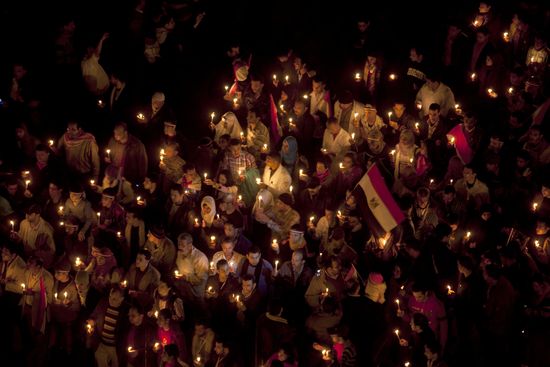
CandlesEgyptAP
by Patrick Appel

Sumit Ganguly believes that the Tunisian tsunami will skip the country:

Why has Pakistan not seen, and is unlikely to see, street demonstrations of the order that have swept aside the regime in Tunisia and now threatens the one in Egypt? The reasons are complex. Despite the elements that Pakistan has in common with both those states, there are important differences. Pakistanis have enjoyed, for varying lengths of time, the advantages of democratic, civilian rule even though they have yet to vote an elected government out of power. The all-powerful military apparatus has frequently stepped in when it has deemed that the civilian regime has either proved to be unstable or breached some invisible but nevertheless real boundaries. Despite the tenuousness of democratic regimes, they are not unknown in Pakistan, as they are in Tunisia and Egypt.

(Photo: Anti-government protestors hold candles as they walk in Cairo, Egypt, Wednesday, Feb. 9, 2011. Protesters appear to have settled in for a long standoff, turning Tahrir Square into a makeshift village with tens of thousands coming every day, with some sleeping in tents made of blankets and plastic sheeting. By Emilio Morenatti/AP)

Fears Of Eurabia Are Greatly Exaggerated

by Zoe Pollock

Rod Dreher interviewed senior researcher Brian J. Grim about The Future of the Global Muslim Population, the latest report from the Pew Forum on Religion & Public Life:

The report shows, for example, that in Tunisia, where the current wave of unrest began, the median age is 29 years — five years above the average for Muslim-majority countries. In comparison, the median age in Egypt is 24, and in Yemen it’s 18 — six years below the average for Muslim-majority countries. … Interestingly, the unrest began in the older, relatively richer country — where the middle class is also relatively larger — and then it spread to the younger, relatively less well-off countries.

Grim also goes into detail about the rise of Muslim populations in Europe and in the United States:

In the United Kingdom, for example, Muslims are expected to comprise 8.2 percent of the population in 2030, up from an estimated 4.6 percent today. In Austria, Muslims are projected to reach 9.3 percent of the population in 2030, up from 5.7 percent today; in Sweden, 9.9 percent (up from 4.9 percent today); in Belgium, 10.2 percent (up from 6.0 percent today); and in France, 10.3 pecent (up from 7.5 percent today).

In the United States, Muslims make up a much smaller share of the total population. But we project that if current trends continue, Muslims will comprise 1.7 percent of the U.S. population in 2030, which is approximately the same portion that Episcopalians, Jews or Mormons represent today.

The “End Of Discovery”? Ctd

by Patrick Appel

A reader writes:

You posted an article today by Jonah Lehrer in which he posits “All the low-hanging facts have been found.” This reminds me a great deal of a famous quote by Charles Duell, then commissioner of the US Patent office, who in 1899 said “Everything that can be invented has been invented.” I think Lehrer over-simplifes what “low-hanging facts” are. I remember learning about relativity as early as elementary school. Who’s to say in the next 40 years someone won’t come up with The Grand Unifying Theory of Physics and that my grandchildren won’t be learning about THAT in elementary school, and 100 years down the road that won’t become the new “low-hanging fact”? All of this is relative. What we have known for decades seems obvious, and obfuscates the difficulty, magnitude, and importance of those discoveries.

Another reader argues along the same lines:

I don't know that any discoveries have been "easy." It's true that you used to be able to set sail, find a new land, claim it, and document new peoples and new species there, but there were trade laws, a limited flow of information (did Spain claim that same island two years ago?) and poor scientific instruments, complicated taxonomic protocol, and, the biggest hurdles of all, religious doctrine and entrenched interests. Let's not forget that the most significant discoveries and theories of the past few hundred years faced (and, in Darwin's case, continue to face) strong religious challenge and even persecution.

Current and future discoveries face even higher hurdles. As obstinate as church and state may be, lay people could understand when a scientist when he discovered a new species of bird, or a new function of the human body. But how many lay people in 2011 can understand the latest discoveries of quantum physics, biochemistry, or climatology? I would argue we still have not realized the cost of popular Luddite culture and politics. How difficult a task the scientist now faces, when discoveries still meet the old hurdles of status quo and stagnant faith, and the new hurdles of a skeptical and apathetic populace. They may have imprisoned Galileo, but how much worse to ignore him and confine his discoveries to obscure cable channels and trade publications? And how different the Roman Church's forced confession, and the ongoing climate denial taking place at the highest levels of US society?

A final reader:

How do you measure discovery?  If you measure it simply by finding a new human organ or finding another asteroid, then of course the  Law of Diminishing Returns set in long ago and discoveries will likely be less dramatic or less significant.  But if you measure it more broadly or more multi-dimensionally, there doesn’t appear to be any fall-off.  We’ve “discovered” the personal computer, distant galaxies and planets, and the human genome.  Twenty years ago, HIV was considered a death sentence, rubbing bone-on bone in your knee meant you were effectively crippled for the rest of your life, and premature babies under two pounds didn’t have a very optimistic prognosis.  Discoveries and inventions have dramatically changed the way we live.

Hold the area of discovery constant and ultimately the Law of Diminishing Returns will set in, perhaps rather quickly.  But so much of the discovery process is discovering things that we didn’t know that we didn’t know, opening new areas for discovery.  The argument that “all the low-hanging facts have been found” has been made since before the Enlightenment.  It wasn’t correct then, and I’m very doubtful that it’s correct today.

Living In The Past

by Patrick Appel

Drum asks:

If you could be transported back to 1900 with your current income, would you take the deal? The answer is almost certainly no. Sure, your current income would go a hell of a long way in 1900, but you'd still swelter in the summer because all the money in the world couldn't buy you an air conditioner. Ditto for plane travel, penicillin, automobiles, etc. etc. Even with a lot of money, 1900 looks pretty crappy.

The harder question:

[W]ould you take the same deal if you could be transported back to 1973?

Again, your income would go a lot further (about 5x further, in fact), which means you'd be pretty well off … Obviously you'd miss your cell phone and the internet and your HD television with 300 channels. But a car would still basically be a car, and interstate highways are about the same as now. Ditto for plane travel, antibiotics, air conditioners,
etc. etc. So what do you say?