Sexting In Texas

by Conor Friedersdorf

After quoting the Attorney General of Texas, who says that sexting teens "don’t understand the consequences of what they’re doing – they are exposing themselves around the world,” Apollo begs to differ:

The thought that would make… Abbot’s skin crawl is this: the teenagers are perfectly aware of the consquences of what they are doing. We’re not dealing with illiterate babes in the woods being exploited here, we’re dealing with tech savvy kids loaded with hormones who are exchanging pictures with people exactly like themselves. I doubt there’s one out of twenty sexters who would be surprised to learn that their pictures could get beyond the original audience. As I’ve long said, there’s a changing culture regarding nude and explicit pictures. In 20 years, I suspect these sexting teenagers will look back not with horror, like today’s serious adults expect, but with bemusement.

There's no way of knowing for sure, but that seems likely to me too. Apollo's post was prompted by a move in Texas to make teen sexting a misdemeanor rather than a felony, which is a step in the right direction. But it includes this:

Attorney General Greg Abbott and state Sen. Kirk Watson, D-Austin, said wording has been added to Senate Bill 407 that would allow judges to order minors and a parent to participate in an education program about the detrimental social and criminal aspects of texting explicit images.

Wouldn't it be better to leave explanations of the social effects to parents, and to get rid of the criminal aspects entirely so that kids don't wind up with serious criminal records for the modern day equivalent of "I'll show you mine if you show me yours"? Parents had good reason to warn their kids against that game too, but they seemed to handle it without having a society wide freak-out that criminalized a common part of growing up.

Why Paywalls Are Bad Business

by Zoe Pollock

Felix Salmon predicts that the NYT will lose to sites like the Huffington Post:

One of the paradoxes of news media is that most of the time, the more you’re paying to use it, the harder it is to navigate. Sites like HuffPo make navigation effortless, while it can take weeks or months to learn how to properly use a Bloomberg or Westlaw terminal. Once the NYT implements its paywall, it’s locking itself into that broken system: it will be providing an expensive service to a self-selecting rich elite who are willing to put in the time to learn how to use it. Meanwhile, most Americans will happily get their news from friendlier and much more approachable free services like HuffPo.

Rather than learning from or trying to emulate HuffPo’s hugely valuable editorial technology, then, the NYT is sticking its head in the sand and retreating to a defensive stance of trying to make as much money as possible from its core loyal readers. There’s no growth in such a strategy. Indeed, the opposite is true: the NYT is making it both hard and expensive to become a core loyal reader. Meanwhile, the open web will become ever more accessible and social, with friends pointing friends to news in a site-agnostic manner. The NYT is distancing itself from that conversation, standing proud and aloof. It’s a strategy which is doomed to fail.

Understanding The Implications, Ctd

by Conor Friedersdorf

Unlike Kevin Drum, I think I understand why Rich Lowry is surprised that so many Republicans in this Fox News panel think Barack Obama is a Muslim – it isn't that he's unaware of the efforts in conservative media to imply otherwise; it's just that he is esconced in a subculture of conservatives who don't take that stuff seriously, and he falsely imagines that the rank-and-file on the right are all similarly disposed, even though the information they'd need to make that judgment is constantly withheld from them.

It's easy to understand how Lowry might make that mistake. Think of National Review's contributors. I don't really know who he interacts with day to day, but let's say that in the course of a week he converses in person or electronically with Kevin D. Williamson, Daniel Foster, Ramesh Ponnuru, Jonah Goldberg, Mark Krikorian, John Derbyshire, and John O'Sullivan. Or if you like, check out the guest speakers on the last National Review cruise. These are almost all media savvy people. Without imputing a particular view to any one of them in particular, a healthy percentage would privately advise a young protege that populist right-wing media figures aren't to be taken seriously as intellects or information sources – they're entertainers who are useful in firing up the base, and after all, this is politics. I think it's safe to surmise that Lowry would be deeply embarassed, even among fellow conservatives with whom he interacts socially, if they thought he  believed that Barack Obama was a secret Muslim.

What I'd like to persuade Lowry is that the Fox panel that surprised him is the inevitable consequence of the conservative movement's relationship with populist entertainers. In order to avoid criticizing ideological allies, or upsetting readers, or alienating powerful figures, magazines like National Review and The Weekly Standard avoid leveling with their audience. The staff's true opinion of cable news and talk radio personalities is seldom expressed – there are notable exceptions – save those few staff members who act as their sycophants, who are permitted to freely and regularly voice their opinions.

Everyone who has spent any time among conservative movement staffers in Washington DC or New York City knows what I'm saying is true: that many of them privately express low opinions of various right-leaning entertainers that they'd never state publicly. This non-aggression pact has its benefits for the movement. But one of the costs is how it skewers the information available to rank-and-file conservatives, people whose jobs don't involve media or politics, and who accrue less insider savvy as a result. Sure, some of these people approach cable news and talk radio with the same attitude as insiders. But as I've said on many occasions, a lot of them aren't in on the joke. If only as a show of loyalty to their most trusting conservative readers, I think movement magazines should let them in on the joke! That's essentially what Lowry is doing here, when he backs up Bill Kristol in his feud with Glenn Beck. But Lowry and I both know that Beck's absurdities are no more egregious than lots of other stuff that gets a pass at National Review and The Weekly Standard – or if you prefer, that Beck's inanities have been going on for years now, and this stand is quite tardy at best.

Unlike Kristol, whose intellectual honesty is suspect for all sorts of reasons, Lowry seems to me like a well-intentioned person whose own journalistic output is miles better than the worst of what's published at NRO. He desserves credit for bringing a lot of exceptional, heterodox writers there, something that wasn't ever required of him. But I have a fundamental disagreement with what I take to be his attitude toward the conservative movement. To me, the right is suffering because too many  voices who know better are complicit in the fiction that populist right-wing entertainers are trustworthy. And the failure to criticize these people – to hold them to any decent standard – means they behave more badly than they might in an alternative conservative movement where more honorable communicators held them to account.

In August, Pew published a survey finding that "a substantial and growing number of Americans say that Barack Obama is a Muslim, while the proportion saying he is a Christian has declined," and that "the view that Obama is a Muslim is more widespread among his political opponents than among his backers. Roughly a third of conservative Republicans (34%) say Obama is a Muslim." It's that third that isn't in on the joke. In fact, "when asked how they learned about Obama’s religion in an open-ended question, 60% of those who say Obama is a Muslim cite the media." Isn't that compelling evidence of what I've been saying – that parts of the conservative media are misleading their audience about the truth?
Wikileaks On Oil That’s Already Peaked

by Zoe Pollock

Ariel Schwartz reports on the latest leaks:

WikiLeaks has released cables revealing that Saudi Arabia's oil reserves have been exaggerated by as much as 40%, or 300 billion barrels. Saudi Arabia is the world's largest oil exporter. Peak oil, or the point when the maximum rate of global petroleum extraction has been reached and is about to enter terminal decline, is no longer the fringe theory it was just 10 years ago. …

Only time will tell whether [U.S. consul general and geologist Sadad] Al-Husseini's predictions are correct, but the possibility of imminent peak oil is enough to make Obama's goal of putting one million electric cars on the road by 2020 a little less overly ambitious.

Kevin Drum isn't surprised:

This won't come as a surprise to anyone who's been following the oil industry over the past few years. … There's always Iraq, of course, which certainly has more production capacity if it can develop it, but Saudi Arabia increasingly looks like it's peaked already. And if that's true, it probably means that the global peak in production, which was delayed a few years by the 2008 recession, is most likely not too far away. Our future is going to be increasingly oil free whether we like it or not.

Barbarism In Indonesia

by Conor Friedersdorf

The chilling news, as reported by AFP:

A Muslim mob burned churches and clashed with police on Tuesday as they demanded the death penalty for a Christian man convicted of blaspheming against Islam, police said.

Two days after a Muslim lynch mob killed three members of a minority Islamic sect, crowds of furious Muslims set two churches alight as they rampaged in anger over the prison sentence imposed on defendant Antonius Bawengan, 58.

A court in the Central Java town had earlier sentenced the man to five years in jail, the maximum allowable, for distributing leaflets insulting Islam. But this only enraged the crowd, who said the sentence was too lenient, police said.

What a blessing it is to live in a country where sectarian violence is unthinkable.

Is Iran Next?

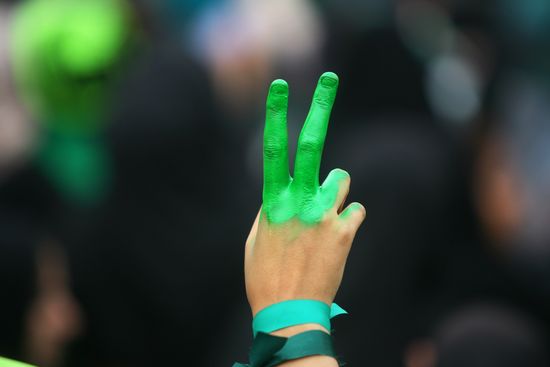
IranFingers

by Patrick Appel

Reza Aslan wonders whether events in Egypt will reignite Iran's reform movement:

Iran is facing many of the same economic woes that plunged Tunisia, Algeria, and Egypt into revolt. As outlined by the Asia Times, Iran's rate of economic growth is close to zero, compared to three percent for Tunisia and 4.6 percent in Egypt. The official unemployment rate in Iran is reported at about 15 percent of the working-age population, and while that is roughly similar to the unemployment figures in Tunisia, most independent estimates place Iran's unemployed at closer to 30 percent. While Egypt's rate of inflation stands at an astonishing 12 percent, that is approximately half of Iran's inflation rate, which economists estimate to be close to 24 percent. According to the United Nations, some 20 to 30 percent of Egypt's population lives below the poverty line (the number in Tunisia is about eight percent). Compare that to the approximately 25 percent in Iran. 

(Photo: By Majid/Getty Images)

There’s A War On In Afghanistan

by Conor Friedersdorf

And it's heating up:

In the first 29 days of January 2011, NATO planes fired their guns, missiles, and bombs on 284 separate sorties. In January 2010, those aircraft only made 157 attack runs. This doubling of air attacks has been a consistent trend, ever since Petraeus took over the Afghan war effort. Under Petraeus, there have been 3,620 of these so-called “weapons sorties” over the last six months, U.S. military statistics show. Under his predecessor, Gen. Stanley McChrystal, there were just 1,813 during a similar stretch.

Petraeus hasn’t just ramped up the air war, however. He’s increased the aggressive tactics across the entire Afghan war effort. Petraeus unleashed special operations forces, who have killed or captured thousands of militants. His generals relied on massive surface-to-surface missiles to clear the Taliban out of Kandahar, and ordered tanks to help crush opponents in Helmand province. In perhaps the signature moment of Petraeus’ campaign, U.S. forces flattened three villages in the Arghandab River Valley which the Taliban had jury-rigged with homemade bombs.

The US and The Taliban are both expected to launch major offensives this spring.


Imaginary Reaganism

by Patrick Appel

Massie calls it out:

For a long while and certainly at the time he was in office Reagan was an under-rated President; today he's in danger of being over-rated. The problem with the Cult of Reagan is not Reagan, but the impact membership has on the believers. He was more flexible than his admirers today sometimes acknowledge. Few of today's Republicans would, one supposes, endorse Reagan's tax-raising 1982 budget. Nor, one suspects, would today's nationalists approve of his decision to talk to the Soviets (indeed, at the time there were some who whispered that Reagan was "soft on Communism".) Nor, for that matter, could a Republican with national aspirations today endorse Reagan's liberal approach to immigration issues.

Indeed, it's not clear a less gifted communicator armed with Reagan's actual beliefs could really win the Republican Presidential nomination today.