What Does It Mean To Be Pwned?

by Conor Friedersdorf

Urban Dictionary's definition: "…to be dominated by an opponent." It's something we've all witnessed, whether in schoolyard fights or poker hands decided by a masterful bluff or a sick crossover on the basketball court. In the blogosphere, the most juvenile writers think they've pwned you if they mock your name (I'm looking at you, Mark Levin). Others imagine that rhetorical excess is the way to impressive victory.

These people are either incapable of articulating a devastating argument, or don't even understand what one is. Perhaps it's understandable. One doesn't see them very often. But shouldn't Urban Dictonary hyperlink as an example of pwning this post by Will Wilkinson? My goodness. Remind me never to cross him.

Torturers: Failing Upwards

Agabuse
by Patrick Appel

The AP reports that "officers who committed serious mistakes that left people wrongly imprisoned or even dead have received only minor admonishments or no punishment at all." Marcy Wheeler is all over it:

There’s Matt, who froze Gul Rahman to death in the Salt Pit. Paul, his boss and the CIA Station Chief of Afghanistan, who ignored Matt’s requests for more help at the prison. There’s Albert, who staged a mock execution of Rahim al-Nashiri, and his boss, Ron, the Station Chief in Poland, who witnessed the forbidden technique and did nothing to stop it. There’s Frances, the analyst who was certain that Khaled el-Masri had to be the terrorist with a similar name, and Elizabeth, the lawyer who approved Frances’ decision to have el-Masri rendered and tortured. There’s Steve, the CIA guy who interrogated Manadel al-Jamadi and, some say, effectively crucified him. There’s Gerry Meyer, the Baghdad station chief, and his deputy, Gordon, who permitted the ghost detainee system in Iraq. And of course, there’s Jennifer Matthews, the Khost station chief who ignored warnings about Humam Khalil Abu-Mulal al-Balawi that might have prevented his attack (and her own death).

These are the CIA officers responsible for the Agency’s biggest known fuck-ups and crimes since 9/11.

The AP has a story tracking what happened to those officers. And it finds that few were held accountable, particularly not senior officers, and even those who were reprimanded have continued to prosper in the agency.

Adam Serwer's warning:

Between the political obstacles to criminal prosecutions, and the willingness of the courts to dismiss civil lawsuits whenever the government invokes the "state secrets" privilege, we essentially have a class of people operating in our intelligence services who are not bound by the law in any meaningful sense when it comes to actions they take in the line of duty. They're promoted rather than sanctioned when they act out of line, eliminating even any internal incentive to play by the rules.

Opposing The Patriot Act

by Conor Friedersdorf

The Washington Post reports that some members of Congress are stepping up:

A measure to extend key provisions of the Patriot Act counterterrorism surveillance law through December failed the House Tuesday night, with more than two-dozen Republicans bucking their party to oppose the measure.

Here are the specifics:

The measure would have extended three key provisions of the Patriot Act that are set to expire on Monday, Feb. 28, unless Congress moves to reauthorize them. One of the provisions authorizes the FBI to continue using roving wiretaps on surveillance targets; the second allows the government to access "any tangible items," such as library records, in the course of surveillance; and the third is a "lone wolf" provision of the Intelligence Reform and Terrorist Prevention Act that allows for the surveillance of targets who are not connected to an identified terrorist group.

And good on Dennis Kucinich for his gamesmanship:

"The 112th Congress began with a historic reading of the U.S. Constitution," Kucinich said. "Will anyone subscribe to the First and Fourth Amendments tomorrow when the PATRIOT Act is up for a vote? I am hopeful that members of the Tea Party who came to Congress to defend the Constitution will join me in challenging the reauthorization."

In fact, some Tea Party alligned Republicans did buck their party. And Rand Paul, the one Senate candidate I defended during the last election, has said that he has reservations about the bill. Let's hope he opposes it in the Senate. If so, that is one area where the Tea Party will have done some good. Of course, overall "twenty-six Republicans voted with 122 Democrats to oppose the measure, while 67 Democrats voted with 210 Republicans to back it," so the GOP has a long way to go on protecting civil liberties.

The “End Of Discovery”?

by Patrick Appel

Jonah Lehrer ponders it:

I think it’s also worth contemplating the disturbing possibility that our cresting living standards might ultimately be rooted in the difficulty of making new scientific discoveries.

… In his Scientometrics paper, Arbesman points out that, in a few rare instances, we’ve already reached this “end of discovery” phase. Consider medicine: For thousands of years, humans documented the discovery of new internal organs. But that process of discovery is over – the last new organ to be identified was the parathyroid gland in 1880. While we’re certainly not close to the end of science – so many profound mysteries remain – we should be prepared to work harder for what we learn next. All the low-hanging facts have been found.

All Eyes On Suleiman

AP090422155599(2)

by Chris Bodenner

Stephen J. Smith sums up the recent behavior of the Egyptian vice president, who has stepped to the forefront of the regime since Mubarak announced last week that he won't run for reelection:

Despite his highly publicized meetings with opposition groups, the limited concessions and promises of future liberalization are not promising. Suleiman's torturous ways have apparently not let up, with his dreaded Mukhabarat running makeshift torture chambers across Cairo, according to two New York Times reporters who witnessed one firsthand. When the opposition Wafd Party asked Suleiman if he was considering lifting the decades-old state of emergency, which allows the government to arrest and detain with impugnity, the longtime intelligence chief responded incredulously, "At a time like this?"

The Obama administration last night explicitly called on Suleiman to end the emergency law, perhaps to quell the criticism it received after Clinton's words of support for Suleiman on Saturday. That air of support was reinforced by new revelations from Wikileaks published yesterday showing how the Israeli government has viewed him as the preferred successor to Mubarak. Greenwald turns up the heat on both governments, as well as the NYT's coverage:

Suleiman's repression and brutality — on behalf of both the U.S. and Mubarak — has been well-documented elsewhere (The New Yorker's Jane Mayer was the first to flag it after the Egyptian uprising, while ABC News recounted how he once offered to chop off the arm of a Terrorist suspect to please the CIA … [Tuesday]'s Times article does a decent job of conveying how unwilling Suleiman is to bring about anything resembling a real transition to democracy, how indifferent (if not supportive) the Obama administration seems to be about that unwillingness, and how dangerously that conduct is fueling anti-American sentiment among the protesters.  But the fact that American policy has "changed" from imposing Mubarak on that country to imposing someone with Suleiman's vile history and character belongs at the forefront of every discussion, especially ones purporting to examine who he is.

Marc Lynch has more hope for the administration. Meanwhile, Suleiman's patience with the protesters is wearing thin.

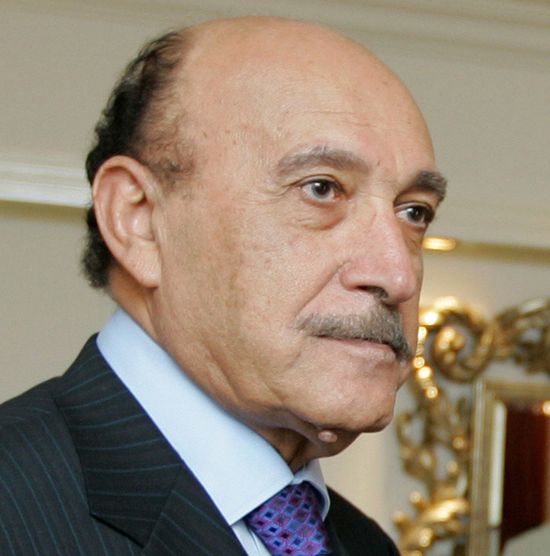
(Photo: In April 22, 2009, Egypt's intelligence chief Omar Suleiman is in Jerusalem for a first high-level meeting between an Egyptian official and Israel's new hard-line government. By Tara Todras-Whitehill/AP)

A Woman’s Self-Promotion Is A Man’s Networking?

by Zoe Pollock

Irin Carmon raises the prospect after reading a couple not-so-positive profiles on "self-promoting" women (including Arianna Huffington):

As cringe-inducing as the phrase "personal brand" is and should be, it's undeniable that it has played a major part in all of these women's successes.

Is it possible to be successful without making yourself generally insufferable, or maybe loathed by a few? Well, supporting your peers and mentoring the next generation, including other women, helps, as does having something tangible to contribute to the world beyond yourself. But even when you've been widely acknowledged as doing those things, as say, Jessica Valenti has, success will always bring someone accusing you of being in it for yourself, as seen in this piece of unvarnished, unearned nastiness. ("She is like every other professional feminist, dedicated to promoting herself.") It's a shame that rising through mainstream channels or getting paid are things that induce knee-jerk sniping from other women, notwithstanding actual substantive criticism.

Talking To The Wrong People

by Chris Bodenner

Samer Shehata runs through the various opposition party representatives who sat down with Suleiman for a "national dialogue":

After the immense upheaval that Egypt has undergone in the past two weeks, it was striking to see that the meeting was still composed of the same old faces, trying to cut a deal as if the protesters in Tahrir Square hardly existed. … One cannot help but conclude that the "national dialogue" is little more than a regime tactic to co-opt the more moderate opposition parties, while leaving the youth protesters out in the cold.

But the presence of Muslim Brotherhood representatives was notable, Shehata admits, calling it a "monumental sea change from decades of Egyptian government pronouncements about the group and its activities."

The New Face Of Tahrir

AP110208124757

by Chris Bodenner

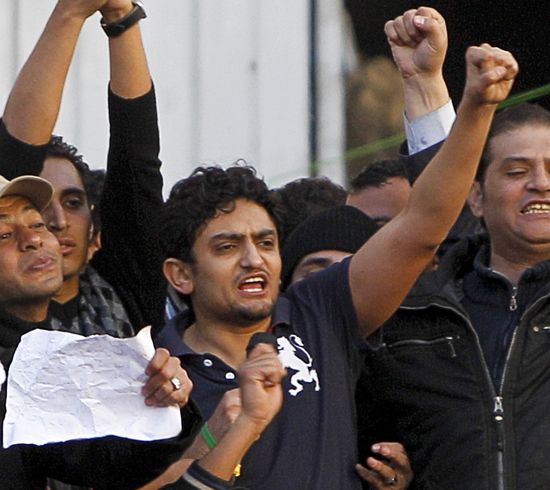
Amira Al Hussaini spotlights Google exec Wael Ghonim, who rallied protesters to near unprecedented levels yesterday:

Ghonim is the formerly anonymous administrator of the We Are All Khaled Said group, which sparked the calls for nation-wide protests to call for change. The group is named after Khaled Said, a young man from Alexandria murdered at the hands of police. His death, last June, caused widespread demonstrations and rage against police torture and the ‘use of Emergency Law to terrorise citizens.'

After his release, Ghomin, gave a candid interview to Egyptian channel Dream TV. Blogger Mohamed El Gohary translates Ghonim's interview here. Ghonim's tears as he mourned the victims killed by Mubarak's regime during the protests, is believed to have rallied even more people towards the cause.

That scene after the jump:

Robert Mackey provides more subtitled clips of that compelling interview. Al Hussaini adds:

Writing at Egyptian Chronicles, Zeinobia says the highlight of [Tuesday]'s protests at Tahrir, was when Ghonim met Khaled Said's mother. Like many others, Zeinobia says that Khaled Said is Egypt's Mohamed Bou Azizi, the young man from Tunisia's Sidi Bouzid, whose self-imolation sparked the Tunisian uprising, which ended with the escape of strongman Zine El Abidine Ben Ali last month.

Amy Davidson highlights the part of Ghonim's interview where he talks about his detention, during which he was threatened with torture:

“Sitting writing on the keyboard”—and sitting in a prison, blindfolded, for twelve days. He also mentions that he had been kept awake for the previous forty-eight hours. If that was meant to expose Ghonim’s rawest aspect, then his interrogators defeated themselves: what has been left most exposed, after twelve days, is a set of clear convictions about what he was doing and why, the meaning of the rule of law, and the gamble of civil disobedience.

(Photo: Egyptian Wael Ghonim, a 30-year-old Google Inc. marketing manager who was a key organizer of the online campaign that sparked the first protest on Jan. 25, talks to the crowd in Tahrir Square, in Cairo, Egypt, Tuesday, Feb. 8, 2011. A young leader of Egypt's anti-government protesters, newly released from detention, joined a massive crowd of hundreds of thousands in Cairo's Tahrir Square for the first time Tuesday, greeted by cheers, whistling and thunderous applause when he declared: "We will not abandon our demand and that is the departure of the regime." By Tara Todras-Whitehill/AP)
The Daily Wrap

Today on the Dish, we took stock of Egypt. Claudio Gallo sounded a despondent note, Robert Springboard listed businesses owned by the army, and Marc Lynch sized up Obama's options. Mark Thompson identified Washington's pickle, Joshua Foust found Yemen a ripe candidate for revolution, protesters relieved themselves in creative ways, and coffee revolutionized the Middle East. We caught up with Southern Sudan, Richard Posner pinned down why autocratic governments fail, and Iran's Green Movement got involved with Egypt.

Patrick zoomed out on Glenn Beck's spat with Bill Kristol, Goldblog parodied, and Conor pushed back against Frum on Bush's torture arrest. We eulogized the Democratic Leadership Council, Conor would have asked Obama tougher questions than O'Reilly, and Hendrik Hertzberg urged Ron Reagan to run. Our collective heads hit the desk for voters who still think Obama is a Muslim, and Conor considered local governments, reenvisioned Social Security, and picked at public employee unions. Britain banned sex for a low IQ, Conor evaluated teachers, and Serwer skewered Pawlenty on repealing repeal. Profits don't apply to libraries, Huff-Po owned the search engine optimization, and more voices in the blogosphere are better. Christopher Guest made funny, non-P.C. commercials, Tony Comstock blogged for Atlantic, and prostitutes loved Blackberrys. Intelligence wasn't only in the eyes, skyscrapers kept housing affordable, and Pippi Longstocking's house, horse, monkey and gold held many political secrets.

Tweet of the day here, quote for the day here, email of the day here, creepy furniture watch here, app of the day here, MHB here, FOTD here, VFYW here, and VFYW contest #36 here.

–Z.P.

As A Revolution Matures

FlagEgyptGetty

by Patrick Appel

David Bell compares Egypt's uprising to famous revolutions throughout history. He argues that "the crucial point to keep in mind, as events in Egypt unfold, is that … the Egyptian Revolution of 2011 may still just be getting started":

 Egypt probably does not face the prospect of an Islamic Revolution in the next few months. But if Mubarak falls and is replaced by a weak, unstable series of governments that cannot restore order or deliver serious social and economic reforms — and thus quickly lose credibility and legitimacy among the population — then a different, far more radical revolutionary movement may yet develop. And despite the current lack of a charismatic leader for such a movement, one could quickly emerge out of the torrent of events. In July 1789, Maximilien Robespierre and Georges Danton were unknown lawyers; Jean-Paul Marat an unknown doctor, known to most of his acquaintances as something of a crackpot. Within four years, they had emerged as leaders of the most radical revolution yet seen in history.

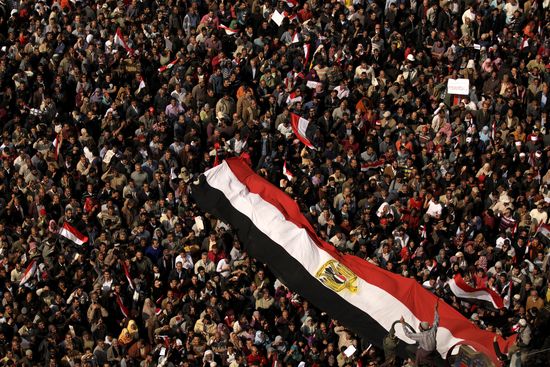
(Photo: Egyptian anti-government protesters hold a huge national flag as they gather at Cairo's Tahrir square on February 8, 2011 on the 15th day of demonstrators against the regime President Hosni Mubarak. By Patrick Baz/AFP/Getty Images)