Keep Your Laws Off Their Suburbs

by Conor Friedersdorf

Matt Yglesias writes:

A few years ago, Virginia Republicans passed a developer friendly bill mandating that each locality designate an “urban development area” in which medium-density construction would be permitted. It doesn’t require that higher density structures actually be built, but it does require that they be permitted. Similarly, it doesn’t require that mixed-use development be built, but it does require that it be permitted. Naturally, a conservative Virginia state legislator has teamed up with a local Tea Party group is looking to overturn this and has founded an outfit called the Campaign for Liberty in defense of stringent development restrictions.

Stephen Smith, who has a good post on this, seems surprised. But there’s really nothing surprising about it. Freedom-talk is an important influence in American rhetoric, but it—and especially its self-consciously antiquarian cousin liberty-talk—has nothing to do with any analytically respectable conception of freedom.

It would be more accurate to say that freedom and liberty talk don't necessarily have anything to do with an analytically respectable conception of freedom, and I certainly think Yglesias is right to call out opposition to more freedom in land use decisions. Nor does the story he flags surprise me. Growing up in Orange County, California, one learns rather quickly that cities dominated by Republicans regularly impose unnecessary restrictions on land use, pass petty laws about the hours one is permitted to walk on the beach, and generally engages in what can only be called a central planning model of economic growth.

The average suburban homeowner is a vocal proponent of property rights until the day when a nearby landowner wants to build an apartment complex on his property. Then the right not to live near renters is treated as sacrosanct.

 

Jane Jacobs, Updated

by Zoe Pollock

Edward Glaeser has a great piece on the future of skyscrapers, in the new Atlantic issue:

Growth, not height restrictions and a fixed building stock, keeps space affordable and ensures that poorer people and less profitable firms can stay and help a thriving city remain successful and diverse. Height restrictions do increase light, and preservation does protect history, but we shouldn’t pretend that these benefits come without a cost.

…The cost of restricting development is that protected areas have become more expensive and more exclusive. In 2000, people who lived in historic districts in Manhattan were on average almost 74 percent wealthier than people who lived outside such areas. Almost three-quarters of the adults living in historic districts had college degrees, as opposed to 54 percent outside them. People living in historic districts were 20 percent more likely to be white. The well-heeled historic-district denizens who persuade the landmarks commission to prohibit taller structures have become the urban equivalent of those restrictive suburbanites who want to mandate five-acre lot sizes to keep out the riffraff. It’s not that poorer people could ever afford 980 Madison Avenue, but restricting new supply anywhere makes it more difficult for the city to accommodate demand, and that pushes up prices everywhere. …

In the post-war boom years between 1955 and 1964, Manhattan issued permits for an average of more than 11,000 new housing units each year. Between 1980 and ’99, when the city’s prices were soaring, Manhattan approved an average of 3,100 new units per year. Fewer new homes meant higher prices; between 1970 and 2000, the median price of a Manhattan housing unit increased by 284 percent in constant dollars.

Alexis has an interactive timeline of skyscrapers.

The Best Nordic Archetype

by Conor Friedersdorf

Here's an interesting frame for the difference between America, Germany, and Sweden: every society has a different relationship to "the triangle formed by reverence for the Family, the State and the Individual." 

Americans favour a Family-Individual axis… suspecting the state as a threat to liberty. Germans revere an axis connecting the family and the state, with a smaller role for individual autonomy. In the Nordic countries… the state and the individual form the dominant alliance.

That's the argument in a paper called "Pippi Longstocking: The Autonomous Child and the Moral Logic of the Swedish Welfare State."

It hails Pippi (the strongest girl in the world and an anarchic individualist who lives without parents in her own house, with only a monkey, horse, a bag of gold and a strong moral compass for company) as a Nordic archetype.

Awesome, right?

And it got Reihan Salam thinking:

The Nordics celebrate the role of the state in setting individuals free from family obligations. Traditional conservatives, in contrast, have seen the discipline of the market as an effective way to deepen and reinforce marital fidelity and intergenerational obligations. In a more affluent society, however, these family bonds almost inevitably fray, and marriages are built on shared consumption preferences rather than the specialization of men in market labor and women in household labor. This helps account for the marked decrease in marriage rates among the poor and near-poor in the U.S., for whom the welfare state and market wages reduce the urgent need for a partner and high incarceration rates reduce the potential supply.

The problem, of course, is that marriage and the pooling of resources that it entails appear to be crucial to upward mobility. One possibility is that the hunger for upward mobility will spark a cultural shift in the direction of increased marriage rates. Another is a turn in a statist, Nordic direction, in which marriage rates never return to the norms that prevailed in the midcentury U.S. and the state steps in with more redistribution.

He outlines a third way too.

One weakness in American political discourse is a tendency to speak of Europe as if every country therein buys into the same model. But that continent clusters a lot of extremely prosperous countries, each with its own policies and cultural canvas. Studying them is useful wherever one falls on the political spectrum. Obviously the American right is very hostile to the Swedish welfare state. On the other hand, "an anarchic individualist who lives without parents in her own house, with only a monkey, horse, a bag of gold and a strong moral compass for company" kinda sounds like a childrens book Ayn Rand might've written.

Faces Of The Day

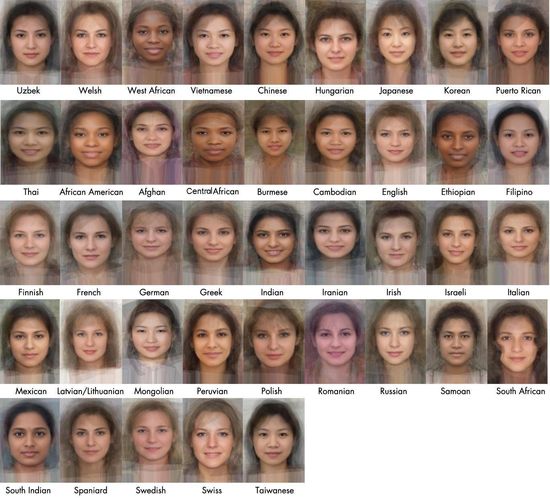
FaceOfDay

by Patrick Appel

 Balko captions:

So this image purports to be a series of composites of the average woman from various countries and ethnicities. I was struck by how attractive they all are. This makes some sense when you think about it from an evolutionary perspective. But I think it’s also a little surprising because it’s not how we typically use the word average.

Paul Bloom's excellent recent book explains this phenomenon in more detail:

[W]hile average faces look good, they don't look terrific – the most attractive faces are not the average ones. (When you do these morphs, you get a fine face, but not one with movie-star good looks.)

Public Sector Unions Are Different

by Conor Friedersdorf

After quoting Franklin Delano Roosevelt's claim that "the process of collective bargaining, as usually understood, cannot be transplanted into the public service," The Economist's Will Wilkinson explains why he was right:

In any productive joint enterprise, there’s a question of how to split the gains from cooperation. Our native sense of fairness tells us that our shares should be roughly proportional to the value of our contributions. But distributive fairness doesn’t automatically prevail. What we actually get—whether we get a fair share or get used—depends on our bargaining power. Individual workers with few options hardly stand a chance against managers backed by massive capital. Workers are most likely to get a cut that reflects the value of their contributions when they band together and bargain collectively…

The thing is, public-sector unions don't work like this. They aren't bargaining against capitalists for a fair cut of the cooperative surplus. They're bargaining against everybody who pays taxes and/or benefits from government spending. 

The question of distribution in democratic politics isn't about splitting up jointly-produced profits. It's about interest groups fighting to grab a bigger share of government revenue while sticking competing groups with the tax bill. Because of the sheer size and relatively uniform interests of the group, public employees constitute a politically powerful bloc with or without unions. As the percentage of the labour force employed by the government rises, the heft of this group only increases.

The limited time I've spent covering public employee unions makes me think that Wilkinson is right when he notes that "a bit of public-employee union busting at the state and municipal level wouldn't leave government workers vulnerable." Beyond civil service protections, they'd enjoy the gains that accrue to people when the narrow interests they care a great deal about are adjudicated by legislative bodies with no corresponding lobby on the other side.

Even if you think that's wrong, it's hard to look at the experience in California without concluding that public employee unions enjoy too much clout under the status quo. And even progressives whose first priority is making government function better ought to recognize that their policy interests don't align with them.

The Administration’s Strategy

by Patrick Appel

Marc Lynch insists that the Obama administration hasn't given up on political reform in Egypt:

Despite the rapid consensus that Suleiman has been designated as America's man in this process, any acceptance of his role is likely by default rather than design.  The administration clearly does not want to allow Suleiman and Mubarak to revert to the status quo ante, or to consolidate a new nakedly military regime. 

Nobody in the administration has any illusions about Suleiman's likely intentions to revert to the old familiar games of the Egyptian national security state:  dividing and co-opting the opposition, selective repression, stoking fears of Islamists, playing for time while evoking a desire for normalcy, offering token reforms which can either be retracted down the road or emptied of meaning, and protecting the core perogoatives of the regime.   The Egyptian military seems to have a winning game plan, and it doesn't include the fundamental reforms for which Egyptian protestors or the Obama administration have called. 

He goes on to list the "ways to communicate that there is real muscle behind the words of 'unacceptable,' before those words fade into easily ignored background noise."

App Of The Day

Confession

by Zoe Pollock

Max Simon reviews Confession: A Roman Catholic, an iPhone app that walks Catholics through the confessional process, now approved by the U.S. Catholic Church:

 It offers a "personalized examination of conscience for each user," the church says, and for $1.99 it offers an express lane for making up for your sins. With password-protected profiles, the app also offers users the option to "choose from seven acts of contrition as well as add sins not listed in the standard examination of conscience." So what button do you press to confess you're a man of the cloth who touched little boys in their no-no places?

The Glenn Beck Method

by Patrick Appel

Goldblog's Beck parody is among the best:

Of course, the conspiracy goes deeper than Beck has yet revealed; I'm hoping that, in coming days, if the Freemasons, working in concert with Hezbollah and the Washington Redskins, don't succeed in suppressing the truth, that Beck will reveal the identities of the most pernicious players in this grotesque campaign to subvert our way of life. I can't reveal too much here, but I think it's fair to say that Beck will be paying a lot of attention in the coming weeks to the dastardly, pro-caliphate work of Joy Behar; the makers of Little Debbie snack cakes; the 1980s hair band Def Leppard; Omar Sharif; and the Automobile Association of America. And remember, you read it here first.

Did Iraq Inspire Egyptians And Tunisians?

by Conor Friedersdorf

Above Mickey Kaus surmises yes, and Bob Wright forcefully insists no. On this one, I agree with Bob, and I've never understood why seeing the United States military invade a country and establish a democracy would inspire revolutions elsewhere. It was never ignorance of democracy's existence that was stopping other Arab populations from rising up – and it isn't as if "get invaded by America" was a viable strategy or a desired thing elsewhere.

Had Iraqis risen up and overthrown Saddaam Hussein, I understand how that might've inspired similar actions elsewhere. But that's not what happened. (Incidentally, Mickey Kaus has been hired by The Daily Caller, where he'll now be blogging, though it doesn't seem like the transfer has happened yet.)

How To Look Smart, Ctd

by Patrick Appel

I've been asking why we associate eyeglasses with intelligence. A reader adds a wrinkle to the debate:

Glad you've highlighted this issue, and I agree with your reader that there is something to the correlation between near-sightedness and IQ, and the review of vision development was quite helpful. However, a second and primary variable s/he does not address, which I believe is fundamental to the illusion of this correlation, namely the very nature of IQ itself.

Similar to the hot controversy surrounding The Bell Curve in the 90s, these questions tend to overlook the way IQ tests are designed. As a neuropsychologist who has administered hundreds of these measures, I can tell you that their structures reflect a deeply embedded bias toward intelligence as a function of reading skills (as well as white middle-class backgrounds), both directly and indirectly.

If I had a dime for every kid I've had in my office who could read a blue streak, but could not make eye contact or could not empathize with others or who could not let go of obsessions or could not grasp simple numbers (while still calculating the syntax of algebra to beat the band), I could retire easily. Conversely, I have had students in my office at a much much lower rate (maybe one per five hundred) who were sharp as tacks, personable and comfortable in their social worlds, inventive and clever, but simply had trouble reading quickly. This profile is not well represented in the general population, but Sally Shawitz (pre-eminent researcher on dyslexia at Yale) has noted anecdotally that those who have such profound trouble learning to read – and translating basic symbols like letters (augmented by interference from the right brain during reading) – are consistently well-adjusted and balanced individuals.

Trust me; though myopia does correlate highly with measured IQ as we refer to it, it decidedly does not correlate with real intelligence. The failure is not in our vision – or lack thereof – but in our measures. There is a slow but steady effort to make changes in the tests, but the key is the pace. Meanwhile, we limp along, dragging these poor kids into increasingly misguided notions of their capabilities and of themselves.