More disturbing than Pawlenty's unworkable proposal for reinstating DADT or defunding repeal is that even in 2012, a Republican primary candidate might feel it necessary offer disdain for gays and lesbians as a selling point. Ultimately, though, it feels a little desperate, a way for a relatively bland candidate to distinguish himself from his more colorful rivals.
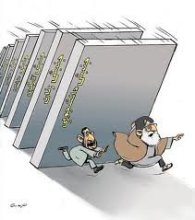
Iran's opposition group is hoping to hold a "peaceful rally" next Monday, February 14, in support of protesters in Egypt. The country's opposition "green" movement would like to "declare support for the popular movements in the region, in particular, the freedom-seeking movements of the people of Egypt and Tunisia," said a letter from Mir Hussein Moussavi and Mehdi Karroubi, two of the rally's organizers and presidential candidates that ran against Mahmoud Ahmadinejad in 2009.
Iran has typically denied permits for public rallies, but Iran's supreme leader Ayatollah Khomeini has vocalized support of protesters in Egypt and Tunisia. The request for the rally has yet to be approved.
The approach by Mir Hossein Mousavi and Mehdi Karroubi for a permit to march on 25 Bahman (14 February), three days after the regime's celebration of the 1979 Revolution, is seeking to "blow fresh breath" into the opposition movement. After months of disappointment and frustration — arguably, going back to this same point last year — the hope is to show that there is still hope. Of course, the big question is whether this surge in discussion is occurring inside Iran as well.
And like Egypt and Tunisia, social media is there to help:
Alex Knapp has some interesting historical notes on federalism in his latest effort to blog Liberty And Tyranny. He also writes this:
I actually don’t think that state and local government reflect their local constituents better. The fact of the matter is, people don’t really care much about local governments except when they’re screwing something up. I guarantee if you stopped 30 random people on the street in a normal sized suburb, they wouldn’t be able to name their mayor, City Councilmen for their district, or their State Representative. I’ll bet they CAN name the mayor of the nearest big city; the name of their governor, and the name of the President.
That last part is true. But local government does reflect prevailing local preferences a lot better than does the federal government. When I lived in Park Slope, I couldn't have told you the name of the people on my community board. But I'll bet a majority of them were in favor of mandatory recycling, as did most of my neighbors.
And I'll hazard that's a lot less common in the City Councils of the Sun Belt's exurbs, even though the people there have no idea who represents them in local government.
If something were to go wrong in that exurb, a concerned citizen could climb into his car, drive to City Hall on a Wednesday night, stand up before a local access television camera, and explain to the mayor and everyone watching the exact nature of the problem. It's no wonder the response is often better than dealing with the feds. Most people underestimate how much change they can effect at the local level.
A group of Iowan Republicans was made to watch the Obama interview Conor analyzed earlier. I laughed at the host's reaction when most the group admitted to believing Obama is a Muslim. The host begins, "now do you understand the implications of what you're saying here," which made me think he was actually going to challenge the group's false belief. But, no, instead he wants them to know "what the media is going to say about this group and about Iowa Caucus voters in the future." Fox News and Sarah Palin have caricatured the rest of the media as liberal and deceitful. Telling these voters, and Fox viewers at home, that the media will attack them for believing an untruth does nothing to dislodge the lie:
National Review's Rich Lowry is surprised that GOP voters think Obama is Muslim. Kevin Drum's head hits the desk:
Both Lowry and Bill Kristol have gone after Glenn Beck for his nutball conspiracy theorizing over the past week about caliphates and the Muslim Brotherhood. That's good news, because someone on the right needs to do this. Now it's time for them to do the same to anyone who helps prolong the maybe-Obama-is-a-Muslim-maybe-he's-not-it's-kinda-hard-to-know meme. Then they can work up to disowning Sarah Palin.
What an interesting feud. Both men are willing to use the ugliest kinds of propagandistic nonsense as a cudgel against ideological adversaries. The ironic result is that in their current contretemps, each is capable of landing devastating blows merely by pointing to indefensible stuff the other has actually said in the past.
Richard Posner speculates as to why autocratic governments fall:
Over a long period of time, democratic and quasi-democratic nations change profoundly, but the change is gradual. Dictatorial regimes change in fits and starts, so that most of the time they seem more stable than nonauthoritarian regimes. They experience punctuated rather than incremental change.
There are several reasons. The obvious one is lack of information. A government that uses intimidation, surveillance, and control of media to quell dissent deprives itself of good information about the population’s concerns. People keep their concerns to themselves out of fear. Grievances are driven underground, to fester. Not having a good handle on what people want, the government risks being blindsided by a sudden explosion of repressed anger. Repression also fosters conspiracy; fearful of expressing themselves publicly, people learn to form secret cabals; they become experts at dissimulation.
Hendrik Hertzberg reviews the HBO documentary on Reagan by Eugene Jarecki, and weighs in on its main interviewee, Ron Reagan, only son of Nancy and Ronald:
He’s now a fit and youthful fifty-two, with no particular career. I wish he’d run for office. I don’t know where he lives, but I suspect it must be someplace where being a liberal Democrat (which he is) isn’t a big liability. Ron has a lot of his late father’s easygoing, nonhostile likeability, without the vagueness and the offputting (to me, though I know many found it charming) heh-heh inanity. Ron has often been quoted as saying he could never be elected to anything because he’s an atheist. To which I say: come to Manhattan.
… Frank Mankiewicz once told me (I hope I’m remembering this right) that back around 1948 or 1950, he (Frank) and his fellow members of the Beverly Hills Democratic Committee considered drafting Ronald Reagan as their local congressional candidate. They decided against the idea because they thought Reagan was too liberal to win. How different history might have turned out if they had not made that monumental blunder. Reagan probably would still have become President, but he’d have been “our” President, if you get my drift. We’d probably have gotten single-payer!
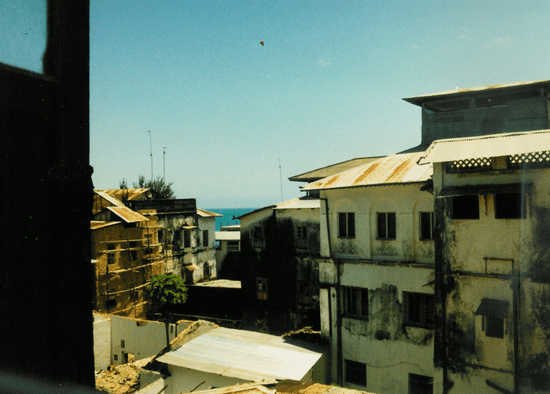
Wow – no landmarks to speak of here! All we have is the ratty architecture, the rusty metal roofs, and the turquoise ocean a couple of blocks away. Even the one tree is rather nondescript. So it’s wild guess time again. I’m going to go with my first hunch – Belize City, Belize.
Another writes:
This is somewhere in the Barrio de Santa Cruz (Santa Cruz neighborhood), Salvador da Bahia, Brazil. Appears to be a Third-World, crowded city (even if it’s in a fast-emerging economic giant), palm tree, black mold on walls, large city on hills above the ocean.
Another:
VASP Airlines in Brazil used to have a flight that stopped in every city along Brazil’s coast (and a few in the interior). You paid for the legs you wanted, it was ridiculously cheap, and the perfect thing for a poverty jet-setter like me. Once I spent a couple days in Sao Luis, Maranhao, in 2004. I was drunk the whole time, I think, so my memory isn’t so good for exactly where this was. But this really looks like the historical district of Sao Luis.
Another:
I lived in Chile for two years. The roofs look like Chiloe or other old cities, but the other building materials don’t quite match up. The decaying buildings certainly match Valparaiso, where termites devour the old wooden homes, but it could also be damage from the recent earthquake. I could say Concepcion, but that would be too obvious, and given the obvious age I am going to guess Valdivia, Chile.
Another:
Sanya, China? This is a wild guess but I was just there last week. There’s a ton of construction going on there right now and that looks like bamboo scaffolding in the photo. The air looks a bit too clean for China though, so I’m probably off!
Another:
Port-au-Prince, Haiti, mostly because the scaffolding and roofless houses bring to mind the earthquake of January 2010. The seaside location would fit, and so would the mouldy façades sugesting a humid tropical climate.
Another:
The red object in the sky is interesting. At first glance, I thought it might be someone parasailing, but upon closer inspection, I think the object is tethered to one of the tall antennas. Maybe a weather balloon? If so, perhaps the picture is taken from near one of the Universities in the Haitian capital, where they do research on weather patterns … Universite d’etat d’Haiti?
Another:
I have never participated in VFYW, although I track it somewhat compulsively every week. I don’t have the time to obsess over Google Maps to find exactly the right window, so I live vicariously through those who do! But I’ll throw out Havana, Cuba. The once-lovely buildings now in decay to the point of collapse reminds me very much of photographs forwarded, with great sadness, by Cuban friends.
Another:
Krasnovodsk, Turkmenistan? It looks like a scene from the film “White Sand of the Desert,” so I’ll go with the Turkmen version of Cabo. The water in the background is the Caspian Sea.
Another:
You guys are getting really good with these hard-to-figure-out photos. I have no clue to be honest. But the image reminds me of two movies: “Lord of War” and “Casino Royale”. In the latter, there’s a scene where Bond is chasing an international bomb-maker in Madagascar:
In Lord Of War, Nick Cage is meeting with a Charles Taylor-type thug in a city that looks like some place in Liberia. So I am leaning heavy towards a place in or around Africa.
Im going to take a guess at either Monrovia, Liberia or Freetown, Sierra Leone. Im not even going to attempt to look it up on Bing Maps or Google Earth. I doubt either website is spending much resources mapping the streets of either country.
Another:
I don’t think Google Street view will be unavailable for this kind of place. The sea is blue enough to be Carribean quality but the style of the buildings is decidedly non-Latino (and anyway, that would be a repeat of last week). I’m picking the Gaza Strip because of the poverty-striken air of the place, a place of constant destruction and an imposed severe shortage of building materials. I’m picking Rafah because it is the only Gaza Strip town I can think of without looking up and also because I recently took a Google Maps arial tour while familiarizing myself with the geography of Egypt, which has been in my thoughts for obvious reasons.
I have no striking or moving anecdote, having never visited Gaza. The Palestinians I encountered in Jerusalem were almost universally kind and gentle towards me when I visited, with an openness I found amazing given that they had every right to be mistrustful.
I have previously gotten Dili, Sarajevo and Madrid right (I found the right window in the case of Madrid), so I’m hoping that eventually I’ll have enough cities to make up for the lack of moving stories!
Another:
That must be Zanzibar, Tanzania. The metal roofs, the algae-stained walls, the small glimpses of the Indian Ocean and the Pemba Channel, the TV aerials – classic Zanzibar. Kudos to anyone that can figure where exactly it is, in that tangled mess of a stonetown. This is a place that I visit often, as an archaeologist of the ancient Swahili, the ancestors of the people that built these towns.
Correct city, but several readers were more specific. One writes:
The mouldy stucco, the rusting sheet metal roofs, the rickety awnings over the windows, the high belevedere to the left that would sit atop an interior building courtyard, the glimpse of the bright sea all speak of Zanzibar and Stone Town. My guess was confirmed with a quick search that brought up the view at Fotolia. Several years ago we spent a magical week over Xmas on Zanzibar in a small beach house of the Indian Ocean side.
One reader – and this week’s winner – was just a tad more detailed:
My boyfriend and I are still competing every month to see who guesses each VFYW closest to the actual location. I was on a roll for a few weeks, but since then he’s won two months in a row! It’s been just about as long since I’ve submitted my guess to the blog, so I’m hoping this is the lucky charm I need to come out on top this month ;)
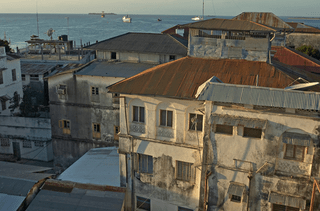
One of the things I love about VFYW is that you discover so much about the world and even find new places to add to your list of must-visit destinations. This week’s was no exception. Something about the scenery and buldings made me think this was in the Middle East or Turkey. Luckily, I stumbled upon a photo of Stone Town, Zanzibar, and knew I had a great lead. It took a bit of searching, even after I found this photo (available on dozens of stock photo sites, but without a clearly identified location in Zanzibar). A search for “balcony views in Stone Town” led me to the Shangani Hotel and this view, which I’m guessing is just around the corner from this week’s contest photo.
In an excellent post on teacher evaluation, Jim Manzi brings his characterisitic analytic clarity. Since he writes from the perspective of someone outside the realm of partisan debate his arguments are unlike anything you've likely seen – do read the whole post. I'm going to excerpt one part that interests me:
The goal of an employee evaluation system is to help the organization achieve an outcome. For purposes of discussion, let’s assume the goal of a particular school to be “produce well-educated, well-adjusted graduates.” The question to be asked about this school’s evaluation system is not “Is it fair to the teachers?” It is not even “Does it measure real educational advancement?” Ultimately, all we should care about is whether or not the school produces more well-educated, well-adjusted graduates with this evaluation system than if it used the next-best alternative. In this way, it is like a new training program, investment in better physical facilities, or anything else that might consume money or time.
The fairness or accuracy of the measurement versus some abstract standard is the means; changing human behavior in a way that increases overall organizational performance is the end. To put a fine point on it, if a teacher evaluation that is based on a formula that considers only blood type, whether it is raining on the day of the evaluation and the last digit of the teacher’s phone number is the one does the best job producing better educated and adjusted graduates, then that’s the best evaluation system.
That seems exactly right to me. And it helps explain the inherent tension between teachers unions and the rest of us. Unions exist to protect the interests of their members. Even in the best case scenario, that means lobbying for an evaluation system that maximizes fairness to the people being evaluated. As citizens, our primary goal should be creating the best education system possible, even if doing so sometimes means (for example) that the teacher most desserving of a bonus doesn't get one. Saying that there is a conflict between the common good and the ends of teachers unions isn't a condemnation of the latter. It's just a fact. And everyone seems to understand the basic concept if you talk about prison guard unions.
Noah Millman has a post reacting to Manzi, and it too is worth reading.
Evaluations establish the principle that there is such a thing as performance in the first place. A great deal of discussion nowadays in education revolves around the idea that what we need to “fix the schools” is great teachers. But if that’s what we need, we’ll never do it. What we need, instead, are mechanisms for getting marginally better performance, year after year, from a teaching pool that remains merely adequate.
One bit of low-hanging fruit for achieving that goal, meanwhile, is the ability to dismiss the bottom 5% of teachers in terms of performance. Not only are these teachers failing comprehensively in their own classrooms, but their mere presence has a corrosive effect on an entire organization – on the teachers, on the students, on the management of the school. But right now, firing these teachers is essentially impossible. For all the difficulty of doing a rigorous evaluation in order to improve teaching performance across the board, I suspect it is a whole lot easier to identify the worst teachers in the school. If that could be done, the pressure to be able to terminate them would be significant, and that could do a lot to improve school performance right there.
I think most people are able to pick out the very best and very worst teachers in any school they observe closely. More here.
Yesterday I wrote that the Egyptian "military profits handsomely from the current power structure." Planet Money reports that one "reason for the military's peaceful response" is because "the military owns virtually every industry in the country." Egypt expert Robert Springboard lists some of the businesses run by the armed forces:
…car assembly, we're talking of clothing, we're talking of construction of roads, highways, bridges. We're talking of pots and pans, we're talking of kitchen appliances. You know, if you buy an appliance there's a good chance that it's manufactured by the military. If you … don't have natural gas piped into your house and you have to have a gas bottle, the gas bottle will have been manufactured by the military. Some of the foodstuffs that you will be eating will have been grown and/or processed by the military.
 in support of protesters in Egypt. The country's opposition "green" movement would like to "declare support for the popular movements in the region, in particular, the freedom-seeking movements of the people of Egypt and Tunisia," said a letter from Mir Hussein Moussavi and Mehdi Karroubi, two of the rally's organizers and presidential candidates that ran against Mahmoud Ahmadinejad in 2009.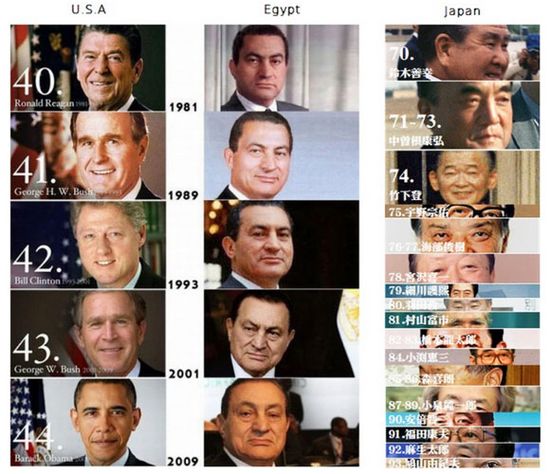
 The Dish