Sudan Splits

108883648

by Chris Bodenner

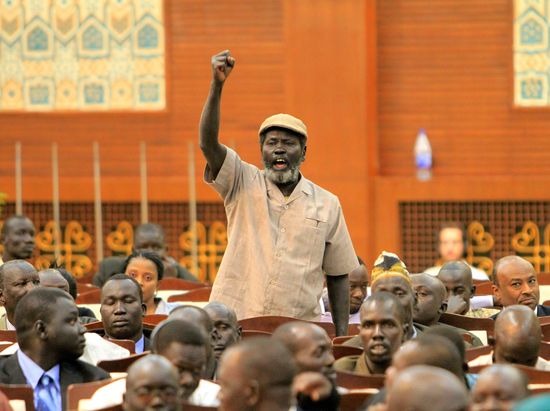
According to official results released yesterday, nearly 99% of voters in Southern Sudan opted for secession last month. Elizabeth Dickinson reads the reaction of President Omar Hassan al-Bashir:

Why all the conciliatory talk? After all, this is the same Bashir who many analysts feared would cancel the referendum — or reject its results — pushing the country back to the brink of civil war. What gives? 

In short, all the carrots that U.S. diplomats are offering the Sudanese president seem to be working.

Among the prizes for Khartoum are a U.S. promise to remove Sudan from its list of terrorism-supporting states and a possible visit by U.S. Secretary of State Hillary Clinton, according to the Sudan Tribune. Earlier this month, U.S. State Department officials also signaled that they would be ready to begin normalization following Sudan's acceptance of the vote.

That's great news for the south; as FP contributor Maggie Fick recently explained, normalization with Washington holds great appeal for Bashir — in fact, it's a big part of his international agenda. So he's likely to yield to U.S. pressure if it pays off. Bashir's speech [Monday] gets Southern Sudan over one big hurdle toward declaring independence, which it is expected to formally do this July.

But Yglesias sees dark clouds in the distance:

The punchline here, sadly, is that normalization is a carrot that can really only be deployed once and so if we use it on behalf of Southern Sudan, our leverage over Darfur runs very thin.

(Photo: A Sudanese man stands and shouts with joy as Sudan's governing body declares the final results of the southern Sudan's independence referendum in Khartoum on February 7, 2011. Southerners voted overwhelming in favour of secession, with nearly 99% of the vote, against a backdrop of acclaim for the process from international monitoring and observing bodies. By Ashraf Shazly/AFP/Getty Images)
Face Of The Day, Ctd

by Chris Bodenner

Nothing gets past the Dish reader:

In your post about the bread helmet, you wrote, "A moment of levity amid the violence". You don't explicitly say so, but it seemed implied that this photo is from Egypt. The flag in the background actually belongs to Yemen (although the flags are nearly identical). That picture was taken at an anti-government rally in Sanaa, Yemen on Thursday. I actually learned that because another blog I frequent, BagNewsNotes, which analyzes political photography, also featured the photo. I found it interesting that the same photo warranted an in depth (and perhaps overly serious) review on one blog I love and a humorous roundup on another. The internet never gets old.

Anyway, as far as actual levity, I came across another piece of headgear while writing this email and thought it would make Andrew feel much better. Keep up the great work!

Likewise.

Dancing Like Demons

by Zoe Pollock

Elissa Lerner reviews a new history book, "Coffee Talk," by Morton Satin, which traces coffee's roots in the Middle East and beyond:

In addition to spates of resistance by Muslim clerics, coffee also met with resistance from the Church, which denounced the beverage as a devil's drink and attempted numerous prohibitions. Eventually however, in a hip move (perhaps presaging Pope Benedict's blessing of Facebook?) Pope Clement VIII sanctified coffee, saying, "We will not let coffee remain the property of Satan. As Christians, our power is greater than Satan's, so we shall make coffee our own." And to complete the Abrahamic trifecta, once coffee was no longer excoriated by the Church, it was a Lebanese Jew who brought coffee to England. He opened the first coffeehouse in Oxford, thus inaugurating the storied relationship between university students and coffee.

Evolving Towards Democracy

by Patrick Appel

Joshua Foust feels Yemen is a better candidate for political reform than its neighbors:

[T]he protesters in Yemen are not demanding revolutionary change. Unlike those in Tunisia and Egypt, the Yemenis, based on their more modest demands and more orderly protests, seem to want some reforms and a peaceful, eventual transition of power–something the country's government seems willing to accept

“Surprisingly, Protesters Have Lost”

by Chris Bodenner

Returning from Tahrir Square, Claudio Gallo sounds a despondent note:

Tahrir Square now appears as a popular fair: songs, dances, slogans, and "Everybody Needs Somebody to Love". People rise to prominence for their fiery wit, but their beautiful and interesting words, avoid any practical solution. …

Boys returning home from Tahrir Square have disappeared, taken by officers of the Mukhabarat, the Egyptian intelligence service. The same intelligence service that was controlled by Omar Suleiman, now the Vice President who is leading so-called transition from the Mubarak regime. The dream of a democratisation of Egypt, the dream of this spontaneous insurgency is being shelved by a regime that knows how to change to remain the same.

(Video from last night via AJE)

The Glenn Beck Divide? Ctd

by Patrick Appel

Bill Kristol sensibly wrote that when Glenn Beck  "lists (invents?) the connections between caliphate-promoters and the American left, he brings to mind no one so much as Robert Welch and the John Birch Society."  This – surprise! - sent Beck into a rage. Steve Benen zooms out:

In the case of U.S. policy towards Egypt, the dynamic is well beyond left vs. right. Instead we're seeing (a) those in the U.S. who support the protesters, their calls for sweeping democratic reforms, and Mubarak's ouster; (b) those who support Mubarak and fear his unknown replacement; and (c) those who believe caliphates run by zombie Islamists, the Illuminati, and the Loch Ness Monster are coming to steal your car.

Earlier commentary on the Republican split over Egypt here.

The Daily Wrap

Today on the Dish, the uprising slowed, Chris summed up today's atmosphere and political developments, and Patrick picked apart the manufactured safety of the Egyptian army. The Muslim Brotherhood promised not to field a candidate in Egypt, and Reuel Marc Gerecht didn't find them a grave threat. We assessed the mystery of assasination attempt of Suleiman, Scott Lucas parsed the opposition talks and feared Tahrir as a tourist trap, and Palin weighed in with some gibberish. Salwa Ismail translated Egypt's class war, revolution rippled in Bahrain, Ammar Abdulhamid didn't foresee an uprising in Syria, and Parmy Olson calculated Egypt's bill for shutting down the Internet. Beinart advised Israel to get used to Arab democracies, Frum urged America to resume its food aid to Egypt, and protesters laughed off the Kentucky Fried Chicken scandal. Sheila Carapico captured what television couldn't, Limbaugh mocked roughed-up NYT reporters, and the US could have restored internet service in Egypt.

Palin tried to trademark her name, AOL acquired the Huffington Post, and Julian Sanchez didn't appreciate balancing metaphors. Conor remembered Reagan at 100, explained why bloggers avoid Israel, and joined Joyner in ragging on the right's dependence on Rush. Glenn Greenwald reminded us of the travesty of Guantanamo, James Gibney analyzed militarized nation-building, Jeb Bush might run, and judges favor lawyers and a more complex legal system. Plundering the lottery isn't as lucrative as consulting, grain production mattered, and Andrew took a couple more days to get better. L.A. supported long-form writing, Bristol planned to pen a memoir, and marriage is a science of its own. Nick Denton reads his news on Facebook, Scientology still creeped us out, and a Dish reader explored the science of looking smart.

Cannabis Closet: Family Feud edition here, Superbowl's best commercials here, single-serving blog of the day here, headline for the day here, VFYW here, MHB here, and FOTD here.

–Z.P.

Pirate Radio: The Cyber Edition

108793085

by Zoe Pollock

Spencer Ackerman reports on how the US could have deployed mobile connectivity in Egypt:

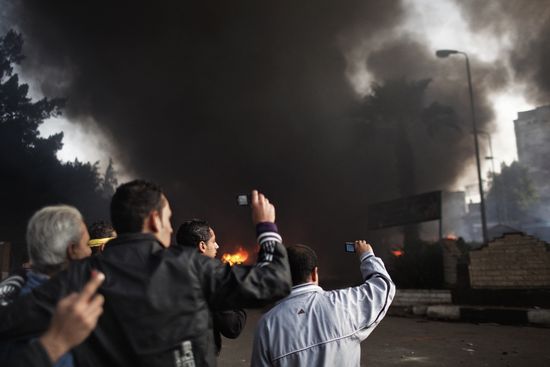
When Hosni Mubarak shut down Egypt’s internet and cellphone communications, it seemed that all U.S. officials could do was ask him politely to change his mind. But the American military does have a second set of options, if it ever wants to force connectivity on a country against its ruler’s wishes.

There’s just one wrinkle. “It could be considered an act of war,” says John Arquilla, a leading military futurist.

The U.S. military has no shortage of devices — many of them classified — that could restore connectivity to a restive populace cut off from the outside world by its rulers.

(Photo: Egyptians take pictures with their cellphones of a burning police station set ablaze by rioters near the Sultan Hassan al-Rifai mosque in central Cairo on January 28, 2011. By Marco Longari/AFP/Getty Images.)

Matrimonial Loss Aversion

by Patrick Appel

Paula Szuchman's applies economic theories to marriage:

The concept that’s had the most profound impact is loss aversion. Behavioral economists have shown that we hate to lose twice as much as we love to win, and when we sense we’re losing, we get irrational. Loss aversion has been partly blamed for Lehman Brothers’ failure to admit its losses early enough to save the company.

I’m vehemently averse to losing. But now I try to be aware of when I cross into loss-aversion mode during disagreements. Then I call a time-out.

And this interview with behavioral economist Colin Camerer is worth a read. The interviewer asks if there is any free riding in his household. The answer:

No. Here’s why: I am one of the world’s leading experts on psychology, the brain and strategic game theory. But my wife is a woman. So it’s a tie.