School Building: A Part Of War Fighting

by Zoe Pollock

James Gibney reviews Armed Humanitarians, by Nathan Hodge and the future of foreign aid funneled through the military:

The enduring legacy of our experiences in Iraq and Afghanistan may well be better, but not more, armed humanitarianism, as when the Pentagon swiftly mobilized aid after Haiti’s earthquake last year and then withdrew once the immediate crisis eased, leaving the Haitians to make their own choices. As Hodge takes pains to show, in nation-building, less is often more.

The Power Of Bread

by Patrick Appel

Frum wants America to resume food aid to Egypt:

The outcome of the power struggle in Egypt remains uncertain. But the outcome of the economic struggle is easy to foresee: whoever emerges with power – including Mubarak himself should he survive – will want to resume food subsidies to allay public discontent. Yet Egypt’s economy will be in even worse shape post-protests than before.  No democracy in Egypt can survive without an early improvement in the bread situation. So how to pay? International help seems the obvious answer. Yes, reform will be needed in time. Bread is needed now. Which leads back to the first question for those Americans who urge democracy upon a food-short Egypt: How much would you be willing to see America contribute?

It’s no good wishing for a new form of government if you then deny that government the means of survival.

Laughing Off The Propaganda

by Chris Bodenner

Robert Mackey notes an amusing trend in Tahrir Square:

As Mosa'ab Elshamy, an Egyptian blogger and activist in the square, explained on Friday, perhaps the most bizarre allegation is that the protesters are only staying for free fried chicken. "Pro-mubarak media said we're only staying at Tahrir because foreign powers are giving us KFC meals," he reported on Twitter. Mona Eltahawy, an Egyptian journalist posted a link on her @monaeltahawy Twitter feed to this satirical video – uploaded to YouTube over the weekend with English subtitles – in which protesters eating in the square pretend that their food is all supplied by KFC (and that foreign powers pay them 100 euros a day).

The Politics Of Anger

by Patrick Appel

As the Arab world democratizes, Beinart advises Israel to adapt: 

For a long time, countries like Turkey and Egypt were ruled by men more interested in pleasing the United States than their own people, and as a result, they shielded Israel from their people’s anger. Now more of that anger will find its way into the corridors of power. The Israeli and American Jewish right will see this as further evidence that all the world hates Jews, and that Israel has no choice but to turn further in on itself. But that would be a terrible mistake.

More than ever in the months and years to come, Israelis and American Jews must distinguish hatred of Israel’s policies from hatred of Israel’s very existence. The Turkish government, after all, has maintained diplomatic ties with Israel even as it excoriates Israel’s policies in Gaza. ElBaradei this week reaffirmed Egypt’s peace treaty with Israel even as he negotiates the formation of a government that could well challenge Israel’s policy in Gaza.

Instead of trying to prop up a dying autocratic order, what Israel desperately needs is to begin competing for Middle Eastern public opinion, something American power and Arab tyranny have kept it from having to do. 

The Right To Disparage My Political Views

by Conor Friedersdorf

I'm surprised to see that Claremont McKenna College has run afoul of FIRE, the non-profit that advocates for free speech on American campuses.

Claremont McKenna's (CMC's) policy on "Acceptable E-Mail Usage" provides that "[t]he College's system must not be used to create or transmit material that is derogatory, defamatory, obscene or offensive. Such material includes, but is not limited to, slurs, epithets or anything that might be construed as harassment or disparagement based on race, color, national origin, sex, sexual orientation, age, disability, or religious or political beliefs." 

This policy is truly breathtaking in its reach. You can be punished for any e-mail that might be construed as disparaging on the basis of religious or political beliefs? Or any e-mail that is found derogatory or offensive by some unspecified standard? Given that e-mail is a widely used mode of communication among college students and faculty, this policy prohibits a large amount of core political and religious expressionthe kind of expression that lies at the heart of the First Amendment and that is crucial to the open debate that should characterize a prestigious college like CMC.

When I attended Pomona College, which is right next door, I edited newspapers that appeared on both campuses, and received e-mail disparaging my political views on a weekly basis! Thank goodness none of my interlocutors were punished back then.

Will Los Angeles Support Long Form?

by Conor Friedersdorf

After an extremely successful debut, the new Los Angeles literary quarterly, Slake – previously mentioned here – has made it to issue number two. A brief excerpt from a piece about the city's Little Tokyo:

The trapezoid of land still stands in 2011, but it is of course filled with development, condominiums, and fabricated lofts spread like STDs—ugly but real and unavoidable—and a new public railway line. I do not know if the area has a name, if it had a name before the transition, but a decade ago I called it the Golden Trapezoid.

Roaming bums and eccentric, acid-damaged fine artists exchanged nods and plotted their murders quietly among the vacant lots, the few warehouses and factories either abandoned or clandestinely in use, and the shrugging, graffiti-soaked, out-of- service rail depots. Anyone could live or die in the Golden Trap. Red stains and no questions asked. Where packs of wild dogs dragged the rotting, skinned heads of pig and steer carcasses from back-alley cut shops as far away as the Grand Central Market and Chinatown for a safe haven to gnaw, and where, too, other wolves of esoteric passion found safe haven to shoot up in broad daylight.

I lived in a warehouse at the corner of Vignes and First, and down in my hollow you could still buy the company of a Mexican T-girl at Little Pedro’s, one of the only businesses in the GT, for $40. The Little Pedro’s building still stands, but its guts have long since departed. I am mentioning all of this because if I stepped out—I took what little food I ate and much of my grog in Little Tokyo—all the decrepit solitude and fragmented suffering of the Golden Trap went with me, every footstep to pavement, glass to lips, mist to mouth. The dim, explicit, and inescapable hollow bore deep in my sad, beautiful green eyes. I broke hearts with a single glance.

A Tunisian Tsunami? Ctd

by Chris Bodenner

Ammar Abdulhamid doesn't see a surge in Syria:

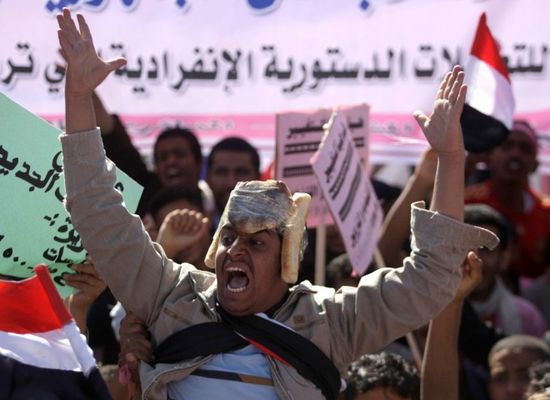
A "day of rage" called for by Syrian opposition members living abroad and scheduled for last Friday and Saturday came and went: the only mass presence detected on the streets of major cities in Syria was that of security forces. …

Syria is definitely not Tunisia or Egypt.

True, the country suffers from the same problems of unemployment, inflation, corruption, nepotism and authoritarian rule, but structurally Syria is defined by additional facts that need to be taken into account.

Fact 1: Syria has a rather heterogeneous population divided along national, religious, sectarian, regional and socioeconomic lines. The ruling regime survives by manipulating mutual suspicions between these groups and their complex history.

Syria's ruling family, the Assads, come from the minority Alawite sect, which makes up less than 10% of the population. The elite striking units within the country's armed forces, especially the Republican Guard, have a membership drawn almost exclusively from the Alawite community. These units are tasked primarily with ensuring the survival of the ruling regime and have no other national agenda to speak of.

But Syrian President Bashar al-Assad did recently promise political reforms, so, if he keeps his word, the Tunisian revolution seems to have had some indirect influence in speeding up progress in Syria. Meanwhile, Naseem Tarawnah checks in on the situation in neighboring Jordan:

[U]nlike Egypt and Tunisia, the protests that took place in Jordan in the past few weeks, most of which have died down now, were not lead by the youth but rather by much older segments. Even in the few protests where I actually saw young people, typically in Amman, they were not playing the starring role we’re seeing youth play out in Egypt or Tunisia. Supporting roles at best, and often times completely absent in towns like Karak or Irbid. While they are part of the educated but unemployed group, it is a whole other generation that is out there making demands. This older crowd finds its origins in various entities, parties, interest groups and unions, most of which the depoliticized youth population generally do not belong to or care to associate with. I’d argue that had the youth genuinely partaken in these recent protests, we would have seen them last a lot longer, and triple in numbers. And so naturally I wonder, with all this in mind: if Tunisia wasn’t enough to do it, will Egypt be the spark for the youth in this country?
Scientology, Fact Checked

by Zoe Pollock

Lawrence Wright has a pretty damning report on Scientology, using Paul Haggis' departure (citing anti-gay sentiment in the Church) as a jumping off point:

But hadn’t certain derogatory references to homosexuality found in some editions of [Scientology founder L. Ron] Hubbard’s books been changed after his death?

[Scientology spokesman Tommy] Davis admitted that that was so, but he maintained that “the current editions are one-hundred-per-cent, absolutely fully verified as being according to what Mr. Hubbard wrote.” Davis said they were checked against Hubbard’s original dictation.

“The extent to which the references to homosexuality have changed are because of mistaken dictation?” I asked.

“No, because of the insertion, I guess, of somebody who was a bigot,” Davis replied.

“Somebody put the material in those—?”

“I can only imagine. . . . It wasn’t Mr. Hubbard,” Davis said, cutting me off.

“Who would’ve done it?”

“I have no idea.”

“Hmm.”

“I don’t think it really matters,” Davis said. “The point is that neither Mr. Hubbard nor the church has any opinion on the subject of anyone’s sexual orientation. . . .”

“Someone inserted words that were not his into literature that was propagated under his name, and that’s been corrected now?” I asked.

“Yeah, I can only assume that’s what happened,” Davis said.

After this exchange, I looked at some recent editions that the church had provided me with. On page 125 of “Dianetics,” a “sexual pervert” is defined as someone engaging in “homosexuality, lesbianism, sexual sadism, etc.” Apparently, the bigot’s handiwork was not fully excised.