The Uprising Slows

MondayEgyptChildGetty

by Patrick Appel

Graeme Wood's latest Cairo dispatch focuses on fissures in the opposition and the state of Tahrir square:

The situation among Egypt's protesters now shifts not by the minute or hour but by the day. With this new metabolism, the protest movement is having to deal with threats more subtle than flying bricks. Dissent and subversion are major preoccupations: There are signs of jitters, even paranoia. Foreigners now have to prove their identity as members of the press, and protesters identifying themselves as members of the movement's "security" team approach in the square to demand a reporter's identity documents. Until recently, this happened only on the outside.

And:

The men at the barricades have not had to repel a serious attack since Thursday night.

Since "Bloody Wednesday" (as the protesters now call it), they have worked out simple systems of communication to tell each other when there's a threat nearby (whistle for more help, bang metal when you think you see something, wave your hands above your head to tell the incoming crowd that the situation is controlled). Alarms went out twice that night — both times when the army turned over the ignition of the tanks near the Egyptian Museum, presumably to inch a little closer to the square and encroach on the protesters' space. Both times, a crowd gathered to sit in front of the tanks. After the second time, a few protesters just decided to spend the night curled in among sprockets and treads of the tank, their bodies interlaced so that even a slight movement would grind up their bodies. At four in the morning, the protesters with their bodies in the tank were snoring. The tanks haven't been turned on since.

Even with the worries, an atmosphere of jubilation and tranquility rules the square.

(Photo: A young Egyptian anti-government demonstrator holds her national flag in Cairo's Tahrir square on February 7, 2011 on the 14th day of protests calling for the ouster of President Hosni Mubarak. By Mohammed Abed/AFP/Getty Images)

A Lack Of Confidence

by Conor Friedersdorf

James Joyner is exactly right:

I’ve long since tired of the notion that the only possible motivation that conservatives could possibly have for calling out the lunatic fringe within their movement is a desire to be loved by liberals and get invited to their cocktail parties. Going back at least to William F. Buckley, Jr.’s famous article casting the John Birch Society out of the legitimate conservative moment, it has been understood that letting the fringe define the cause hurts it. Buckley correctly reasoned that Birch founder Robert Welch’s crazy and outrageous conspiracy theories were tainting the legitimate anti-Communist movement.

Similarly, the psychotic rantings of Glenn Beck invite ridicule on the rest of us. Legitimate points are inevitably countered by comparisons with absurd variants by Beck, Coulter, Limbaugh, and others who make a living stoking the fears of the base. This is, at best, a distraction from the debate and, often, makes intelligent discussion of the issues next to impossible because they’ve been preemptively framed by the loudest, most shrill, most hyperbolic voices.

Robert Stacy McCain responds:

If we had listened to that argument in 2009, there never would have been a Tea Party movement. Republicans would have rolled over and played dead and gone along with the whole Obama/Pelosi/Reid agenda because it was not respectable to oppose Keynesian “stimulus” spending, cap-and-trade, nationalized health care, and so forth.

Now that “the loudest, most shrill, most hyperbolic voices” have succeeded in fomenting grassroots opposition, however, we are told that elected representatives must ignore the people who elected them and, instead, must heed those respectable voices who did nothing at all to help encourage the Tea Party movement.

It's sad indeed that conservatives like RSM doubt the ability of the right to compete in American politics without the Limbaughs, Becks, and Levins of the world. The way they talk you'd think conservatism never won a victory prior to the rise of talk radio, and that conservative and libertarian ideas are so weak that Americans will only go along with them if tricked by the most talented propagandists available. Where is their confidence? And what of their discernment? What's actually gone on in the United States since the year 2000? For almost eight years, the Bush Administration managed to keep the support of its base, despite pursuing all manner of idiotic policies. And they did so in large part by relying on sycophantic propagandists. Rush Limbaugh himself admitted to carrying water for Republicans during that era despite thinking they were taking the country in the wrong direction. And many pundits, especially on Fox News, behaved even worse. The way RSM talks, you'd think it was RINOs who were responsible for the idiocy of that administration. Was Tom Delay a RINO? How about Dick Cheney? Denny Hastert? The problem wasn't that DC turned people moderate – it turned them corrupt.

You'd think that experience would've chasten the conservative movement. The perils of a propagandistic echo chamber were aptly demonstrated, even before a weak GOP field gave us the awful McCain/Palin ticket, and the Democrats won a historic election. Some months later they passed the health care bill they'd been wanting for decades – and all this occured in the age of Fox News and Rush Limbaugh! As the conservative movement suffered loss after loss, its entertainers were never better off! Still, their apologists insist that the movement's fate is tied to theirs. And what evidence is offered? A tremendous policy achievement? That is never the metric the apologists site. (They'd have to keep quiet.) All they've got is the Tea Party, its very partial reliance on talk radio, and the fact that it managed to take back the House of Representatives for the GOP… during a midterm election when an incumbent Democrat was seen by many Americans as flailing through the worst economy in a generation.

This alone is enough to persuade Robert Stacy McCain that Limbaughs and Palins and Becks and Levins do more good than harm. He needs to actual policy achievement. Why are those who agree with him being such cheap dates?

Says Joyner:

Nobody’s arguing that the alternative to Beck-style lyin’ and cryin’ is to adopt the Democratic agenda. Rather, the alternative is to present a passionate, reasonable, and honest defense of conservative principles. I just prefer Ronald Reagan to Sarah Palin, George Will to Ann Coulter, and Bill Buckley to Glenn Beck.

One can be respectable and stand for fiscal responsibility and smaller government. Indeed, if one’s goal is to persuade those who don’t already agree, you’re much more likely to do it that way than with screaming loons.

Just so. It even happened once before, in 1979, when Bill Buckley and George Will helped Ronald Reagan win the presidency, The New York Times and the network news ruled the media, and Rush Limbaugh was working as director of promotions for the Kansas City Royals. Now the right has a guy like Mark Levin, once a respected man within the movement, whose squandered his reputation so he can attract listeners by making a spectacle of himself on the radio, and gone so far off the rails intellectually under the current incentive system that he is picking fights with Bill Kristol (going so far as to compare him to a Stalinist!) in order to defend Glenn Beck! I've got many disagreements with Kristol, but when he says that Beck "brings to mind no one so much as Robert Welch and the John Birch Society," he's got a point.

I wish that either the conservatives who know better would stop ennabling these people (you'll never control Beck, but Limbaugh and Levin are deeply anxious about maintaining a veneer of respectability and lip service about their supposed brilliance among conservative intellectuals), or that the libertarians or even the liberaltarians would succeed in building their own coalition so that I don't have to care about the right anymore. Instead the future is looking like more big-spending, civil liberties destroying progressives, people so enamored with public employee unions that an efficient government becomes a third order priority. Or else civil liberties destroying movement conservatives who never deliver on promises to shrink government, demagogue any issue related to terrorism, and conduct foreign policy with a zeal for American aggression and empire that exceeds even the current administration's undeclared drone wars, assasination orders, and anti-drug operations in 86 countries.

Egypt’s Class War

by Patrick Appel

Salwa Ismail explains it:

Mubarak and the clique surrounding him have long treated Egypt as their fiefdom and its resources as spoils to be divided among them.

Under sweeping privatisation policies, they appropriated profitable public enterprises and vast areas of state-owned lands. A small group of businessmen seized public assets and acquired monopoly positions in strategic commodity markets such as iron and steel, cement and wood. While crony capitalism flourished, local industries that were once the backbone of the economy were left to decline. At the same time, private sector industries making environmentally hazardous products like ceramics, marble and fertilisers have expanded without effective regulation at a great cost to the health of the population.

Reagan At 100

by Conor Friedersdorf

Libertarian David Boaz is among the many writers reflecting on Ronald Reagan:

When we’re feeling positive, we remember that he used to say, “Libertarianism is the heart and soul of conservatism.” Other times, we call to mind his military interventionism, his encouragement of the then-new religious right (“I know you can’t endorse me, but I endorse you.”), and his failure to really reduce the size of government. But the more experience we have with later presidents, the better Reagan looks in retrospect.

He adds this apt criticism:

Edward H. Crane, the president of the Cato Institute, wrote in the Wall Street Journal in 1988 that Reagan never paid much attention to the people he appointed to important positions in his administrations in Sacramento and Washington, thus undercutting his own efforts to implement his goals and policies. He appointed a lieutenant governor of California he’d barely met. He promised to abolish the departments of Energy and Education, then appointed secretaries who had no interest in carrying out that mission. And most particularly, he chose George Bush as his vice president and then endorsed him for the presidency. Perhaps Ronald Reagan’s worst legacy is 12 years of Bush presidencies.

Doug Mataconis had a good post on Reagan too. Like Boaz and Mataconis, I tend to think he was a very good president compared to many others who've held that position, and that the right tends to go a bit overboard with the hagiography, whereas confronting the faults of a successful man prove instructive.

How To Get Someone With Friends In Egypt To Lose His Temper, Ctd

by Conor Friedersdorf

When Peter Schweitzer said he didn't have any sympathy for journalists being attacked in Egypt I reacted angrily. Little did I know that other pundits would discredit themselves with statements even more vile.

Rush Limbaugh is one of them:

It is being breathlessly reported that the Egyptian army is rounding up foreign journalists. I mean even two New York Times reporters were detained. Now this is supposed to make us feel what exactly? Are we supposed to feel outrage? I don’t feel any outrage over it. Are we supposed to feel anger? I don’t feel any anger over this. Do we feel happy? Well – do we feel kinda going like nyah nyah nyah! [Only later when Fox News reporters were beatendid he point out he was only kidding.]

When he says stuff like this, I wonder what his partners in the conservative movement think. After all, National Review describes as "a friend and benefactor," he has a partnership with The Heritage Foundation, Human Events named him Man of the Year in 2007, he once received The Claremont Institute's Statesmanship Award, he's invited to give speeches at places like Hillsdale College, and he was celebrated last year at CPAC.

Under normal circumstances, the leaders of these organizations look down on people like Rush Limbaugh – people who mock American reporters when they're targeted by authoritarian thugs, people who regularly make frivolous accusations of racism, people who deliberately excacerbate the racial anxieties of Americans, people who mean-spiritedly mock the language of foreign visitors, people who used the Tuscon shooting to attack ideological adversaries, people who joke about speaking "a little Negro dialect," people who try to score points by mocking a man for having Parkinsons… this list could easily go on for paragraphs. But Rush Limbaugh has a large audience. Very high ratings indeed! So the wrongheadedness of his rhetoric doesn't matter. It's like in professional sports where an athlete performs exceptionally well and all else is forgiven. The conservative movement and its institutions are the fawning fanboys. Their moral compass goes haywire whenever the talk radio host comes up. If you asked, they'd tell you very earnestly that the ends don't justify the means, as a general proposition. But celebrating Rush Limbaugh? How quickly they abandon that philosophy.

Anyway, the account of the New York Times reporters that Limbaugh mocked is here.

Palin’s Foreign Policy Courtesy Of Mad Libs

by Patrick Appel

Doug Mataconis attempts to decipher Palin's thoughts on Egypt:

I’ve read through this incomprehensible word salad three times and I still can’t figure out for the life of me what Palin is trying to say here. As with most of her comments on substantive issues, it seems like she’s just throwing talking points together in some kind of stream-of-consciousness chant, hoping that it will make sense when it all comes together.

But it doesn’t.

Grains: The Most Important Market

Badharvest

by Patrick Appel

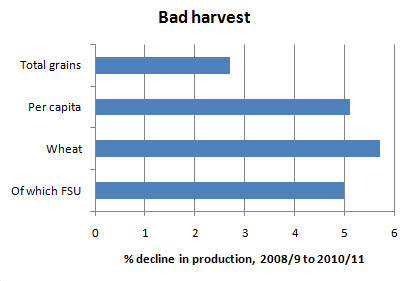
Krugman cries out that "grain production is down — and it’s down substantially more when you take account of a growing world population":

You might ask why a production shortfall of 5 percent leads to a doubling of prices. Part of the answer is that some kinds of demand are growing faster than population — in particular, China is becoming a growing importer of feed to meet the demand for meat. But the main point is that the demand for grain is highly price-inelastic: it takes big price rises to induce people to consume less, yet collectively that’s what they must do given the shortfall in production.

Why is production down? Most of the decline in world wheat production, and about half of the total decline in grain production, has taken place in the former Soviet Union — mainly Russia, Ukraine, and Kazakhstan. And we know what that’s about: an incredible, unprecedented heat wave

Off Balance

by Patrick Appel

Julian Sanchez considers "how the analogy between sound judgment and balancing weights may constrain our thinking in unhealthy ways":

Perhaps the most obvious problem with balancing metaphors is that they suggest a relationship that is always, by necessity, zero sum: If one side rises, the other must fall in exact proportion. Also implicit in balancing talk is the idea that equilibrium is the ideal, and anything that upsets that balance is a change for the worse. That’s probably true if you’re walking a tightrope, but it clearly doesn’t hold in other cases. If you have a perfectly balanced investment portfolio and somebody gives you some shares of stock, the balance is upset (until you can shift some assets around), but you’re plainly better off—and would be better off even if for some reason you couldn’t trade off some of the stock to restore the optimal mix.